
A French Word to Live By
How to Conjugate Écrouir in French
/e.kʁu.iʁ/
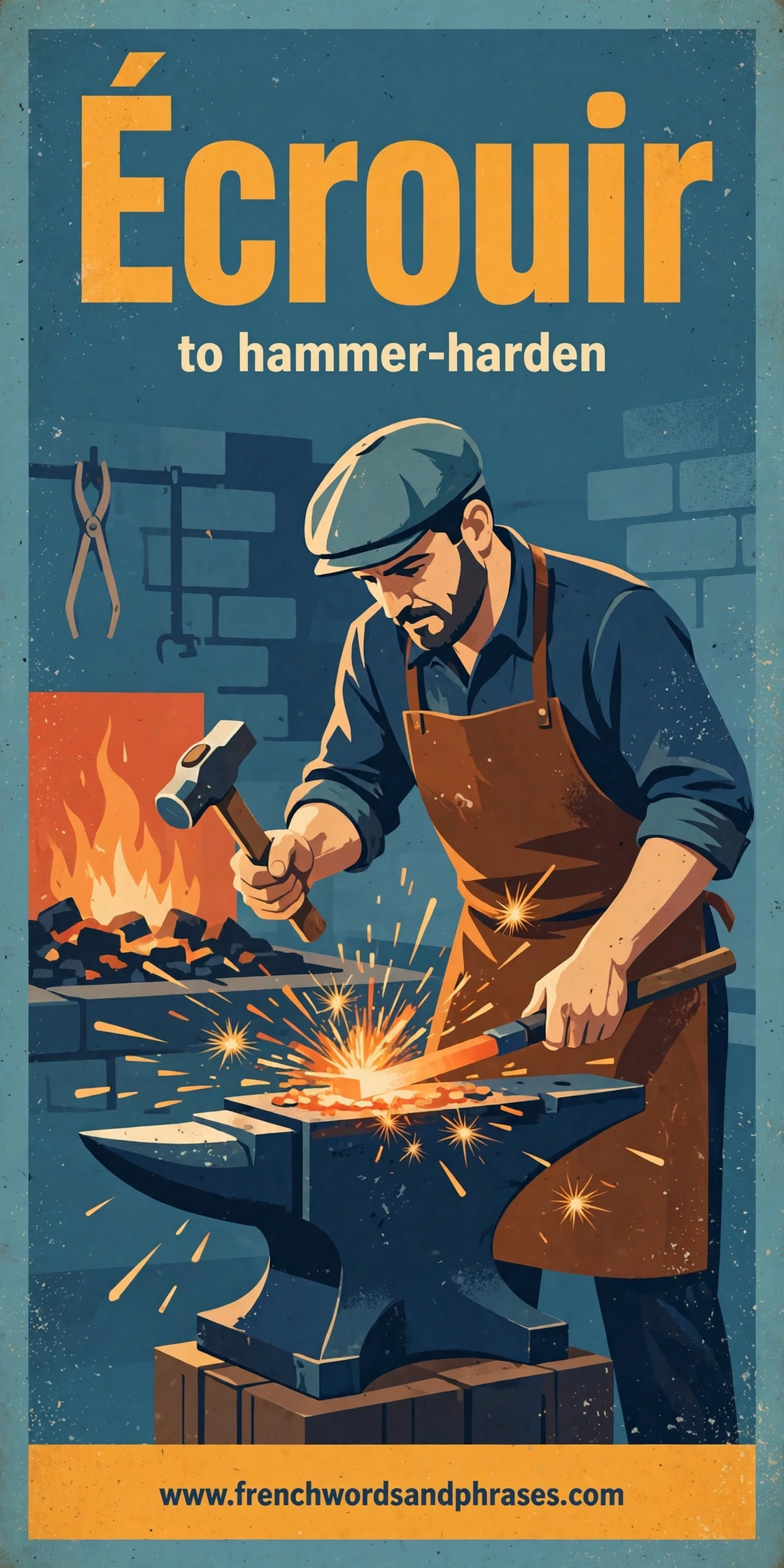
Écrouir means to hammer-harden — to work-harden metal.
A strip of copper under the hammer, growing harder with every blow until it rings instead of bending — écrouir is the metalworker’s verb for hardening metal by working it cold: no fire, no melting, just pressure that changes the metal from inside.
In this guide, you’ll learn how to conjugate écrouir in all the major French tenses and moods. Explore complete conjugation tables, French examples, English translations, and practice quizzes.
Understanding the French Verb Écrouir
Écrouir is a regular French verb belonging to the second group of verbs, those ending in -ir.
It means to hammer-harden. It is commonly used in metalworking and industry for cold-hammering copper and brass, for rolling and drawing steel, and in technical writing about how far a metal can be worked before it must be softened again by heat.
Verb classification: Second group (-ir)
Auxiliary verb: Avoir
Past participle: écroui
Present participle: écrouissant
English equivalents: To work-harden, to hammer-harden (metal); l’écrouissage — work hardening; acier écroui — work-hardened steel.
One important detail: écrouir looks like its near-twin écrouer, to imprison, but it conjugates like finir: j’écrouis, nous écrouissons, past participle écroui. The process is l’écrouissage: hammering, rolling or drawing metal cold so that it grows harder — and more brittle — at once, a bargain every smith learns when an over-worked piece suddenly snaps. To soften the metal again, you heat it: c’est le recuit, annealing.
Experience the Word
Écrouir is the verb of hardness earned by blows — the metal is not melted into strength, it is beaten into it.
Imagine a coppersmith shaping a bowl. At first the metal yields like butter; after an hour of hammering it resists, rings higher, and threatens to crack. He stops, heats it soft again, and smiles: the copper has been écroui — worked to the edge of its strength.
Nothing was added and nothing was melted. The metal has been hammer-hardened — écroui — changed by pressure alone.
How to Conjugate Écrouir: Complete French Conjugation Guide
Let’s explore every major conjugation of écrouir, beginning with the indicative mood.
How to Conjugate Écrouir in the Indicative Mood
The indicative mood is used to express facts, observations, actions, and events.
How to Conjugate Écrouir in the Present Tense (Présent)
Used for actions happening now, habitual actions, and general truths.
| Subject | Conjugation |
|---|---|
| je | écrouis |
| tu | écrouis |
| il / elle | écrouit |
| nous | écrouissons |
| vous | écrouissez |
| ils / elles | écrouissent |
Example
Le forgeron écrouit le cuivre à froid, sans jamais le chauffer.
The smith work-hardens the copper cold, without ever heating it.
Quick Quiz 1
Complete the sentence:
Nous ______ le laiton au laminoir.
Reveal the answer
écrouissons
Nous écrouissons le laiton au laminoir.
We work-harden the brass in the rolling mill.
How to Conjugate Écrouir in the Passé Composé
Used for completed actions in the past. Écrouir takes the auxiliary verb avoir.
| Subject | Conjugation |
|---|---|
| j’ | ai écroui |
| tu | as écroui |
| il / elle | a écroui |
| nous | avons écroui |
| vous | avez écroui |
| ils / elles | ont écroui |
Example
Ils ont écroui la bande d’acier au laminoir.
They work-hardened the steel strip in the rolling mill.
How to Conjugate Écrouir in the Imparfait (Imperfect Tense)
Used for habitual past actions, descriptions, and ongoing situations in the past.
| Subject | Conjugation |
|---|---|
| je | écrouissais |
| tu | écrouissais |
| il / elle | écrouissait |
| nous | écrouissions |
| vous | écrouissiez |
| ils / elles | écrouissaient |
Example
Autrefois, on écrouissait les lames en les martelant longuement.
In the old days, blades were work-hardened by long hammering.
Quick Quiz 2
Choose the correct form:
They work-hardened the sheets.
Ils ______ les tôles. (ont écroui / sont écrouis)
Reveal the answer
ont écroui
Ils ont écroui les tôles.
Écrouir takes avoir.
How to Conjugate Écrouir in the Plus-que-parfait
Used to describe an action that had already been completed before another past event.
| Subject | Conjugation |
|---|---|
| j’ | avais écroui |
| tu | avais écroui |
| il / elle | avait écroui |
| nous | avions écroui |
| vous | aviez écroui |
| ils / elles | avaient écroui |
Example
Il avait trop écroui le métal, et la pièce s’est fissurée.
He had over-worked the metal, and the piece cracked.
How to Conjugate Écrouir in the Passé Simple
Primarily used in formal writing, literature, and historical narratives. It is rarely used in everyday conversation.
| Subject | Conjugation |
|---|---|
| je | écrouis |
| tu | écrouis |
| il / elle | écrouit |
| nous | écrouîmes |
| vous | écrouîtes |
| ils / elles | écrouirent |
Example
Le chaudronnier écrouit la feuille de cuivre en une matinée.
The coppersmith work-hardened the copper sheet in one morning.
How to Conjugate Écrouir in the Passé Antérieur
A literary tense used to express an action completed immediately before another past action, generally in the passé simple.
| Subject | Conjugation |
|---|---|
| j’ | eus écroui |
| tu | eus écroui |
| il / elle | eut écroui |
| nous | eûmes écroui |
| vous | eûtes écroui |
| ils / elles | eurent écroui |
Example
Quand il eut écroui le fil, il le recuit pour le ramollir.
When he had work-hardened the wire, he annealed it to soften it.
How to Conjugate Écrouir in the Future Tense (Futur Simple)
Used to describe actions that will take place in the future.
| Subject | Conjugation |
|---|---|
| je | écrouirai |
| tu | écrouiras |
| il / elle | écrouira |
| nous | écrouirons |
| vous | écrouirez |
| ils / elles | écrouiront |
Example
Demain, nous écrouirons ces tôles au marteau.
Tomorrow, we will hammer-harden these sheets.
How to Conjugate Écrouir in the Futur Antérieur (Future Perfect)
Used for an action that will have been completed before a particular point in the future.
| Subject | Conjugation |
|---|---|
| j’ | aurai écroui |
| tu | auras écroui |
| il / elle | aura écroui |
| nous | aurons écroui |
| vous | aurez écroui |
| ils / elles | auront écroui |
Example
À la fin de la journée, ils auront écroui toutes les bandes.
By the end of the day, they will have work-hardened all the strips.
How to Conjugate Écrouir in the Near Future (Futur Proche)
Used to describe something that is going to happen soon. Formed with aller + infinitive.
| Subject | Conjugation |
|---|---|
| je | vais écrouir |
| tu | vas écrouir |
| il / elle | va écrouir |
| nous | allons écrouir |
| vous | allez écrouir |
| ils / elles | vont écrouir |
Example
Je vais écrouir cette plaque de laiton.
I am going to work-harden this brass plate.
How to Conjugate Écrouir in the Conditional Mood
The conditional mood expresses what would happen under certain circumstances. It is also frequently used to make polite requests or express wishes.
How to Conjugate Écrouir in the Present Conditional
| Subject | Conjugation |
|---|---|
| je | écrouirais |
| tu | écrouirais |
| il / elle | écrouirait |
| nous | écrouirions |
| vous | écrouiriez |
| ils / elles | écrouiraient |
Example
Sans marteau assez lourd, on n’écrouirait pas ce métal.
Without a heavy enough hammer, we would not work-harden this metal.
How to Conjugate Écrouir in the Past Conditional
| Subject | Conjugation |
|---|---|
| j’ | aurais écroui |
| tu | aurais écroui |
| il / elle | aurait écroui |
| nous | aurions écroui |
| vous | auriez écroui |
| ils / elles | auraient écroui |
Example
Elle aurait écroui le fil si la commande l’avait exigé.
She would have work-hardened the wire if the order had required it.
Écrouir in the Literary Past Conditional Form
This less common literary form uses the imperfect subjunctive of avoir.
| Subject | Conjugation |
|---|---|
| j’ | eusse écroui |
| tu | eusses écroui |
| il / elle | eût écroui |
| nous | eussions écroui |
| vous | eussiez écroui |
| ils / elles | eussent écroui |
Example
Le forgeron eût écroui l’acier de l’épée à froid.
The smith would have work-hardened the sword’s steel cold.
How to Conjugate Écrouir in the Subjunctive Mood
The subjunctive is used to express wishes, emotions, doubts, necessity, and uncertainty. It frequently follows expressions such as il faut que (it is necessary that) or bien que (although).
How to Conjugate Écrouir in the Present Subjunctive
| Subject | Conjugation |
|---|---|
| que je | écrouisse |
| que tu | écrouisses |
| qu’il / qu’elle | écrouisse |
| que nous | écrouissions |
| que vous | écrouissiez |
| qu’ils / qu’elles | écrouissent |
Example
Il est essentiel que l’ouvrier écrouisse le cuivre lentement.
It is essential that the worker work-harden the copper slowly.
Quick Quiz 3
Complete the sentence using the subjunctive:
Il faut que vous ______ le cuivre lentement.
Reveal the answer
écrouissiez
Il faut que vous écrouissiez le cuivre lentement.
You must work-harden the copper slowly.
How to Conjugate Écrouir in the Imperfect Subjunctive
A literary tense, rarely encountered in modern spoken French.
| Subject | Conjugation |
|---|---|
| que je | écrouisse |
| que tu | écrouisses |
| qu’il / qu’elle | écrouît |
| que nous | écrouissions |
| que vous | écrouissiez |
| qu’ils / qu’elles | écrouissent |
Example
Le maître voulait que l’apprenti écrouît le laiton sans le casser.
The master wanted the apprentice to work-harden the brass without breaking it.
How to Conjugate Écrouir in the Pluperfect Subjunctive
A literary construction used to express an action completed before another past action.
| Subject | Conjugation |
|---|---|
| que j’ | eusse écroui |
| que tu | eusses écroui |
| qu’il / qu’elle | eût écroui |
| que nous | eussions écroui |
| que vous | eussiez écroui |
| qu’ils / qu’elles | eussent écroui |
Example
On craignait qu’il eût trop écroui le ressort.
People feared he had over-worked the spring.
How to Conjugate Écrouir in the Past Subjunctive
| Subject | Conjugation |
|---|---|
| que j’ | aie écroui |
| que tu | aies écroui |
| qu’il / qu’elle | ait écroui |
| que nous | ayons écroui |
| que vous | ayez écroui |
| qu’ils / qu’elles | aient écroui |
Example
Je suis content que vous ayez écroui l’acier correctement.
I am glad you work-hardened the steel correctly.
How to Conjugate Écrouir in the Imperative
The imperative is used to give commands, instructions, invitations, or suggestions. Subject pronouns are omitted.
How to Conjugate Écrouir in the Present Imperative
| Person | Conjugation |
|---|---|
| (tu) | écrouis |
| (nous) | écrouissons |
| (vous) | écrouissez |
Example
Écrouis ce cuivre à petits coups réguliers !
Work-harden this copper with small, regular blows!
Quick Quiz 4
How would you say Work-harden this copper (tu form)?
Reveal the answer
Écrouis ce cuivre !
French Participles of Écrouir
Participles are verb forms that can be used in compound tenses and other grammatical constructions.
Present Participle of Écrouir
écrouissant
En écrouissant le métal, on le rend plus dur mais plus fragile.
By work-hardening metal, you make it harder but more brittle.
Past Participle of Écrouir
écroui
Écroui par le laminage, l’acier résiste mieux à l’usure.
Work-hardened by rolling, the steel resists wear better.
Écrouir in Everyday French: Real-Life Examples
Now that you know the conjugations, let’s see how écrouir appears in everyday French.
Example 1 — Present
Le marteau écrouit le cuivre à chaque coup.
The hammer work-hardens the copper with every blow.
Example 2 — Passé composé
Ils ont écroui les tôles avant l’assemblage.
They work-hardened the sheets before assembly.
Example 3 — Imparfait
On écrouissait le fer battu dans les vieux ateliers.
Beaten iron used to be work-hardened in the old workshops.
Example 4 — Future
Nous écrouirons le fil demain matin.
We will work-harden the wire tomorrow morning.
Example 5 — Conditional
On écrouirait mieux avec un laminoir.
We would work-harden better with a rolling mill.
Example 6 — Imperative
Écrouissez la plaque avant de la souder !
Work-harden the plate before welding it!
Beyond Translation: The Meaning of Écrouir
English says work-hardened or strain-hardened — honest descriptions, but long ones; French écrouir packs the whole forge into a single verb.
Hardness without fire.
Every spring, wire and sheet of acier écroui in a French catalogue carries this verb inside it: metal made stronger by the very blows that seemed to attack it.
How to Remember the French Verb Écrouir
Remember it this way: Écrouir is about metal hardened by hammering — strength without fire.
- L’écrouissage — work hardening: hammering metal cold until it hardens.
- Conjugated like finir: j’écrouis, nous écrouissons, past participle écroui.
- Acier écroui — work-hardened steel; the twin écrouer means to imprison.
The key idea is metal hardened by hammering — strength without fire.
Test Your Knowledge of Écrouir
Let’s see how much you’ve learned. Try answering these questions before revealing the answers.
Question 1
What is l’écrouissage?
Reveal the answer
Work hardening — hardening metal by hammering, rolling or drawing it cold.
Question 2
How do you say The smith work-hardens the copper in French?
Reveal the answer
Le forgeron écrouit le cuivre.
Question 3
Translate: They work-hardened the steel strip.
Reveal the answer
Ils ont écroui la bande d’acier.
Question 4
What is the past participle of écrouir?
Reveal the answer
Écroui.
Question 5
Complete the sentence:
Il faut que tu ______ la plaque lentement.
Reveal the answer
écrouisses
Il faut que tu écrouisses la plaque lentement.
You must work-harden the plate slowly.
Your Final Challenge
Can You Use It?
How would you say this in French?
The smith work-hardens the copper with small blows, and the metal learns to resist.
Reveal the answer
Le forgeron écrouit le cuivre à petits coups, et le métal apprend à résister.
The smith work-hardens the copper with small blows, and the metal learns to resist.
A little French. A little curiosity. A richer everyday life.
LEARN FRENCH ONE WORD AT A TIME




