A French Word to Live By
How to Conjugate Écrivasser in French
/e.kʁi.va.se/
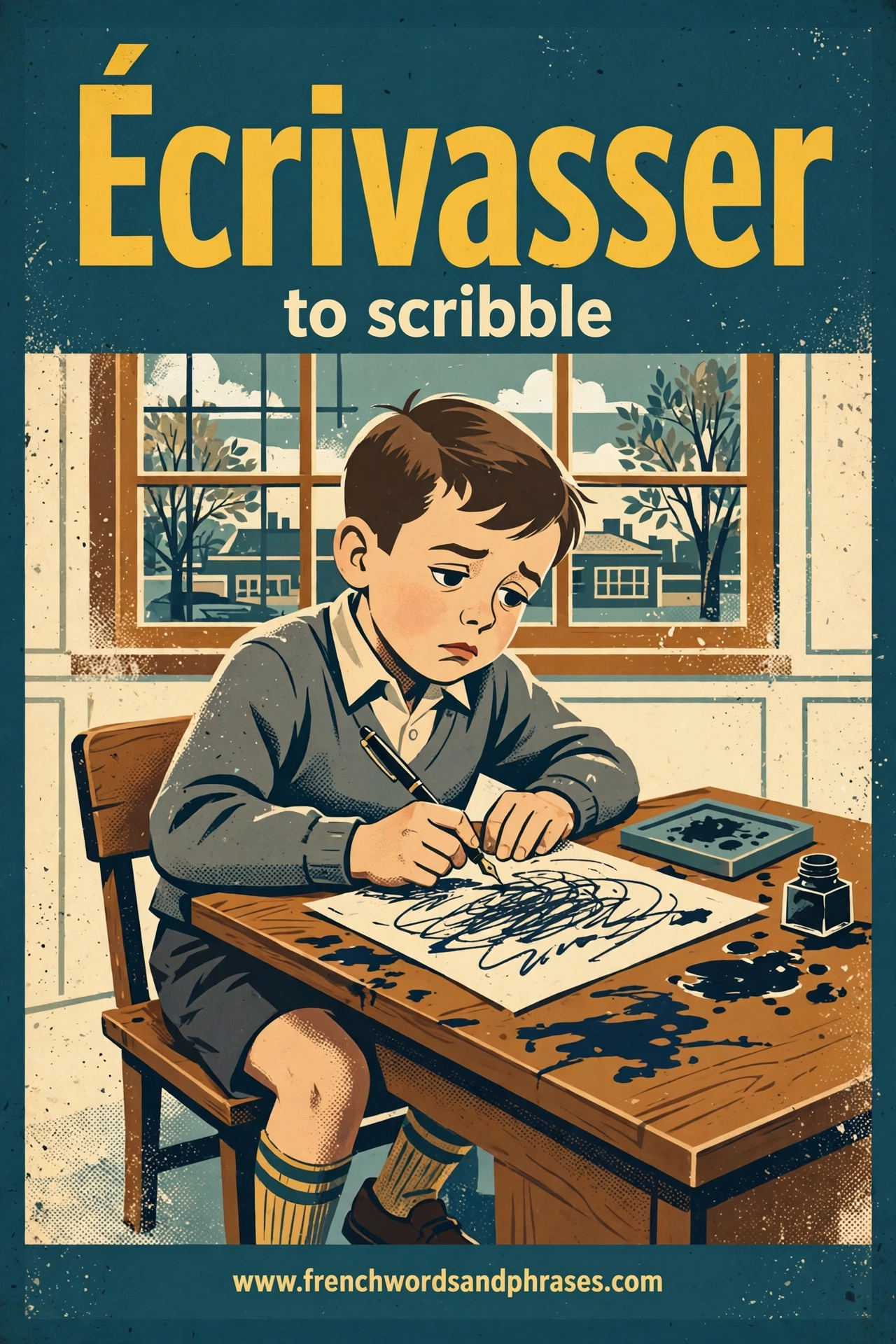
Écrivasser means to scribble — to churn out hack writing.
Articles ground out by the column, novels written to order in a fortnight, prose produced like sausages — écrivasser is the verb of hack writing: words manufactured for money by someone who has stopped caring whether they are any good.
In this guide, you’ll learn how to conjugate écrivasser in all the major French tenses and moods. Explore complete conjugation tables, French examples, English translations, and practice quizzes.
Understanding the French Verb Écrivasser
Écrivasser is a regular French verb belonging to the first group of verbs, those ending in -er.
It means to scribble. It is commonly used for journalists churning out copy against the clock, for authors of formula novels written to order, and in criticism for any writing produced in bulk without care — always with the sense of quantity defeating quality.
Verb classification: First group (-er)
Auxiliary verb: Avoir
Past participle: écrivassé
Present participle: écrivassant
English equivalents: To scribble for a living, to churn out hack writing; un écrivassier — a hack writer, a penny-a-liner.
One important detail: écrivasser is the professional cousin of écrivailler. The scribbler of écrivailler writes for his drawer; the écrivassier writes for a cheque — articles, serials and potboilers produced fast and forgotten faster. Both verbs are unkind, but écrivasser adds the till to the insult: this is bad writing as a trade.
Experience the Word
Écrivasser is the verb of the word factory — the pen as piecework, paid by the line.
Imagine a Paris garret in 1850: a writer at a desk stacked with paper, producing a serial novel a chapter a day for the newspapers, inventing as he goes and never rereading. His name will be forgotten; his pages filled a thousand breakfast tables. He did not quite write — il écrivassait.
The words were sold by the column and read by the thousand. They were churned out — écrivassés — writing as piecework.
How to Conjugate Écrivasser: Complete French Conjugation Guide
Let’s explore every major conjugation of écrivasser, beginning with the indicative mood.
How to Conjugate Écrivasser in the Indicative Mood
The indicative mood is used to express facts, observations, actions, and events.
How to Conjugate Écrivasser in the Present Tense (Présent)
Used for actions happening now, habitual actions, and general truths.
| Subject | Conjugation |
|---|---|
| je | écrivasse |
| tu | écrivasses |
| il / elle | écrivasse |
| nous | écrivassons |
| vous | écrivassez |
| ils / elles | écrivassent |
Example
Il écrivasse des articles pour trois journaux à la fois.
He churns out articles for three newspapers at once.
Quick Quiz 1
Complete the sentence:
Nous ______ des articles pour le journal local.
Reveal the answer
écrivassons
Nous écrivassons des articles pour le journal local.
We churn out articles for the local newspaper.
How to Conjugate Écrivasser in the Passé Composé
Used for completed actions in the past. Écrivasser takes the auxiliary verb avoir.
| Subject | Conjugation |
|---|---|
| j’ | ai écrivassé |
| tu | as écrivassé |
| il / elle | a écrivassé |
| nous | avons écrivassé |
| vous | avez écrivassé |
| ils / elles | ont écrivassé |
Example
Elle a écrivassé dix romans en cinq ans.
She churned out ten novels in five years.
How to Conjugate Écrivasser in the Imparfait (Imperfect Tense)
Used for habitual past actions, descriptions, and ongoing situations in the past.
| Subject | Conjugation |
|---|---|
| je | écrivassais |
| tu | écrivassais |
| il / elle | écrivassait |
| nous | écrivassions |
| vous | écrivassiez |
| ils / elles | écrivassaient |
Example
Autrefois, il écrivassait des feuilletons pour les journaux du soir.
In the old days, he used to churn out serials for the evening papers.
Quick Quiz 2
Choose the correct form:
She churned out three articles.
Elle ______ trois articles. (a écrivassé / est écrivassée)
Reveal the answer
a écrivassé
Elle a écrivassé trois articles.
Écrivasser takes avoir.
How to Conjugate Écrivasser in the Plus-que-parfait
Used to describe an action that had already been completed before another past event.
| Subject | Conjugation |
|---|---|
| j’ | avais écrivassé |
| tu | avais écrivassé |
| il / elle | avait écrivassé |
| nous | avions écrivassé |
| vous | aviez écrivassé |
| ils / elles | avaient écrivassé |
Example
Il avait écrivassé des centaines d’articles avant de trouver un vrai sujet.
He had churned out hundreds of articles before finding a real subject.
How to Conjugate Écrivasser in the Passé Simple
Primarily used in formal writing, literature, and historical narratives. It is rarely used in everyday conversation.
| Subject | Conjugation |
|---|---|
| je | écrivassai |
| tu | écrivassas |
| il / elle | écrivassa |
| nous | écrivassâmes |
| vous | écrivassâtes |
| ils / elles | écrivassèrent |
Example
Il écrivassa toute sa vie sans jamais signer un bon livre.
He churned out writing all his life without ever signing a good book.
How to Conjugate Écrivasser in the Passé Antérieur
A literary tense used to express an action completed immediately before another past action, generally in the passé simple.
| Subject | Conjugation |
|---|---|
| j’ | eus écrivassé |
| tu | eus écrivassé |
| il / elle | eut écrivassé |
| nous | eûmes écrivassé |
| vous | eûtes écrivassé |
| ils / elles | eurent écrivassé |
Example
Quand elle eut écrivassé son article, elle le posta sans le relire.
When she had churned out her article, she sent it off without rereading it.
How to Conjugate Écrivasser in the Future Tense (Futur Simple)
Used to describe actions that will take place in the future.
| Subject | Conjugation |
|---|---|
| je | écrivasserai |
| tu | écrivasseras |
| il / elle | écrivassera |
| nous | écrivasserons |
| vous | écrivasserez |
| ils / elles | écrivasseront |
Example
Demain, il écrivassera encore deux articles avant midi.
Tomorrow, he will churn out two more articles before noon.
How to Conjugate Écrivasser in the Futur Antérieur (Future Perfect)
Used for an action that will have been completed before a particular point in the future.
| Subject | Conjugation |
|---|---|
| j’ | aurai écrivassé |
| tu | auras écrivassé |
| il / elle | aura écrivassé |
| nous | aurons écrivassé |
| vous | aurez écrivassé |
| ils / elles | auront écrivassé |
Example
À la fin du mois, il aura écrivassé vingt chroniques.
By the end of the month, he will have churned out twenty columns.
How to Conjugate Écrivasser in the Near Future (Futur Proche)
Used to describe something that is going to happen soon. Formed with aller + infinitive.
| Subject | Conjugation |
|---|---|
| je | vais écrivasser |
| tu | vas écrivasser |
| il / elle | va écrivasser |
| nous | allons écrivasser |
| vous | allez écrivasser |
| ils / elles | vont écrivasser |
Example
Je vais écrivasser un article vite fait pour le site.
I am going to churn out a quick article for the website.
How to Conjugate Écrivasser in the Conditional Mood
The conditional mood expresses what would happen under certain circumstances. It is also frequently used to make polite requests or express wishes.
How to Conjugate Écrivasser in the Present Conditional
| Subject | Conjugation |
|---|---|
| je | écrivasserais |
| tu | écrivasserais |
| il / elle | écrivasserait |
| nous | écrivasserions |
| vous | écrivasseriez |
| ils / elles | écrivasseraient |
Example
Pour ce salaire, il écrivasserait n’importe quoi.
For that pay, he would churn out anything at all.
How to Conjugate Écrivasser in the Past Conditional
| Subject | Conjugation |
|---|---|
| j’ | aurais écrivassé |
| tu | aurais écrivassé |
| il / elle | aurait écrivassé |
| nous | aurions écrivassé |
| vous | auriez écrivassé |
| ils / elles | auraient écrivassé |
Example
Elle aurait écrivassé un roman entier si l’éditeur avait payé davantage.
She would have churned out a whole novel if the publisher had paid more.
Écrivasser in the Literary Past Conditional Form
This less common literary form uses the imperfect subjunctive of avoir.
| Subject | Conjugation |
|---|---|
| j’ | eusse écrivassé |
| tu | eusses écrivassé |
| il / elle | eût écrivassé |
| nous | eussions écrivassé |
| vous | eussiez écrivassé |
| ils / elles | eussent écrivassé |
Example
Il eût écrivassé ses mémoires pour quelques pièces d’or.
He would have churned out his memoirs for a few gold coins.
How to Conjugate Écrivasser in the Subjunctive Mood
The subjunctive is used to express wishes, emotions, doubts, necessity, and uncertainty. It frequently follows expressions such as il faut que (it is necessary that) or bien que (although).
How to Conjugate Écrivasser in the Present Subjunctive
| Subject | Conjugation |
|---|---|
| que je | écrivasse |
| que tu | écrivasses |
| qu’il / qu’elle | écrivasse |
| que nous | écrivassions |
| que vous | écrivassiez |
| qu’ils / qu’elles | écrivassent |
Example
Je ne crois pas qu’il écrivasse encore pour ce journal.
I do not think he still churns out copy for that newspaper.
Quick Quiz 3
Complete the sentence using the subjunctive:
Je doute que vous ______ pour ce site.
Reveal the answer
écrivassiez
Je doute que vous écrivassiez pour ce site.
I doubt you churn out copy for this website.
How to Conjugate Écrivasser in the Imperfect Subjunctive
A literary tense, rarely encountered in modern spoken French.
| Subject | Conjugation |
|---|---|
| que je | écrivassasse |
| que tu | écrivassasses |
| qu’il / qu’elle | écrivassât |
| que nous | écrivassassions |
| que vous | écrivassassiez |
| qu’ils / qu’elles | écrivassassent |
Example
L’éditeur exigeait qu’elle écrivassât un chapitre par semaine.
The publisher demanded that she churn out a chapter a week.
How to Conjugate Écrivasser in the Pluperfect Subjunctive
A literary construction used to express an action completed before another past action.
| Subject | Conjugation |
|---|---|
| que j’ | eusse écrivassé |
| que tu | eusses écrivassé |
| qu’il / qu’elle | eût écrivassé |
| que nous | eussions écrivassé |
| que vous | eussiez écrivassé |
| qu’ils / qu’elles | eussent écrivassé |
Example
On murmura qu’il eût écrivassé le discours en une heure.
People whispered that he had churned out the speech in an hour.
How to Conjugate Écrivasser in the Past Subjunctive
| Subject | Conjugation |
|---|---|
| que j’ | aie écrivassé |
| que tu | aies écrivassé |
| qu’il / qu’elle | ait écrivassé |
| que nous | ayons écrivassé |
| que vous | ayez écrivassé |
| qu’ils / qu’elles | aient écrivassé |
Example
Je suis surpris qu’elle ait écrivassé un texte si bâclé.
I am surprised she churned out such a sloppy text.
How to Conjugate Écrivasser in the Imperative
The imperative is used to give commands, instructions, invitations, or suggestions. Subject pronouns are omitted.
How to Conjugate Écrivasser in the Present Imperative
| Person | Conjugation |
|---|---|
| (tu) | écrivasse |
| (nous) | écrivassons |
| (vous) | écrivassez |
Example
N’écrivasse pas ce rapport, écris-le correctement !
Do not churn out this report, write it properly!
Quick Quiz 4
How would you say Do not churn out this report (tu form)?
Reveal the answer
N’écrivasse pas ce rapport !
French Participles of Écrivasser
Participles are verb forms that can be used in compound tenses and other grammatical constructions.
Present Participle of Écrivasser
écrivassant
En écrivassant jour et nuit, il a usé son style.
By churning out copy day and night, he wore out his style.
Past Participle of Écrivasser
écrivassé
Écrivassés à la hâte, ces articles ne disent rien.
Churned out in haste, these articles say nothing.
Écrivasser in Everyday French: Real-Life Examples
Now that you know the conjugations, let’s see how écrivasser appears in everyday French.
Example 1 — Present
Il écrivasse pour un journal gratuit.
He churns out copy for a free newspaper.
Example 2 — Passé composé
Elle a écrivassé trois articles ce matin.
She churned out three articles this morning.
Example 3 — Imparfait
Il écrivassait des romans de gare.
He used to churn out station novels.
Example 4 — Future
Nous écrivasserons la brochure demain, vite fait.
We will churn out the brochure tomorrow, quickly.
Example 5 — Conditional
Tu écrivasserais un article pour cent euros ?
Would you churn out an article for a hundred euros?
Example 6 — Imperative
N’écrivassez pas vos copies, relisez-les !
Do not churn out your essays, reread them!
Beyond Translation: The Meaning of Écrivasser
English has hack and penny-a-liner for the person, but French écrivasser turns the whole trade into a verb.
Écrivasser is writing as piecework.
The word carries the smell of cheap ink and deadline panic: the article exists because a column was empty, not because anything needed saying.
How to Remember the French Verb Écrivasser
Remember it this way: Écrivasser is about hack writing — words by the column, quality by the wayside.
- Écrivasser = bad writing for money; écrivailler = bad writing for the drawer.
- Un écrivassier — a hack writer, paid by the line.
- Regular -er: j’écrivasse, nous écrivassons, past participle écrivassé.
The key idea is hack writing — words by the column, quality by the wayside.
Test Your Knowledge of Écrivasser
Let’s see how much you’ve learned. Try answering these questions before revealing the answers.
Question 1
How does écrivasser differ from écrivailler?
Reveal the answer
Écrivasser is hack writing for money — écrivailler is idle scribbling nobody pays for.
Question 2
How do you say He churns out articles for three newspapers in French?
Reveal the answer
Il écrivasse des articles pour trois journaux.
Question 3
Translate: She churned out ten novels in five years.
Reveal the answer
Elle a écrivassé dix romans en cinq ans.
Question 4
What is the past participle of écrivasser?
Reveal the answer
Écrivassé.
Question 5
Complete the sentence:
Je ne crois pas qu’il ______ encore pour ce journal.
Reveal the answer
écrivasse
Je ne crois pas qu’il écrivasse encore pour ce journal.
I do not think he still churns out copy for that newspaper.
Your Final Challenge
Can You Use It?
How would you say this in French?
He has been churning out articles for twenty years, and not one will outlive the week.
Reveal the answer
Il écrivasse des articles depuis vingt ans, et aucun ne survivra à la semaine.
He has been churning out articles for twenty years, and not one will outlive the week.
A little French. A little curiosity. A richer everyday life.
LEARN FRENCH ONE WORD AT A TIME