
A French Word to Live By
How to Conjugate Écrivailler in French
/e.kʁi.va.je/
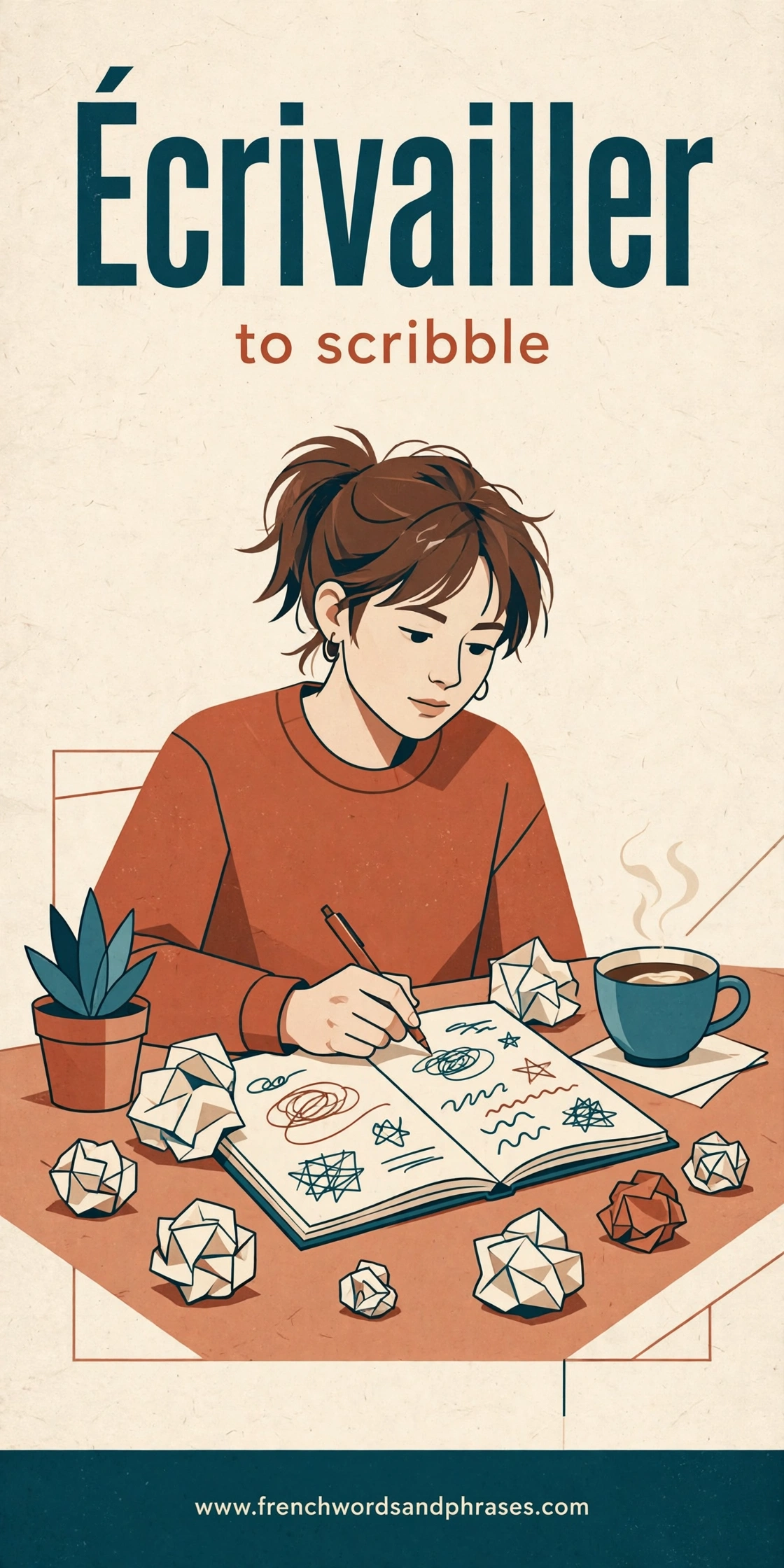
Écrivailler means to scribble — to write badly or idly.
A notebook filled in the margins of a boring meeting, verses written at midnight and regretted at dawn, pages and pages that nobody will ever read — écrivailler is the verb of scribbling without ambition: writing badly, idly, or just for oneself, with a shrug built into the word.
In this guide, you’ll learn how to conjugate écrivailler in all the major French tenses and moods. Explore complete conjugation tables, French examples, English translations, and practice quizzes.
Understanding the French Verb Écrivailler
Écrivailler is a regular French verb belonging to the first group of verbs, those ending in -er.
It means to scribble. It is commonly used for filling notebooks with idle verses and drafts, for would-be writers producing page after page of unpublishable prose, and teasingly for anyone — a student, a colleague, oneself — who is always writing something nobody will read.
Verb classification: First group (-er)
Auxiliary verb: Avoir
Past participle: écrivaillé
Present participle: écrivaillant
English equivalents: To scribble, to write badly or idly; un écrivailleur — a scribbler, a petty would-be writer.
One important detail: écrivailler carries its judgment in the suffix -ailler, the same dismissive ending as in criailler, to squawk, or traînailler, to dawdle — it marks the action as small, sloppy and endlessly repeated. The person is un écrivailleur, a scribbler: not an écrivain, a writer, and the distance between the two words is the whole lesson. Nobody is ever praised for écrivailler; the verb always smiles or sneers.
Experience the Word
Écrivailler is the verb of writing with the stakes removed — no reader, no deadline, and no mercy from the word itself.
Imagine an attic room in 1890. A young clerk fills notebook after notebook with poems by candlelight, certain of his genius; a century later the notebooks surface at a flea market, and the buyer smiles: voilà un écrivailleur — all that ink, all that hope.
Nothing was published or remembered. It was scribbled — écrivaillé — writing for the drawer.
How to Conjugate Écrivailler: Complete French Conjugation Guide
Let’s explore every major conjugation of écrivailler, beginning with the indicative mood.
How to Conjugate Écrivailler in the Indicative Mood
The indicative mood is used to express facts, observations, actions, and events.
How to Conjugate Écrivailler in the Present Tense (Présent)
Used for actions happening now, habitual actions, and general truths.
| Subject | Conjugation |
|---|---|
| je | écrivaille |
| tu | écrivailles |
| il / elle | écrivaille |
| nous | écrivaillons |
| vous | écrivaillez |
| ils / elles | écrivaillent |
Example
Le soir, il écrivaille des poèmes dans un vieux cahier.
In the evening, he scribbles poems in an old notebook.
Quick Quiz 1
Complete the sentence:
Nous ______ des chansons le soir.
Reveal the answer
écrivaillons
Nous écrivaillons des chansons le soir.
We scribble songs in the evening.
How to Conjugate Écrivailler in the Passé Composé
Used for completed actions in the past. Écrivailler takes the auxiliary verb avoir.
| Subject | Conjugation |
|---|---|
| j’ | ai écrivaillé |
| tu | as écrivaillé |
| il / elle | a écrivaillé |
| nous | avons écrivaillé |
| vous | avez écrivaillé |
| ils / elles | ont écrivaillé |
Example
Elle a écrivaillé toute la nuit sans rien garder.
She scribbled all night and kept nothing.
How to Conjugate Écrivailler in the Imparfait (Imperfect Tense)
Used for habitual past actions, descriptions, and ongoing situations in the past.
| Subject | Conjugation |
|---|---|
| je | écrivaillais |
| tu | écrivaillais |
| il / elle | écrivaillait |
| nous | écrivaillions |
| vous | écrivailliez |
| ils / elles | écrivaillaient |
Example
À vingt ans, il écrivaillait des romans dans les marges de ses cahiers.
At twenty, he used to scribble novels in the margins of his notebooks.
Quick Quiz 2
Choose the correct form:
She scribbled all weekend.
Elle ______ tout le week-end. (a écrivaillé / est écrivaillée)
Reveal the answer
a écrivaillé
Elle a écrivaillé tout le week-end.
Écrivailler takes avoir.
How to Conjugate Écrivailler in the Plus-que-parfait
Used to describe an action that had already been completed before another past event.
| Subject | Conjugation |
|---|---|
| j’ | avais écrivaillé |
| tu | avais écrivaillé |
| il / elle | avait écrivaillé |
| nous | avions écrivaillé |
| vous | aviez écrivaillé |
| ils / elles | avaient écrivaillé |
Example
Il avait écrivaillé des centaines de pages avant de se décider à écrire vraiment.
He had scribbled hundreds of pages before deciding to write properly.
How to Conjugate Écrivailler in the Passé Simple
Primarily used in formal writing, literature, and historical narratives. It is rarely used in everyday conversation.
| Subject | Conjugation |
|---|---|
| je | écrivaillai |
| tu | écrivaillas |
| il / elle | écrivailla |
| nous | écrivaillâmes |
| vous | écrivaillâtes |
| ils / elles | écrivaillèrent |
Example
Toute sa jeunesse, il écrivailla des vers que personne ne lut.
All through his youth, he scribbled verses that nobody read.
How to Conjugate Écrivailler in the Passé Antérieur
A literary tense used to express an action completed immediately before another past action, generally in the passé simple.
| Subject | Conjugation |
|---|---|
| j’ | eus écrivaillé |
| tu | eus écrivaillé |
| il / elle | eut écrivaillé |
| nous | eûmes écrivaillé |
| vous | eûtes écrivaillé |
| ils / elles | eurent écrivaillé |
Example
Quand il eut écrivaillé son dixième cahier, il le jeta au feu.
When he had scribbled his tenth notebook, he threw it into the fire.
How to Conjugate Écrivailler in the Future Tense (Futur Simple)
Used to describe actions that will take place in the future.
| Subject | Conjugation |
|---|---|
| je | écrivaillerai |
| tu | écrivailleras |
| il / elle | écrivaillera |
| nous | écrivaillerons |
| vous | écrivaillerez |
| ils / elles | écrivailleront |
Example
Il écrivaillera encore à quatre-vingts ans.
He will still be scribbling at eighty.
How to Conjugate Écrivailler in the Futur Antérieur (Future Perfect)
Used for an action that will have been completed before a particular point in the future.
| Subject | Conjugation |
|---|---|
| j’ | aurai écrivaillé |
| tu | auras écrivaillé |
| il / elle | aura écrivaillé |
| nous | aurons écrivaillé |
| vous | aurez écrivaillé |
| ils / elles | auront écrivaillé |
Example
À la fin de l’année, elle aura écrivaillé trois cahiers entiers.
By the end of the year, she will have scribbled three whole notebooks.
How to Conjugate Écrivailler in the Near Future (Futur Proche)
Used to describe something that is going to happen soon. Formed with aller + infinitive.
| Subject | Conjugation |
|---|---|
| je | vais écrivailler |
| tu | vas écrivailler |
| il / elle | va écrivailler |
| nous | allons écrivailler |
| vous | allez écrivailler |
| ils / elles | vont écrivailler |
Example
Je vais écrivailler quelques lignes avant de dormir.
I am going to scribble a few lines before sleeping.
How to Conjugate Écrivailler in the Conditional Mood
The conditional mood expresses what would happen under certain circumstances. It is also frequently used to make polite requests or express wishes.
How to Conjugate Écrivailler in the Present Conditional
| Subject | Conjugation |
|---|---|
| je | écrivaillerais |
| tu | écrivaillerais |
| il / elle | écrivaillerait |
| nous | écrivaillerions |
| vous | écrivailleriez |
| ils / elles | écrivailleraient |
Example
Il écrivaillerait toute sa vie sans jamais publier.
He would scribble all his life without ever publishing.
How to Conjugate Écrivailler in the Past Conditional
| Subject | Conjugation |
|---|---|
| j’ | aurais écrivaillé |
| tu | aurais écrivaillé |
| il / elle | aurait écrivaillé |
| nous | aurions écrivaillé |
| vous | auriez écrivaillé |
| ils / elles | auraient écrivaillé |
Example
Elle aurait écrivaillé un roman entier si on l’avait encouragée.
She would have scribbled a whole novel if anyone had encouraged her.
Écrivailler in the Literary Past Conditional Form
This less common literary form uses the imperfect subjunctive of avoir.
| Subject | Conjugation |
|---|---|
| j’ | eusse écrivaillé |
| tu | eusses écrivaillé |
| il / elle | eût écrivaillé |
| nous | eussions écrivaillé |
| vous | eussiez écrivaillé |
| ils / elles | eussent écrivaillé |
Example
Il eût écrivaillé ses mémoires dans sa retraite.
He would have scribbled his memoirs in his retirement.
How to Conjugate Écrivailler in the Subjunctive Mood
The subjunctive is used to express wishes, emotions, doubts, necessity, and uncertainty. It frequently follows expressions such as il faut que (it is necessary that) or bien que (although).
How to Conjugate Écrivailler in the Present Subjunctive
| Subject | Conjugation |
|---|---|
| que je | écrivaille |
| que tu | écrivailles |
| qu’il / qu’elle | écrivaille |
| que nous | écrivaillions |
| que vous | écrivailliez |
| qu’ils / qu’elles | écrivaillent |
Example
Je doute qu’il écrivaille jamais un vrai livre.
I doubt he will ever scribble a real book.
Quick Quiz 3
Complete the sentence using the subjunctive:
Je doute que vous ______ quelque chose de bon.
Reveal the answer
écrivailliez
Je doute que vous écrivailliez quelque chose de bon.
I doubt you scribble anything good.
How to Conjugate Écrivailler in the Imperfect Subjunctive
A literary tense, rarely encountered in modern spoken French.
| Subject | Conjugation |
|---|---|
| que je | écrivaillasse |
| que tu | écrivaillasses |
| qu’il / qu’elle | écrivaillât |
| que nous | écrivaillassions |
| que vous | écrivaillassiez |
| qu’ils / qu’elles | écrivaillassent |
Example
Il fallait qu’elle écrivaillât moins et travaillât plus.
She needed to scribble less and work more.
How to Conjugate Écrivailler in the Pluperfect Subjunctive
A literary construction used to express an action completed before another past action.
| Subject | Conjugation |
|---|---|
| que j’ | eusse écrivaillé |
| que tu | eusses écrivaillé |
| qu’il / qu’elle | eût écrivaillé |
| que nous | eussions écrivaillé |
| que vous | eussiez écrivaillé |
| qu’ils / qu’elles | eussent écrivaillé |
Example
On souriait qu’il eût écrivaillé tant de pages pour rien.
People smiled that he had scribbled so many pages for nothing.
How to Conjugate Écrivailler in the Past Subjunctive
| Subject | Conjugation |
|---|---|
| que j’ | aie écrivaillé |
| que tu | aies écrivaillé |
| qu’il / qu’elle | ait écrivaillé |
| que nous | ayons écrivaillé |
| que vous | ayez écrivaillé |
| qu’ils / qu’elles | aient écrivaillé |
Example
Je suis étonné qu’elle ait écrivaillé tout le week-end.
I am surprised she scribbled all weekend.
How to Conjugate Écrivailler in the Imperative
The imperative is used to give commands, instructions, invitations, or suggestions. Subject pronouns are omitted.
How to Conjugate Écrivailler in the Present Imperative
| Person | Conjugation |
|---|---|
| (tu) | écrivaille |
| (nous) | écrivaillons |
| (vous) | écrivaillez |
Example
Écrivaille si tu veux, mais ne montre ça à personne !
Scribble if you like, but do not show it to anyone!
Quick Quiz 4
How would you say Scribble in your notebook (tu form)?
Reveal the answer
Écrivaille dans ton cahier !
French Participles of Écrivailler
Participles are verb forms that can be used in compound tenses and other grammatical constructions.
Present Participle of Écrivailler
écrivaillant
En écrivaillant dans le train, il a rempli trois pages.
While scribbling on the train, he filled three pages.
Past Participle of Écrivailler
écrivaillé
Écrivaillées à la hâte, ces pages ne valaient rien.
Scribbled in haste, these pages were worth nothing.
Écrivailler in Everyday French: Real-Life Examples
Now that you know the conjugations, let’s see how écrivailler appears in everyday French.
Example 1 — Present
Il écrivaille des chansons dans son cahier.
He scribbles songs in his notebook.
Example 2 — Passé composé
Elle a écrivaillé pendant toutes les vacances.
She scribbled through the whole holiday.
Example 3 — Imparfait
Nous écrivaillions des poèmes au fond de la classe.
We used to scribble poems at the back of the classroom.
Example 4 — Future
Tu écrivailleras encore ce soir ?
Will you be scribbling again this evening?
Example 5 — Conditional
J’écrivaillerais bien un journal, moi.
I would gladly scribble a diary, me.
Example 6 — Imperative
Écrivaille dans ton cahier, pas sur la table !
Scribble in your notebook, not on the table!
Beyond Translation: The Meaning of Écrivailler
English scribble can be affectionate — a child’s first scribbles; French écrivailler has already judged the writing before you read a line.
The -ailler ending is the raised eyebrow.
Call someone un écrivain and you honour him; call him un écrivailleur and you have reviewed his life’s work in one word.
How to Remember the French Verb Écrivailler
Remember it this way: Écrivailler is about writing with a sneer built in — pages nobody will read.
- The suffix -ailler sneers: écrivailler is writing small, sloppy and endless.
- Un écrivailleur — a scribbler; never confuse him with un écrivain, a writer.
- Regular -er: j’écrivaille, nous écrivaillons, past participle écrivaillé.
The key idea is writing with a sneer built in — pages nobody will read.
Test Your Knowledge of Écrivailler
Let’s see how much you’ve learned. Try answering these questions before revealing the answers.
Question 1
What does the ending -ailler suggest in écrivailler?
Reveal the answer
Something small, sloppy and repeated — the verb judges the writing as it names it.
Question 2
How do you say He scribbles poems in a notebook in French?
Reveal the answer
Il écrivaille des poèmes dans un cahier.
Question 3
Translate: She scribbled all night.
Reveal the answer
Elle a écrivaillé toute la nuit.
Question 4
What is the past participle of écrivailler?
Reveal the answer
Écrivaillé.
Question 5
Complete the sentence:
Je doute qu’il ______ jamais un vrai livre.
Reveal the answer
écrivaille
Je doute qu’il écrivaille jamais un vrai livre.
I doubt he will ever scribble a real book.
Your Final Challenge
Can You Use It?
How would you say this in French?
He has been scribbling poems for twenty years, and his drawer overflows with notebooks.
Reveal the answer
Il écrivaille des poèmes depuis vingt ans, et son tiroir déborde de cahiers.
He has been scribbling poems for twenty years, and his drawer overflows with notebooks.
A little French. A little curiosity. A richer everyday life.
LEARN FRENCH ONE WORD AT A TIME




