
A French Word to Live By
How to Conjugate Écôter in French
/e.ko.te/
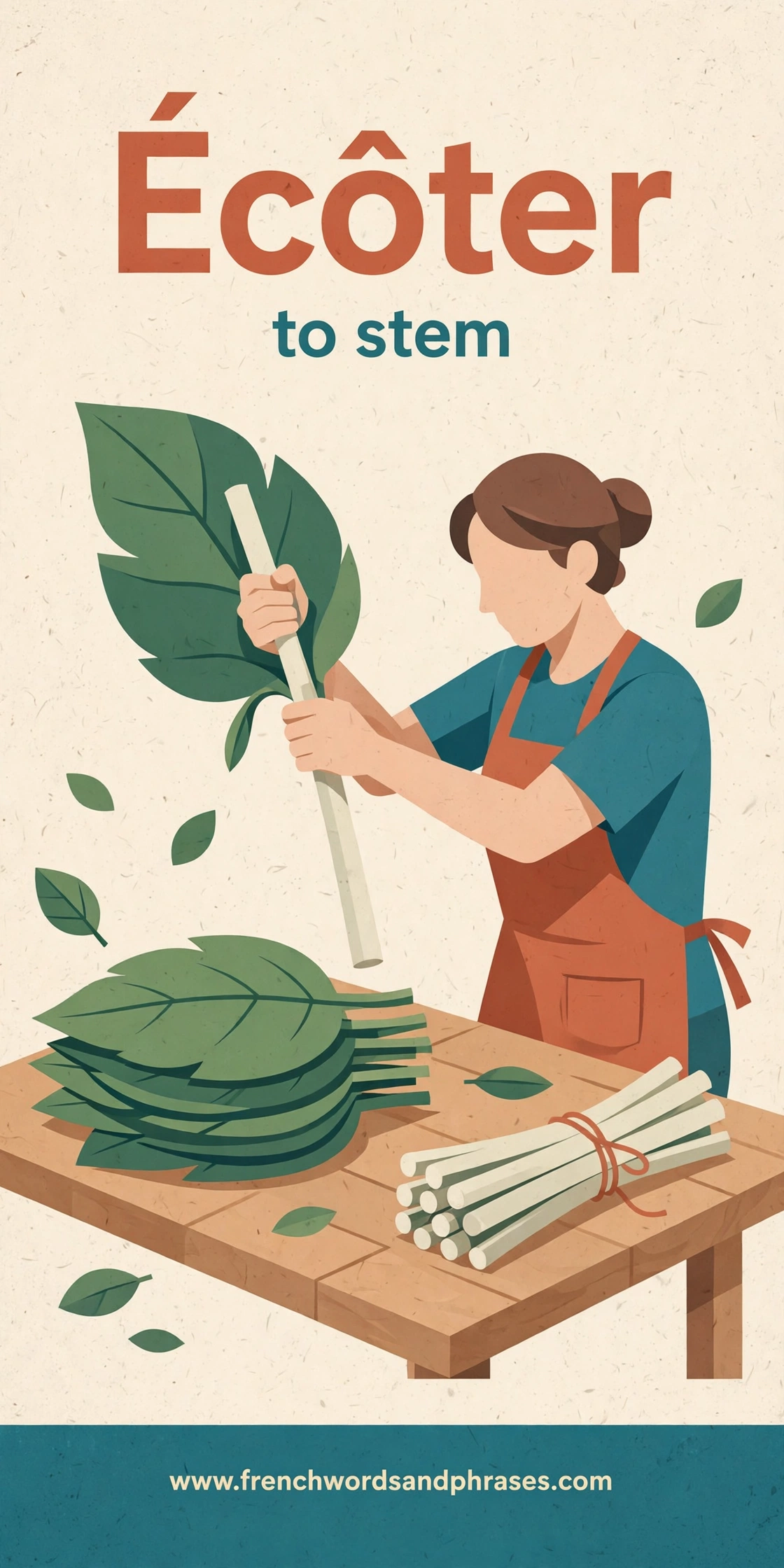
Écôter means to stem — to strip the central stalk or rib from a leaf.
A leaf laid flat, a small knife drawn along its spine, the tough central rib lifted away — écôter is the tobacco worker’s precise verb, stemming leaves so that only the soft, usable part remains.
In this guide, you’ll learn how to conjugate écôter in all the major French tenses and moods. Explore complete conjugation tables, French examples, English translations, and practice quizzes.
Understanding the French Verb Écôter
Écôter is a regular French verb belonging to the first group of verbs, those ending in -er.
It means to stem. It is commonly used in tobacco growing for stemming the leaves (écôter les feuilles de tabac), and more generally for removing the tough central rib from large leaves so the soft leaf can be used — a slow, skilled, seated job traditionally done leaf by leaf.
Verb classification: First group (-er)
Auxiliary verb: Avoir
Past participle: écôté
Present participle: écôtant
English equivalents: To stem, to strip the midrib from a leaf; écôter des feuilles de tabac — to stem tobacco leaves; la côte — the rib, the stalk.
One important detail: écôter is built on la côte — a rib, and by extension the thick central rib of a leaf. The circumflex on the ô is the gravestone of an old s: the word was once written coste. Its kitchen cousin is équeuter, to pull the stalk off fruit and vegetables like cherries and green beans; écôter is the leaf specialist, above all in the tobacco sheds where the rib of every leaf is drawn out before the leaf is dried and rolled.
Experience the Word
Écôter is the verb of the leaf’s spine — remove the rib, and a stiff leaf becomes soft, pliable material.
Imagine a tobacco shed in the Dordogne. Bundles of dried leaves hang in the warm dark, and at a long table the workers écôtent leaf after leaf, the ribs falling in a rustling pile, the soft blades stacked ready for the cigar factory.
The leaf has not been cut or torn. It has been stemmed — its spine drawn out, its softness set free.
How to Conjugate Écôter: Complete French Conjugation Guide
Let’s explore every major conjugation of écôter, beginning with the indicative mood.
How to Conjugate Écôter in the Indicative Mood
The indicative mood is used to express facts, observations, actions, and events.
How to Conjugate Écôter in the Present Tense (Présent)
Used for actions happening now, habitual actions, and general truths.
| Subject | Conjugation |
|---|---|
| je | écôte |
| tu | écôtes |
| il / elle | écôte |
| nous | écôtons |
| vous | écôtez |
| ils / elles | écôtent |
Example
Les ouvriers écôtent les feuilles de tabac dans le séchoir.
The workers stem the tobacco leaves in the drying shed.
Quick Quiz 1
Complete the sentence:
Nous ______ les feuilles dans le séchoir.
Reveal the answer
écôtons
Nous écôtons les feuilles dans le séchoir.
We stem the leaves in the drying shed.
How to Conjugate Écôter in the Passé Composé
Used for completed actions in the past. Écôter takes the auxiliary verb avoir.
| Subject | Conjugation |
|---|---|
| j’ | ai écôté |
| tu | as écôté |
| il / elle | a écôté |
| nous | avons écôté |
| vous | avez écôté |
| ils / elles | ont écôté |
Example
Elle a écôté trois cents feuilles aujourd’hui.
She stemmed three hundred leaves today.
How to Conjugate Écôter in the Imparfait (Imperfect Tense)
Used for habitual past actions, descriptions, and ongoing situations in the past.
| Subject | Conjugation |
|---|---|
| je | écôtais |
| tu | écôtais |
| il / elle | écôtait |
| nous | écôtions |
| vous | écôtiez |
| ils / elles | écôtaient |
Example
Autrefois, les femmes du village écôtaient le tabac tout l’hiver.
In the old days, the village women used to stem tobacco all winter.
Quick Quiz 2
Choose the correct form:
She stemmed the leaves.
Elle ______ les feuilles. (a écôté / est écôtée)
Reveal the answer
a écôté
Elle a écôté les feuilles.
Écôter takes avoir.
How to Conjugate Écôter in the Plus-que-parfait
Used to describe an action that had already been completed before another past event.
| Subject | Conjugation |
|---|---|
| j’ | avais écôté |
| tu | avais écôté |
| il / elle | avait écôté |
| nous | avions écôté |
| vous | aviez écôté |
| ils / elles | avaient écôté |
Example
Ils avaient écôté les feuilles avant la première gelée.
They had stemmed the leaves before the first frost.
How to Conjugate Écôter in the Passé Simple
Primarily used in formal writing, literature, and historical narratives. It is rarely used in everyday conversation.
| Subject | Conjugation |
|---|---|
| je | écôtai |
| tu | écôtas |
| il / elle | écôta |
| nous | écôtâmes |
| vous | écôtâtes |
| ils / elles | écôtèrent |
Example
Le fermier écôta les plus belles feuilles pour les cigares.
The farmer stemmed the finest leaves for the cigars.
How to Conjugate Écôter in the Passé Antérieur
A literary tense used to express an action completed immediately before another past action, generally in the passé simple.
| Subject | Conjugation |
|---|---|
| j’ | eus écôté |
| tu | eus écôté |
| il / elle | eut écôté |
| nous | eûmes écôté |
| vous | eûtes écôté |
| ils / elles | eurent écôté |
Example
Quand elle eut écôté la dernière feuille, elle rangea son couteau.
When she had stemmed the last leaf, she put away her knife.
How to Conjugate Écôter in the Future Tense (Futur Simple)
Used to describe actions that will take place in the future.
| Subject | Conjugation |
|---|---|
| je | écôterai |
| tu | écôteras |
| il / elle | écôtera |
| nous | écôterons |
| vous | écôterez |
| ils / elles | écôteront |
Example
Demain, nous écôterons les feuilles récoltées hier.
Tomorrow, we will stem the leaves harvested yesterday.
How to Conjugate Écôter in the Futur Antérieur (Future Perfect)
Used for an action that will have been completed before a particular point in the future.
| Subject | Conjugation |
|---|---|
| j’ | aurai écôté |
| tu | auras écôté |
| il / elle | aura écôté |
| nous | aurons écôté |
| vous | aurez écôté |
| ils / elles | auront écôté |
Example
À la fin de la semaine, ils auront écôté toute la récolte.
By the end of the week, they will have stemmed the whole harvest.
How to Conjugate Écôter in the Near Future (Futur Proche)
Used to describe something that is going to happen soon. Formed with aller + infinitive.
| Subject | Conjugation |
|---|---|
| je | vais écôter |
| tu | vas écôter |
| il / elle | va écôter |
| nous | allons écôter |
| vous | allez écôter |
| ils / elles | vont écôter |
Example
Je vais écôter ces feuilles avant le repas.
I am going to stem these leaves before the meal.
How to Conjugate Écôter in the Conditional Mood
The conditional mood expresses what would happen under certain circumstances. It is also frequently used to make polite requests or express wishes.
How to Conjugate Écôter in the Present Conditional
| Subject | Conjugation |
|---|---|
| je | écôterais |
| tu | écôterais |
| il / elle | écôterait |
| nous | écôterions |
| vous | écôteriez |
| ils / elles | écôteraient |
Example
Avec un meilleur couteau, on écôterait les feuilles plus vite.
With a better knife, we would stem the leaves faster.
How to Conjugate Écôter in the Past Conditional
| Subject | Conjugation |
|---|---|
| j’ | aurais écôté |
| tu | aurais écôté |
| il / elle | aurait écôté |
| nous | aurions écôté |
| vous | auriez écôté |
| ils / elles | auraient écôté |
Example
Elle aurait écôté le tabac si la récolte avait été bonne.
She would have stemmed the tobacco if the harvest had been good.
Écôter in the Literary Past Conditional Form
This less common literary form uses the imperfect subjunctive of avoir.
| Subject | Conjugation |
|---|---|
| j’ | eusse écôté |
| tu | eusses écôté |
| il / elle | eût écôté |
| nous | eussions écôté |
| vous | eussiez écôté |
| ils / elles | eussent écôté |
Example
La fermière eût écôté les feuilles avant la veillée.
The farmer’s wife would have stemmed the leaves before the evening gathering.
How to Conjugate Écôter in the Subjunctive Mood
The subjunctive is used to express wishes, emotions, doubts, necessity, and uncertainty. It frequently follows expressions such as il faut que (it is necessary that) or bien que (although).
How to Conjugate Écôter in the Present Subjunctive
| Subject | Conjugation |
|---|---|
| que je | écôte |
| que tu | écôtes |
| qu’il / qu’elle | écôte |
| que nous | écôtions |
| que vous | écôtiez |
| qu’ils / qu’elles | écôtent |
Example
Il faut que tu écôtes les feuilles sans les déchirer.
You must stem the leaves without tearing them.
Quick Quiz 3
Complete the sentence using the subjunctive:
Il faut que vous ______ les feuilles avec soin.
Reveal the answer
écôtiez
Il faut que vous écôtiez les feuilles avec soin.
You must stem the leaves with care.
How to Conjugate Écôter in the Imperfect Subjunctive
A literary tense, rarely encountered in modern spoken French.
| Subject | Conjugation |
|---|---|
| que je | écôtasse |
| que tu | écôtasses |
| qu’il / qu’elle | écôtât |
| que nous | écôtassions |
| que vous | écôtassiez |
| qu’ils / qu’elles | écôtassent |
Example
Le contremaître voulait qu’elle écôtât les feuilles les plus fines.
The foreman wanted her to stem the thinnest leaves.
How to Conjugate Écôter in the Pluperfect Subjunctive
A literary construction used to express an action completed before another past action.
| Subject | Conjugation |
|---|---|
| que j’ | eusse écôté |
| que tu | eusses écôté |
| qu’il / qu’elle | eût écôté |
| que nous | eussions écôté |
| que vous | eussiez écôté |
| qu’ils / qu’elles | eussent écôté |
Example
On regrettait qu’ils eussent écôté les feuilles trop tôt.
People regretted that they had stemmed the leaves too early.
How to Conjugate Écôter in the Past Subjunctive
| Subject | Conjugation |
|---|---|
| que j’ | aie écôté |
| que tu | aies écôté |
| qu’il / qu’elle | ait écôté |
| que nous | ayons écôté |
| que vous | ayez écôté |
| qu’ils / qu’elles | aient écôté |
Example
Je suis content que vous ayez écôté toute la récolte.
I am glad you stemmed the whole harvest.
How to Conjugate Écôter in the Imperative
The imperative is used to give commands, instructions, invitations, or suggestions. Subject pronouns are omitted.
How to Conjugate Écôter in the Present Imperative
| Person | Conjugation |
|---|---|
| (tu) | écôte |
| (nous) | écôtons |
| (vous) | écôtez |
Example
Écôte ces feuilles doucement, elles sont fragiles !
Stem these leaves gently, they are fragile!
Quick Quiz 4
How would you say Stem these leaves gently (tu form)?
Reveal the answer
Écôte ces feuilles doucement !
French Participles of Écôter
Participles are verb forms that can be used in compound tenses and other grammatical constructions.
Present Participle of Écôter
écôtant
En écôtant le tabac, elle chantait de vieilles chansons.
While stemming the tobacco, she sang old songs.
Past Participle of Écôter
écôté
Écôtées avec soin, les feuilles partent pour la manufacture.
Stemmed with care, the leaves leave for the factory.
Écôter in Everyday French: Real-Life Examples
Now that you know the conjugations, let’s see how écôter appears in everyday French.
Example 1 — Present
On écôte les feuilles de tabac après le séchage.
We stem the tobacco leaves after drying.
Example 2 — Passé composé
Elle a écôté les feuilles toute la journée.
She stemmed leaves all day long.
Example 3 — Imparfait
Les saisonniers écôtaient le tabac dans les granges.
The seasonal workers used to stem tobacco in the barns.
Example 4 — Future
Nous écôterons la récolte la semaine prochaine.
We will stem the harvest next week.
Example 5 — Conditional
Tu écôterais ces feuilles en une heure, toi ?
Would you stem these leaves in an hour, you?
Example 6 — Imperative
Écôtez les feuilles sans les abîmer !
Stem the leaves without damaging them!
Beyond Translation: The Meaning of Écôter
English to stem is a general word; French écôter belongs to one trade and one gesture — the knife along the leaf’s spine in the tobacco shed.
La côte is the rib of the leaf.
The same word gives you a rib of beef, a coastline and a hillside — French sees ribs and ridges everywhere, and écôter removes the one in the leaf.
How to Remember the French Verb Écôter
Remember it this way: Écôter is about the leaf’s spine drawn out — the tobacco worker’s precise gesture.
- La côte — the rib: écôter draws the rib out of a leaf, above all tobacco.
- Écôter for leaves, équeuter for the stalks of fruit and green beans.
- Regular -er: j’écôte, nous écôtons, past participle écôté.
The key idea is the leaf’s spine drawn out — the tobacco worker’s precise gesture.
Test Your Knowledge of Écôter
Let’s see how much you’ve learned. Try answering these questions before revealing the answers.
Question 1
What does écôter remove from a leaf?
Reveal the answer
La côte — the thick central rib or stalk of the leaf.
Question 2
How do you say The workers stem the tobacco leaves in French?
Reveal the answer
Les ouvriers écôtent les feuilles de tabac.
Question 3
Translate: She stemmed three hundred leaves today.
Reveal the answer
Elle a écôté trois cents feuilles aujourd’hui.
Question 4
What is the past participle of écôter?
Reveal the answer
Écôté.
Question 5
Complete the sentence:
Il faut que tu ______ les feuilles sans les déchirer.
Reveal the answer
écôtes
Il faut que tu écôtes les feuilles sans les déchirer.
You must stem the leaves without tearing them.
Your Final Challenge
Can You Use It?
How would you say this in French?
She stems the tobacco leaves one by one, and the pile of soft leaves grows beside her.
Reveal the answer
Elle écôte les feuilles de tabac une à une, et le tas de feuilles douces grandit à côté d’elle.
She stems the tobacco leaves one by one, and the pile of soft leaves grows beside her.
A little French. A little curiosity. A richer everyday life.
LEARN FRENCH ONE WORD AT A TIME




