A French Word to Live By
How to Conjugate Écosser in French
/e.kɔ.se/
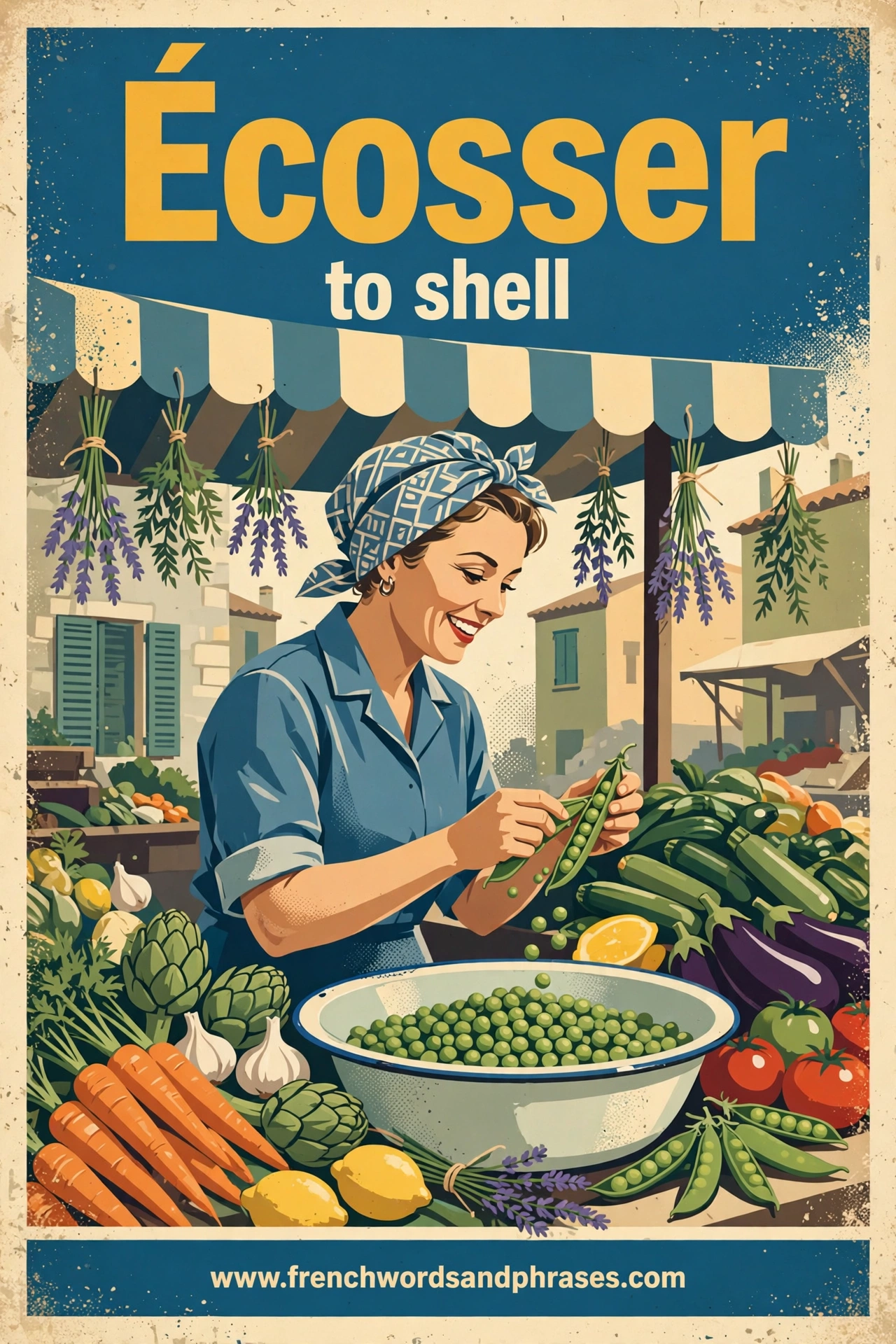
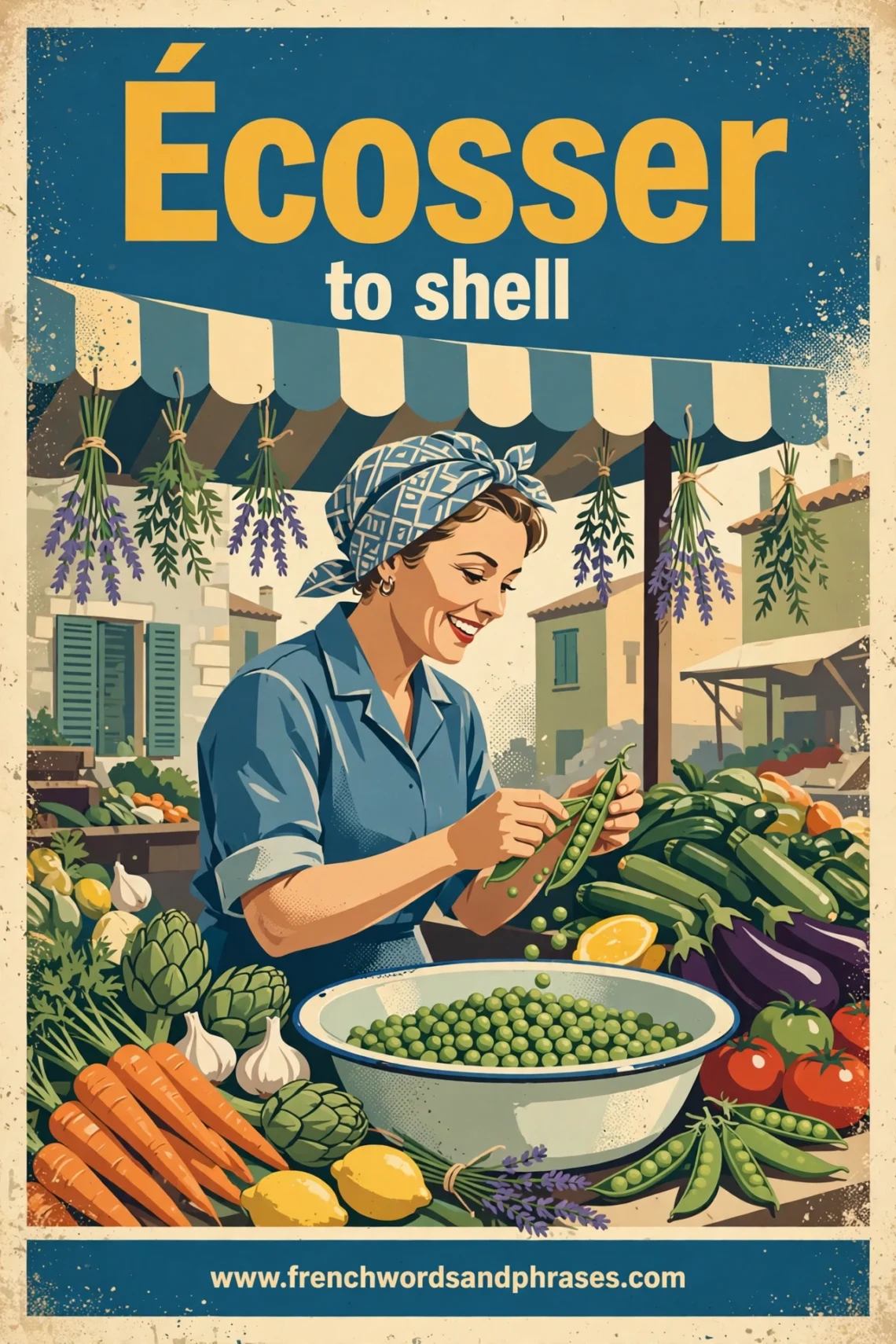
Écosser means to shell — to take peas or beans out of their pods.
A basket of peas between the knees, a thumb splitting each pod with a soft pop, green pearls tumbling into the bowl — écosser is the verb of the kitchen garden’s quietest job, shelling peas and beans before the pot.
In this guide, you’ll learn how to conjugate écosser in all the major French tenses and moods. Explore complete conjugation tables, French examples, English translations, and practice quizzes.
Understanding the French Verb Écosser
Écosser is a regular French verb belonging to the first group of verbs, those ending in -er.
It means to shell. It is commonly used in the kitchen and the garden for shelling peas (écosser des petits pois), broad beans (des fèves) and dried beans still in the pod, usually sitting comfortably, bowl on the lap, in a job French grandmothers have turned into a social occasion.
Verb classification: First group (-er)
Auxiliary verb: Avoir
Past participle: écossé
Present participle: écossant
English equivalents: To shell, to pod; écosser des petits pois — to shell peas; la cosse — the pod.
One important detail: écosser is built on la cosse, the pod of peas and beans. French divides the peeling jobs carefully: écosser opens pods (petits pois, fèves, haricots en grains), écaler shells nuts and eggs, and éplucher peels almost everything else. So a pea is never épluché and a potato is never écossée — each vegetable keeps its own verb.
Experience the Word
Écosser is the verb of the slow kitchen — a task so gentle that conversation flows around it like water around a stone.
Imagine a farmhouse doorway in June. Two neighbours sit side by side, a mountain of pea pods between them, thumbs working without looking, while the bowl fills and the village news gets thoroughly shelled too.
The peas have not been cooked or seasoned. They have been shelled — freed from the pod, ready for the pot.
How to Conjugate Écosser: Complete French Conjugation Guide
Let’s explore every major conjugation of écosser, beginning with the indicative mood.
How to Conjugate Écosser in the Indicative Mood
The indicative mood is used to express facts, observations, actions, and events.
How to Conjugate Écosser in the Present Tense (Présent)
Used for actions happening now, habitual actions, and general truths.
| Subject | Conjugation |
|---|---|
| je | écosse |
| tu | écosses |
| il / elle | écosse |
| nous | écossons |
| vous | écossez |
| ils / elles | écossent |
Example
Elle écosse les petits pois sur le perron.
She shells the peas on the doorstep.
Quick Quiz 1
Complete the sentence:
Nous ______ les fèves pour la soupe.
Reveal the answer
écossons
Nous écossons les fèves pour la soupe.
We shell the broad beans for the soup.
How to Conjugate Écosser in the Passé Composé
Used for completed actions in the past. Écosser takes the auxiliary verb avoir.
| Subject | Conjugation |
|---|---|
| j’ | ai écossé |
| tu | as écossé |
| il / elle | a écossé |
| nous | avons écossé |
| vous | avez écossé |
| ils / elles | ont écossé |
Example
Nous avons écossé deux kilos de fèves ce matin.
We shelled two kilos of broad beans this morning.
How to Conjugate Écosser in the Imparfait (Imperfect Tense)
Used for habitual past actions, descriptions, and ongoing situations in the past.
| Subject | Conjugation |
|---|---|
| je | écossais |
| tu | écossais |
| il / elle | écossait |
| nous | écossions |
| vous | écossiez |
| ils / elles | écossaient |
Example
Ma grand-mère écossait les pois en écoutant la radio.
My grandmother used to shell the peas while listening to the radio.
Quick Quiz 2
Choose the correct form:
They shelled the beans.
Ils ______ les haricots. (ont écossé / sont écossés)
Reveal the answer
ont écossé
Ils ont écossé les haricots.
Écosser takes avoir.
How to Conjugate Écosser in the Plus-que-parfait
Used to describe an action that had already been completed before another past event.
| Subject | Conjugation |
|---|---|
| j’ | avais écossé |
| tu | avais écossé |
| il / elle | avait écossé |
| nous | avions écossé |
| vous | aviez écossé |
| ils / elles | avaient écossé |
Example
Ils avaient écossé les haricots avant l’arrivée des invités.
They had shelled the beans before the guests arrived.
How to Conjugate Écosser in the Passé Simple
Primarily used in formal writing, literature, and historical narratives. It is rarely used in everyday conversation.
| Subject | Conjugation |
|---|---|
| je | écossai |
| tu | écossas |
| il / elle | écossa |
| nous | écossâmes |
| vous | écossâtes |
| ils / elles | écossèrent |
Example
La cuisinière écossa les pois et les jeta dans l’eau bouillante.
The cook shelled the peas and threw them into the boiling water.
How to Conjugate Écosser in the Passé Antérieur
A literary tense used to express an action completed immediately before another past action, generally in the passé simple.
| Subject | Conjugation |
|---|---|
| j’ | eus écossé |
| tu | eus écossé |
| il / elle | eut écossé |
| nous | eûmes écossé |
| vous | eûtes écossé |
| ils / elles | eurent écossé |
Example
Quand elle eut écossé les fèves, elle prépara la soupe.
When she had shelled the broad beans, she prepared the soup.
How to Conjugate Écosser in the Future Tense (Futur Simple)
Used to describe actions that will take place in the future.
| Subject | Conjugation |
|---|---|
| je | écosserai |
| tu | écosseras |
| il / elle | écossera |
| nous | écosserons |
| vous | écosserez |
| ils / elles | écosseront |
Example
Demain, nous écosserons les pois du jardin.
Tomorrow, we will shell the peas from the garden.
How to Conjugate Écosser in the Futur Antérieur (Future Perfect)
Used for an action that will have been completed before a particular point in the future.
| Subject | Conjugation |
|---|---|
| j’ | aurai écossé |
| tu | auras écossé |
| il / elle | aura écossé |
| nous | aurons écossé |
| vous | aurez écossé |
| ils / elles | auront écossé |
Example
À midi, elle aura écossé tous les haricots.
By noon, she will have shelled all the beans.
How to Conjugate Écosser in the Near Future (Futur Proche)
Used to describe something that is going to happen soon. Formed with aller + infinitive.
| Subject | Conjugation |
|---|---|
| je | vais écosser |
| tu | vas écosser |
| il / elle | va écosser |
| nous | allons écosser |
| vous | allez écosser |
| ils / elles | vont écosser |
Example
Je vais écosser les petits pois, assieds-toi avec moi.
I am going to shell the peas, sit down with me.
How to Conjugate Écosser in the Conditional Mood
The conditional mood expresses what would happen under certain circumstances. It is also frequently used to make polite requests or express wishes.
How to Conjugate Écosser in the Present Conditional
| Subject | Conjugation |
|---|---|
| je | écosserais |
| tu | écosserais |
| il / elle | écosserait |
| nous | écosserions |
| vous | écosseriez |
| ils / elles | écosseraient |
Example
Avec de l’aide, on écosserait ces fèves en dix minutes.
With some help, we would shell these broad beans in ten minutes.
How to Conjugate Écosser in the Past Conditional
| Subject | Conjugation |
|---|---|
| j’ | aurais écossé |
| tu | aurais écossé |
| il / elle | aurait écossé |
| nous | aurions écossé |
| vous | auriez écossé |
| ils / elles | auraient écossé |
Example
Elle aurait écossé les pois si on les avait cueillis plus tôt.
She would have shelled the peas if they had been picked earlier.
Écosser in the Literary Past Conditional Form
This less common literary form uses the imperfect subjunctive of avoir.
| Subject | Conjugation |
|---|---|
| j’ | eusse écossé |
| tu | eusses écossé |
| il / elle | eût écossé |
| nous | eussions écossé |
| vous | eussiez écossé |
| ils / elles | eussent écossé |
Example
La servante eût écossé les pois avant la messe.
The maid would have shelled the peas before mass.
How to Conjugate Écosser in the Subjunctive Mood
The subjunctive is used to express wishes, emotions, doubts, necessity, and uncertainty. It frequently follows expressions such as il faut que (it is necessary that) or bien que (although).
How to Conjugate Écosser in the Present Subjunctive
| Subject | Conjugation |
|---|---|
| que je | écosse |
| que tu | écosses |
| qu’il / qu’elle | écosse |
| que nous | écossions |
| que vous | écossiez |
| qu’ils / qu’elles | écossent |
Example
Il faut que tu écosses les pois avant le dîner.
You must shell the peas before dinner.
Quick Quiz 3
Complete the sentence using the subjunctive:
Il faut que vous ______ les pois.
Reveal the answer
écossiez
Il faut que vous écossiez les pois.
You must shell the peas.
How to Conjugate Écosser in the Imperfect Subjunctive
A literary tense, rarely encountered in modern spoken French.
| Subject | Conjugation |
|---|---|
| que je | écossasse |
| que tu | écossasses |
| qu’il / qu’elle | écossât |
| que nous | écossassions |
| que vous | écossassiez |
| qu’ils / qu’elles | écossassent |
Example
Elle voulait que les enfants écossassent les fèves dehors.
She wanted the children to shell the broad beans outside.
How to Conjugate Écosser in the Pluperfect Subjunctive
A literary construction used to express an action completed before another past action.
| Subject | Conjugation |
|---|---|
| que j’ | eusse écossé |
| que tu | eusses écossé |
| qu’il / qu’elle | eût écossé |
| que nous | eussions écossé |
| que vous | eussiez écossé |
| qu’ils / qu’elles | eussent écossé |
Example
Il regrettait qu’elle eût écossé les pois trop tôt.
He regretted that she had shelled the peas too early.
How to Conjugate Écosser in the Past Subjunctive
| Subject | Conjugation |
|---|---|
| que j’ | aie écossé |
| que tu | aies écossé |
| qu’il / qu’elle | ait écossé |
| que nous | ayons écossé |
| que vous | ayez écossé |
| qu’ils / qu’elles | aient écossé |
Example
Je suis content que vous ayez écossé les haricots à temps.
I am glad you shelled the beans in time.
How to Conjugate Écosser in the Imperative
The imperative is used to give commands, instructions, invitations, or suggestions. Subject pronouns are omitted.
How to Conjugate Écosser in the Present Imperative
| Person | Conjugation |
|---|---|
| (tu) | écosse |
| (nous) | écossons |
| (vous) | écossez |
Example
Écosse ces petits pois pendant que je mets la table !
Shell these peas while I set the table!
Quick Quiz 4
How would you say Shell these peas (tu form)?
Reveal the answer
Écosse ces petits pois !
French Participles of Écosser
Participles are verb forms that can be used in compound tenses and other grammatical constructions.
Present Participle of Écosser
écossant
En écossant les pois, elles échangeaient les nouvelles du village.
While shelling the peas, they exchanged the village news.
Past Participle of Écosser
écossé
Écossés à la main, les petits pois gardent toute leur douceur.
Shelled by hand, the peas keep all their sweetness.
Écosser in Everyday French: Real-Life Examples
Now that you know the conjugations, let’s see how écosser appears in everyday French.
Example 1 — Present
J’écosse les petits pois frais du marché.
I shell the fresh peas from the market.
Example 2 — Passé composé
Nous avons écossé les fèves ensemble.
We shelled the broad beans together.
Example 3 — Imparfait
On écossait les pois sous le tilleul, autrefois.
People used to shell peas under the lime tree, in the old days.
Example 4 — Future
Tu écosseras les haricots pour la soupe.
You will shell the beans for the soup.
Example 5 — Conditional
On écosserait plus vite à deux.
We would shell faster with two of us.
Example 6 — Imperative
Écossez les pois et mettez-les dans le bol !
Shell the peas and put them in the bowl!
Beyond Translation: The Meaning of Écosser
English shell does everything from peas to artillery; French écosser stays peacefully in the kitchen garden, tied to its pod.
La cosse is the whole story.
No pod, no écosser — which is why the verb carries such a specific picture: thumbs, a bowl, and a pile of empty green husks growing beside you.
How to Remember the French Verb Écosser
Remember it this way: Écosser is about peas out of the pod — the slow kitchen’s quietest job.
- La cosse — the pod: écosser is taking peas and beans out of la cosse.
- Écosser for pods, écaler for nuts and eggs, éplucher for everything else.
- Regular -er: j’écosse, nous écossons — past participle écossé.
The key idea is peas out of the pod — the slow kitchen’s quietest job.
Test Your Knowledge of Écosser
Let’s see how much you’ve learned. Try answering these questions before revealing the answers.
Question 1
What is la cosse?
Reveal the answer
The pod — the case that peas and beans grow in, and that écosser removes.
Question 2
How do you say She shells the peas in French?
Reveal the answer
Elle écosse les petits pois.
Question 3
Translate: We shelled two kilos of broad beans.
Reveal the answer
Nous avons écossé deux kilos de fèves.
Question 4
What is the past participle of écosser?
Reveal the answer
Écossé.
Question 5
Complete the sentence:
Il faut que tu ______ les pois avant le dîner.
Reveal the answer
écosses
Il faut que tu écosses les pois avant le dîner.
You must shell the peas before dinner.
Your Final Challenge
Can You Use It?
How would you say this in French?
She shells the peas from the garden, and the evening soup is already almost ready.
Reveal the answer
Elle écosse les petits pois du jardin, et la soupe du soir est déjà presque prête.
She shells the peas from the garden, and the evening soup is already almost ready.
A little French. A little curiosity. A richer everyday life.
LEARN FRENCH ONE WORD AT A TIME