A French Word to Live By
How to Conjugate Écorer in French
/e.kɔ.ʁe/
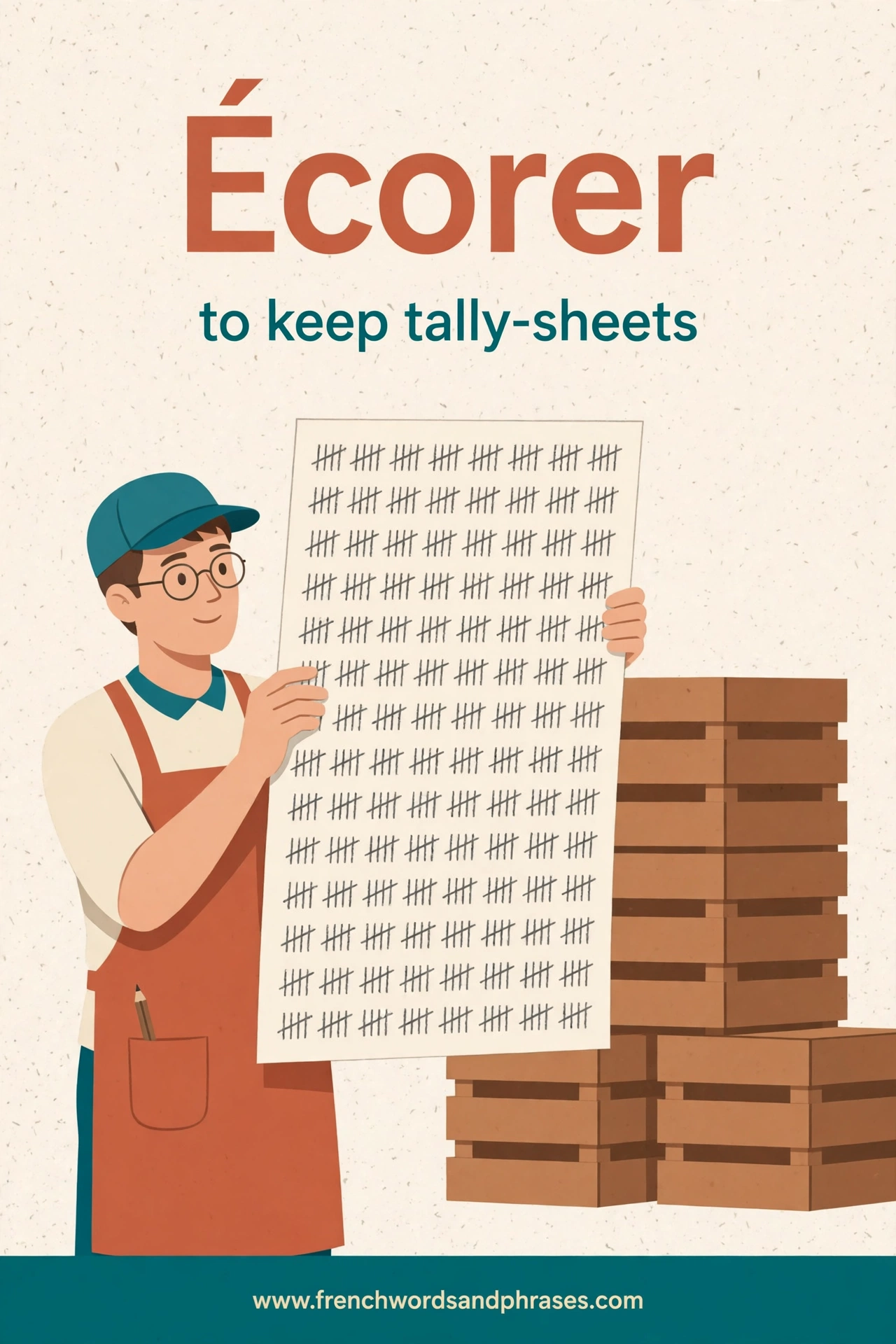
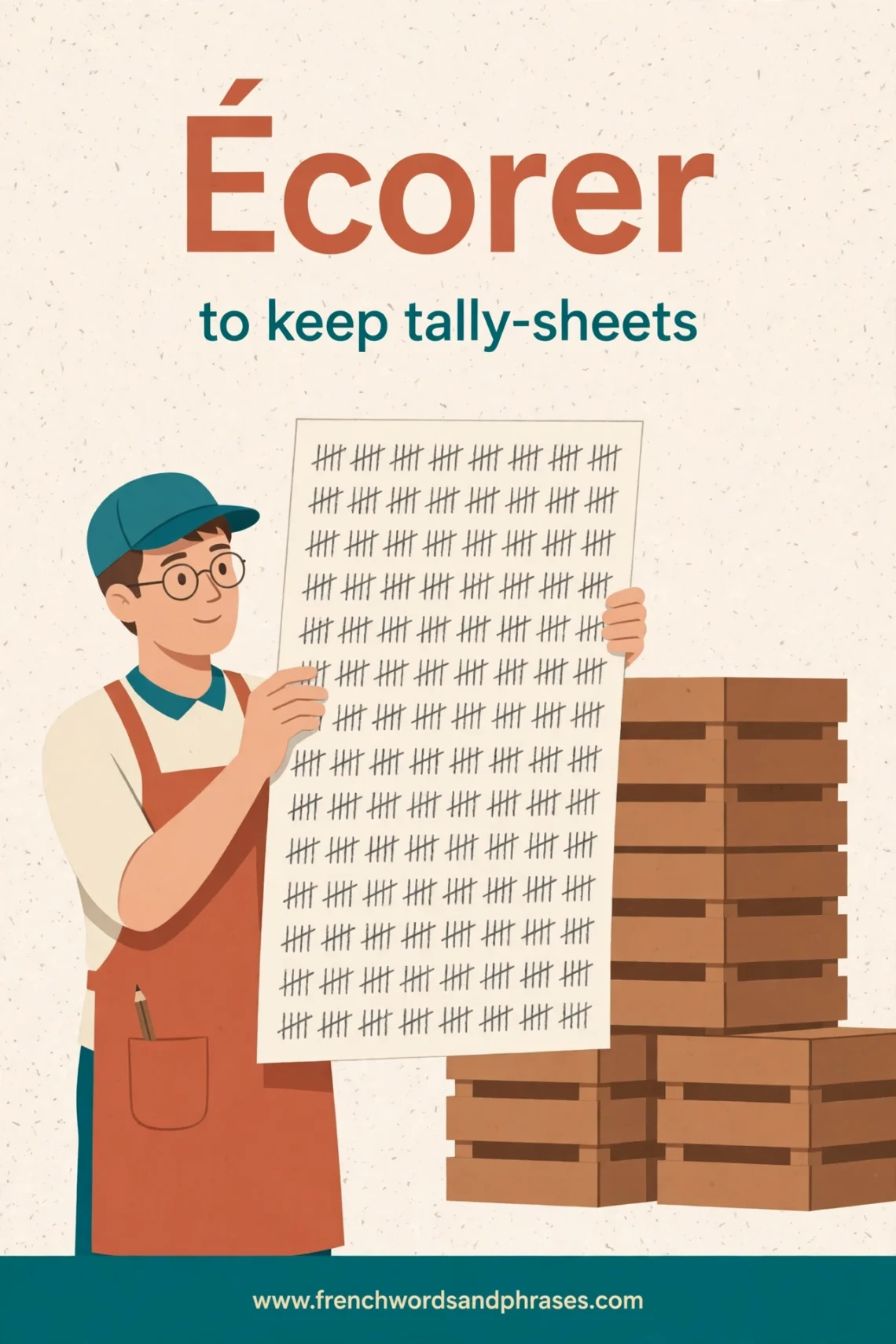
Écorer means to keep tally-sheets — the old trade verb for recording goods on the tally.
A clerk in a candlelit warehouse, a long sheet ruled into columns, barrels and bales ticked off one by one — écorer is an old trade verb, the bookkeeping word of the days when every cargo was counted by hand and kept on tally-sheets.
In this guide, you’ll learn how to conjugate écorer in all the major French tenses and moods. Explore complete conjugation tables, French examples, English translations, and practice quizzes.
Understanding the French Verb Écorer
Écorer is a regular French verb belonging to the first group of verbs, those ending in -er.
It means to keep tally-sheets. It was commonly used in warehouses, ports and wine cellars for tallying barrels, bales and crates as they arrived and left, for keeping the written count that settled arguments between merchants, and in the paper world of old commerce where the tally-sheet, not the computer, was the truth.
Verb classification: First group (-er)
Auxiliary verb: Avoir
Past participle: écoré
Present participle: écorant
English equivalents: To keep tally-sheets, to tally goods, to enter goods on the tally (old trade term).
One important detail: écorer is a survivor from the old counting houses. The écore was the tally-sheet — the written record, column by column, of goods received, stored and shipped — and the clerk who écorait was the human memory of the warehouse. The verb is rare today and smells of paper, ink and port wine cellars, but it belongs to the same family of ideas as English score: a notch, a mark, a count you can trust. You will meet it in old trade documents and historical novels rather than in a modern office.
Experience the Word
Écorer is the verb of the trusted count — before databases, a careful man with a sheet and a pen stood between a cargo and chaos.
Imagine a Bordeaux cellar in 1780. Casks roll in from the cooper, and the clerk écore each one on his tally-sheet — number, mark, measure — by candlelight, knowing that a single missed line could cost a fortune.
Nothing has been counted by machine. It has been tallied — écoré, written down line by line.
How to Conjugate Écorer: Complete French Conjugation Guide
Let’s explore every major conjugation of écorer, beginning with the indicative mood.
How to Conjugate Écorer in the Indicative Mood
The indicative mood is used to express facts, observations, actions, and events.
How to Conjugate Écorer in the Present Tense (Présent)
Used for actions happening now, habitual actions, and general truths.
| Subject | Conjugation |
|---|---|
| je | écore |
| tu | écores |
| il / elle | écore |
| nous | écorons |
| vous | écorez |
| ils / elles | écorent |
Example
Le commis écore les barriques dès leur arrivée au chai.
The clerk tallies the casks as soon as they arrive at the cellar.
Quick Quiz 1
Complete the sentence:
Nous ______ les sacs de café au déchargement.
Reveal the answer
écorons
Nous écorons les sacs de café au déchargement.
We tally the coffee sacks at unloading.
How to Conjugate Écorer in the Passé Composé
Used for completed actions in the past. Écorer takes the auxiliary verb avoir.
| Subject | Conjugation |
|---|---|
| j’ | ai écoré |
| tu | as écoré |
| il / elle | a écoré |
| nous | avons écoré |
| vous | avez écoré |
| ils / elles | ont écoré |
Example
Nous avons écoré toute la cargaison avant le soir.
We tallied the whole cargo before evening.
How to Conjugate Écorer in the Imparfait (Imperfect Tense)
Used for habitual past actions, descriptions, and ongoing situations in the past.
| Subject | Conjugation |
|---|---|
| je | écorais |
| tu | écorais |
| il / elle | écorait |
| nous | écorions |
| vous | écoriez |
| ils / elles | écoraient |
Example
Autrefois, le magasinier écorait chaque balle de laine.
In the old days, the warehouseman used to tally every bale of wool.
Quick Quiz 2
Choose the correct form:
They tallied the goods.
Ils ______ les marchandises. (ont écoré / sont écorés)
Reveal the answer
ont écoré
Ils ont écoré les marchandises.
Écorer takes avoir.
How to Conjugate Écorer in the Plus-que-parfait
Used to describe an action that had already been completed before another past event.
| Subject | Conjugation |
|---|---|
| j’ | avais écoré |
| tu | avais écoré |
| il / elle | avait écoré |
| nous | avions écoré |
| vous | aviez écoré |
| ils / elles | avaient écoré |
Example
Ils avaient écoré les marchandises avant l’arrivée de l’inspecteur.
They had tallied the goods before the inspector arrived.
How to Conjugate Écorer in the Passé Simple
Primarily used in formal writing, literature, and historical narratives. It is rarely used in everyday conversation.
| Subject | Conjugation |
|---|---|
| je | écorai |
| tu | écoras |
| il / elle | écora |
| nous | écorâmes |
| vous | écorâtes |
| ils / elles | écorèrent |
Example
Le commis écora les fûts un à un, sans se tromper.
The clerk tallied the barrels one by one, without a mistake.
How to Conjugate Écorer in the Passé Antérieur
A literary tense used to express an action completed immediately before another past action, generally in the passé simple.
| Subject | Conjugation |
|---|---|
| j’ | eus écoré |
| tu | eus écoré |
| il / elle | eut écoré |
| nous | eûmes écoré |
| vous | eûtes écoré |
| ils / elles | eurent écoré |
Example
Quand il eut écoré la dernière caisse, il ferma le registre.
When he had tallied the last crate, he closed the register.
How to Conjugate Écorer in the Future Tense (Futur Simple)
Used to describe actions that will take place in the future.
| Subject | Conjugation |
|---|---|
| je | écorerai |
| tu | écoreras |
| il / elle | écorera |
| nous | écorerons |
| vous | écorerez |
| ils / elles | écoreront |
Example
Demain, nous écorerons les sacs de café au déchargement.
Tomorrow, we will tally the coffee sacks at unloading.
How to Conjugate Écorer in the Futur Antérieur (Future Perfect)
Used for an action that will have been completed before a particular point in the future.
| Subject | Conjugation |
|---|---|
| j’ | aurai écoré |
| tu | auras écoré |
| il / elle | aura écoré |
| nous | aurons écoré |
| vous | aurez écoré |
| ils / elles | auront écoré |
Example
À la fin de la semaine, vous aurez écoré tout le stock.
By the end of the week, you will have tallied all the stock.
How to Conjugate Écorer in the Near Future (Futur Proche)
Used to describe something that is going to happen soon. Formed with aller + infinitive.
| Subject | Conjugation |
|---|---|
| je | vais écorer |
| tu | vas écorer |
| il / elle | va écorer |
| nous | allons écorer |
| vous | allez écorer |
| ils / elles | vont écorer |
Example
Je vais écorer ces tonneaux avant la vente.
I am going to tally these barrels before the sale.
How to Conjugate Écorer in the Conditional Mood
The conditional mood expresses what would happen under certain circumstances. It is also frequently used to make polite requests or express wishes.
How to Conjugate Écorer in the Present Conditional
| Subject | Conjugation |
|---|---|
| je | écorerais |
| tu | écorerais |
| il / elle | écorerait |
| nous | écorerions |
| vous | écoreriez |
| ils / elles | écoreraient |
Example
Avec deux commis, on écorerait la cargaison en une matinée.
With two clerks, we would tally the cargo in one morning.
How to Conjugate Écorer in the Past Conditional
| Subject | Conjugation |
|---|---|
| j’ | aurais écoré |
| tu | aurais écoré |
| il / elle | aurait écoré |
| nous | aurions écoré |
| vous | auriez écoré |
| ils / elles | auraient écoré |
Example
Il aurait écoré plus vite avec une meilleure lumière.
He would have tallied faster with better light.
Écorer in the Literary Past Conditional Form
This less common literary form uses the imperfect subjunctive of avoir.
| Subject | Conjugation |
|---|---|
| j’ | eusse écoré |
| tu | eusses écoré |
| il / elle | eût écoré |
| nous | eussions écoré |
| vous | eussiez écoré |
| ils / elles | eussent écoré |
Example
Le magasinier eût écoré les balles jusqu’à la nuit tombée.
The warehouseman would have tallied the bales until nightfall.
How to Conjugate Écorer in the Subjunctive Mood
The subjunctive is used to express wishes, emotions, doubts, necessity, and uncertainty. It frequently follows expressions such as il faut que (it is necessary that) or bien que (although).
How to Conjugate Écorer in the Present Subjunctive
| Subject | Conjugation |
|---|---|
| que je | écore |
| que tu | écores |
| qu’il / qu’elle | écore |
| que nous | écorions |
| que vous | écoriez |
| qu’ils / qu’elles | écorent |
Example
Il faut que le commis écore chaque caisse séparément.
The clerk must tally each crate separately.
Quick Quiz 3
Complete the sentence using the subjunctive:
Il faut que vous ______ tout le stock.
Reveal the answer
écoriez
Il faut que vous écoriez tout le stock.
You must tally all the stock.
How to Conjugate Écorer in the Imperfect Subjunctive
A literary tense, rarely encountered in modern spoken French.
| Subject | Conjugation |
|---|---|
| que je | écorasse |
| que tu | écorasses |
| qu’il / qu’elle | écorât |
| que nous | écorassions |
| que vous | écorassiez |
| qu’ils / qu’elles | écorassent |
Example
Le marchand exigeait que l’on écorât les fûts en sa présence.
The merchant required the barrels to be tallied in his presence.
How to Conjugate Écorer in the Pluperfect Subjunctive
A literary construction used to express an action completed before another past action.
| Subject | Conjugation |
|---|---|
| que j’ | eusse écoré |
| que tu | eusses écoré |
| qu’il / qu’elle | eût écoré |
| que nous | eussions écoré |
| que vous | eussiez écoré |
| qu’ils / qu’elles | eussent écoré |
Example
On vérifia qu’il eût écoré les marchandises sans erreur.
They checked that he had tallied the goods without error.
How to Conjugate Écorer in the Past Subjunctive
| Subject | Conjugation |
|---|---|
| que j’ | aie écoré |
| que tu | aies écoré |
| qu’il / qu’elle | ait écoré |
| que nous | ayons écoré |
| que vous | ayez écoré |
| qu’ils / qu’elles | aient écoré |
Example
Je suis content que vous ayez écoré tout le stock.
I am glad you tallied all the stock.
How to Conjugate Écorer in the Imperative
The imperative is used to give commands, instructions, invitations, or suggestions. Subject pronouns are omitted.
How to Conjugate Écorer in the Present Imperative
| Person | Conjugation |
|---|---|
| (tu) | écore |
| (nous) | écorons |
| (vous) | écorez |
Example
Écore ces barriques et note tout dans le registre !
Tally these casks and note everything in the register!
Quick Quiz 4
How would you say Tally these casks (tu form)?
Reveal the answer
Écore ces barriques !
French Participles of Écorer
Participles are verb forms that can be used in compound tenses and other grammatical constructions.
Present Participle of Écorer
écorant
En écorant les caisses, il découvrit le compte juste.
While tallying the crates, he found the count was right.
Past Participle of Écorer
écoré
Écorées avec soin, les marchandises ne donnèrent lieu à aucun litige.
Tallied with care, the goods gave rise to no dispute.
Écorer in Everyday French: Real-Life Examples
Now that you know the conjugations, let’s see how écorer appears in everyday French.
Example 1 — Present
Le commis écore les tonneaux à l’entrée du chai.
The clerk tallies the barrels at the cellar entrance.
Example 2 — Passé composé
Nous avons écoré la cargaison en une journée.
We tallied the cargo in one day.
Example 3 — Imparfait
Le magasinier écorait les balles de coton.
The warehouseman used to tally the cotton bales.
Example 4 — Future
Vous écorerez les caisses demain matin.
You will tally the crates tomorrow morning.
Example 5 — Conditional
On écorerait plus juste à la lumière du jour.
We would tally more accurately by daylight.
Example 6 — Imperative
Écorez chaque fût, sans exception !
Tally every barrel, without exception!
Beyond Translation: The Meaning of Écorer
English threw its tally sticks away and kept only the word score; French écorer preserves the whole scene — the sheet, the columns, the clerk.
It is bookkeeping as a craft.
Rare and old-fashioned, yes, but perfect: to écorer was to make a count that men could swear by, in ink, in a world of barrels and candlelight.
How to Remember the French Verb Écorer
Remember it this way: Écorer is about the clerk’s verb — goods counted by hand on the tally-sheet.
- Une écore — the tally-sheet; écorer is to keep it, line by line.
- An old trade word: warehouses, ports and wine cellars, not modern offices.
- Regular -er: j’écore, nous écorons, past participle écoré.
The key idea is the clerk’s verb — goods counted by hand on the tally-sheet.
Test Your Knowledge of Écorer
Let’s see how much you’ve learned. Try answering these questions before revealing the answers.
Question 1
What was une écore?
Reveal the answer
A tally-sheet — the written record of goods that the clerk kept.
Question 2
How do you say We tallied the whole cargo in French?
Reveal the answer
Nous avons écoré toute la cargaison.
Question 3
Translate: The clerk tallies the casks as they arrive.
Reveal the answer
Le commis écore les barriques dès leur arrivée.
Question 4
What is the past participle of écorer?
Reveal the answer
Écoré.
Question 5
Complete the sentence:
Il faut que le commis ______ chaque caisse séparément.
Reveal the answer
écore
Il faut que le commis écore chaque caisse séparément.
The clerk must tally each crate separately.
Your Final Challenge
Can You Use It?
How would you say this in French?
The clerk tallies the casks one by one, and the cellar keeps its count true.
Reveal the answer
Le commis écore les barriques une à une, et le chai garde son compte juste.
The clerk tallies the casks one by one, and the cellar keeps its count true.
A little French. A little curiosity. A richer everyday life.
LEARN FRENCH ONE WORD AT A TIME