
A French Word to Live By
How to Conjugate Écorcher in French
/e.kɔʁ.ʃe/
Écorcher means to flay — to skin, and by extension to mangle or to fleece.
A rabbit skinned at the market stall, a name twisted by a bad accent until nobody recognises it, a bill so high it hurts — écorcher is the verb of skinning, and French uses it for everything that gets roughly torn, mangled or overcharged.
In this guide, you’ll learn how to conjugate écorcher in all the major French tenses and moods. Explore complete conjugation tables, French examples, English translations, and practice quizzes.
Understanding the French Verb Écorcher
Écorcher is a regular French verb belonging to the first group of verbs, those ending in -er.
It means to flay. It is commonly used at the butcher’s and in the country for skinning animals, in language talk for names and words pronounced or written badly (écorcher le français), for sounds that hurt the ears, and in complaints about prices that skin the customer alive.
Verb classification: First group (-er)
Auxiliary verb: Avoir
Past participle: écorché
Present participle: écorchant
English equivalents: To flay, to skin; to mangle (a word, a name); to grate on (the ears); se faire écorcher — to be fleeced, ripped off.
One important detail: écorcher spends much of its life in figurative senses. Écorcher un nom or écorcher un mot is to mangle it — to say or spell it so badly it suffers; écorcher les oreilles is to grate on the ears, said of false notes and harsh sounds; and se faire écorcher is to be fleeced — the tourist who pays triple has been well and truly skinned. The violent picture is always there underneath: something precious — skin, language, money — roughly stripped away.
Experience the Word
Écorcher is the verb of rough stripping — skin off an animal, polish off a word, money off a customer.
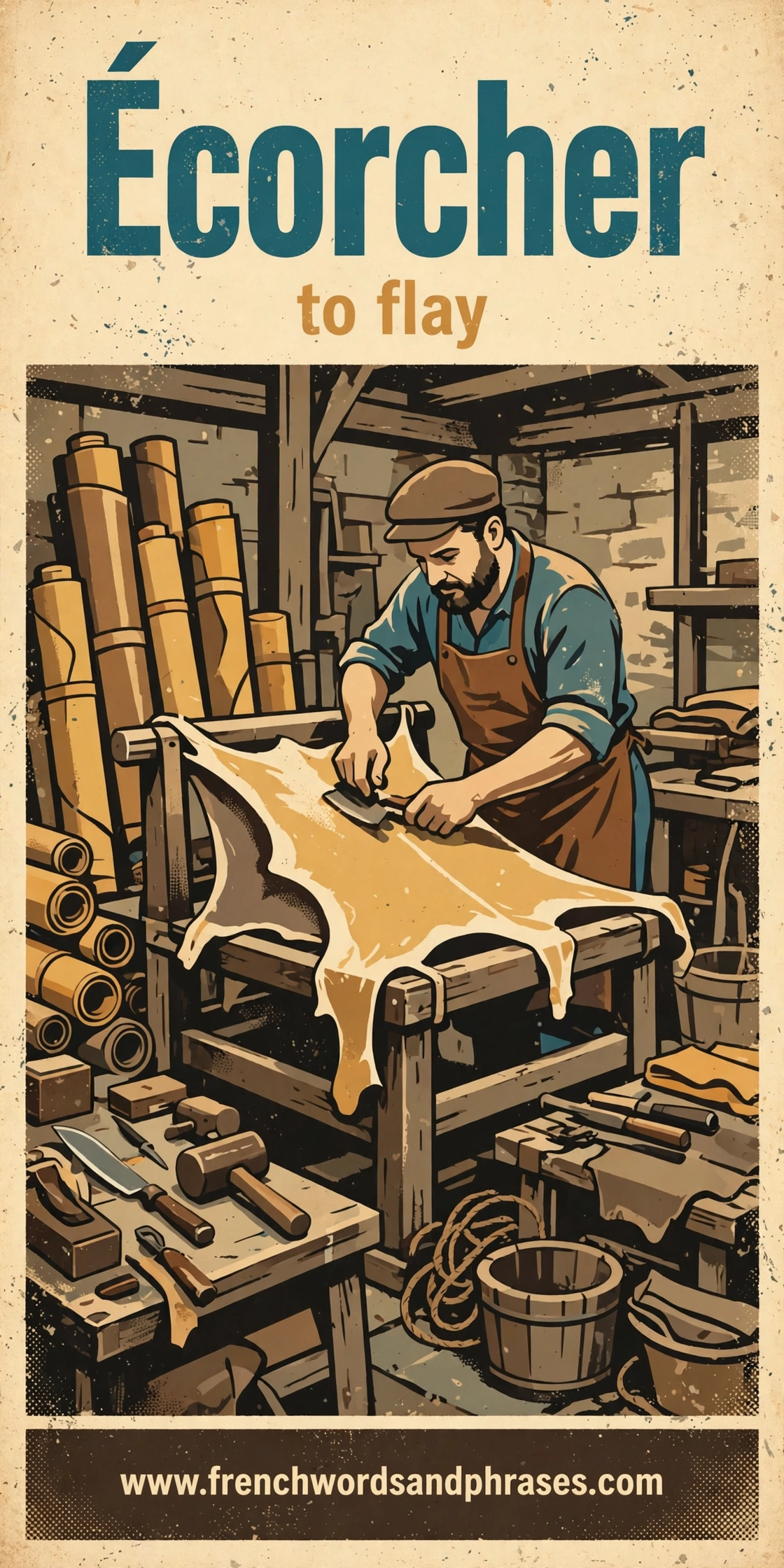
Imagine a village butcher at his block before dawn. In a few practised movements the rabbit is skinned — écorché — clean and quick, the way his grandfather taught him, while the first customers wait with their baskets.
The work is hard to watch but honest. The skin has been stripped — écorché, taken off in one piece.
How to Conjugate Écorcher: Complete French Conjugation Guide
Let’s explore every major conjugation of écorcher, beginning with the indicative mood.
How to Conjugate Écorcher in the Indicative Mood
The indicative mood is used to express facts, observations, actions, and events.
How to Conjugate Écorcher in the Present Tense (Présent)
Used for actions happening now, habitual actions, and general truths.
| Subject | Conjugation |
|---|---|
| je | écorche |
| tu | écorches |
| il / elle | écorche |
| nous | écorchons |
| vous | écorchez |
| ils / elles | écorchent |
Example
Le boucher écorche le lapin en quelques gestes.
The butcher skins the rabbit in a few movements.
Quick Quiz 1
Complete the sentence:
Nous ______ les lapins le samedi.
Reveal the answer
écorchons
Nous écorchons les lapins le samedi.
We skin the rabbits on Saturdays.
How to Conjugate Écorcher in the Passé Composé
Used for completed actions in the past. Écorcher takes the auxiliary verb avoir.
| Subject | Conjugation |
|---|---|
| j’ | ai écorché |
| tu | as écorché |
| il / elle | a écorché |
| nous | avons écorché |
| vous | avez écorché |
| ils / elles | ont écorché |
Example
Il a écorché mon nom du début à la fin de son discours.
He mangled my name from the beginning to the end of his speech.
How to Conjugate Écorcher in the Imparfait (Imperfect Tense)
Used for habitual past actions, descriptions, and ongoing situations in the past.
| Subject | Conjugation |
|---|---|
| je | écorchais |
| tu | écorchais |
| il / elle | écorchait |
| nous | écorchions |
| vous | écorchiez |
| ils / elles | écorchaient |
Example
Autrefois, on écorchait les bêtes à la ferme même.
In the old days, people used to skin the animals on the farm itself.
Quick Quiz 2
Choose the correct form:
We got fleeced.
On ______ dans ce restaurant. (s’est fait écorcher / a fait écorcher)
Reveal the answer
s’est fait écorcher
On s’est fait écorcher dans ce restaurant.
Se faire écorcher means to be fleeced.
How to Conjugate Écorcher in the Plus-que-parfait
Used to describe an action that had already been completed before another past event.
| Subject | Conjugation |
|---|---|
| j’ | avais écorché |
| tu | avais écorché |
| il / elle | avait écorché |
| nous | avions écorché |
| vous | aviez écorché |
| ils / elles | avaient écorché |
Example
Le chasseur avait écorché le lièvre avant de rentrer.
The hunter had skinned the hare before coming home.
How to Conjugate Écorcher in the Passé Simple
Primarily used in formal writing, literature, and historical narratives. It is rarely used in everyday conversation.
| Subject | Conjugation |
|---|---|
| je | écorchai |
| tu | écorchas |
| il / elle | écorcha |
| nous | écorchâmes |
| vous | écorchâtes |
| ils / elles | écorchèrent |
Example
Le garçon écorcha le mot si bien que personne ne comprit.
The boy mangled the word so well that nobody understood.
How to Conjugate Écorcher in the Passé Antérieur
A literary tense used to express an action completed immediately before another past action, generally in the passé simple.
| Subject | Conjugation |
|---|---|
| j’ | eus écorché |
| tu | eus écorché |
| il / elle | eut écorché |
| nous | eûmes écorché |
| vous | eûtes écorché |
| ils / elles | eurent écorché |
Example
Quand il eut écorché la bête, il salit la peau.
When he had skinned the animal, he salted the hide.
How to Conjugate Écorcher in the Future Tense (Futur Simple)
Used to describe actions that will take place in the future.
| Subject | Conjugation |
|---|---|
| je | écorcherai |
| tu | écorcheras |
| il / elle | écorchera |
| nous | écorcherons |
| vous | écorcherez |
| ils / elles | écorcheront |
Example
À ce prix-là, ce restaurant écorchera les touristes tout l’été.
At that price, that restaurant will fleece the tourists all summer.
How to Conjugate Écorcher in the Futur Antérieur (Future Perfect)
Used for an action that will have been completed before a particular point in the future.
| Subject | Conjugation |
|---|---|
| j’ | aurai écorché |
| tu | auras écorché |
| il / elle | aura écorché |
| nous | aurons écorché |
| vous | aurez écorché |
| ils / elles | auront écorché |
Example
À la fin de la leçon, tu auras écorché tous les noms propres.
By the end of the lesson, you will have mangled every proper name.
How to Conjugate Écorcher in the Near Future (Futur Proche)
Used to describe something that is going to happen soon. Formed with aller + infinitive.
| Subject | Conjugation |
|---|---|
| je | vais écorcher |
| tu | vas écorcher |
| il / elle | va écorcher |
| nous | allons écorcher |
| vous | allez écorcher |
| ils / elles | vont écorcher |
Example
Attention, ce violon va écorcher les oreilles de tout le monde.
Careful, that violin is going to grate on everyone’s ears.
How to Conjugate Écorcher in the Conditional Mood
The conditional mood expresses what would happen under certain circumstances. It is also frequently used to make polite requests or express wishes.
How to Conjugate Écorcher in the Present Conditional
| Subject | Conjugation |
|---|---|
| je | écorcherais |
| tu | écorcherais |
| il / elle | écorcherait |
| nous | écorcherions |
| vous | écorcheriez |
| ils / elles | écorcheraient |
Example
Un bon élève n’écorcherait jamais un si beau texte.
A good student would never mangle such a beautiful text.
How to Conjugate Écorcher in the Past Conditional
| Subject | Conjugation |
|---|---|
| j’ | aurais écorché |
| tu | aurais écorché |
| il / elle | aurait écorché |
| nous | aurions écorché |
| vous | auriez écorché |
| ils / elles | auraient écorché |
Example
Sans le guide, le chauffeur nous aurait écorchés sur le prix.
Without the guide, the driver would have fleeced us on the price.
Écorcher in the Literary Past Conditional Form
This less common literary form uses the imperfect subjunctive of avoir.
| Subject | Conjugation |
|---|---|
| j’ | eusse écorché |
| tu | eusses écorché |
| il / elle | eût écorché |
| nous | eussions écorché |
| vous | eussiez écorché |
| ils / elles | eussent écorché |
Example
Le bourreau eût écorché le prisonnier sans un mot.
The executioner would have flayed the prisoner without a word.
How to Conjugate Écorcher in the Subjunctive Mood
The subjunctive is used to express wishes, emotions, doubts, necessity, and uncertainty. It frequently follows expressions such as il faut que (it is necessary that) or bien que (although).
How to Conjugate Écorcher in the Present Subjunctive
| Subject | Conjugation |
|---|---|
| que je | écorche |
| que tu | écorches |
| qu’il / qu’elle | écorche |
| que nous | écorchions |
| que vous | écorchiez |
| qu’ils / qu’elles | écorchent |
Example
Je déteste que l’on écorche les noms étrangers.
I hate it when people mangle foreign names.
Quick Quiz 3
Complete the sentence using the subjunctive:
Je déteste que vous ______ les noms étrangers.
Reveal the answer
écorchiez
Je déteste que vous écorchiez les noms étrangers.
I hate it when you mangle foreign names.
How to Conjugate Écorcher in the Imperfect Subjunctive
A literary tense, rarely encountered in modern spoken French.
| Subject | Conjugation |
|---|---|
| que je | écorchasse |
| que tu | écorchasses |
| qu’il / qu’elle | écorchât |
| que nous | écorchassions |
| que vous | écorchassiez |
| qu’ils / qu’elles | écorchassent |
Example
Le professeur ne voulait pas que l’élève écorchât chaque mot.
The teacher did not want the pupil to mangle every word.
How to Conjugate Écorcher in the Pluperfect Subjunctive
A literary construction used to express an action completed before another past action.
| Subject | Conjugation |
|---|---|
| que j’ | eusse écorché |
| que tu | eusses écorché |
| qu’il / qu’elle | eût écorché |
| que nous | eussions écorché |
| que vous | eussiez écorché |
| qu’ils / qu’elles | eussent écorché |
Example
On se plaignit qu’il eût écorché la langue pendant tout le discours.
People complained that he had mangled the language throughout the speech.
How to Conjugate Écorcher in the Past Subjunctive
| Subject | Conjugation |
|---|---|
| que j’ | aie écorché |
| que tu | aies écorché |
| qu’il / qu’elle | ait écorché |
| que nous | ayons écorché |
| que vous | ayez écorché |
| qu’ils / qu’elles | aient écorché |
Example
Je suis désolé que j’aie écorché votre nom.
I am sorry that I mangled your name.
How to Conjugate Écorcher in the Imperative
The imperative is used to give commands, instructions, invitations, or suggestions. Subject pronouns are omitted.
How to Conjugate Écorcher in the Present Imperative
| Person | Conjugation |
|---|---|
| (tu) | écorche |
| (nous) | écorchons |
| (vous) | écorchez |
Example
N’écorche pas ce pauvre mot, relis-le lentement !
Do not mangle that poor word, read it again slowly!
Quick Quiz 4
How would you say Do not mangle that word (tu form)?
Reveal the answer
N’écorche pas ce mot !
French Participles of Écorcher
Participles are verb forms that can be used in compound tenses and other grammatical constructions.
Present Participle of Écorcher
écorchant
En écorchant chaque syllabe, il rendait le poème méconnaissable.
By mangling every syllable, he made the poem unrecognisable.
Past Participle of Écorcher
écorché
Écorché par le vent et le soleil, son visage racontait sa vie.
Flayed by the wind and the sun, his face told his life story.
Écorcher in Everyday French: Real-Life Examples
Now that you know the conjugations, let’s see how écorcher appears in everyday French.
Example 1 — Present
Ce chanteur écorche les oreilles de tout le quartier.
That singer grates on the whole neighbourhood’s ears.
Example 2 — Passé composé
On s’est fait écorcher dans ce restaurant touristique.
We got fleeced in that tourist restaurant.
Example 3 — Imparfait
Le boucher écorchait les lapins le samedi matin.
The butcher used to skin the rabbits on Saturday mornings.
Example 4 — Future
Tu écorcheras encore mon prénom, je parie.
You will mangle my first name again, I bet.
Example 5 — Conditional
Avec un peu d’attention, tu n’écorcherais pas ces mots.
With a little care, you would not mangle those words.
Example 6 — Imperative
N’écorchez pas le français, articulez !
Do not mangle French, enunciate!
Beyond Translation: The Meaning of Écorcher
English flay stayed literal and literary; French écorcher moved into daily speech and now skins anything that can suffer.
Words, ears and wallets all get écorchés.
To learn the verb is to gain three insults and a warning at once: do not mangle the language, do not hurt our ears, and do not let yourself be fleeced.
How to Remember the French Verb Écorcher
Remember it this way: Écorcher is about the skinning verb — animals, words, ears and wallets.
- Écorcher un nom — to mangle a name; écorcher les oreilles — to grate on the ears.
- Se faire écorcher — to be fleeced, ripped off on the price.
- Regular -er: j’écorche, nous écorchons, past participle écorché.
The key idea is the skinning verb — animals, words, ears and wallets.
Test Your Knowledge of Écorcher
Let’s see how much you’ve learned. Try answering these questions before revealing the answers.
Question 1
What does se faire écorcher mean?
Reveal the answer
To be fleeced — to be badly overcharged, ripped off.
Question 2
How do you say He mangled my name in French?
Reveal the answer
Il a écorché mon nom.
Question 3
Translate: That singer grates on everyone’s ears.
Reveal the answer
Ce chanteur écorche les oreilles de tout le monde.
Question 4
What is the past participle of écorcher?
Reveal the answer
Écorché.
Question 5
Complete the sentence:
Je déteste que l’on ______ les noms étrangers.
Reveal the answer
écorche
Je déteste que l’on écorche les noms étrangers.
I hate it when people mangle foreign names.
Your Final Challenge
Can You Use It?
How would you say this in French?
The butcher skins the rabbit in silence, and the market wakes up around him.
Reveal the answer
Le boucher écorche le lapin en silence, et le marché s’éveille autour de lui.
The butcher skins the rabbit in silence, and the market wakes up around him.
A little French. A little curiosity. A richer everyday life.
LEARN FRENCH ONE WORD AT A TIME




