A French Word to Live By
How to Conjugate Ébrancher in French
/e.bʁɑ̃.ʃe/
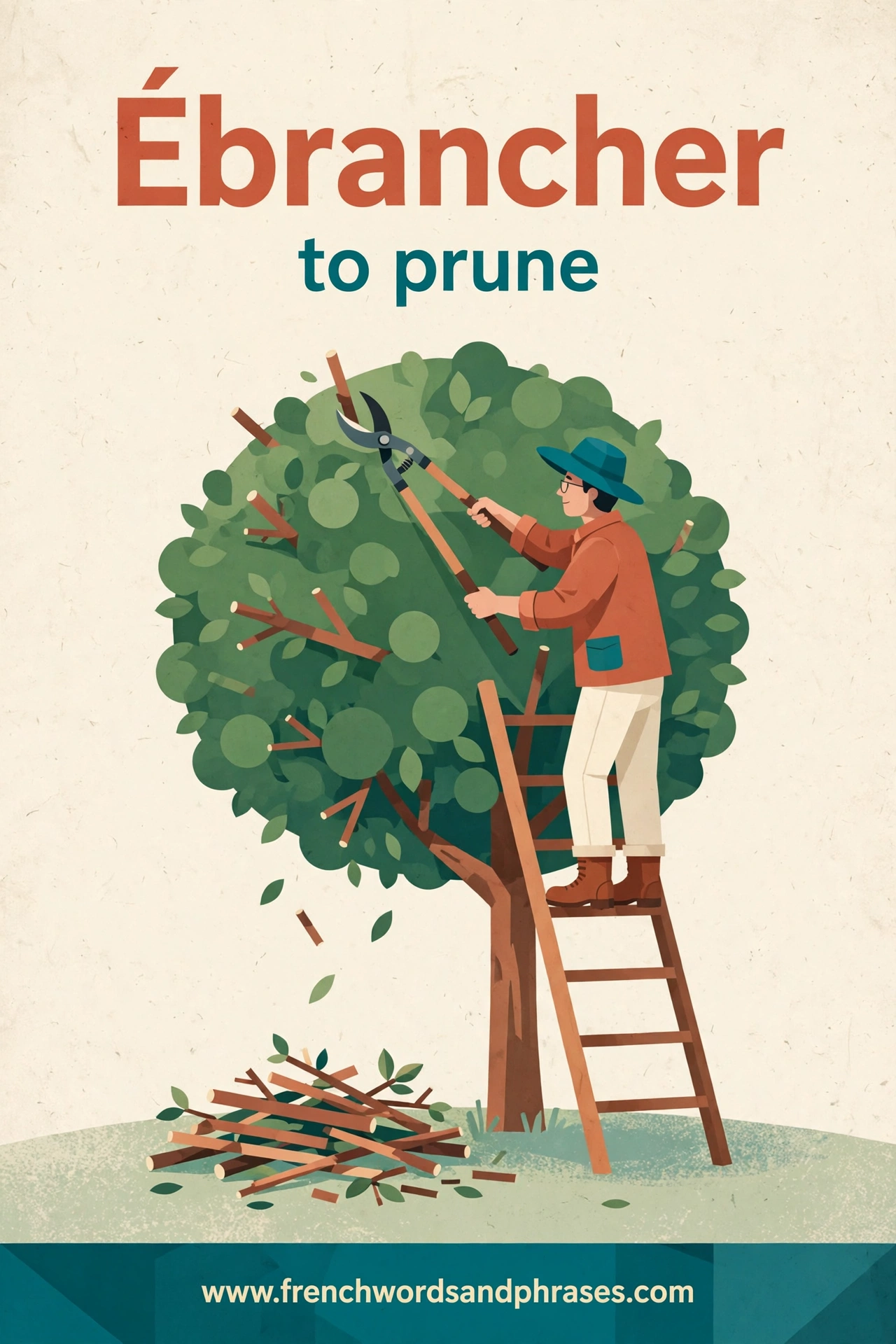
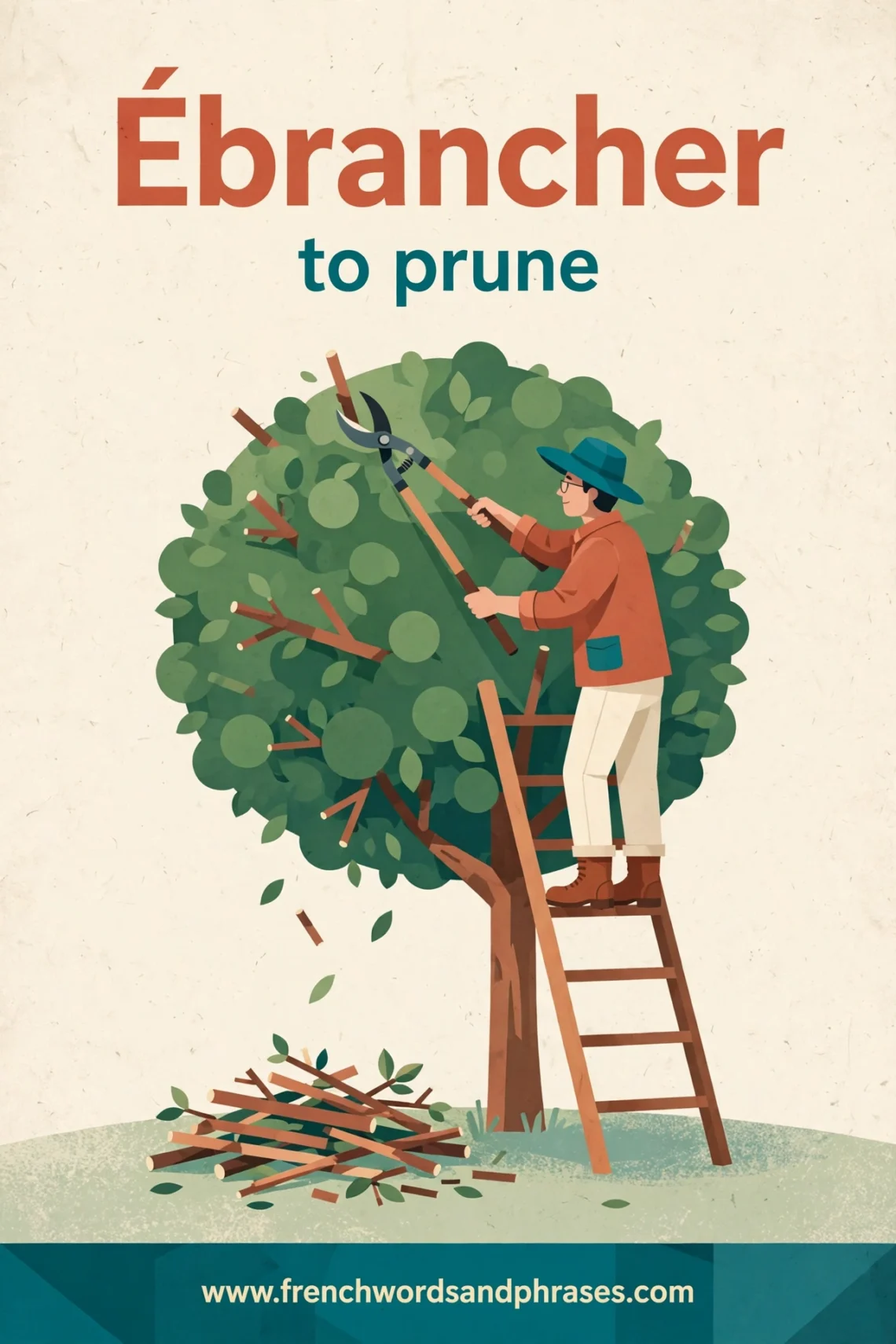
Ébrancher means to prune — to strip a tree of its branches, or a felled trunk of every branch it grew.
A ladder against an apple tree, the saw’s clean bite, branches falling one by one onto the grass — ébrancher is the verb of taking the branches off, whether the tree stays standing in the orchard or lies felled in the forest.
In this guide, you’ll learn how to conjugate ébrancher in all the major French tenses and moods. Explore complete conjugation tables, French examples, English translations, and practice quizzes.
Understanding the French Verb Ébrancher
Ébrancher is a regular French verb belonging to the first group of verbs, those ending in -er.
It means to prune. It is commonly used in orchards for lopping the branches of fruit trees, along roads and in gardens for clearing trees of dead or crowded wood, and in forestry for delimbing felled trunks before transport — anywhere branches come off, one by one or all at once.
Verb classification: First group (-er)
Auxiliary verb: Avoir
Past participle: ébranché
Present participle: ébranchant
English equivalents: To prune, to lop off branches, to delimb; la branche — the branch; l’ébranchage — lopping, delimbing.
One important detail: ébrancher is la branche, the branch, with the removing prefix é- — branch-removal, nothing hidden. Forestry gives the verb its industrial sense: ébrancher un tronc is to delimb a felled tree, stripping every branch so the bare trunk can travel to the sawmill, and the work is l’ébranchage. Its close cousin élaguer prunes more selectively, shaping a standing tree; ébrancher takes the branches off wholesale. The conjugation is regular: j’ébranche, nous ébranchons.
Experience the Word
Ébrancher is the verb of the tree made simple — crown, thicket and tangle reduced to a clean trunk and a pile of branches.
Imagine a winter orchard in Normandy, the trees black against a white sky. The pruners move from tree to tree with saw and ladder, ébranchant the crowded crowns, and by evening each apple tree stands open like a hand — ready for light, air and fruit.
The trees have not been diminished. They have been ébranchés — pruned, cleared, given back their shape.
How to Conjugate Ébrancher: Complete French Conjugation Guide
Let’s explore every major conjugation of ébrancher, beginning with the indicative mood.
How to Conjugate Ébrancher in the Indicative Mood
The indicative mood is used to express facts, observations, actions, and events.
How to Conjugate Ébrancher in the Present Tense (Présent)
Used for actions happening now, habitual actions, and general truths.
| Subject | Conjugation |
|---|---|
| je | ébranche |
| tu | ébranches |
| il / elle | ébranche |
| nous | ébranchons |
| vous | ébranchez |
| ils / elles | ébranchent |
Example
Le jardinier ébranche les pommiers en hiver.
The gardener prunes the apple trees in winter.
Quick Quiz 1
Complete the sentence:
Nous ______ les pommiers en hiver.
Reveal the answer
ébranchons
Nous ébranchons les pommiers en hiver.
We prune the apple trees in winter.
How to Conjugate Ébrancher in the Passé Composé
Used for completed actions in the past. Ébrancher takes the auxiliary verb avoir.
| Subject | Conjugation |
|---|---|
| j’ | ai ébranché |
| tu | as ébranché |
| il / elle | a ébranché |
| nous | avons ébranché |
| vous | avez ébranché |
| ils / elles | ont ébranché |
Example
Les bûcherons ont ébranché les troncs avant de les charger.
The lumberjacks delimbed the trunks before loading them.
How to Conjugate Ébrancher in the Imparfait (Imperfect Tense)
Used for habitual past actions, descriptions, and ongoing situations in the past.
| Subject | Conjugation |
|---|---|
| je | ébranchais |
| tu | ébranchais |
| il / elle | ébranchait |
| nous | ébranchions |
| vous | ébranchiez |
| ils / elles | ébranchaient |
Example
Autrefois, on ébranchait les chênes à la hache.
In the old days, people used to lop the oaks with an axe.
Quick Quiz 2
Choose the correct form:
They pruned the whole orchard.
Ils ______ tout le verger. (ont ébranché / sont ébranchés)
Reveal the answer
ont ébranché
Ils ont ébranché tout le verger.
Ébrancher takes avoir.
How to Conjugate Ébrancher in the Plus-que-parfait
Used to describe an action that had already been completed before another past event.
| Subject | Conjugation |
|---|---|
| j’ | avais ébranché |
| tu | avais ébranché |
| il / elle | avait ébranché |
| nous | avions ébranché |
| vous | aviez ébranché |
| ils / elles | avaient ébranché |
Example
Il avait ébranché le vieux noyer avant la tempête.
He had pruned the old walnut tree before the storm.
How to Conjugate Ébrancher in the Passé Simple
Primarily used in formal writing, literature, and historical narratives. It is rarely used in everyday conversation.
| Subject | Conjugation |
|---|---|
| je | ébranchai |
| tu | ébranchas |
| il / elle | ébrancha |
| nous | ébranchâmes |
| vous | ébranchâtes |
| ils / elles | ébranchèrent |
Example
L’équipe ébrancha les peupliers le long de la route.
The team lopped the poplars along the road.
How to Conjugate Ébrancher in the Passé Antérieur
A literary tense used to express an action completed immediately before another past action, generally in the passé simple.
| Subject | Conjugation |
|---|---|
| j’ | eus ébranché |
| tu | eus ébranché |
| il / elle | eut ébranché |
| nous | eûmes ébranché |
| vous | eûtes ébranché |
| ils / elles | eurent ébranché |
Example
Quand ils eurent ébranché le dernier tronc, le camion partit.
When they had delimbed the last trunk, the truck left.
How to Conjugate Ébrancher in the Future Tense (Futur Simple)
Used to describe actions that will take place in the future.
| Subject | Conjugation |
|---|---|
| je | ébrancherai |
| tu | ébrancheras |
| il / elle | ébranchera |
| nous | ébrancherons |
| vous | ébrancherez |
| ils / elles | ébrancheront |
Example
Demain, nous ébrancherons le cerisier du fond.
Tomorrow, we will prune the cherry tree at the back.
How to Conjugate Ébrancher in the Futur Antérieur (Future Perfect)
Used for an action that will have been completed before a particular point in the future.
| Subject | Conjugation |
|---|---|
| j’ | aurai ébranché |
| tu | auras ébranché |
| il / elle | aura ébranché |
| nous | aurons ébranché |
| vous | aurez ébranché |
| ils / elles | auront ébranché |
Example
À la fin de la semaine, ils auront ébranché tout le verger.
By the end of the week, they will have pruned the whole orchard.
How to Conjugate Ébrancher in the Near Future (Futur Proche)
Used to describe something that is going to happen soon. Formed with aller + infinitive.
| Subject | Conjugation |
|---|---|
| je | vais ébrancher |
| tu | vas ébrancher |
| il / elle | va ébrancher |
| nous | allons ébrancher |
| vous | allez ébrancher |
| ils / elles | vont ébrancher |
Example
Je vais ébrancher ce rosier grimpant, il étouffe la fenêtre.
I am going to prune this climbing rose, it is smothering the window.
How to Conjugate Ébrancher in the Conditional Mood
The conditional mood expresses what would happen under certain circumstances. It is also frequently used to make polite requests or express wishes.
How to Conjugate Ébrancher in the Present Conditional
| Subject | Conjugation |
|---|---|
| je | ébrancherais |
| tu | ébrancherais |
| il / elle | ébrancherait |
| nous | ébrancherions |
| vous | ébrancheriez |
| ils / elles | ébrancheraient |
Example
Avec une tronçonneuse, on ébrancherait ces troncs en une heure.
With a chainsaw, we would delimb these trunks in an hour.
How to Conjugate Ébrancher in the Past Conditional
| Subject | Conjugation |
|---|---|
| j’ | aurais ébranché |
| tu | aurais ébranché |
| il / elle | aurait ébranché |
| nous | aurions ébranché |
| vous | auriez ébranché |
| ils / elles | auraient ébranché |
Example
Ils auraient ébranché le noyer si l’échelle avait été assez haute.
They would have pruned the walnut tree if the ladder had been tall enough.
Ébrancher in the Literary Past Conditional Form
This less common literary form uses the imperfect subjunctive of avoir.
| Subject | Conjugation |
|---|---|
| j’ | eusse ébranché |
| tu | eusses ébranché |
| il / elle | eût ébranché |
| nous | eussions ébranché |
| vous | eussiez ébranché |
| ils / elles | eussent ébranché |
Example
Le bûcheron eût ébranché le chêne centenaire.
The lumberjack would have lopped the hundred-year-old oak.
How to Conjugate Ébrancher in the Subjunctive Mood
The subjunctive is used to express wishes, emotions, doubts, necessity, and uncertainty. It frequently follows expressions such as il faut que (it is necessary that) or bien que (although).
How to Conjugate Ébrancher in the Present Subjunctive
| Subject | Conjugation |
|---|---|
| que je | ébranche |
| que tu | ébranches |
| qu’il / qu’elle | ébranche |
| que nous | ébranchions |
| que vous | ébranchiez |
| qu’ils / qu’elles | ébranchent |
Example
Il faut que tu ébranches ce pommier avant le printemps.
You must prune this apple tree before spring.
Quick Quiz 3
Complete the sentence using the subjunctive:
Il faut que vous ______ le verger à temps.
Reveal the answer
ébranchiez
Il faut que vous ébranchiez le verger à temps.
You must prune the orchard in time.
How to Conjugate Ébrancher in the Imperfect Subjunctive
A literary tense, rarely encountered in modern spoken French.
| Subject | Conjugation |
|---|---|
| que je | ébranchasse |
| que tu | ébranchasses |
| qu’il / qu’elle | ébranchât |
| que nous | ébranchassions |
| que vous | ébranchassiez |
| qu’ils / qu’elles | ébranchassent |
Example
Le propriétaire voulait que l’équipe ébranchât les tilleuls en janvier.
The owner wanted the team to lop the lime trees in January.
How to Conjugate Ébrancher in the Pluperfect Subjunctive
A literary construction used to express an action completed before another past action.
| Subject | Conjugation |
|---|---|
| que j’ | eusse ébranché |
| que tu | eusses ébranché |
| qu’il / qu’elle | eût ébranché |
| que nous | eussions ébranché |
| que vous | eussiez ébranché |
| qu’ils / qu’elles | eussent ébranché |
Example
On voyait qu’ils eussent ébranché les troncs au cordeau.
You could see they had delimbed the trunks with precision.
How to Conjugate Ébrancher in the Past Subjunctive
| Subject | Conjugation |
|---|---|
| que j’ | aie ébranché |
| que tu | aies ébranché |
| qu’il / qu’elle | ait ébranché |
| que nous | ayons ébranché |
| que vous | ayez ébranché |
| qu’ils / qu’elles | aient ébranché |
Example
Je suis ravi que vous ayez ébranché le verger à temps.
I am delighted you pruned the orchard in time.
How to Conjugate Ébrancher in the Imperative
The imperative is used to give commands, instructions, invitations, or suggestions. Subject pronouns are omitted.
How to Conjugate Ébrancher in the Present Imperative
| Person | Conjugation |
|---|---|
| (tu) | ébranche |
| (nous) | ébranchons |
| (vous) | ébranchez |
Example
Ébranche ce cerisier, mais épargne la branche du milieu !
Prune this cherry tree, but spare the middle branch!
Quick Quiz 4
How would you say Prune this cherry tree (tu form)?
Reveal the answer
Ébranche ce cerisier !
French Participles of Ébrancher
Participles are verb forms that can be used in compound tenses and other grammatical constructions.
Present Participle of Ébrancher
ébranchant
En ébranchant le noyer, il a découvert un nid vide.
While pruning the walnut tree, he found an empty nest.
Past Participle of Ébrancher
ébranché
Ébranchés en hiver, les pommiers fleurissent mieux au printemps.
Pruned in winter, the apple trees blossom better in spring.
Ébrancher in Everyday French: Real-Life Examples
Now that you know the conjugations, let’s see how ébrancher appears in everyday French.
Example 1 — Present
On ébranche les arbres fruitiers en hiver.
We prune the fruit trees in winter.
Example 2 — Passé composé
Ils ont ébranché les peupliers de la route.
They lopped the poplars along the road.
Example 3 — Imparfait
Le forestier ébranchait les troncs à la hache.
The forester used to delimb the trunks with an axe.
Example 4 — Future
Nous ébrancherons le vieux noyer samedi.
We will prune the old walnut tree on Saturday.
Example 5 — Conditional
J’ébrancherais ce cerisier s’il faisait moins froid.
I would prune this cherry tree if it were less cold.
Example 6 — Imperative
Ébranchez les troncs avant de les charger !
Delimb the trunks before loading them!
Beyond Translation: The Meaning of Ébrancher
English splits the work between prune, lop and the forester’s delimb; French ébrancher covers the whole family with one transparent word — branches off.
It belongs to the great é- family of removals.
Ébourgeonner takes the buds, ébrancher takes the branches, écorcer takes the bark: French gardening is a vocabulary of careful subtraction.
How to Remember the French Verb Ébrancher
Remember it this way: Ébrancher is about branches off — the tree made simple, in orchard and forest.
- La branche — the branch; é- removes it: ébrancher is branch-removal, in orchard and forest.
- Ébrancher un tronc — to delimb a felled trunk; l’ébranchage — the delimbing itself.
- Regular -er: j’ébranche, nous ébranchons, past participle ébranché.
The key idea is branches off — the tree made simple, in orchard and forest.
Test Your Knowledge of Ébrancher
Let’s see how much you’ve learned. Try answering these questions before revealing the answers.
Question 1
What is une branche?
Reveal the answer
A branch — the part ébrancher removes.
Question 2
How do you say We prune the fruit trees in winter in French?
Reveal the answer
On ébranche les arbres fruitiers en hiver.
Question 3
Translate: They lopped the poplars along the road.
Reveal the answer
Ils ont ébranché les peupliers de la route.
Question 4
What is the past participle of ébrancher?
Reveal the answer
Ébranché.
Question 5
Complete the sentence:
Il faut que tu ______ ce pommier avant le printemps.
Reveal the answer
ébranches
Il faut que tu ébranches ce pommier avant le printemps.
You must prune this apple tree before spring.
Your Final Challenge
Can You Use It?
How would you say this in French?
In winter, the gardener prunes the apple trees, and the orchard breathes while waiting for the blossom.
Reveal the answer
En hiver, le jardinier ébranche les pommiers, et le verger respire en attendant les fleurs.
In winter, the gardener prunes the apple trees, and the orchard breathes while waiting for the blossom.
A little French. A little curiosity. A richer everyday life.
LEARN FRENCH ONE WORD AT A TIME