
A French Word to Live By
Translate Dur to English
/dyʁ/
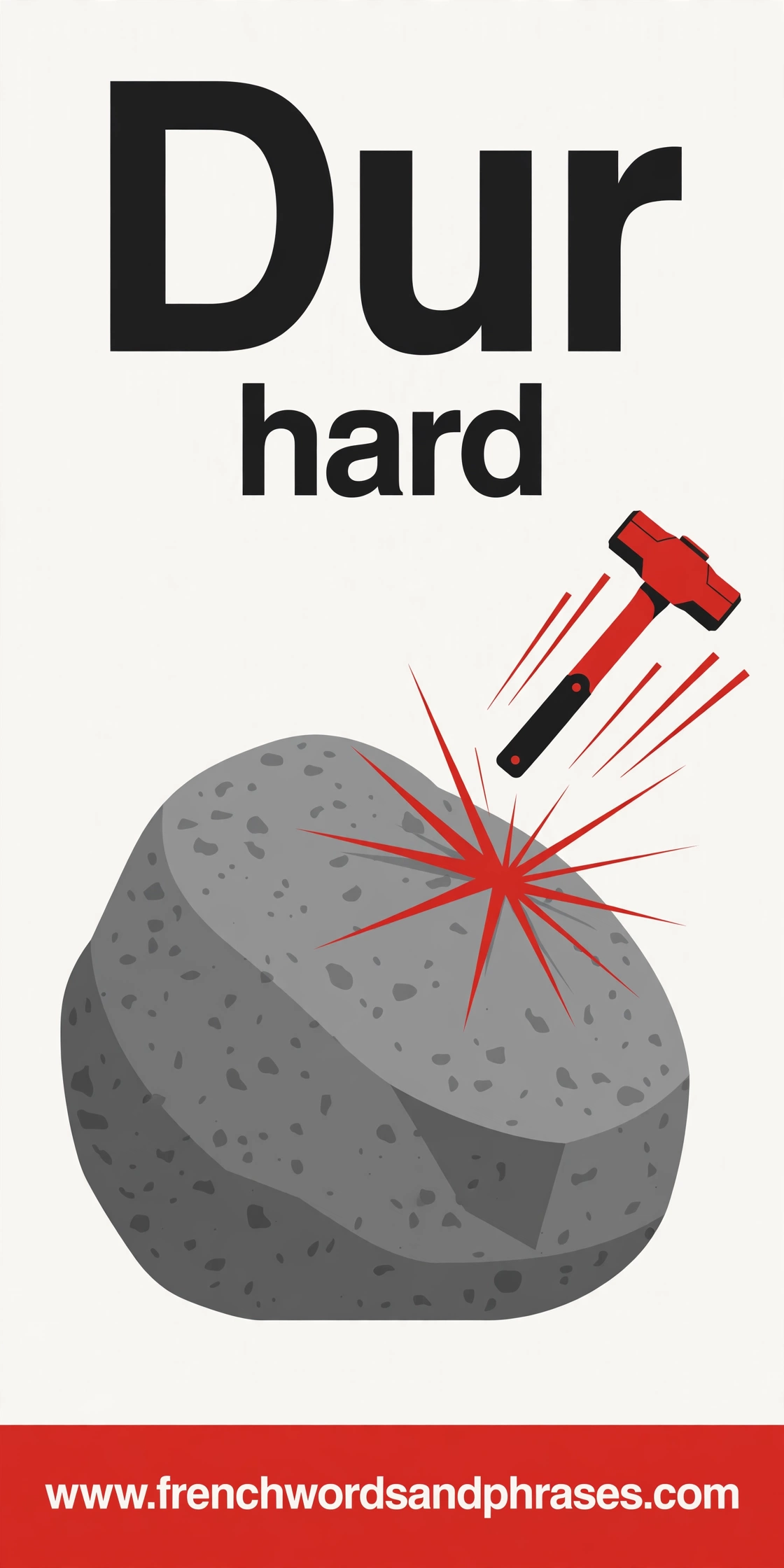
Dur means hard.
The little boy knocks on the frozen lake with his boot, then looks up, delighted: « C’est dur comme de la pierre ! » — It is hard as stone. Dur is the adjective of resistance: what does not yield — hard bread, hard work, a hard winter, a hard heart.
In this guide, you’ll learn what dur means in English, how its feminine dure is formed, where it stands in the sentence, and how one small word covers hard objects, hard times and hard people. Explore French examples, English translations, and practice quizzes.
Understanding the French Adjective Dur
Dur is a French adjective of quality, from the Latin durus, hard, harsh. It stands after the noun: un pain dur, stale hard bread; un travail dur, hard work. Its feminine is dure — dur simply takes an -e, and the sound stays the same, which makes it one of the friendliest agreements in French.
It means hard — hard to the touch (un lit dur, a hard bed; un œuf dur, a hard-boiled egg), hard to bear (un hiver dur, a hard winter; des temps durs, hard times), and hard in character (un homme dur, a hard man; un cœur dur, a hard heart). One word walks from the bakery to the biography without changing its coat.
Type: Adjective of quality — hardness of things, times and people
Answers the question: Comment ? — What is it like? (Answer: hard, resistant, unyielding)
Changes form: dur / dure; durs / dures — the feminine just adds -e
English equivalents: Hard; tough; harsh; stale (for bread).
One important usage detail: dur is also an adverb in disguise — travailler dur means to work hard, frapper dur to hit hard; there the word never changes, even for a woman: elle travaille dur. And watch the egg: un œuf dur is hard-boiled — order un œuf dur and no one will bring you a tough egg, they will bring you a boiled one.
Experience the Word
Dur is the adjective of the world’s resistance — everything that pushes back when you push it.
Imagine the old mason testing a stone with his thumb, then his hammer: « Celle-là est dure, elle tiendra cent ans. » That one is hard, it will last a hundred years. In his mouth, dur is not a complaint — it is the highest praise a material can earn.
You have not just described a surface. You have measured what a thing can withstand — and dur is the measure.
How to Use Dur in French: Complete Guide
Let’s explore how dur works in French, beginning with the whole word on one card.
Dur at a Glance
Before the details, here is the whole word on one card.
The Whole Word on One Card
Meaning, type, position and forms — dur in four lines.
| Point | Dur |
|---|---|
| Meaning | hard — to the touch, to bear, or in character |
| Type | adjective of quality — resistance and difficulty |
| Usual position | after the noun — un travail dur |
| Form | dur for him, dure for her — the sound never changes |
Example
Ce pain est dur comme une pierre.
This bread is hard as a stone.
The Four Forms of Dur
Dur is a gentle agreer: add -e for the feminine, -s for the plural, and nothing moves in the sound.
| Form | Dur | Example |
|---|---|---|
| Masculine singular | dur | un hiver dur — a hard winter |
| Feminine singular | dure | une vie dure — a hard life |
| Masculine plural | durs | des temps durs — hard times |
| Feminine plural | dures | des journées dures — hard days |
Example
Après des journées dures, le repos est doux.
After hard days, rest is sweet.
Quick Quiz 1
What is the feminine of dur?
Reveal the answer
dure
Une pierre dure — just add -e; the sound does not change.
A hard stone.
The Feminine of Dur: Dure
Dur belongs to the easy family: its feminine is the masculine plus -e, and the two forms sound identical.
| Situation | Example |
|---|---|
| Masculine | un sol dur — hard ground |
| Feminine | une terre dure — hard earth |
| Why | dur ends in a consonant that is already pronounced, so -e changes nothing in the sound |
| The plural | dures — des conditions dures, hard conditions |
Example
La terre est dure en été, impossible à creuser.
The ground is hard in summer, impossible to dig.
Where Dur Goes: After the Noun
Dur follows the noun it describes, like most French adjectives of quality, and it sits naturally after être.
| Pattern | Example |
|---|---|
| After the noun | un lit dur — a hard bed |
| After être | ce pain est dur — this bread is hard (stale) |
| As an adverb (no change) | travailler dur — to work hard |
| Before the noun | only in poetry — everyday French keeps dur after |
Example
Elle travaille dur toute la semaine.
She works hard all week.
Quick Quiz 2
How do you say ‘a hard life’ — une dur vie or une vie dure?
Reveal the answer
une vie dure
Dur stands after the noun, and vie is feminine, so dure.
A hard life.
More Dur: Comparing with Dur
Dur compares the regular way, with plus, moins and aussi — a scale of resistance.
| Degree | Example |
|---|---|
| As hard as | aussi dur que — as hard as |
| Harder | plus dur — harder, tougher |
| Less hard | moins dur — less hard |
| The hardest (masc.) | le plus dur — le plus dur des hivers |
| The hardest (fem.) | la plus dure — la plus dure des épreuves |
Example
Rien n’est plus dur que de dire adieu.
Nothing is harder than saying goodbye.
Everyday Expressions with Dur
Dur is everywhere — in the kitchen, at work and in the weather forecast.
| Expression | In English |
|---|---|
| un œuf dur | a hard-boiled egg |
| des temps durs | hard times |
| travailler dur | to work hard |
| dur comme fer | hard as iron — and croire dur comme fer: to firmly believe |
| un coup dur | a hard blow, a setback |
Example
Après ce coup dur, elle a recommencé à zéro.
After that hard blow, she started again from zero.
Quick Quiz 3
What is un œuf dur?
Reveal the answer
A hard-boiled egg — dur here means boiled until hard.
Je voudrais un œuf dur et une salade.
I would like a hard-boiled egg and a salad.
Close Cousins: Dur, Difficile, Mou, Doux
Hard has neighbours on both sides: difficile shares the difficulty, and mou and doux stand on the opposite bank.
| Word | The difference |
|---|---|
| dur | hard — of things, times and hearts |
| difficile | difficult — of tasks and questions: un exercice difficile |
| mou / molle | soft, flabby — the touch opposite of dur |
| doux / douce | soft, gentle, sweet — the kind opposite of dur |
Example
Un exercice difficile le matin, un lit dur le soir : quelle journée !
A difficult exercise in the morning, a hard bed in the evening: what a day!
Watch Out: The Traps Around Dur
The traps: dur as an adverb that must not agree, and difficile reaching for dur’s territory.
| Trap | The truth |
|---|---|
| elle travaille dure (wrong) | as an adverb, dur never changes: elle travaille dur |
| un problème dur | problems are difficile, not dur: un problème difficile — dur is for what resists the hand or the heart |
| hard bread = spoiled bread? | pain dur is stale, gone hard — French wastes no insult on it, it becomes croutons |
| un cœur dur = a strong heart | no — un cœur dur is a hard, unfeeling heart; a strong heart is un cœur solide |
Example
Il a le cœur dur, mais il travaille dur pour ses enfants.
He has a hard heart, but he works hard for his children.
Quick Quiz 4
Complete: Elle chante faux le matin, mais elle travaille ______. (she works hard)
Reveal the answer
dur
As an adverb, dur never changes form — not even for elle.
She works hard.
Dur in Everyday French: Real-Life Examples
Now that you know the word, let’s see how dur appears in everyday French.
Example 1 — Breakfast
Je voudrais un œuf dur, s’il vous plaît.
I would like a hard-boiled egg, please.
Example 2 — Work
Ils travaillent dur pendant la récolte.
They work hard during the harvest.
Example 3 — Winter
L’hiver sera dur cette année, dit le fermier.
The winter will be hard this year, says the farmer.
Example 4 — Bread
Ce pain est dur, faisons des croutons.
This bread is hard, let’s make croutons.
Example 5 — Times
En temps durs, le village se serre les coudes.
In hard times, the village sticks together.
Example 6 — A blow
Perdre son travail est un coup dur.
Losing one’s job is a hard blow.
Beyond Translation: The Meaning of Dur
Dur comes straight from the Latin durus — hard, harsh, unyielding — and French kept every shade of it: the stone, the winter, the master, the times. Where English splits the work between hard, tough, harsh and stale, French trusts one short word and lets the noun do the explaining.
To say dur is to pay respect to resistance — nothing worthwhile, French suggests, comes soft.
It is the adjective of masons and grandmothers: the stone that will last a century, the life that made someone strong — une vie dure, forgée comme le fer.
How to Remember the French Adjective Dur
Remember it this way: Dur means hard — after the noun, feminine dure with no change of sound, and frozen as an adverb in travailler dur.
- It follows the noun — un travail dur, une vie dure.
- The feminine is a whisper — dure adds an -e and changes nothing you can hear.
- As an adverb it freezes — elle travaille dur, never dure.
The key idea is dur / dure = hard; un œuf dur = a hard-boiled egg; travailler dur = to work hard (invariable).
Test Your Knowledge of Dur
Let’s see how much you’ve learned. Try answering these questions before revealing the answers.
Question 1
What does dur mean?
Reveal the answer
Hard — hard to the touch, hard to bear, or hard in character.
Question 2
What is the feminine of dur?
Reveal the answer
Dure — une vie dure, a hard life.
Question 3
Translate: They work hard.
Reveal the answer
Ils travaillent dur.
Question 4
What is the difference between dur and difficile?
Reveal the answer
Dur is hard (things, times, hearts); difficile is difficult (tasks, questions) — un exercice difficile, un hiver dur.
Question 5
Complete the sentence:
Cette pierre est très ______. (hard)
Reveal the answer
dure
Cette pierre est très dure.
This stone is very hard.
Your Final Challenge
Can You Use It?
How would you say this in French?
“They work hard during the harvest.”
Reveal the answer
Ils travaillent dur pendant la récolte.
They work hard during the harvest.
A little French. A little curiosity. A richer everyday life.
LEARN FRENCH ONE WORD AT A TIME




