
A French Word to Live By
Translate Drôle to English
/dʁol/
Drôle means funny.
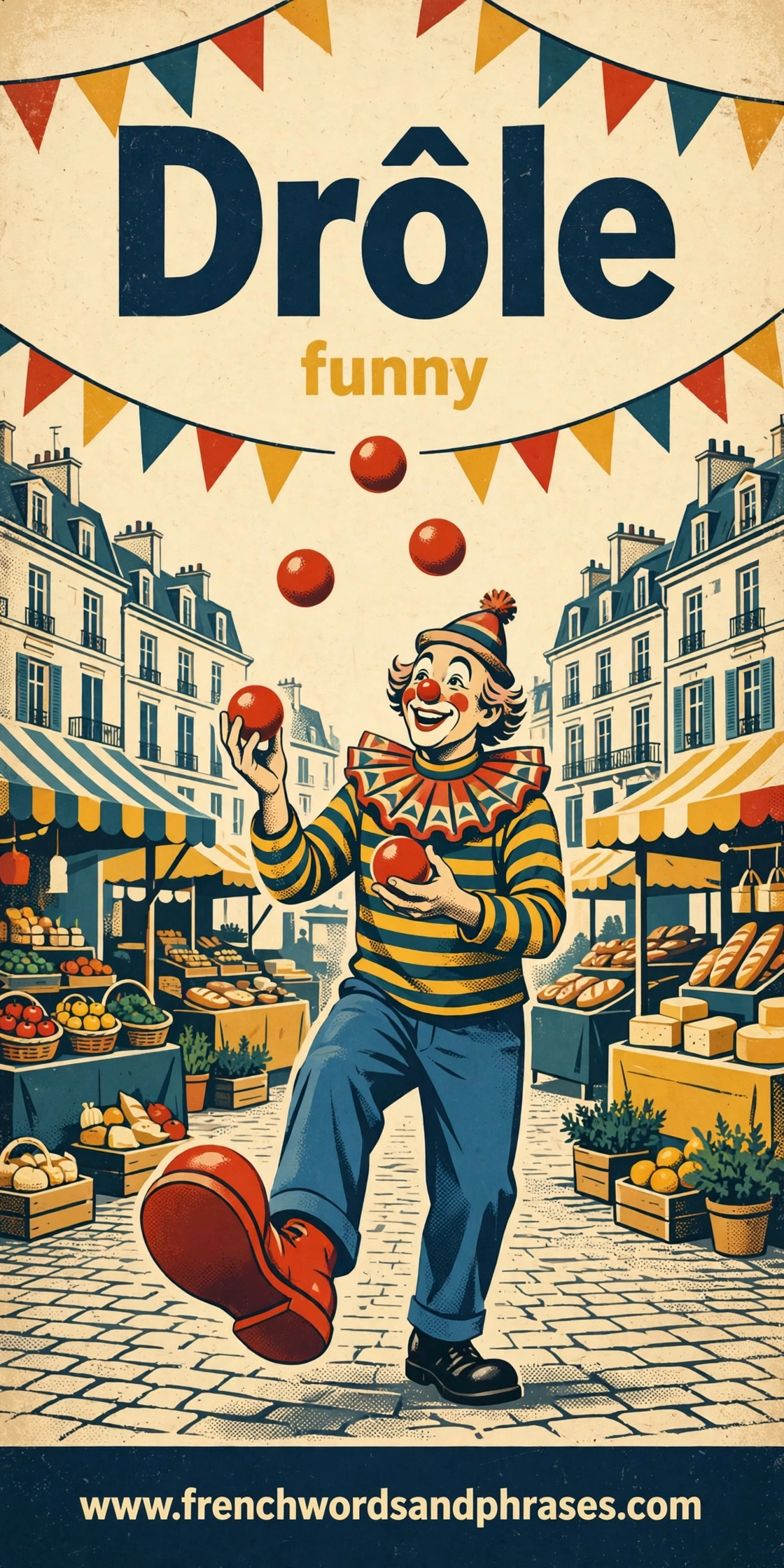
A village fête, a stage of three planks, and a clown whose trousers have just fallen down for the fourth time — and the whole square, from the mayor to the smallest child, is helpless with laughter. French applauds with one word: drôle. But keep the word in your pocket. Tonight, in the attic above the square, something will scratch — and you will need it again, in its other meaning.
In this guide, you’ll learn what drôle means in English, why it never changes between masculine and feminine, how its position splits it into two words — funny after the noun, strange before it — and the phrases French uses for both. Explore French examples, English translations, and practice quizzes.
Understanding the French Adjective Drôle
Drôle is a French adjective of quality — the adjective of laughter, with a second life as the adjective of strangeness. It already ends in -e, so masculine and feminine are identical: un film drôle, une histoire drôle. Only the plural adds an s.
It means funny — un clown drôle, une blague drôle, a joke that works. But placed before a noun with de, it turns: un drôle de bruit, a strange noise; une drôle d’idée, a peculiar idea. English ‘funny’ does exactly the same double duty — funny ha-ha, and funny peculiar — and French trusts you, as English does, to hear which one is meant.
Type: Adjective of quality — humour and strangeness
Answers the question: What is it like? — funny (or odd)
Changes form: Only in the plural — drôle / drôles, the same for masculine and feminine
English equivalents: Funny; amusing; strange, peculiar.
One important usage detail: position splits drôle in two. After the noun it means funny — un film drôle. Before the noun, welded to it with de, it means strange — un drôle de bruit, une drôle d’idée. Learn the pair and you learn the word.
Experience the Word
Drôle is the adjective of the family joker and the midnight noise — half laugh, half raised eyebrow, and it never tells you in advance which half you are getting.
Imagine the attic again: a scratch, a pause, another scratch. Downstairs, someone looks up from their book and says, very quietly, « Un drôle de bruit… ». Nobody laughs. The same word that filled the square an hour ago now empties the room of everything except listening.
You have not just described something. You have raised one eyebrow in a single syllable.
How to Use Drôle in French: Complete Guide
Let’s explore how drôle works in French, beginning with the whole word on one card.
Drôle at a Glance
Before the details, here is the whole word on one card.
The Whole Word on One Card
Meaning, type, position and forms — drôle in four lines.
| Point | Drôle |
|---|---|
| Meaning | funny — and strange |
| Type | adjective of quality — humour |
| Usual position | after the noun = funny; before, with de = strange |
| Form | drôle for everyone — drôles in the plural |
Example
C’est un film très drôle.
It’s a very funny film.
The Four Forms of Drôle
Drôle already ends in -e, so the feminine changes nothing at all. All four forms use the same word — only the plural adds an s.
| Form | Drôle | Example |
|---|---|---|
| Masculine singular | drôle | un clown drôle — a funny clown |
| Feminine singular | drôle | une histoire drôle — a funny story |
| Masculine plural | drôles | des enfants drôles — funny children |
| Feminine plural | drôles | des blagues drôles — funny jokes |
Example
Ses histoires sont drôles et ses enfants sont drôles aussi.
His stories are funny and his children are funny too.
Quick Quiz 1
Does drôle change for a feminine noun?
Reveal the answer
No
Un clown drôle, une histoire drôle — the form is identical.
A funny clown, a funny story.
The Feminine of Drôle: Nothing Changes
Like calme and difficile, drôle was born ending in -e, so the feminine adds nothing. Its circumflex, however, is not decoration: drôle keeps its hat in every form.
| Situation | Example |
|---|---|
| Masculine | un homme drôle — a funny man |
| Feminine | une femme drôle — identical |
| Why | drôle already ends in -e, so the feminine adds nothing |
| The plural | add s — des remarques drôles, funny remarks |
Example
Elle est drôle, tout le monde rit avec elle.
She is funny, everyone laughs with her.
Where Drôle Goes: Two Positions, Two Meanings
This is the heart of the word. Behind the noun, drôle laughs. In front of the noun, joined to it by de, it frowns and wonders. Position is meaning.
| Pattern | Example |
|---|---|
| After the noun = funny | un film drôle — a funny film |
| Before the noun + de = strange | un drôle de bruit — a strange noise |
| Another strange one | une drôle d’idée — a peculiar idea |
| After être | il est drôle — he is funny |
Example
J’ai entendu un drôle de bruit dans le grenier.
I heard a strange noise in the attic.
Quick Quiz 2
In un drôle de bruit, does drôle mean funny or strange?
Reveal the answer
Strange
Before the noun, with de, drôle means peculiar.
Un drôle de bruit — a strange noise.
Funnier Still: Comparing with Drôle
Drôle compares the regular way, with plus, moins and aussi — and the superlative keeps its shape for both genders: le plus drôle, la plus drôle.
| Degree | Example |
|---|---|
| As funny as | aussi drôle que — as funny as |
| Funnier | plus drôle — funnier |
| Less funny | moins drôle — less funny |
| The funniest (masc.) | le plus drôle — le plus drôle des clowns |
| The funniest (fem.) | la plus drôle — la plus drôle des histoires |
Example
Le deuxième film est plus drôle que le premier.
The second film is funnier than the first.
Everyday Expressions with Drôle
Drôle works all day in both its meanings — greeting coincidences, naming odd fellows, and delivering the driest verdict in French comedy: ce n’est pas drôle.
| Expression | In English |
|---|---|
| c’est drôle | that’s funny — or that’s odd; context decides |
| un drôle de + noun | a strange… — un drôle de type, a strange fellow |
| drôle d’idée | a peculiar idea |
| ce n’est pas drôle | that’s not funny — the smile switched off |
| drôlement | really, awfully (informal adverb) — drôlement bon, really good |
| un drôle de nom | a strange name |
Example
C’est drôle, je pensais exactement la même chose.
That’s funny, I was thinking exactly the same thing.
Quick Quiz 3
How do you say ‘That’s funny!’ in French?
Reveal the answer
C’est drôle !
C’est drôle, nous avons le même manteau.
That’s funny, we have the same coat.
Drôle and Its Neighbours
Drôle stands at a crossroads: one road leads to the laughter words, the other to the strangeness words. It keeps a foot in both camps, which is exactly its charm.
| French | In English |
|---|---|
| amusant | amusing — gently funny |
| comique | comic — funny by profession |
| hilarant | hilarious — the laughter at full volume |
| marrant | funny — informal, everyday |
| étrange | strange — the eyebrow without the laugh |
| bizarre | weird, bizarre |
Example
Son spectacle est amusant et parfois hilarant.
His show is amusing and sometimes hilarious.
Watch Out: The Traps Around Drôle
The traps are all about the double meaning: hear the de, watch the plural, and recognise when ‘not funny’ is a serious sentence.
| Trap | The truth |
|---|---|
| Two meanings | after the noun drôle laughs; un drôle de… before it, it means strange |
| Agreement | the plural is drôles — never invent a feminine in -esse |
| ce n’est pas drôle | can be a real protest: stop, that’s not funny, I mean it |
| The circumflex | drôle keeps its hat everywhere — drôle, drôles, drôlement |
Example
Ce n’est pas drôle, je suis vraiment inquiet.
It’s not funny, I’m really worried.
Quick Quiz 4
Une drôle d’idée — a funny-ha-ha idea, or a peculiar idea?
Reveal the answer
A peculiar idea
Before the noun, with de, drôle means strange.
Une drôle d’idée — a peculiar idea.
Drôle in Everyday French: Real-Life Examples
Now that you know the word, let’s see how drôle appears in everyday French.
Example 1 — At the cinema
La comédie est drôle du début à la fin.
The comedy is funny from start to finish.
Example 2 — Family
Mon grand-père est très drôle, il adore les blagues.
My grandfather is very funny, he loves jokes.
Example 3 — A strange noise
Tu entends ce drôle de bruit dans la cuisine ?
Can you hear that strange noise in the kitchen?
Example 4 — A coincidence
C’est drôle, nous avons le même manteau.
That’s funny, we have the same coat.
Example 5 — Children
Les enfants trouvent le clown très drôle.
The children find the clown very funny.
Example 6 — Not funny
Arrête, ce n’est pas drôle.
Stop it, that’s not funny.
Beyond Translation: The Meaning of Drôle
English says funny for the meaning of drôle — and here the two languages shake hands, because English funny does the same double work: funny ha-ha and funny peculiar, with nothing but the voice to tell them apart.
Drôle is the raised eyebrow of French: half laugh, half question, and entirely alive to both.
A language that lets one small word hold laughter and unease at once is not being careless. It is being honest — because in real life, the strange noise in the attic and the clown in the square arrive in the same day, and the eyebrow goes up for both.
How to Remember the French Adjective Drôle
Remember it this way: Drôle is the two-faced charmer — it laughs behind the noun and wonders in front of it, and it never changes its form for anyone.
- You laugh with it after the noun — un film drôle, une histoire drôle.
- You wonder with it before, welded by de — un drôle de bruit.
- You add only an s in the plural — des blagues drôles.
The key idea is drôle after the noun = funny; un drôle de… = a strange….
Test Your Knowledge of Drôle
Let’s see how much you’ve learned. Try answering these questions before revealing the answers.
Question 1
What does drôle mean?
Reveal the answer
Funny — and, before a noun with de, strange or peculiar.
Question 2
What is the feminine of drôle?
Reveal the answer
drôle — identical. The word already ends in -e.
Question 3
Translate: a funny story.
Reveal the answer
Une histoire drôle.
Question 4
Complete the sentence:
J’ai entendu un ______ de bruit dans le grenier.
Reveal the answer
drôle
J’ai entendu un drôle de bruit dans le grenier.
I heard a strange noise in the attic.
Question 5
What is the plural of drôle?
Reveal the answer
drôles — just add an s.
Your Final Challenge
Can You Use It?
How would you say this in French?
“This film is funny, but that strange noise is not funny.”
Reveal the answer
Ce film est drôle, mais ce drôle de bruit n’est pas drôle.
This film is funny, but that strange noise is not funny.
A little French. A little curiosity. A richer everyday life.
LEARN FRENCH ONE WORD AT A TIME




