A French Word to Live By
How to Conjugate Juger in French
/ʒy.ʒe/
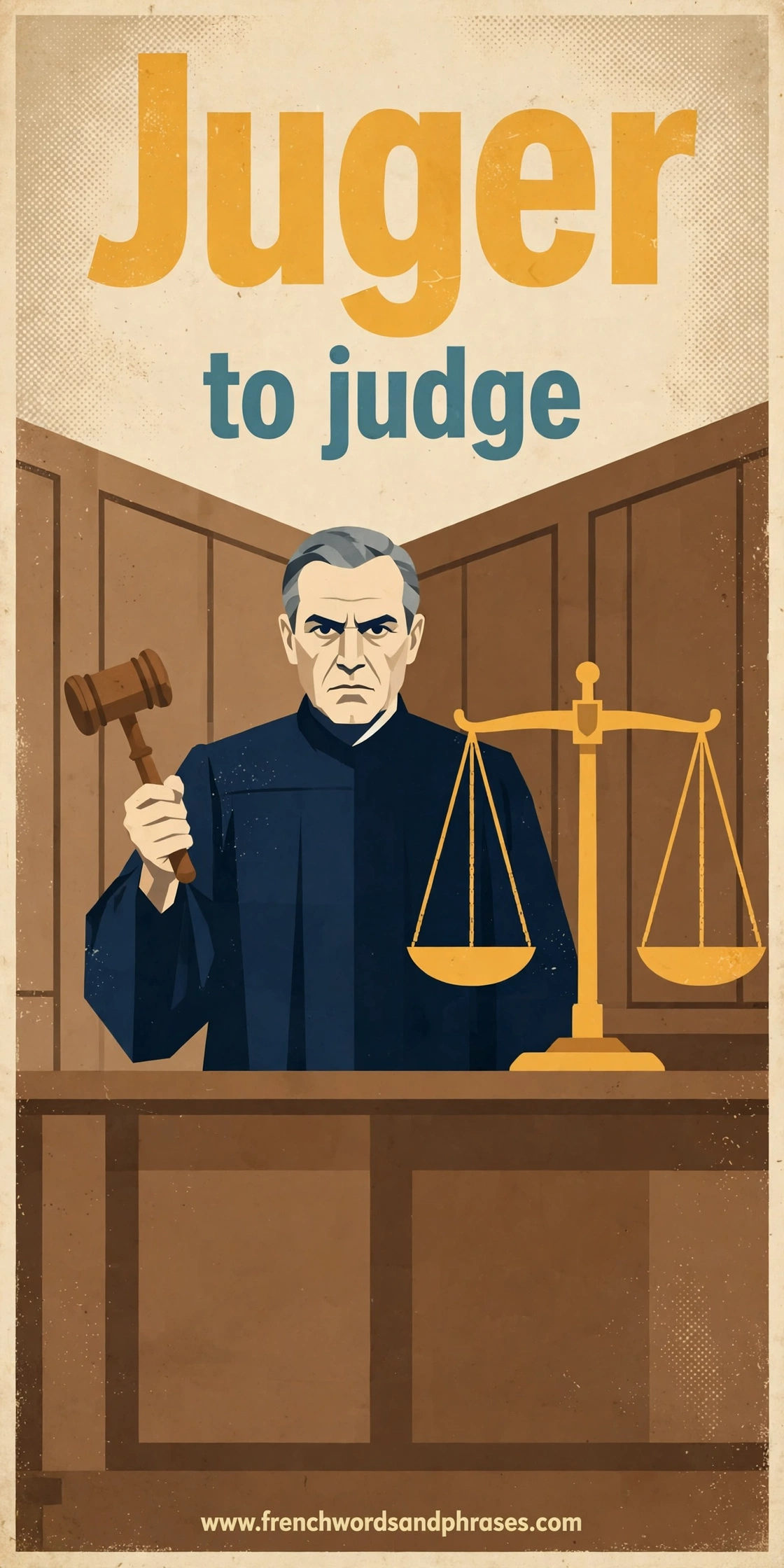
Juger means to judge — in court, where a judge decides a case; in life, where everyone weighs everyone; and in the mind, where juger bon, juger utile mean to think it right, to deem it wise.
A magistrate reading a dossier, a cook tasting a sauce, a friend listening to both sides before speaking — juger is the verb of the weighed verdict, solemn in the courtroom and constant in the kitchen.
In this guide, you’ll learn how to conjugate juger in all the major French tenses and moods. Explore complete conjugation tables, French examples, English translations, and practice quizzes.
Understanding the French Verb Juger
Juger is a regular French verb belonging to the first group of verbs, those ending in-er.
It means to judge. Its everyday centre is evaluation: juger un livre, juger un vin, juger la situation — and the warning against haste: il ne faut pas juger sur les apparences, one must not judge by appearances. The construction juger de is the connoisseur’s: juger d’un tableau, to judge a painting. And the courtroom sense is exact: juger un homme, to try a man; être jugé, to stand trial.
Verb classification: First group (-er)
Auxiliary verb: Avoir
Past participle: jugé
Present participle: jugeant
English equivalents: To judge, to try (a case), to deem; juger un accusé — to try an accused; juger de quelque chose — to judge of something; juger bon de — to think fit to; à en juger par — judging by.
One important detail: juger is a -ger verb — it keeps its e before a and o so the g stays soft: nous jugeons, je jugeais, en jugeant. Before e and i the g softens on its own: je juge, nous jugions. Its past participle is jugé, and its family is proud: un juge, a judge; un jugement, a judgement.
Experience the Word
Juger is the verb of the scales — evidence on one side, mercy on the other, and a human hand holding the beam.
Imagine the village mayor asked to settle the quarrel of two neighbours over a hedge, a fence and twenty years of small grievances. He walks the boundary, listens to both gardens, asks three questions and says little. Il juge lentement, parce qu’il sait qu’un jugement divise ou répare — he judges slowly, because he knows a judgement divides or repairs. The village accepts his word because it was weighed, not thrown.
Slow scales, fair weights. That is juger — judgement as a craft, not a reflex.
How to Conjugate Juger: Complete French Conjugation Guide
Let’s explore every major conjugation of juger, beginning with the indicative mood.
How to Conjugate Juger in the Indicative Mood
The indicative mood is used to express facts, observations, actions, and events.
How to Conjugate Juger in the Present Tense (Présent)
Used for actions happening now, habitual actions, and general truths.
| Subject | Conjugation |
|---|---|
| je | juge |
| tu | juges |
| il / elle | juge |
| nous | jugeons |
| vous | jugez |
| ils / elles | jugent |
Example
Le tribunal juge l’affaire cette semaine.
The court is trying the case this week.
Quick Quiz 1
Complete the sentence:
Nous ______ l’affaire demain matin.
Reveal the answer
jugeons
Nous jugeons l’affaire demain matin.
We are trying the case tomorrow morning — jugeons keeps the e.
How to Conjugate Juger in the Passé Composé
Used for completed actions in the past. Juger takes the auxiliary verb avoir.
| Subject | Conjugation |
|---|---|
| j’ | ai jugé |
| tu | as jugé |
| il / elle | a jugé |
| nous | avons jugé |
| vous | avez jugé |
| ils / elles | ont jugé |
Example
Nous avons jugé ce vin excellent.
We judged this wine excellent.
How to Conjugate Juger in the Imparfait (Imperfect Tense)
Used for habitual past actions, descriptions, and ongoing situations in the past.
| Subject | Conjugation |
|---|---|
| je | jugeais |
| tu | jugeais |
| il / elle | jugeait |
| nous | jugions |
| vous | jugiez |
| ils / elles | jugeaient |
Example
Autrefois, on jugeait les gens sur leur accent.
In the old days, people judged others by their accent.
Quick Quiz 2
Choose the correct form:
We judged this wine excellent.
Nous avons ______ ce vin excellent. (jugé / jugeons)
Reveal the answer
jugé
Nous avons jugé ce vin excellent.
The past participle of juger is jugé.
How to Conjugate Juger in the Plus-que-parfait
Used to describe an action that had already been completed before another past event.
| Subject | Conjugation |
|---|---|
| j’ | avais jugé |
| tu | avais jugé |
| il / elle | avait jugé |
| nous | avions jugé |
| vous | aviez jugé |
| ils / elles | avaient jugé |
Example
Elle avait jugé la situation dangereuse.
She had judged the situation dangerous.
How to Conjugate Juger in the Passé Simple
Primarily used in formal writing, literature, and historical narratives. It is rarely used in everyday conversation.
| Subject | Conjugation |
|---|---|
| je | jugeai |
| tu | jugeas |
| il / elle | jugea |
| nous | jugeâmes |
| vous | jugeâtes |
| ils / elles | jugeèrent |
Example
Le roi jugea l’affaire en personne.
The king judged the case in person.
How to Conjugate Juger in the Passé Antérieur
A literary tense used to express an action completed immediately before another past action, generally in the passé simple.
| Subject | Conjugation |
|---|---|
| j’ | eus jugé |
| tu | eus jugé |
| il / elle | eut jugé |
| nous | eûmes jugé |
| vous | eûtes jugé |
| ils / elles | eurent jugé |
Example
Quand le jury eut jugé l’accusé, la salle se tut.
When the jury had judged the accused, the room fell silent.
How to Conjugate Juger in the Future Tense (Futur Simple)
Used to describe actions that will take place in the future.
| Subject | Conjugation |
|---|---|
| je | jugerai |
| tu | jugeras |
| il / elle | jugera |
| nous | jugerons |
| vous | jugerez |
| ils / elles | jugeront |
Example
L’histoire jugera ses décisions.
History will judge his decisions.
How to Conjugate Juger in the Futur Antérieur (Future Perfect)
Used for an action that will have been completed before a particular point in the future.
| Subject | Conjugation |
|---|---|
| j’ | aurai jugé |
| tu | auras jugé |
| il / elle | aura jugé |
| nous | aurons jugé |
| vous | aurez jugé |
| ils / elles | auront jugé |
Example
À la fin du procès, ils auront jugé dix témoins.
By the end of the trial, they will have judged ten witnesses.
How to Conjugate Juger in the Near Future (Futur Proche)
Used to describe something that is going to happen soon. Formed with aller + infinitive.
| Subject | Conjugation |
|---|---|
| je | vais juger |
| tu | vas juger |
| il / elle | va juger |
| nous | allons juger |
| vous | allez juger |
| ils / elles | vont juger |
Example
Le jury va juger l’affaire demain.
The jury is going to try the case tomorrow.
How to Conjugate Juger in the Conditional Mood
The conditional mood expresses what would happen under certain circumstances. It is also frequently used to make polite requests or express wishes.
How to Conjugate Juger in the Present Conditional
| Subject | Conjugation |
|---|---|
| je | jugerais |
| tu | jugerais |
| il / elle | jugerait |
| nous | jugerions |
| vous | jugeriez |
| ils / elles | jugeraient |
Example
Je jugerais plus doucement à ta place.
I would judge more gently in your place.
How to Conjugate Juger in the Past Conditional
| Subject | Conjugation |
|---|---|
| j’ | aurais jugé |
| tu | aurais jugé |
| il / elle | aurait jugé |
| nous | aurions jugé |
| vous | auriez jugé |
| ils / elles | auraient jugé |
Example
Il aurait jugé autrement avec ces preuves.
He would have judged otherwise with this evidence.
Juger in the Literary Past Conditional Form
This less common literary form uses the imperfect subjunctive of avoir.
| Subject | Conjugation |
|---|---|
| j’ | eusse jugé |
| tu | eusses jugé |
| il / elle | eût jugé |
| nous | eussions jugé |
| vous | eussiez jugé |
| ils / elles | eussent jugé |
Example
Les anciens eussent jugé ce crime avec sévérité.
The ancients would have judged this crime severely.
How to Conjugate Juger in the Subjunctive Mood
The subjunctive is used to express wishes, emotions, doubts, necessity, and uncertainty. It frequently follows expressions such as il faut que (it is necessary that) or bien que (although).
How to Conjugate Juger in the Present Subjunctive
| Subject | Conjugation |
|---|---|
| que je | juge |
| que tu | juges |
| qu’il / qu’elle | juge |
| que nous | jugions |
| que vous | jugiez |
| qu’ils / qu’elles | jugent |
Example
Il faut que le jury juge en toute indépendance.
The jury must judge in complete independence.
Quick Quiz 3
Complete the sentence using the subjunctive:
Il faut que le jury ______ en toute indépendance.
Reveal the answer
juge
Il faut que le jury juge en toute indépendance.
The jury must judge in complete independence.
How to Conjugate Juger in the Imperfect Subjunctive
A literary tense, rarely encountered in modern spoken French.
| Subject | Conjugation |
|---|---|
| que je | jugasse |
| que tu | jugasses |
| qu’il / qu’elle | jugât |
| que nous | jugassions |
| que vous | jugassiez |
| qu’ils / qu’elles | jugassent |
Example
Je craignais qu’elle jugeât trop vite.
I feared she might judge too quickly.
How to Conjugate Juger in the Pluperfect Subjunctive
A literary construction used to express an action completed before another past action.
| Subject | Conjugation |
|---|---|
| que j’ | eusse jugé |
| que tu | eusses jugé |
| qu’il / qu’elle | eût jugé |
| que nous | eussions jugé |
| que vous | eussiez jugé |
| qu’ils / qu’elles | eussent jugé |
Example
On regrettait qu’ils eussent jugé sans preuves.
People regretted that they had judged without proof.
How to Conjugate Juger in the Past Subjunctive
| Subject | Conjugation |
|---|---|
| que j’ | aie jugé |
| que tu | aies jugé |
| qu’il / qu’elle | ait jugé |
| que nous | ayons jugé |
| que vous | ayez jugé |
| qu’ils / qu’elles | aient jugé |
Example
Je suis heureux que tu aies jugé par toi-même.
I am glad you judged for yourself.
How to Conjugate Juger in the Imperative
The imperative is used to give commands, instructions, invitations, or suggestions. Subject pronouns are omitted.
How to Conjugate Juger in the Present Imperative
| Person | Conjugation |
|---|---|
| (tu) | juge |
| (nous) | jugeons |
| (vous) | jugez |
Example
Ne juge pas sans écouter les deux côtés !
Do not judge without hearing both sides!
Quick Quiz 4
How would you say Do not judge without hearing both sides (tu form)?
Reveal the answer
Ne juge pas sans écouter les deux côtés !
French Participles of Juger
Participles are verb forms that can be used in compound tenses and other grammatical constructions.
Present Participle of Juger
jugeant
En jugeant ce tableau, elle a montré son œil sûr.
In judging this painting, she showed her sure eye.
Past Participle of Juger
jugé
Jugé coupable, il a accepté la sentence en silence.
Judged guilty, he accepted the sentence in silence.
Juger in Everyday French: Real-Life Examples
Now that you know the conjugations, let’s see how juger appears in everyday French.
Example 1 — Present
Le tribunal juge l’affaire cette semaine.
The court is trying the case this week.
Example 2 — Passé composé
Nous avons jugé ce vin excellent.
We judged this wine excellent.
Example 3 — Imparfait
On jugeait les gens sur leur accent, autrefois.
People used to judge others by their accent.
Example 4 — Future
L’histoire jugera ses décisions.
History will judge his decisions.
Example 5 — Conditional
Je jugerais plus doucement à ta place.
I would judge more gently in your place.
Example 6 — Imperative
Ne juge pas sans écouter les deux côtés !
Do not judge without hearing both sides!
Beyond Translation: The Meaning of Juger
Juger descends from the Latin judicare — jus, the law, plus dicere, to say: to say the law. French kept the whole family in the open: un juge says it, un jugement is it said, and juger is the saying. The verb then walked out of the courtroom into every tasting, reading and first impression — because a judgement, in French, is any verdict the mind delivers after weighing.
To judge in French is to weigh before you speak.
Learn juger beside un juge and un jugement, and the whole courthouse comes with it.
How to Remember the French Verb Juger
Remember it this way: Juger is about the mayor walking the boundary hedge — judging slowly, so the judgement repairs.
- -ger spelling: nous jugeons, je jugeais — the e keeps the g soft before a and o.
- Two theatres: the courtroom (juger un accusé) and the table (juger un vin).
- Regular -er otherwise: past participle jugé; family: un juge, un jugement.
The key idea is the mayor walking the boundary hedge — judging slowly, so the judgement repairs.
Test Your Knowledge of Juger
Let’s see how much you’ve learned. Try answering these questions before revealing the answers.
Question 1
Why is it nous jugeons and not nous jugons?
Reveal the answer
The e keeps the g soft — before o, g would harden; -ger verbs keep an e: jugeons, jugeais.
Question 2
How do you say The court is trying the case in French?
Reveal the answer
Le tribunal juge l’affaire cette semaine.
Question 3
Translate: One must not judge by appearances.
Reveal the answer
Il ne faut pas juger sur les apparences.
Question 4
What is the past participle of juger?
Reveal the answer
Jugé.
Question 5
Complete the sentence:
En ______, elle a montré son œil sûr.
Reveal the answer
jugeant
En jugeant ce tableau, elle a montré son œil sûr.
In judging this painting, she showed her sure eye — jugeant keeps the e.
Your Final Challenge
Can You Use It?
How would you say this in French?
The mayor judges slowly, because a judgement divides or repairs.
Reveal the answer
Le maire juge lentement, parce qu’un jugement divise ou répare.
The mayor judges slowly, because a judgement divides or repairs.
A little French. A little curiosity. A richer everyday life.
LEARN FRENCH ONE WORD AT A TIME