
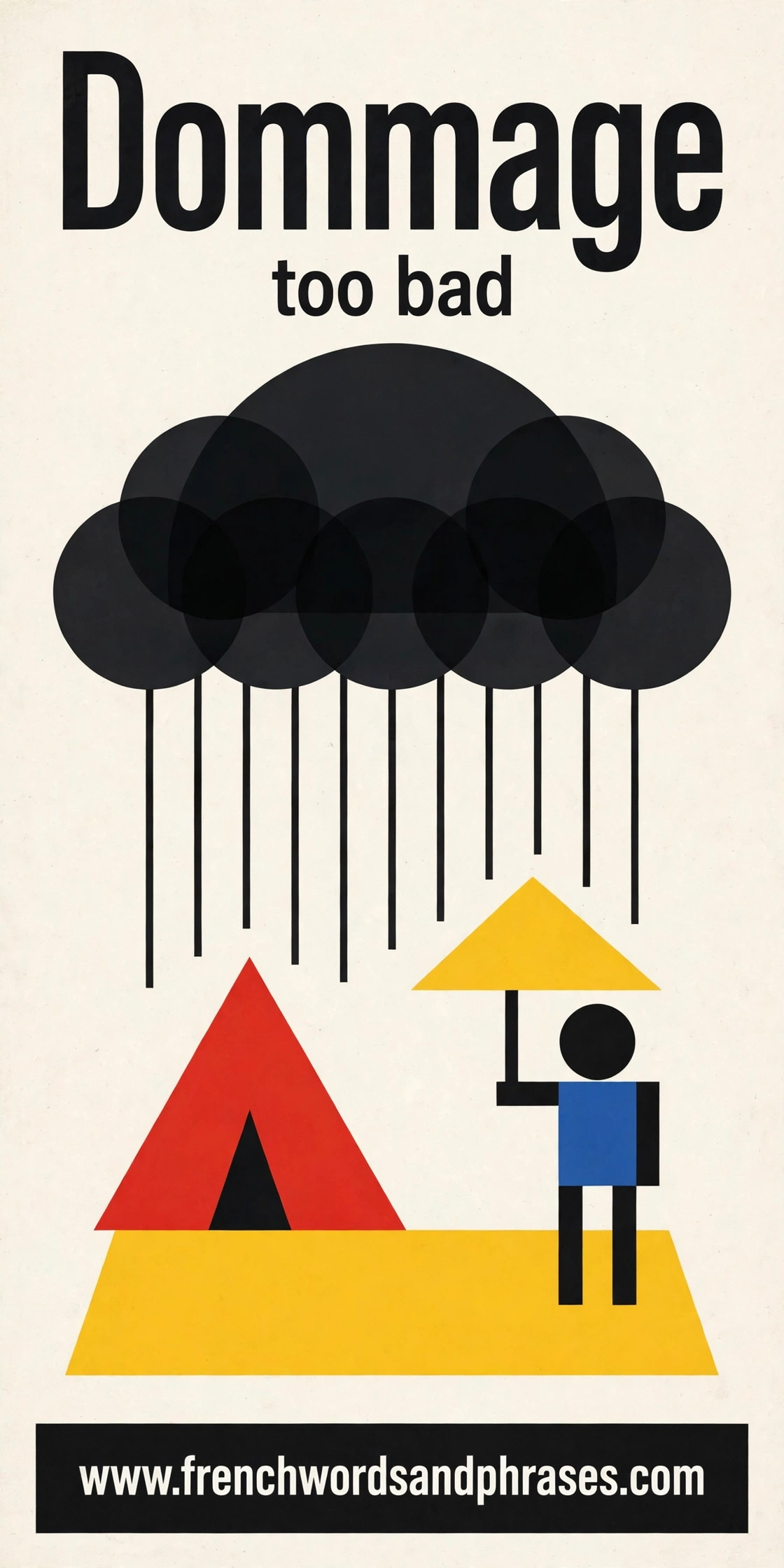
A French Word to Live By
Translate Dommage to English
/dɔ.maʒ/
Dommage means too bad!.
Two friends arrive at the little theatre in Aix-en-Provence at seven o’clock sharp — and the poster on the door says COMPLET in red letters. Sold out. The whole season gone. One of them touches the poster sadly and says: « Quel dommage ! » What a pity. Dommage is the French sigh for the things that nearly happened: the ticket, the sunny day, the friend who cannot come.
Let’s explore how dommage works in French, beginning with the whole reaction on one card.
Understanding the French Interjection Dommage
Dommage is a French noun that works as an interjection of regret. The noun means “a pity, a shame” (and, in legal language, damage) — but shouted or sighed as a reaction, it is pure sympathy: for yourself, or more often for somebody else.
It means too bad, what a shame, what a pity. Where tant pis shrugs and moves on, dommage stays a moment with the feeling: it regrets, it sympathises, and it often arrives holding an umbrella for somebody else’s rained-off plan.
Type: Interjection — regret / sympathy (the noun dommage, used as a reaction)
Answers the need: Regretting — a missed chance, a failed plan, someone else’s bad luck
Register: Polite and warm — safe everywhere, kind with strangers
Strength: Moderate and sincere — warmer than tant pis, far from a catastrophe
One important usage detail: dommage has a grammar string attached. “C’est dommage que” is followed by the subjunctive — c’est dommage que tu partes, it is a shame you are leaving. When the same person stays in charge, French switches to “c’est dommage de” + infinitive: c’est dommage de partir si tôt.
Experience the Word
Dommage is the sound of a door closing gently — not slammed, just… closed.
Imagine a grandmother who has baked a tarte aux pommes for grandchildren who, at the last minute, cannot visit. She covers it with a cloth, looks out at the rain, and murmurs: « Quel dommage. »
You have not shrugged the thing away. You have taken one honest moment to be sorry about it.
How to Use Dommage in French: Complete Guide
Let’s explore how dommage works in French, beginning with the whole reaction on one card.
Dommage at a Glance
The Whole Reaction on One Card
Meaning, job, register and strength — dommage in four lines.
| Point | Dommage |
|---|---|
| Meaning | too bad / what a shame / what a pity |
| Job | regrets a missed chance and sympathises with the loser |
| Register | polite and warm — safe in every company |
| Strength | moderate and sincere — real regret, no drama |
Example
Quel dommage, le musée est fermé !
What a pity, the museum is closed!
When You Say It: The Trigger Moments
Dommage appears when something good slips away — yours or somebody else’s.
| Situation | Example |
|---|---|
| A friend cannot come | dommage, tu vas nous manquer — too bad, we’ll miss you |
| The concert is sold out | quel dommage, plus une place ! — what a shame, not one seat left! |
| Rain spoils a celebration | dommage pour la fête, ce déluge — too bad for the party, this downpour |
| Someone loses a job | j’ai appris pour ton travail, quel dommage — I heard about your job, what a pity |
| A team loses at the end | dommage, ils ont perdu à la dernière minute — too bad, they lost in the last minute |
Example
C’est dommage, le restaurant est complet ce soir.
It’s a pity, the restaurant is fully booked tonight.
Quick Quiz 1
Which reaction shows more sympathy — tant pis or dommage?
Reveal the answer
dommage — tant pis shrugs and moves on; dommage stays to be sorry with you.
Quel dommage que tu partes déjà.
What a pity you’re leaving already.
The Reaction Question: The Sigh and the Exclamation
Dommage can be sighed or exclaimed — and it loves company: a kind follow-up sentence.
| Delivery | What it does |
|---|---|
| Soft and falling: dommage… | quiet sympathy — ‘I’m sorry to hear that’ |
| Quel dommage ! with feeling | full regret, often about your own lost chance |
| C’est vraiment dommage | stronger — a real shame, sincerely meant |
| Dommage + an offer | dommage… mais je peux t’aider — sympathy that rolls up its sleeves |
| Ce serait dommage de… | a gentle warning — it would be a shame to miss it |
Example
Ce serait dommage de rater ce coucher de soleil.
It would be a shame to miss this sunset.
Where It Goes: Standalone, Quel, and the Subjunctive After Que
Dommage stands alone, dresses up with quel, or opens the door to its signature structure: c’est dommage que + subjunctive.
| Position / pattern | Example |
|---|---|
| Standalone | dommage ! — the whole reaction, one word |
| Quel dommage ! | quel dommage, cette pluie ! — what a pity, this rain! |
| C’est dommage que + subjunctive | c’est dommage que tu partes — it’s a shame you’re leaving |
| C’est dommage de + infinitive | c’est dommage de partir si tôt — it’s a shame to leave so early |
Example
C’est dommage qu’il ne fasse pas beau.
It’s a pity the weather isn’t good.
Quick Quiz 2
After c’est dommage que, which mood — indicative or subjunctive?
Reveal the answer
The subjunctive — regret looks at the world as wished, not as stated.
C’est dommage que vous ne veniez pas.
It’s a shame you aren’t coming.
Everyday Expressions with Dommage
Dommage lives inside a few set phrases — each one a small, polite rain cloud.
| Expression | In English |
|---|---|
| quel dommage ! | what a pity! / what a shame! |
| c’est bien dommage | it really is a pity |
| dommage pour lui | too bad for him |
| ce serait dommage de + infinitive | it would be a shame to… |
| c’est dommage, mais… | it’s a pity, but… (softening a disagreement) |
Example
C’est bien dommage, il faisait si beau hier.
It really is a pity, the weather was so lovely yesterday.
Close Cousins: The Regret Family
French regrets in several temperatures — dommage is the warm, everyday one.
| Word | The difference |
|---|---|
| dommage | too bad — warm regret with sympathy inside |
| tant pis | oh well — cooler and more resigned; you accept and move on |
| zut | damn-lite — annoyance at a mishap, not sympathy for a person |
| hélas | alas — grander and literary, the regret of novels |
| malheureusement | unfortunately — the adverb cousin, for building sentences |
Example
Hélas, dommage, le spectacle est annulé.
Alas, too bad, the show is cancelled.
Quick Quiz 3
Which cousin is the literary, old-fashioned “alas” — dommage or hélas?
Reveal the answer
hélas — dommage is its warm, everyday descendant.
Hélas, il est trop tard.
Alas, it is too late.
Dommage and Its Neighbours
The regret shelf around dommage, from the shrug to the celebration it cannot join.
| French | In English |
|---|---|
| tant pis | oh well (accepted, moving on) |
| dommage | too bad (regretting, sympathising) |
| quel dommage ! | what a shame! (regret at full volume) |
| zut ! | damn! (annoyed at the mishap itself) |
| tant mieux | great! (the opposite — the plan worked) |
Example
Dommage pour la pluie, tant mieux pour les fleurs.
Too bad for us about the rain, all the better for the flowers.
Watch Out: The Traps Around Dommage
The traps: the English word damage, the forgotten subjunctive, and the wrong kind of broken.
| Trap | The truth |
|---|---|
| translating English “damage” directly | everyday dommage means “a pity” — physical damage to things is les dégâts; a damaged car is une voiture abîmée |
| the legal exception | in law and insurance, les dommages ARE damages — dommages et intérêts is the money a court awards |
| indicative after dommage que | c’est dommage que tu partes (subjunctive), not que tu pars |
| using it for tiny mishaps | for a dropped pen, zut or mince is the right size — dommage is for real disappointments |
Example
C’est dommage que le train soit en retard.
It’s a pity the train is late.
Quick Quiz 4
True or false: dommage is the everyday French word for physical damage to a car.
Reveal the answer
False — everyday dommage means “a pity”; physical damage is les dégâts (les dommages survives in legal French).
Quel dommage, la voiture est abîmée.
What a pity, the car is damaged.
Dommage in Everyday French: Real-Life Examples
Now that you know the word, let’s see how dommage appears in everyday French.
Example Example 1 — Travel
Quel dommage, le musée est fermé le lundi !
What a pity, the museum is closed on Mondays!
Example Example 2 — Friends
C’est dommage que tu ne viennes pas à la fête.
It’s a shame you aren’t coming to the party.
Example Example 3 — Weather
Dommage, la plage sous la pluie, ce n’est pas pareil.
Too bad, the beach in the rain isn’t the same.
Example Example 4 — Work
Il a perdu son emploi, quel dommage.
He lost his job, what a shame.
Example Example 5 — Food
C’est dommage, le restaurant est complet ce soir.
It’s a pity, the restaurant is fully booked tonight.
Example Example 6 — Sport
Dommage, ils ont perdu à la dernière minute.
Too bad, they lost in the last minute.
Beyond Translation: The Meaning of Dommage
English “too bad” has grown hard with sarcasm — say it flatly and it means “I don’t care”. French dommage has kept its softness: underneath the sigh you can still hear the old noun, a word for harm and loss, doing gentle work as sympathy.
To say dommage is to spend one moment being sorry — usually for someone else.
And it brings its grammar with it: c’est dommage que pulls the subjunctive behind it, the mood of wishes and regrets, because a pity is always about the world as it should have been.
How to Remember the French Interjection Dommage
Remember it this way: Remember it this way: Dommage is the sigh at the sold-out door — regret with its sympathy showing.
- You feel it, not shrug it — dommage regrets where tant pis accepts.
- You bring the subjunctive — c’est dommage que tu partes.
- You keep damage out of it — a broken car is abîmée, its story is quel dommage.
The key idea is dommage means too bad, it carries sympathy, and c’est dommage que takes the subjunctive.
Test Your Knowledge of Dommage
Let’s see how much you’ve learned. Try answering these questions before revealing the answers.
Question 1
What does dommage mean?
Reveal the answer
Too bad / what a shame / what a pity — regret, usually with sympathy for someone.
Question 2
Which mood follows c’est dommage que?
Reveal the answer
The subjunctive — c’est dommage que tu partes, it’s a shame you’re leaving.
Question 3
Translate: What a pity, the museum is closed today!
Reveal the answer
Quel dommage, le musée est fermé aujourd’hui !
Question 4
What is the difference between dommage and tant pis?
Reveal the answer
Dommage regrets; tant pis accepts. Dommage stays a moment with the feeling, tant pis shrugs and moves on.
Question 5
Complete the sentence:
C’est dommage que tu ______ (partir) si tôt. (It’s a shame you’re leaving so early.)
Reveal the answer
partes — the subjunctive of partir.
C’est dommage que tu partes si tôt.
It’s a shame you’re leaving so early.
Your Final Challenge
Can You Use It?
How would you say this in French?
“How would you say this in French?”
Reveal the answer
Quel dommage, tu pars déjà !
What a pity, you’re leaving already!
A little French. A little curiosity. A richer everyday life.
LEARN FRENCH ONE WORD AT A TIME




