A French Word to Live By
Translate Dîner to English
/di.ne/
Le dîner means the dinner.
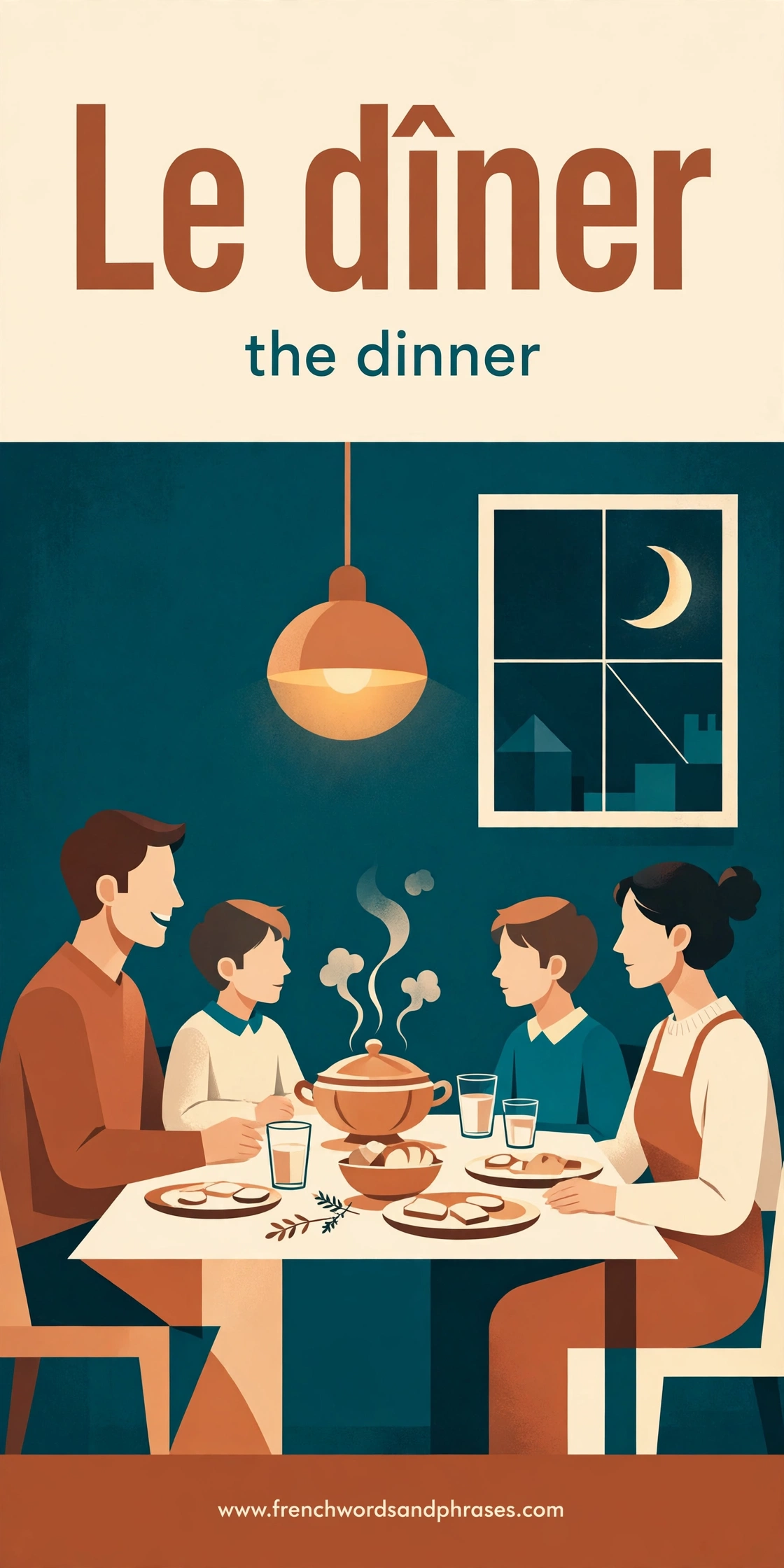
The candles are lit, the plates come in steaming, and the day slows down around the table: le dîner, the dinner — the main evening meal in France, the meal the whole day has been walking towards.
In this guide, you’ll learn what dîner means in English, how to use it with its articles, how to form its plural, and how it appears in everyday French. Explore French examples, English translations, and practice quizzes.
Understanding the French Noun Dîner
Dîner is a masculine French noun, learned with its article: le dîner, un dîner. It shares its spelling with the verb dîner, to dine — the meal and the act of eating it carry the same name. Both descend from the Latin disjejunare, to break the fast, the same root as déjeuner.
It means dinner — the main meal of the evening: le dîner est prêt, dinner is ready, un dîner de famille, a family dinner, un dîner d’affaires, a business dinner. Do not mix it up with le déjeuner, which is lunch, eaten at midday: the French day is le petit-déjeuner (breakfast), le déjeuner (lunch), le dîner (dinner). A late, light evening meal can also be called le souper, but le dîner is the standard word.
Gender: Masculine — le dîner
Definite article: le — le dîner (the dinner)
Indefinite article: un — un dîner (a dinner)
Plural: les dîners — regular, with a simple -s
Spelling note: the circumflex on the î is a souvenir of an old lost s — and the same word is the verb dîner, to dine
The day’s three meals: le petit-déjeuner (breakfast), le déjeuner (lunch), le dîner (dinner)
English equivalents: The dinner.
The invitation is inviter quelqu’un à dîner, to invite someone to dinner, and the announcement every child waits for is le dîner est servi !, dinner is served. In France le dîner is rarely eaten before half past seven, and a dîner en ville is a dinner out, at a restaurant or at friends’.
Experience the Word
Dîner is the day’s closing ceremony: work is put away, phones go quiet, and the table becomes the centre of the house again.
Imagine the kitchen at seven — the soup tureen steaming, someone calling à table ! up the stairs, and everyone arriving at a different speed, hungry in the same direction.
You have not just named a meal. You have named the evening itself — le dîner, the dinner, the day’s last and longest pause.
How to Use Dîner in French: Complete Guide
Let’s explore how dîner works in French, beginning with its articles — le dîner, un dîner, le dîner est servi.
Dîner with the Definite Article (Le, Les)
Used for a specific dinner — tonight’s, Sunday’s, the one already on the table.
| Form | French |
|---|---|
| Masculine singular | le dîner |
| Plural | les dîners |
Example
Le dîner de ce soir est presque prêt.
Tonight’s dinner is almost ready.
Dîner with the Indefinite Article (Un, Des)
Used for a dinner in general — any evening meal, planned or improvised.
| Form | French |
|---|---|
| Masculine singular | un dîner |
| Plural | des dîners |
Example
Nous organisons un dîner avec les voisins samedi.
We are organising a dinner with the neighbours on Saturday.
Kinds of Dîner (De famille, d’affaires, romantique…)
Dinners are named by their company — family, business, romance or celebration.
| Kind | French |
|---|---|
| a family dinner | un dîner de famille |
| a business dinner | un dîner d’affaires |
| a romantic dinner | un dîner romantique |
| a celebration dinner | un dîner de fête |
| a light dinner | un dîner léger |
Example
Un dîner d’affaires peut durer trois heures.
A business dinner can last three hours.
Quick Quiz 1
Complete the sentence:
______ dîner est servi, tout le monde à table ! (the)
Reveal the answer
Le
Le dîner est servi, tout le monde à table !
Dinner is served, everyone to the table — dîner is masculine, so le.
The Plural of Dîner
Dîner takes a regular plural in -s — dinners remembered across a whole season.
| Number | French |
|---|---|
| Singular | le dîner |
| Plural | les dîners |
Example
Les dîners de famille du dimanche durent longtemps.
Sunday family dinners last a long time.
Dîner with Possessive Adjectives (Mon, Ton, Son…)
Possessives agree with the noun: dîner is masculine, so mon, ton, son in the singular.
| Owner | French |
|---|---|
| my | mon dîner |
| your (tu) | ton dîner |
| his / her | son dîner |
| our | notre dîner |
| your (vous) | votre dîner |
| their | leur dîner |
Example
Je prépare mon dîner pendant que tu mets la table.
I am making my dinner while you lay the table.
Quick Quiz 2
Complete the sentence:
Elle a invité ses parents pour ______ dîner d’anniversaire. (her)
Reveal the answer
son
Elle a invité ses parents pour son dîner d’anniversaire.
She invited her parents for her birthday dinner — son, because dîner is masculine.
Dîner with Demonstrative Adjectives (Ce, Ces)
Used to point: ce dîner, this dinner — the one being talked about all evening.
| Form | French |
|---|---|
| Masculine singular | ce dîner |
| Plural | ces dîners |
Example
Ce dîner était délicieux, merci pour tout.
This dinner was delicious, thank you for everything.
Dîner with Adjectives
Adjectives agree with dîner — masculine singular: un dîner délicieux, un long dîner.
| Adjective | With Dîner |
|---|---|
| délicieux (delicious) | un dîner délicieux |
| long (long) | un long dîner |
| léger (light) | un dîner léger |
| romantique (romantic) | un dîner romantique |
| prêt (ready) | le dîner est prêt |
Example
Après le marché, nous avons fait un dîner léger.
After the market, we made a light dinner.
Quick Quiz 3
Complete the sentence:
Le dîner est ______, passez à table. (ready)
Reveal the answer
prêt
Le dîner est prêt, passez à table.
Dinner is ready, come to the table — prêt, masculine, to agree with dîner.
Everyday Expressions with Dîner
Invitations, announcements and evenings out — the dîner phrases of daily life.
| Expression | In English |
|---|---|
| le dîner est servi | dinner is served |
| inviter quelqu’un à dîner | to invite someone to dinner |
| l’heure du dîner | dinnertime |
| un dîner en ville | a dinner out |
| après le dîner | after dinner |
Example
L’heure du dîner approche, rentrons à la maison.
Dinnertime is approaching, let’s go home.
Words from the Same Family as Dîner
Meals and dining — the words that travel with dîner.
| French | In English |
|---|---|
| le déjeuner | the lunch — the midday meal |
| le petit-déjeuner | the breakfast |
| le repas | the meal — any meal at all |
| dîner | to dine (the verb — the same word) |
| la salle à manger | the dining room |
Example
Le déjeuner est à midi, le dîner est le soir.
Lunch is at midday, dinner is in the evening.
Quick Quiz 4
What is the difference between le déjeuner and le dîner?
Reveal the answer
Le déjeuner is lunch, le dîner is dinner — midday versus evening.
On déjeune à midi et on dîne le soir.
We have lunch at midday and dinner in the evening.
Dîner in Everyday French: Real-Life Examples
Now that you know the word, let’s see how dîner appears in everyday French.
Example 1 — The announcement
Le dîner est servi, à table !
Dinner is served, to the table!
Example 2 — The invitation
Tu viens dîner à la maison vendredi ?
Are you coming to dinner at our house on Friday?
Example 3 — Cooking
Je prépare le dîner, mets la table.
I’m making dinner, lay the table.
Example 4 — Eating out
Ce soir, nous avons un dîner en ville.
Tonight, we have a dinner out.
Example 5 — After the meal
Après le dîner, nous ferons une promenade.
After dinner, we will go for a walk.
Example 6 — Too early
Il est six heures, c’est tôt pour le dîner.
It’s six o’clock, it’s early for dinner.
Beyond Translation: The Meaning of Dîner
Dîner and déjeuner are the same word twice: both grow out of the Latin for breaking a fast, and for centuries the dîner was the FIRST meal of the day, eaten late in the morning. As centuries passed, the great meal slid later and later across the day — morning, then midday, then evening — pushing déjeuner into the noon slot and leaving dîner to close the day. The word kept the ceremony of the main meal wherever it landed: guests, courses, conversation.
To say dîner is to name the meal the day is organised around.
It evokes the laid table, the steaming tureen and the call of « à table ! » — France sitting down, together, at last.
How to Remember the French Noun Dîner
Remember it this way: Dîner is the evening meal — masculine: le dîner. Lunch is le déjeuner; never swap them.
- Always masculine — le dîner, un dîner, mon dîner.
- The day’s map — le petit-déjeuner, le déjeuner (lunch), le dîner (dinner).
- The call — le dîner est servi, dinner is served.
The key idea is le dîner — the dinner, masculine; déjeuner = lunch, dîner = dinner.
Test Your Knowledge of Dîner
Let’s see how much you’ve learned. Try answering these questions before revealing the answers.
Question 1
Is dîner masculine or feminine?
Reveal the answer
Masculine — le dîner, un dîner.
Question 2
How do you say dinner is served?
Reveal the answer
Le dîner est servi.
Question 3
Translate: We are having dinner at eight.
Reveal the answer
Nous dînons à huit heures.
Question 4
What is le déjeuner?
Reveal the answer
Lunch — the midday meal; le dîner is the evening one.
Question 5
Complete the sentence:
______ dîners du dimanche sont toujours longs. (the)
Reveal the answer
Les
Les dîners du dimanche sont toujours longs.
Sunday dinners are always long.
Your Final Challenge
Can You Use It?
How would you say this in French?
“Dinner is served, everyone to the table.”
Reveal the answer
Le dîner est servi, tout le monde à table.
Dinner is served, everyone to the table.
A little French. A little curiosity. A richer everyday life.
LEARN FRENCH ONE WORD AT A TIME