A French Word to Live By
Translate Différent to English
/di.fe.ʁɑ̃/
Différent means different.
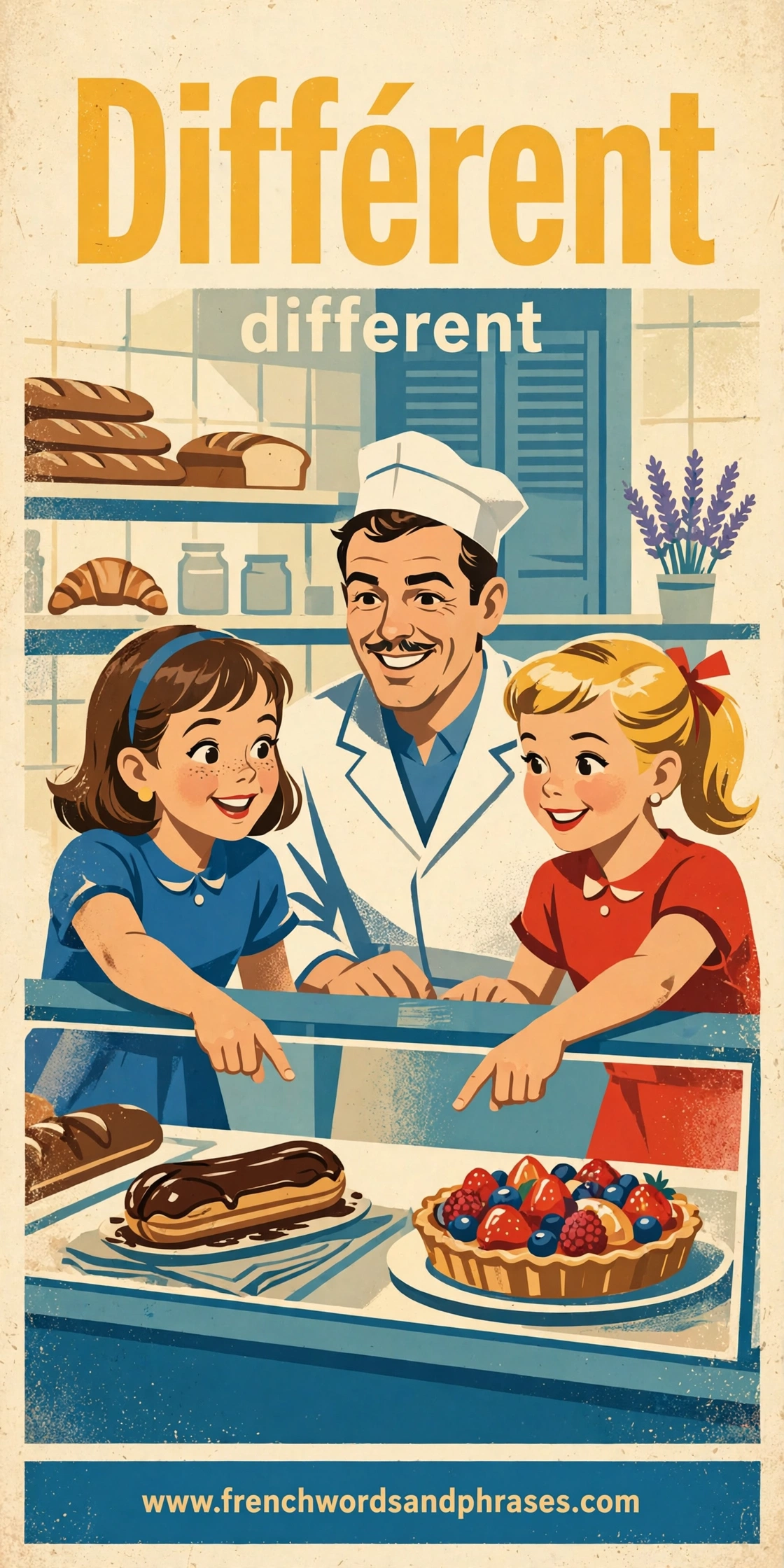
Two sisters stand in a Lyon bakery pointing at the same éclair. « Tu prends toujours le même ! » — « Et toi, tu veux toujours quelque chose de différent. » The baker, wise, says nothing at all.
In this guide, you’ll learn what différent means in English, its four forms, the essential phrase différent de, and the trap hiding in the plural — where différents stops meaning ‘different’ and starts meaning ‘various’. Explore French examples, English translations, and practice quizzes.
Understanding the French Adjective Différent
Différent is a French adjective of quality — the adjective of difference. It agrees in the regular way: différent, différente, différents, différentes. Its feminine simply adds -e, and the masculine plural already carries its -s inside the singular.
It means different — not the same. French almost always pairs it with de: différent de son frère, different from his brother. And watch the plural closely: des idées différentes are different ideas, but différents in front of a plural noun — différents livres — quietly changes job and means ‘various, several’. One word, two lives, separated by position.
Type: Adjective of quality — difference
Answers the question: What is it like? — different, not the same
Changes form: Yes — différent, différente, différents, différentes
English equivalents: Different; (before a plural noun) various, several.
One important usage detail: French says différent de, with de — différent de toi, different from you. English ‘different than’ and ‘different to’ both translate to de. Never à, never que in this construction.
Experience the Word
Différent is the adjective of the second sister — the one who always orders the other éclair.
Imagine a school photo in Provence: thirty children in the same uniform, and thirty completely différent faces. French loves this word because it protects the individual inside the group.
You have not just compared two things. You have defended the right of each one to be itself.
How to Use Différent in French: Complete Guide
Let’s explore how différent works in French, beginning with the whole word on one card.
Différent at a Glance
Before the details, here is the whole word on one card.
The Whole Word on One Card
Meaning, type, position and forms — différent in four lines.
| Point | Différent |
|---|---|
| Meaning | different |
| Type | adjective of quality — difference |
| Usual position | after the noun — un avis différent |
| Form | différent / différente / différents / différentes |
Example
C’est un avis différent.
That’s a different opinion.
The Four Forms of Différent
Différent agrees in the regular way: the feminine adds -e, the plurals add -s — and the masculine singular already ends in -t, so its plural only adds the s you cannot hear.
| Form | Différent | Example |
|---|---|---|
| Masculine singular | différent | un goût différent — a different taste |
| Feminine singular | différente | une réponse différente — a different answer |
| Masculine plural | différents | des goûts différents — different tastes |
| Feminine plural | différentes | des réponses différentes — different answers |
Example
Ils ont des goûts très différents.
They have very different tastes.
Quick Quiz 1
Which form of différent goes with réponse (feminine)?
Reveal the answer
différente
Une réponse différente.
A different answer.
Différent de: The Essential Partner
Différent almost never travels alone: de introduces the thing it differs from. The pattern works for people, things and whole ideas.
| Pattern | Example |
|---|---|
| différent de + noun | différent de son frère — different from his brother |
| différent de + pronoun | différent de moi — different from me |
| différent des autres | différent des autres — different from the others (de + les = des) |
| différent à | never — French always uses de here |
Example
Ce village est différent des autres.
This village is different from the others.
More Different: Comparing with Différent
Différent compares the regular way, with plus, moins and aussi — très différent is the everyday favourite.
| Degree | Example |
|---|---|
| As different as | aussi différent que — as different as |
| More different | plus différent — plus différent qu’avant |
| Less different | moins différent — less different |
| Very different | très différent — complètement différent in stronger speech |
| The most different | le plus différent — le plus différent des deux |
Example
Les deux sœurs sont très différentes.
The two sisters are very different.
Quick Quiz 2
What does c’est différent mean when someone says it with a smile?
Reveal the answer
That’s different — that changes everything, that’s another matter.
Ah, si c’est un cadeau, c’est différent !
Ah, if it’s a present, that’s different!
Everyday Expressions with Différent
Différent turns up in opinions, in families, and in one position where it changes meaning entirely.
| Expression | In English |
|---|---|
| différent de | different from |
| c’est différent | that’s different — another matter |
| différents + plural noun | various, several — différents livres, various books |
| de différentes façons | in various ways |
| une autre histoire | a different story — another matter entirely |
| pas différent | no different — pas différent des autres |
Example
J’ai lu différents livres sur le sujet.
I have read various books on the subject.
Différent and Its Neighbours
French separates its comparison words carefully. Différent says ‘not the same’; its neighbours say ‘another’, ‘similar’, or the exact opposite.
| French | In English |
|---|---|
| autre | other, another — un autre livre |
| pareil | the same, identical — the opposite |
| semblable | similar, alike |
| contraire | opposite, contrary |
| le même | the same — le même livre |
| divers | various, diverse — formal cousin of différents |
Example
Ce n’est pas pareil, c’est complètement différent.
It’s not the same, it’s completely different.
Quick Quiz 3
In différents livres, does différents mean ‘different’ or ‘various’?
Reveal the answer
Various — before a plural noun, différents changes job and means several, various.
Différents livres parlent de ce sujet.
Various books talk about this subject.
Différent in Daily Choices
Différent lives in the small decisions of the day: menus, routes, opinions and outfits. A tour of the choices it colours.
| Choice | Example |
|---|---|
| At the table | un plat différent chaque jour — a different dish every day |
| On the road | une route différente — a different route |
| In opinion | un avis différent — a different opinion |
| In style | une coiffure différente — a different hairstyle |
Example
Demain, je prends une route différente.
Tomorrow, I’ll take a different route.
Watch Out: The Traps Around Différent
Three traps wait here — the English preposition, the wandering accent, and the plural that changes jobs.
| Trap | The truth |
|---|---|
| différent à / différent que | French uses de: différent de son frère — never à or que |
| differant | the word is spelled with é and a final -ent: différent, différente |
| différents before the noun | position changes meaning: des livres différents = different books; différents livres = various books |
| la différence | the noun is différence, with -ence — ne confondez pas avec l’adjectif |
Example
Différents villages ont des traditions différentes.
Various villages have different traditions.
Quick Quiz 4
How do you say ‘a different answer’ — une différente réponse or une réponse différente?
Reveal the answer
une réponse différente
Différent stands after the noun when it means ‘different’.
Une réponse différente — a different answer.
Différent in Everyday French: Real-Life Examples
Now that you know the word, let’s see how différent appears in everyday French.
Example 1 — Two sisters
Nous sommes sœurs, mais très différentes.
We are sisters, but very different.
Example 2 — At the bakery
Aujourd’hui, je prends quelque chose de différent.
Today, I’m having something different.
Example 3 — Opinions
C’est un avis différent, mais intéressant.
It’s a different opinion, but an interesting one.
Example 4 — Travel
Chaque village est différent des autres.
Every village is different from the others.
Example 5 — Various books
J’ai acheté différents livres pour les vacances.
I bought various books for the holidays.
Example 6 — That’s different
Ah, si tu viens aussi, c’est différent !
Ah, if you’re coming too, that’s different!
Beyond Translation: The Meaning of Différent
English says different for the meaning of différent — but différent hides a second career inside its plural. After the noun it compares; before a plural noun it counts: différents livres are not books that differ, they are simply several books.
Few adjectives in French change their meaning by moving house — différent is the elegant proof that position is meaning.
And its everyday partner never changes: différent de, different from — the small de that English speakers must trade for all their ‘froms’, ‘tos’ and ‘thans’.
How to Remember the French Adjective Différent
Remember it this way: Différent carries its partner de everywhere — and in the plural, position flips its meaning from ‘different’ to ‘various’.
- You hear the pair together — différent de — the way you hear ‘different from’ as one word.
- You agree it regularly: différent, différente, différents, différentes.
- You watch the plural’s address: after the noun it compares, before it it counts — différents livres, various books.
The key idea is différent means different, pairs with de, and différents before a plural noun means various.
Test Your Knowledge of Différent
Let’s see how much you’ve learned. Try answering these questions before revealing the answers.
Question 1
What does différent mean?
Reveal the answer
Different — not the same; and, before a plural noun, various.
Question 2
Which preposition follows différent?
Reveal the answer
De
Différent de son frère.
Different from his brother.
Question 3
Translate: a different answer.
Reveal the answer
Une réponse différente.
Question 4
What does différents livres mean?
Reveal the answer
Various books — before the noun, différents means several, various.
Question 5
Complete the sentence:
Ce fromage est ______ de l’autre.
Reveal the answer
différent
Ce fromage est différent de l’autre.
This cheese is different from the other one.
Your Final Challenge
Can You Use It?
How would you say this in French?
“This cheese is different from the other one, and various villages make it in different ways.”
Reveal the answer
Ce fromage est différent de l’autre, et différents villages le fabriquent de façons différentes.
This cheese is different from the other one, and various villages make it in different ways.
A little French. A little curiosity. A richer everyday life.
LEARN FRENCH ONE WORD AT A TIME