
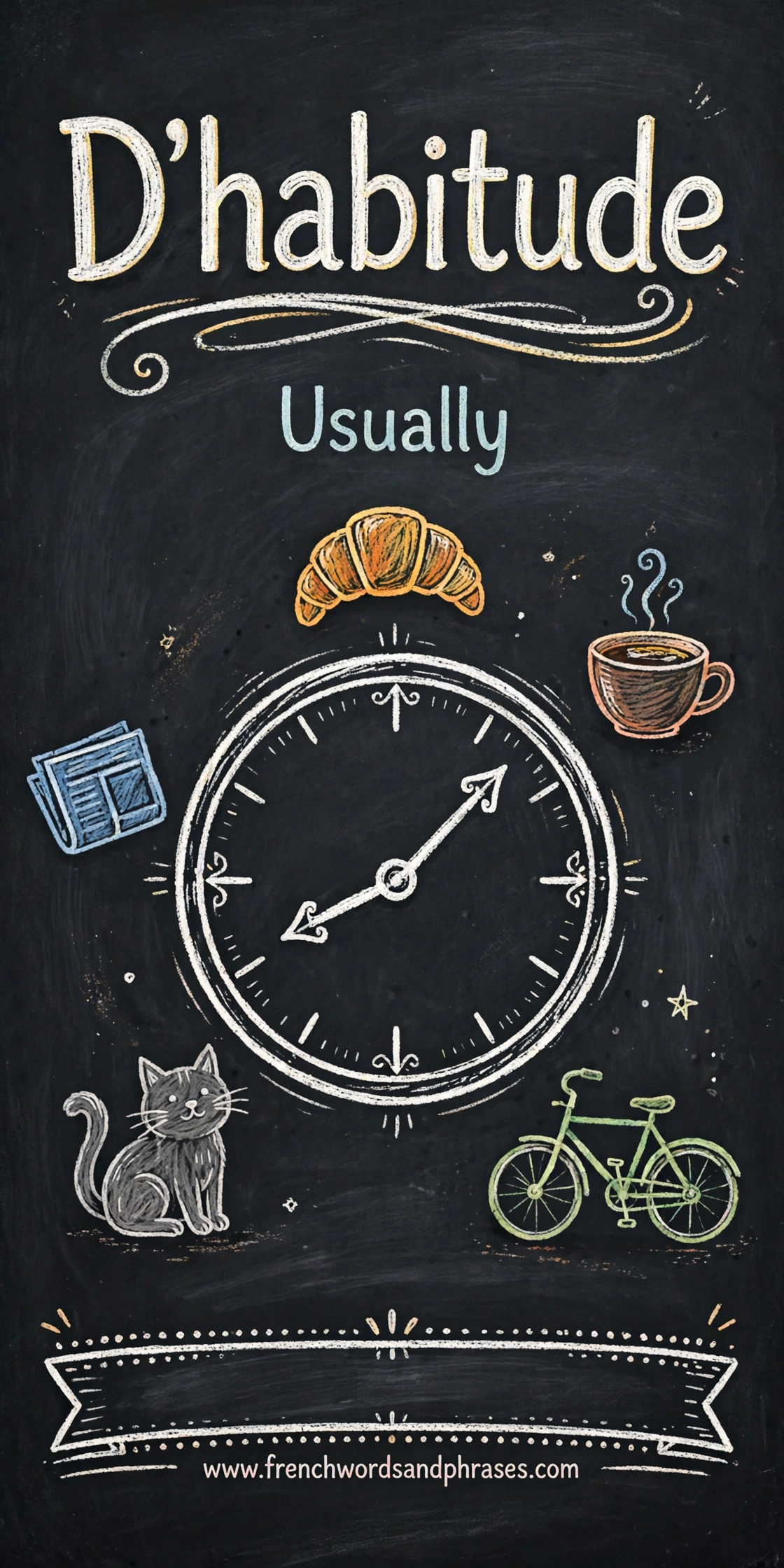
A French Word to Live By
Translate D’habitude to English
/da.bi.tyd/
D’habitude means usually.
The little café on the corner knows you. You push the door, the waiter glances up, and before you have said a word he is already reaching for the cup: ‘Comme d’habitude ?’ — The usual? Some phrases describe a routine; this one is the routine, wearing words.
Let’s explore how d’habitude works in French, beginning with the whole phrase on one card.
Understanding the French Phrase D’habitude
D’habitude is a French time phrase — the preposition de fused onto habitude, a habit, with the apostrophe marking where the two words melted together. It is the adverb of routine: it describes not what happened once, but what normally happens, day after day.
It means usually — as a rule, in the normal run of things. English ‘usually’ is built on ‘usual’; French d’habitude is built on ‘habit’, and the picture is warmer: your days have habits, and d’habitude simply reports what those habits are. Its partner comme d’habitude means as usual — often with a smile, sometimes with a sigh.
Type: Time phrase — de + habitude (habit), contracted to d’habitude
Answers the need: Describing the rule of your days — and setting up the exception
Register: Neutral and everyday — the voice of routine everywhere
Strength: Everyday — mornings, cafés, timetables, and every ‘but today…’ story
One important usage detail: d’habitude states the rule, and its favourite sentence shape is the exception — d’habitude, je prends le train, mais aujourd’hui… For a single event on a single day, leave d’habitude out; it only ever describes what normally happens.
Experience the Word
D’habitude is the sound of a life running on rails — the same train, the same café, the same walk to the bakery, until the day something small changes and the whole routine lights up.
Imagine the drama it sets up: d’habitude, Madame Fabre arrives at eight sharp. This morning, at half past eight, her chair is still empty. Every detective story and every love story begins exactly there — in the gap between d’habitude and today.
And then there is its sighing twin. Comme d’habitude ! — as usual! — said when the train is late again, when he forgets again: half complaint, half affection for a world that repeats itself.
How to Use D’habitude in French: Complete Guide
Let’s explore how d’habitude works in French, beginning with the whole phrase on one card.
D’habitude at a Glance
The Whole Phrase on One Card
Real meaning, literal building blocks, English twin and register — d’habitude in five lines.
| Point | D’habitude |
|---|---|
| What it really means | usually — what normally happens, as a rule |
| Word for word | of habit (de + habitude, melted into d’habitude) |
| English equivalent | usually / as usual (comme d’habitude) |
| Register | neutral and everyday — the voice of routine |
| Use it for | routines, orders at the café, timetables, and setting up exceptions |
Example
D’habitude, je me lève à sept heures.
Usually, I get up at seven o’clock.
Word by Word: Building the Routine
Two pieces — and one of them has melted into the other.
| Word | Literal meaning | Its job in the phrase |
|---|---|---|
| d’ | of (de, squeezed) | de contracts to d’ because habitude begins with a vowel sound — its h is silent |
| habitude | a habit, a custom | the routine itself — the phrase literally means ‘of habit’ |
Example
Une habitude du matin : le café, puis la promenade, d’habitude dans cet ordre.
A morning habit: coffee, then the walk, usually in that order.
Quick Quiz 1
Why d’ and not de in d’habitude?
Reveal the answer
Because habitude starts with a vowel sound — its h is silent, so de melts into d’.
C’est une question d’habitude.
It’s a matter of habit.
When You Say It: The Routine Moments
D’habitude belongs to timetables, café orders and every story that begins with the rule.
| Situation | Example |
|---|---|
| The morning routine | d’habitude, je me lève à six heures et demie — usually, I get up at half past six |
| Ordering at the café | comme d’habitude, un café crème — the usual, a white coffee |
| Work habits | d’habitude, la réunion commence à neuf heures — usually, the meeting starts at nine |
| The exception day | d’habitude, il est ponctuel, mais aujourd’hui il est en retard — usually he is punctual, but today he is late |
| Someone else’s habits | d’habitude, elle lit avant de dormir — usually, she reads before sleeping |
Example
D’habitude, ce train est plein ; aujourd’hui, il est presque vide.
Usually, this train is full; today, it is almost empty.
Make It Yours: Bending the Routine
The phrase moves around the sentence, sighs in comme d’habitude, and stretches with more and less.
| Form | French | In English |
|---|---|---|
| At the head | d’habitude, je prends le bus | usually, I take the bus |
| After the verb | je me couche d’habitude à vingt-trois heures | I usually go to bed at eleven |
| As usual | comme d’habitude | as usual |
| Setting up the exception | d’habitude oui, mais aujourd’hui non | usually yes, but not today |
| More than usual | plus fatigué que d’habitude | more tired than usual |
| Less than usual | moins de monde que d’habitude | fewer people than usual |
Example
Il y a moins de monde que d’habitude au marché ce matin.
There are fewer people than usual at the market this morning.
Quick Quiz 2
Your train is cancelled today for the first time ever. Which frame announces the exception — comme d’habitude or d’habitude, mais aujourd’hui?
Reveal the answer
D’habitude, mais aujourd’hui — comme d’habitude says everything repeated itself; the exception needs the rule stated first, then the break.
D’habitude, le train est à l’heure, mais aujourd’hui il est annulé.
Usually the train is on time, but today it is cancelled.
Everyday Expressions: Building on the Habit
Habitude grows a whole family of routine frames — learn these and French daily life reports itself.
| Frame | In English |
|---|---|
| comme d’habitude | as usual |
| d’habitude, le dimanche, on… | usually, on Sundays, we… |
| plus tôt que d’habitude | earlier than usual |
| d’habitude, pas de problème | usually, no problem |
| une mauvaise habitude | a bad habit |
| prendre l’habitude de | to get into the habit of |
Example
Il a pris l’habitude de marcher après le dîner.
He has got into the habit of walking after dinner.
Close Cousins: The Other Usually Words
French grades its routines — from the everyday rule to the statistic.
| Expression | The difference |
|---|---|
| généralement | generally — a touch more formal, at home in reports and statistics |
| normalement | normally — also carries ‘supposedly, in theory’: normalement, le train arrive à huit heures |
| en général | in general — opens a broad statement rather than a personal routine |
| habituellement | habitually — the formal, written twin of d’habitude, built on the same root |
| toujours | always — stronger than d’habitude: no exceptions allowed |
Example
Généralement, les magasins ferment plus tôt le dimanche ; d’habitude, le nôtre ferme à midi.
Generally, shops close earlier on Sundays; usually, ours closes at noon.
Quick Quiz 3
Which cousin is the formal, written twin of d’habitude, built on the very same root — habituellement or généralement?
Reveal the answer
Habituellement — habit is hiding inside both words.
Habituellement, le musée est fermé le lundi.
The museum is usually closed on Mondays.
D’habitude and Its Neighbours
The routine family at a glance — rules, sighs and statistics.
| French | In English |
|---|---|
| d’habitude | usually |
| comme d’habitude | as usual |
| généralement | generally |
| normalement | normally |
| habituellement | habitually, usually (formal) |
| toujours | always |
Example
Comme d’habitude, il arrive toujours en retard le lundi.
As usual, he always arrives late on Mondays.
Watch Out: The Traps Around D’habitude
Three traps wait around this routine phrase — step round them.
| Trap | The truth |
|---|---|
| Writing ‘de habitude’ | the apostrophe is part of the word — de melts into habitude: d’habitude, always |
| Using it for one single event | d’habitude paints the rule, not one occasion — for one day, say ce jour-là or cette fois |
| Confusing habitude with habiter | habitude is a habit; habiter is to live somewhere — near-identical coats, different words |
| Missing the sigh | comme d’habitude can be warm or resigned — the tone decides whether it is praise or complaint |
Example
Elle habite ici depuis dix ans, et c’est devenu une habitude : le marché, d’habitude, le samedi.
She has lived here for ten years, and it has become a habit: the market, usually, on Saturdays.
Quick Quiz 4
True or false: d’habitude can describe one single event that happened yesterday.
Reveal the answer
False — it describes what normally happens. A single event takes a single-event word.
Hier, pour une fois, je me suis levé tard.
Yesterday, for once, I got up late.
D’habitude in Everyday French: Real-Life Examples
Now that you know the word, let’s see how d’habitude appears in everyday French.
Example 1 — The café order
Comme d’habitude, monsieur ? — Oui, un café crème, s’il vous plaît.
The usual, sir? — Yes, a white coffee, please.
Example 2 — The morning routine
D’habitude, je cours vingt minutes avant le petit déjeuner.
Usually, I run for twenty minutes before breakfast.
Example 3 — The exception
D’habitude, la boulangerie ouvre à sept heures, mais aujourd’hui la porte est fermée.
Usually, the bakery opens at seven, but today the door is closed.
Example 4 — At work
D’habitude, nous finissons le vendredi à dix-sept heures.
Usually, we finish at five on Fridays.
Example 5 — The sigh
Le bus est encore en retard, comme d’habitude !
The bus is late again, as usual!
Example 6 — Sunday habits
D’habitude, le dimanche, on déjeune chez ma mère.
Usually, on Sundays, we have lunch at my mother’s.
Beyond Translation: The Meaning of D’habitude
English ‘usually’ is a cool, statistical word — it counts how often things happen. D’habitude is warmer and more human: it does not count your days, it knows them. Inside it sits habitude, a habit, the small repeated gesture that makes a life recognisable. That is why comme d’habitude can carry so much in three words at a café counter — recognition, affection, and the gentle comedy of being predictable.
How to Remember the French Phrase D’habitude
Remember it this way: D’habitude is the rule of your days spoken aloud — habitude, habit, is hiding inside it, and the exception is always waiting in the next clause.
- You hear habitude inside it — if it is a habit, d’habitude can say it.
- You pair it with its favourite partner — d’habitude…, mais aujourd’hui… — the rule, then the break.
- You sigh with its twin — comme d’habitude, as usual, warm or resigned depending on the day.
The key idea is d’habitude means usually — de + habitude (habit) melted together; comme d’habitude = as usual.
Test Your Knowledge of D’habitude
Let’s see how much you’ve learned. Try answering these questions before revealing the answers.
Question 1
What does d’habitude mean?
Reveal the answer
Usually — what normally happens, as a rule.
Question 2
What word is hiding inside d’habitude?
Reveal the answer
Habitude — a habit. The phrase literally means ‘of habit’.
Question 3
How do you say ‘as usual’?
Reveal the answer
Comme d’habitude — warm at the café counter, resigned when the bus is late again.
Question 4
Why can d’habitude not describe one single event yesterday?
Reveal the answer
Because it states the rule, not an occasion — one event takes ce jour-là or cette fois.
Question 5
Complete the sentence:
______, je prends le train de huit heures, mais aujourd’hui, je prends la voiture. (Usually, I take the eight o’clock train, but today I am taking the car.)
Reveal the answer
D’habitude — D’habitude, je prends le train de huit heures.
Your Final Challenge
Can You Use It?
How would you say this in French?
“Usually, I take the eight o’clock train, but today I am taking the car.”
Reveal the answer
D’habitude, je prends le train de huit heures, mais aujourd’hui, je prends la voiture.
Usually, I take the eight o’clock train, but today I am taking the car.
A little French. A little curiosity. A richer everyday life.
LEARN FRENCH ONE WORD AT A TIME




