A French Word to Live By
How to Conjugate Détirer in French
/de.ti.ʁe/
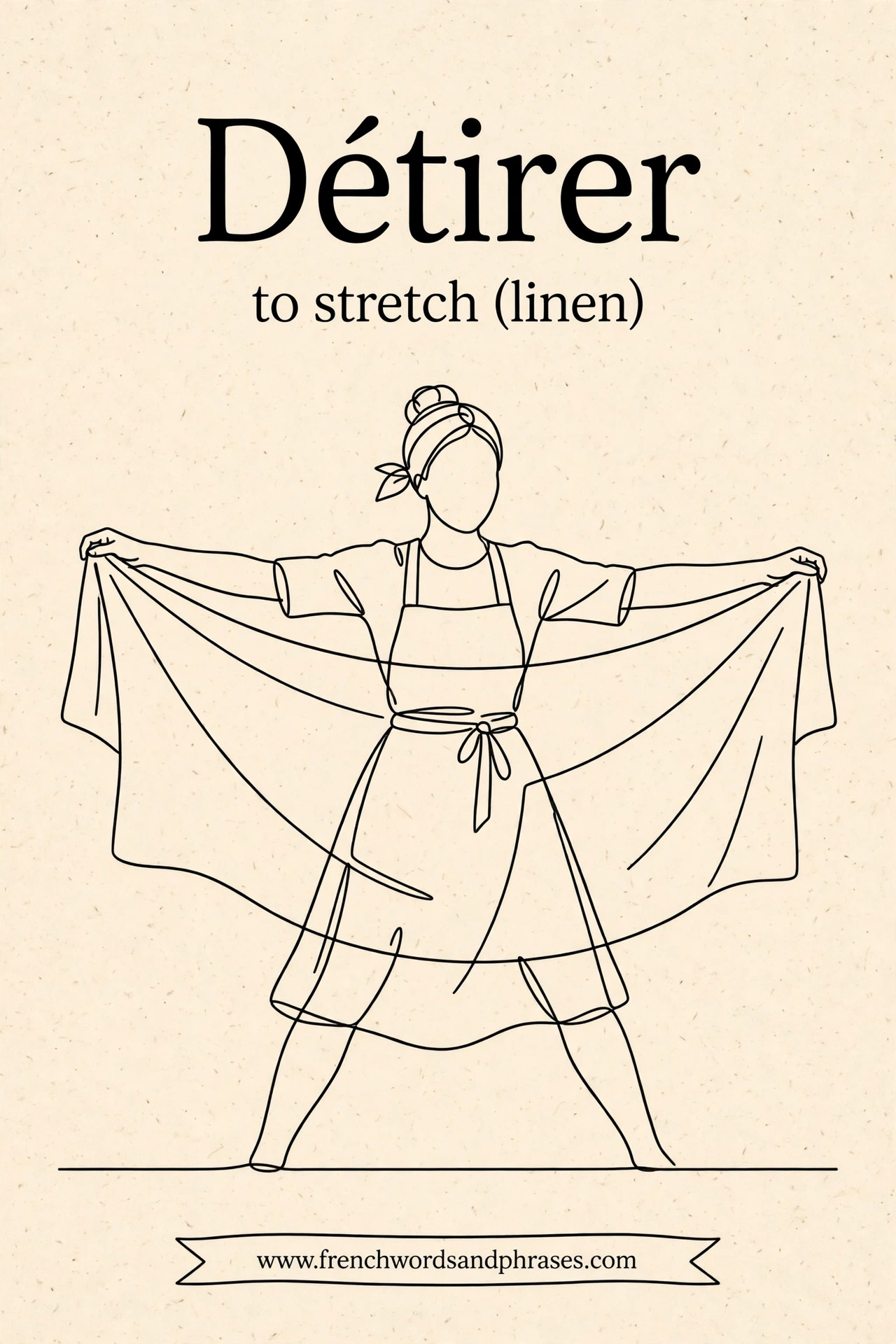
Détirer means to stretch — classically, to stretch linen: to pull washed cloth smooth and taut so it dries without a crease.
A laundress of a century ago shaking out a wet sheet and pulling it, hand over hand, until every wrinkle gives up — détirer is the verb of stretching things out flat and smooth, born in the laundry and still at work on cloth, canvas and dough.
In this guide, you’ll learn how to conjugate détirer in all the major French tenses and moods. Explore complete conjugation tables, French examples, English translations, and practice quizzes.
Understanding the French Verb Détirer
Détirer is a regular French verb belonging to the first group of verbs, those ending in-er.
It means to stretch (linen). It survives wherever cloth is handled with care — laundries, tailors, upholsterers stretching fabric over frames — and in the kitchen, where one dé tire pastry and dough thin. Think of it as tirer, to pull, with a purpose: pull until smooth, pull until flat.
Verb classification: First group (-er)
Auxiliary verb: Avoir
Past participle: détiré
Present participle: détirant
English equivalents: To stretch out, to pull smooth; détirer le linge — to stretch the washing; détirer une nappe — to pull a tablecloth smooth; détirer une toile — to stretch a canvas; détirer à la main — to stretch by hand.
One important detail: détirer belongs to the laundry. Its classic object is le linge — sheets, shirts and tablecloths pulled taut after washing so they dry flat and need less ironing. It stretches other flat things too — canvas on a frame, pastry on a board — but when the stretcher is a person stretching their own body, French switches to the reflexive: se détirer. The verb itself is a regular -er: je détire, nous détirons.
Experience the Word
Détirer is the verb of the pulled-smooth — the wrinkle’s defeat at the hands of someone patient.
Imagine a farmhouse washday in 1900. The sheets come out of the copper heavy and steaming, and two women take a sheet between them, walk apart, and détirent it with a crack like a sail. Hung on the line an hour later, it dries as flat as paper — no iron on earth could do better.
The sheet was not ironed into flatness. It was stretched there — détiré, pulled smooth while the water was still in it.
How to Conjugate Détirer: Complete French Conjugation Guide
Let’s explore every major conjugation of détirer, beginning with the indicative mood.
How to Conjugate Détirer in the Indicative Mood
The indicative mood is used to express facts, observations, actions, and events.
How to Conjugate Détirer in the Present Tense (Présent)
Used for actions happening now, habitual actions, and general truths.
| Subject | Conjugation |
|---|---|
| je | détire |
| tu | détires |
| il / elle | détire |
| nous | détirons |
| vous | détirez |
| ils / elles | détirent |
Example
La blanchisseuse détire le linge avant de l’étendre.
The laundress stretches the washing before hanging it out.
Quick Quiz 1
Complete the sentence:
Nous ______ la nappe sur la grande table.
Reveal the answer
détirons
Nous détirons la nappe sur la grande table.
We are pulling the tablecloth smooth over the big table.
How to Conjugate Détirer in the Passé Composé
Used for completed actions in the past. Détirer takes the auxiliary verb avoir.
| Subject | Conjugation |
|---|---|
| j’ | ai détiré |
| tu | as détiré |
| il / elle | a détiré |
| nous | avons détiré |
| vous | avez détiré |
| ils / elles | ont détiré |
Example
Elle a détiré la nappe sur la grande table.
She pulled the tablecloth smooth over the big table.
How to Conjugate Détirer in the Imparfait (Imperfect Tense)
Used for habitual past actions, descriptions, and ongoing situations in the past.
| Subject | Conjugation |
|---|---|
| je | détirais |
| tu | détirais |
| il / elle | détirait |
| nous | détirions |
| vous | détiriez |
| ils / elles | détiraient |
Example
Autrefois, on détirait les draps à deux, dans la cour.
In the old days, people used to stretch the sheets in pairs, in the yard.
Quick Quiz 2
Choose the correct form:
She stretched the canvas.
Elle ______ la toile. (a détiré / est détirée)
Reveal the answer
a détiré
Elle a détiré la toile.
Détirer takes avoir.
How to Conjugate Détirer in the Plus-que-parfait
Used to describe an action that had already been completed before another past event.
| Subject | Conjugation |
|---|---|
| j’ | avais détiré |
| tu | avais détiré |
| il / elle | avait détiré |
| nous | avions détiré |
| vous | aviez détiré |
| ils / elles | avaient détiré |
Example
Le tailleur avait détiré l’étoffe avant de la couper.
The tailor had stretched the fabric before cutting it.
How to Conjugate Détirer in the Passé Simple
Primarily used in formal writing, literature, and historical narratives. It is rarely used in everyday conversation.
| Subject | Conjugation |
|---|---|
| je | détirai |
| tu | détiras |
| il / elle | détira |
| nous | détirâmes |
| vous | détirâtes |
| ils / elles | détirèrent |
Example
Les servantes détirèrent les draps encore fumants.
The maids stretched the still-steaming sheets.
How to Conjugate Détirer in the Passé Antérieur
A literary tense used to express an action completed immediately before another past action, generally in the passé simple.
| Subject | Conjugation |
|---|---|
| j’ | eus détiré |
| tu | eus détiré |
| il / elle | eut détiré |
| nous | eûmes détiré |
| vous | eûtes détiré |
| ils / elles | eurent détiré |
Example
Quand elle eut détiré la toile, le peintre commença à dessiner.
When she had stretched the canvas, the painter began to draw.
How to Conjugate Détirer in the Future Tense (Futur Simple)
Used to describe actions that will take place in the future.
| Subject | Conjugation |
|---|---|
| je | détirerai |
| tu | détireras |
| il / elle | détirera |
| nous | détirerons |
| vous | détirerez |
| ils / elles | détireront |
Example
Demain, nous détirerons les rideaux après le lavage.
Tomorrow, we will stretch the curtains after washing them.
How to Conjugate Détirer in the Futur Antérieur (Future Perfect)
Used for an action that will have been completed before a particular point in the future.
| Subject | Conjugation |
|---|---|
| j’ | aurai détiré |
| tu | auras détiré |
| il / elle | aura détiré |
| nous | aurons détiré |
| vous | aurez détiré |
| ils / elles | auront détiré |
Example
À midi, elle aura détiré tout le linge de la semaine.
By noon, she will have stretched the whole week’s washing.
How to Conjugate Détirer in the Near Future (Futur Proche)
Used to describe something that is going to happen soon. Formed with aller + infinitive.
| Subject | Conjugation |
|---|---|
| je | vais détirer |
| tu | vas détirer |
| il / elle | va détirer |
| nous | allons détirer |
| vous | allez détirer |
| ils / elles | vont détirer |
Example
Je vais détirer cette nappe, elle est toute froissée.
I am going to pull this tablecloth smooth, it is all creased.
How to Conjugate Détirer in the Conditional Mood
The conditional mood expresses what would happen under certain circumstances. It is also frequently used to make polite requests or express wishes.
How to Conjugate Détirer in the Present Conditional
| Subject | Conjugation |
|---|---|
| je | détirerais |
| tu | détirerais |
| il / elle | détirerait |
| nous | détirerions |
| vous | détireriez |
| ils / elles | détireraient |
Example
Avec un cadre, on détirerait la toile plus régulièrement.
With a frame, we would stretch the canvas more evenly.
How to Conjugate Détirer in the Past Conditional
| Subject | Conjugation |
|---|---|
| j’ | aurais détiré |
| tu | aurais détiré |
| il / elle | aurait détiré |
| nous | aurions détiré |
| vous | auriez détiré |
| ils / elles | auraient détiré |
Example
Tu aurais détiré le linge plus tôt, il serait sec.
If you had stretched the washing earlier, it would be dry.
Détirer in the Literary Past Conditional Form
This less common literary form uses the imperfect subjunctive of avoir.
| Subject | Conjugation |
|---|---|
| j’ | eusse détiré |
| tu | eusses détiré |
| il / elle | eût détiré |
| nous | eussions détiré |
| vous | eussiez détiré |
| ils / elles | eussent détiré |
Example
Les blanchisseuses eussent détiré les draps sans la pluie soudaine.
The laundresses would have stretched the sheets, if not for the sudden rain.
How to Conjugate Détirer in the Subjunctive Mood
The subjunctive is used to express wishes, emotions, doubts, necessity, and uncertainty. It frequently follows expressions such as il faut que (it is necessary that) or bien que (although).
How to Conjugate Détirer in the Present Subjunctive
| Subject | Conjugation |
|---|---|
| que je | détire |
| que tu | détires |
| qu’il / qu’elle | détire |
| que nous | détirions |
| que vous | détiriez |
| qu’ils / qu’elles | détirent |
Example
Il faut que tu détires le linge avant qu’il sèche.
You must stretch the washing before it dries.
Quick Quiz 3
Complete the sentence using the subjunctive:
Il faut que vous ______ le linge avant qu’il sèche.
Reveal the answer
détiriez
Il faut que vous détiriez le linge avant qu’il sèche.
You must stretch the washing before it dries.
How to Conjugate Détirer in the Imperfect Subjunctive
A literary tense, rarely encountered in modern spoken French.
| Subject | Conjugation |
|---|---|
| que je | détirasse |
| que tu | détirasses |
| qu’il / qu’elle | détirât |
| que nous | détirassions |
| que vous | détirassiez |
| qu’ils / qu’elles | détirassent |
Example
Elle souhaitait que l’apprenti détirât la toile sans la déchirer.
She wished the apprentice would stretch the canvas without tearing it.
How to Conjugate Détirer in the Pluperfect Subjunctive
A literary construction used to express an action completed before another past action.
| Subject | Conjugation |
|---|---|
| que j’ | eusse détiré |
| que tu | eusses détiré |
| qu’il / qu’elle | eût détiré |
| que nous | eussions détiré |
| que vous | eussiez détiré |
| qu’ils / qu’elles | eussent détiré |
Example
On racontait que les sœurs eussent détiré des kilomètres de draps.
People said the sisters had stretched kilometres of sheets.
How to Conjugate Détirer in the Past Subjunctive
| Subject | Conjugation |
|---|---|
| que j’ | aie détiré |
| tu | aies détiré |
| qu’il / qu’elle | ait détiré |
| que nous | ayons détiré |
| que vous | ayez détiré |
| qu’ils / qu’elles | aient détiré |
Example
Je suis content que vous ayez détiré la nappe à temps.
I am glad you pulled the tablecloth smooth in time.
How to Conjugate Détirer in the Imperative
The imperative is used to give commands, instructions, invitations, or suggestions. Subject pronouns are omitted.
How to Conjugate Détirer in the Present Imperative
| Person | Conjugation |
|---|---|
| (tu) | détire |
| (nous) | détirons |
| (vous) | détirez |
Example
Détire bien les coins, sinon la nappe restera froissée !
Stretch the corners well, or the tablecloth will stay creased!
Quick Quiz 4
How would you say Stretch the corners well (tu form)?
Reveal the answer
Détire bien les coins !
French Participles of Détirer
Participles are verb forms that can be used in compound tenses and other grammatical constructions.
Present Participle of Détirer
détirant
En détirant la toile, il a découvert une ancienne signature.
By stretching the canvas, he discovered an old signature.
Past Participle of Détirer
détiré
Détirée sur le cadre, la toile attend la première couche.
Stretched on the frame, the canvas awaits the first coat.
Détirer in Everyday French: Real-Life Examples
Now that you know the conjugations, let’s see how détirer appears in everyday French.
Example 1 — Present
La blanchisseuse détire le linge avant de l’étendre.
The laundress stretches the washing before hanging it out.
Example 2 — Passé composé
Elle a détiré la nappe sur la table.
She pulled the tablecloth smooth over the table.
Example 3 — Imparfait
On détirait les draps à deux, dans la cour.
People used to stretch the sheets in pairs, in the yard.
Example 4 — Future
Nous détirerons les rideaux après le lavage.
We will stretch the curtains after washing them.
Example 5 — Conditional
On détirerait la toile plus régulièrement avec un cadre.
We would stretch the canvas more evenly with a frame.
Example 6 — Imperative
Détire bien les coins de la nappe !
Stretch the corners of the tablecloth well!
Beyond Translation: The Meaning of Détirer
English stretch does everything; French divides the labour — étirer stretches in general, and détirer keeps the laundry sense, pulling washed cloth smooth.
It is a verb from before the iron ruled.
A well-détiré sheet needed almost no pressing: two people, wet linen, and a good pull did the work of an appliance. The word still smells faintly of soap, steam and courtyard sun.
How to Remember the French Verb Détirer
Remember it this way: Détirer is about two women, one wet sheet, and a crack like a sail as the wrinkles give up.
- Born in the laundry: détirer le linge — pull the washing smooth so it dries flat.
- Flat things only: linen, cloth, canvas, pastry. A person stretching is se détirer.
- Regular -er: je détire, nous détirons, past participle détiré.
The key idea is two women, one wet sheet, and a crack like a sail as the wrinkles give up.
Test Your Knowledge of Détirer
Let’s see how much you’ve learned. Try answering these questions before revealing the answers.
Question 1
What is the classic object of détirer?
Reveal the answer
Le linge — the washing: détirer le linge, to stretch it smooth before it dries.
Question 2
How do you say She pulled the tablecloth smooth in French?
Reveal the answer
Elle a détiré la nappe.
Question 3
Translate: You must stretch the washing before it dries.
Reveal the answer
Il faut que tu détires le linge avant qu’il sèche.
Question 4
What is the past participle of détirer?
Reveal the answer
Détiré.
Question 5
Complete the sentence:
Nous ______ les rideaux après le lavage.
Reveal the answer
détirerons
Nous détirerons les rideaux après le lavage.
We will stretch the curtains after washing them.
Your Final Challenge
Can You Use It?
How would you say this in French?
She stretches the still-warm sheet, and the whole room smells of clean linen.
Reveal the answer
Elle détire le drap encore tiède, et la chambre entière sent le linge propre.
She stretches the still-warm sheet, and the whole room smells of clean linen.
A little French. A little curiosity. A richer everyday life.
LEARN FRENCH ONE WORD AT A TIME