A French Word to Live By
How to Conjugate Déterrer in French
/de.te.ʁe/
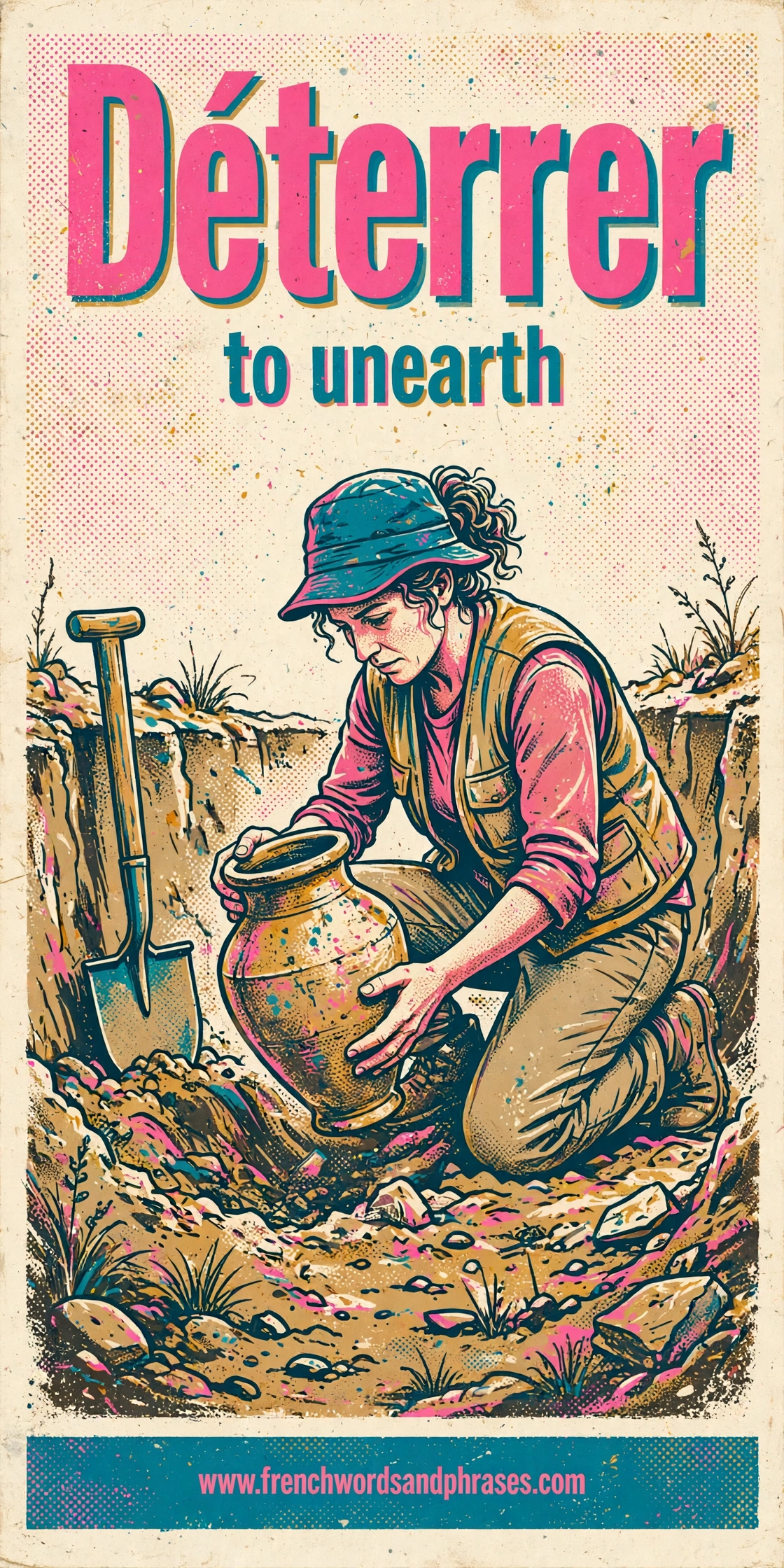
Déterrer means to unearth — to dig something back out of the ground: a coffin, a treasure, buried roots, or a secret that was meant to stay buried.
An archaeologist’s brush clearing sand from a Roman coin, a gardener hauling out the roots of a dead tree, a journalist pulling a forty-year-old letter out of an archive — déterrer is the verb of bringing buried things back into the light, welcome or not.
In this guide, you’ll learn how to conjugate déterrer in all the major French tenses and moods. Explore complete conjugation tables, French examples, English translations, and practice quizzes.
Understanding the French Verb Déterrer
Déterrer is a regular French verb belonging to the first group of verbs, those ending in-er.
It means to unearth. It is used literally for digging up bodies, roots, potatoes and treasure, in archaeology for bringing objects to light, and figuratively for anything dragged back from oblivion: old scandals, forgotten songs, family secrets — un dossier déterré is a file somebody wishes had stayed buried.
Verb classification: First group (-er)
Auxiliary verb: Avoir
Past participle: déterré
Present participle: déterrant
English equivalents: To unearth, to dig up, to exhume; déterrer un trésor — to unearth a treasure; déterrer un mort — to exhume a body; déterrer un secret — to dig up a secret; déterrer la hache de guerre — to dig up the hatchet, to renew hostilities.
One important detail: déterrer is simply dé- plus terre, earth — to un-earth. It is a regular -er verb, but watch the double r: it belongs to terre and never leaves: je déterre, nous déterrons, je déterrerai. Its opposite is enterrer, to bury. And its most famous figurative use reverses a peace ceremony: déterrer la hache de guerre is to dig the war hatchet back up — to start the old quarrel again.
Experience the Word
Déterrer is the verb of the second appearance — everything it touches was hidden, covered, and meant to be forgotten.
Imagine a field in Normandy and a metal detector’s sudden song. The farmer kneels, works the spade gently, and déterre a belt buckle stamped with an eagle, eighty years asleep in the soil. The field gives up its secret in one muddy handful.
The buckle was not found; it was never really lost. It was unearthed — déterré, pulled back across eighty years of earth.
How to Conjugate Déterrer: Complete French Conjugation Guide
Let’s explore every major conjugation of déterrer, beginning with the indicative mood.
How to Conjugate Déterrer in the Indicative Mood
The indicative mood is used to express facts, observations, actions, and events.
How to Conjugate Déterrer in the Present Tense (Présent)
Used for actions happening now, habitual actions, and general truths.
| Subject | Conjugation |
|---|---|
| je | déterre |
| tu | déterres |
| il / elle | déterre |
| nous | déterrons |
| vous | déterrez |
| ils / elles | déterrent |
Example
Les archéologues déterrent une villa romaine près de la rivière.
The archaeologists are unearthing a Roman villa near the river.
Quick Quiz 1
Complete the sentence:
Nous ______ un trésor sous la vieille grange.
Reveal the answer
déterrons
Nous déterrons un trésor sous la vieille grange.
We are unearthing a treasure under the old barn.
How to Conjugate Déterrer in the Passé Composé
Used for completed actions in the past. Déterrer takes the auxiliary verb avoir.
| Subject | Conjugation |
|---|---|
| j’ | ai déterré |
| tu | as déterré |
| il / elle | a déterré |
| nous | avons déterré |
| vous | avez déterré |
| ils / elles | ont déterré |
Example
Le chien a déterré un os énorme dans le jardin.
The dog dug up an enormous bone in the garden.
How to Conjugate Déterrer in the Imparfait (Imperfect Tense)
Used for habitual past actions, descriptions, and ongoing situations in the past.
| Subject | Conjugation |
|---|---|
| je | déterrais |
| tu | déterrais |
| il / elle | déterrait |
| nous | déterrions |
| vous | déterriez |
| ils / elles | déterraient |
Example
Chaque automne, il déterrait les racines des vieux pommiers.
Every autumn, he used to dig up the roots of the old apple trees.
Quick Quiz 2
Choose the correct form:
The farmers unearthed the chest.
Les paysans ______ le coffre. (ont déterré / sont déterrés)
Reveal the answer
ont déterré
Les paysans ont déterré le coffre.
Déterrer takes avoir.
How to Conjugate Déterrer in the Plus-que-parfait
Used to describe an action that had already been completed before another past event.
| Subject | Conjugation |
|---|---|
| j’ | avais déterré |
| tu | avais déterré |
| il / elle | avait déterré |
| nous | avions déterré |
| vous | aviez déterré |
| ils / elles | avaient déterré |
Example
Elle avait déterré de vieilles lettres dans le grenier de sa grand-mère.
She had dug up old letters in her grandmother’s attic.
How to Conjugate Déterrer in the Passé Simple
Primarily used in formal writing, literature, and historical narratives. It is rarely used in everyday conversation.
| Subject | Conjugation |
|---|---|
| je | déterrai |
| tu | déterras |
| il / elle | déterra |
| nous | déterrâmes |
| vous | déterrâtes |
| ils / elles | déterrèrent |
Example
Les paysans déterrèrent un trésor de pièces d’argent sous la grange.
The farmers unearthed a hoard of silver coins under the barn.
How to Conjugate Déterrer in the Passé Antérieur
A literary tense used to express an action completed immediately before another past action, generally in the passé simple.
| Subject | Conjugation |
|---|---|
| j’ | eus déterré |
| tu | eus déterré |
| il / elle | eut déterré |
| nous | eûmes déterré |
| vous | eûtes déterré |
| ils / elles | eurent déterré |
Example
Quand ils eurent déterré le coffre, ils appelèrent le maire.
When they had dug up the chest, they called the mayor.
How to Conjugate Déterrer in the Future Tense (Futur Simple)
Used to describe actions that will take place in the future.
| Subject | Conjugation |
|---|---|
| je | déterrerai |
| tu | déterreras |
| il / elle | déterrera |
| nous | déterrerons |
| vous | déterrerez |
| ils / elles | déterreront |
Example
Demain, nous déterrerons les pommes de terre du fond du champ.
Tomorrow, we will dig up the potatoes at the far end of the field.
How to Conjugate Déterrer in the Futur Antérieur (Future Perfect)
Used for an action that will have been completed before a particular point in the future.
| Subject | Conjugation |
|---|---|
| j’ | aurai déterré |
| tu | auras déterré |
| il / elle | aura déterré |
| nous | aurons déterré |
| vous | aurez déterré |
| ils / elles | auront déterré |
Example
À la fin de l’été, l’équipe aura déterré tout le cimetière ancien.
By the end of the summer, the team will have unearthed the whole ancient cemetery.
How to Conjugate Déterrer in the Near Future (Futur Proche)
Used to describe something that is going to happen soon. Formed with aller + infinitive.
| Subject | Conjugation |
|---|---|
| je | vais déterrer |
| tu | vas déterrer |
| il / elle | va déterrer |
| nous | allons déterrer |
| vous | allez déterrer |
| ils / elles | vont déterrer |
Example
Attention, le chien va encore déterrer tes fleurs !
Careful, the dog is going to dig up your flowers again!
How to Conjugate Déterrer in the Conditional Mood
The conditional mood expresses what would happen under certain circumstances. It is also frequently used to make polite requests or express wishes.
How to Conjugate Déterrer in the Present Conditional
| Subject | Conjugation |
|---|---|
| je | déterrerais |
| tu | déterrerais |
| il / elle | déterrerait |
| nous | déterrerions |
| vous | déterreriez |
| ils / elles | déterreraient |
Example
Avec une meilleure carte, on déterrerait le trésor en une journée.
With a better map, we would unearth the treasure in a day.
How to Conjugate Déterrer in the Past Conditional
| Subject | Conjugation |
|---|---|
| j’ | aurais déterré |
| tu | aurais déterré |
| il / elle | aurait déterré |
| nous | aurions déterré |
| vous | auriez déterré |
| ils / elles | auraient déterré |
Example
Le journaliste aurait déterré le scandale sans ces menaces.
The journalist would have dug up the scandal without those threats.
Déterrer in the Literary Past Conditional Form
This less common literary form uses the imperfect subjunctive of avoir.
| Subject | Conjugation |
|---|---|
| j’ | eusse déterré |
| tu | eusses déterré |
| il / elle | eût déterré |
| nous | eussions déterré |
| vous | eussiez déterré |
| ils / elles | eussent déterré |
Example
Les soldats eussent déterré leurs morts sans l’ordre de partir.
The soldiers would have exhumed their dead, had the order to leave not come.
How to Conjugate Déterrer in the Subjunctive Mood
The subjunctive is used to express wishes, emotions, doubts, necessity, and uncertainty. It frequently follows expressions such as il faut que (it is necessary that) or bien que (although).
How to Conjugate Déterrer in the Present Subjunctive
| Subject | Conjugation |
|---|---|
| que je | déterre |
| que tu | déterres |
| qu’il / qu’elle | déterre |
| que nous | déterrions |
| que vous | déterriez |
| qu’ils / qu’elles | déterrent |
Example
Il faut que vous déterriez ces racines avant de replanter.
You must dig up these roots before replanting.
Quick Quiz 3
Complete the sentence using the subjunctive:
Il faut que tu ______ ce secret une bonne fois pour toutes.
Reveal the answer
déterres
Il faut que tu déterres ce secret une bonne fois pour toutes.
You must dig up that secret once and for all.
How to Conjugate Déterrer in the Imperfect Subjunctive
A literary tense, rarely encountered in modern spoken French.
| Subject | Conjugation |
|---|---|
| que je | déterrasse |
| que tu | déterrasses |
| qu’il / qu’elle | déterrât |
| que nous | déterrassions |
| que vous | déterrassiez |
| qu’ils / qu’elles | déterrassent |
Example
Je doutais qu’il déterrât quoi que ce soit dans ce champ vide.
I doubted he would unearth anything at all in that empty field.
How to Conjugate Déterrer in the Pluperfect Subjunctive
A literary construction used to express an action completed before another past action.
| Subject | Conjugation |
|---|---|
| que j’ | eusse déterré |
| que tu | eusses déterré |
| qu’il / qu’elle | eût déterré |
| que nous | eussions déterré |
| que vous | eussiez déterré |
| qu’ils / qu’elles | eussent déterré |
Example
On racontait que les frères eussent déterré l’or pendant la nuit.
People said the brothers had dug up the gold during the night.
How to Conjugate Déterrer in the Past Subjunctive
| Subject | Conjugation |
|---|---|
| que j’ | aie déterré |
| que tu | aies déterré |
| qu’il / qu’elle | ait déterré |
| nous | ayons déterré |
| que vous | ayez déterré |
| qu’ils / qu’elles | aient déterré |
Example
Je suis étonné qu’elle ait déterré cette vieille histoire.
I am amazed she dug up that old story.
How to Conjugate Déterrer in the Imperative
The imperative is used to give commands, instructions, invitations, or suggestions. Subject pronouns are omitted.
How to Conjugate Déterrer in the Present Imperative
| Person | Conjugation |
|---|---|
| (tu) | déterre |
| (nous) | déterrons |
| (vous) | déterrez |
Example
Déterre ce trésor, mais doucement, le coffre est fragile !
Unearth that treasure, but gently, the chest is fragile!
Quick Quiz 4
How would you say Dig up these roots (tu form)?
Reveal the answer
Déterre ces racines !
French Participles of Déterrer
Participles are verb forms that can be used in compound tenses and other grammatical constructions.
Present Participle of Déterrer
déterrant
En déterrant le coffre, ils ont trouvé une carte ancienne.
By digging up the chest, they found an old map.
Past Participle of Déterrer
déterré
Déterrée après deux mille ans, la statue a gardé ses couleurs.
Unearthed after two thousand years, the statue kept its colours.
Déterrer in Everyday French: Real-Life Examples
Now that you know the conjugations, let’s see how déterrer appears in everyday French.
Example 1 — Present
Les archéologues déterrent une villa romaine.
The archaeologists are unearthing a Roman villa.
Example 2 — Passé composé
Le chien a déterré un os dans le jardin.
The dog dug up a bone in the garden.
Example 3 — Imparfait
Il déterrait les racines chaque automne.
He used to dig up the roots every autumn.
Example 4 — Future
Nous déterrerons les pommes de terre demain.
We will dig up the potatoes tomorrow.
Example 5 — Conditional
On déterrerait le trésor avec une meilleure carte.
We would unearth the treasure with a better map.
Example 6 — Imperative
Déterrez ces racines avant de replanter !
Dig up these roots before replanting!
Beyond Translation: The Meaning of Déterrer
English unearth is the exact mirror — both languages build the word by undoing the earth itself.
But French buries and unburies its quarrels too.
Enterrer la hache de guerre is to bury the hatchet and make peace; déterrer la hache de guerre is to dig it up again and restart the feud. A déterré secret is rarely forgiven — the verb remembers that some things were buried on purpose.
How to Remember the French Verb Déterrer
Remember it this way: Déterrer is about the spade in the Normandy field — eighty years of earth, lifted in one handful.
- Dé- plus terre: to un-earth — the exact opposite of enterrer, to bury.
- The double r of terre never leaves: je déterre, nous déterrons, je déterrerai.
- Figurative gold: déterrer un secret, and déterrer la hache de guerre — to restart an old quarrel.
The key idea is the spade in the Normandy field — eighty years of earth, lifted in one handful.
Test Your Knowledge of Déterrer
Let’s see how much you’ve learned. Try answering these questions before revealing the answers.
Question 1
What is the opposite of déterrer?
Reveal the answer
Enterrer — to bury. Déterrer un-does it: to unearth, to dig up.
Question 2
How do you say The dog dug up a bone in the garden in French?
Reveal the answer
Le chien a déterré un os dans le jardin.
Question 3
Translate: To dig up the hatchet (to renew hostilities).
Reveal the answer
Déterrer la hache de guerre.
Question 4
What is the past participle of déterrer?
Reveal the answer
Déterré.
Question 5
Complete the sentence:
Il faut que vous ______ ces racines avant de replanter.
Reveal the answer
déterriez
Il faut que vous déterriez ces racines avant de replanter.
You must dig up these roots before replanting.
Your Final Challenge
Can You Use It?
How would you say this in French?
Every spring, the gardener unearths the same roots and the same memories.
Reveal the answer
Chaque printemps, le jardinier déterre les mêmes racines et les mêmes souvenirs.
Every spring, the gardener unearths the same roots and the same memories.
A little French. A little curiosity. A richer everyday life.
LEARN FRENCH ONE WORD AT A TIME