A French Word to Live By
How to Conjugate Desseller in French
/de.sɛ.le/
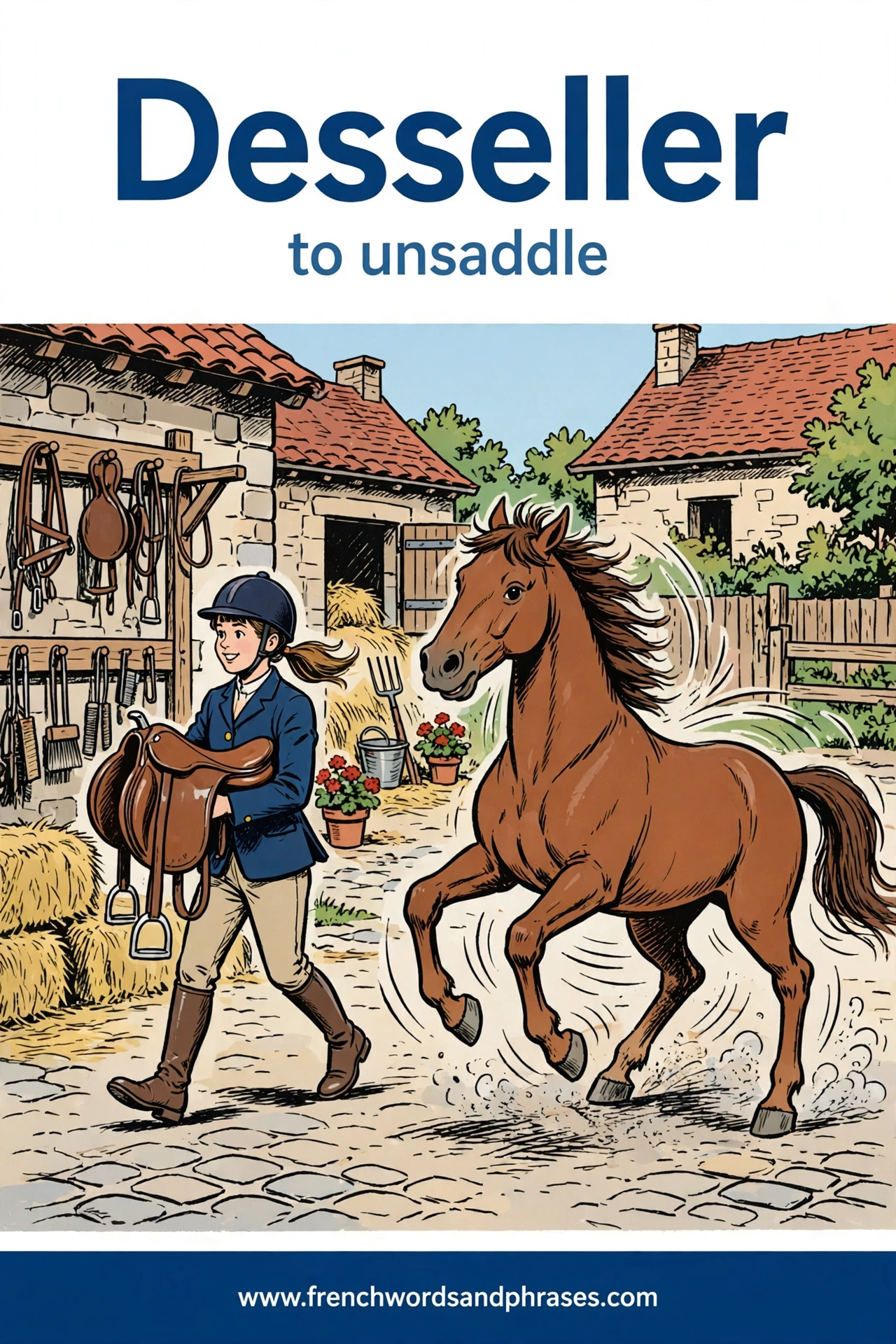
Desseller means to unsaddle — to lift the saddle off a horse’s back at the end of the ride.
The ride is over, the horse is steaming in the cold stable air, and the rider lifts the saddle clear with both hands — desseller is the stable verb of the day’s last kindness: the weight comes off, and the horse is free.
In this guide, you’ll learn how to conjugate desseller in all the major French tenses and moods. Explore complete conjugation tables, French examples, English translations, and practice quizzes.
Understanding the French Verb Desseller
Desseller is a regular French verb belonging to the first group of verbs, those ending in-er.
It means to unsaddle. It belongs to the end-of-ride ritual and almost always takes the horse as its object: desseller un cheval. The order of the ritual is fixed in every riding school — first dessangler, loosen the girth, then desseller, lift the saddle off — and the verb appears in manuals, stable rules and horsey novels far more than in daily speech.
Verb classification: First group (-er)
Auxiliary verb: Avoir
Past participle: dessellé
Present participle: dessellant
English equivalents: To unsaddle; desseller un cheval — to unsaddle a horse; desseller avant de brosser — to unsaddle before grooming; la selle — the saddle; seller — to saddle up; desseller et dessangler — to unsaddle and ungirth.
One important detail: desseller is built on la selle, the saddle, and the double l of selle stays in every form: je desselle, nous dessellons, ils dessellent — there is no stem change to hunt for, the ll is simply part of the stem. It is the exact reverse of seller, to saddle. Take care with its one-letter neighbours: dessaler removes salt in the kitchen, desseller removes saddles in the stable, and desserrer loosens things in the workshop.
Experience the Word
Desseller is the verb of the saddle coming off — the moment the horse’s day of work truly ends.
Imagine a winter evening at a riding school. The last lesson is over; a girl leads her pony into the stable, loosens the girth, then desselle with a practised heave — the saddle lands on its rack, and the pony shakes its whole body like a dog coming out of water.
Saddle off, back free, dinner next. The pony is unsaddled — dessellé, and already thinking about hay.
How to Conjugate Desseller: Complete French Conjugation Guide
Let’s explore every major conjugation of desseller, beginning with the indicative mood.
How to Conjugate Desseller in the Indicative Mood
The indicative mood is used to express facts, observations, actions, and events.
How to Conjugate Desseller in the Present Tense (Présent)
Used for actions happening now, habitual actions, and general truths.
| Subject | Conjugation |
|---|---|
| je | desselle |
| tu | desselles |
| il / elle | desselle |
| nous | dessellons |
| vous | dessellez |
| ils / elles | dessellent |
Example
Le cavalier desselle son cheval dans la cour de l’écurie.
The rider unsaddles his horse in the stable yard.
Quick Quiz 1
Complete the sentence:
Nous ______ les chevaux avant de les rentrer.
Reveal the answer
dessellons
Nous dessellons les chevaux avant de les rentrer.
We unsaddle the horses before bringing them in.
How to Conjugate Desseller in the Passé Composé
Used for completed actions in the past. Desseller takes the auxiliary verb avoir.
| Subject | Conjugation |
|---|---|
| j’ | ai dessellé |
| tu | as dessellé |
| il / elle | a dessellé |
| nous | avons dessellé |
| vous | avez dessellé |
| ils / elles | ont dessellé |
Example
Elle a dessellé le poney avant de le brosser.
She unsaddled the pony before grooming it.
How to Conjugate Desseller in the Imparfait (Imperfect Tense)
Used for habitual past actions, descriptions, and ongoing situations in the past.
| Subject | Conjugation |
|---|---|
| je | dessellais |
| tu | dessellais |
| il / elle | dessellait |
| nous | dessellions |
| vous | desselliez |
| ils / elles | dessellaient |
Example
Chaque soir, le garçon d’écurie dessellait les chevaux des clients.
Every evening, the stable boy used to unsaddle the clients’ horses.
Quick Quiz 2
Choose the correct form:
She unsaddled the pony.
Elle ______ le poney. (a dessellé / est dessellée)
Reveal the answer
a dessellé
Elle a dessellé le poney.
Desseller takes avoir.
How to Conjugate Desseller in the Plus-que-parfait
Used to describe an action that had already been completed before another past event.
| Subject | Conjugation |
|---|---|
| j’ | avais dessellé |
| tu | avais dessellé |
| il / elle | avait dessellé |
| nous | avions dessellé |
| vous | aviez dessellé |
| ils / elles | avaient dessellé |
Example
Il avait dessellé sa monture avant même de boire un verre d’eau.
He had unsaddled his mount before even drinking a glass of water.
How to Conjugate Desseller in the Passé Simple
Primarily used in formal writing, literature, and historical narratives. It is rarely used in everyday conversation.
| Subject | Conjugation |
|---|---|
| je | dessellai |
| tu | dessellas |
| il / elle | dessella |
| nous | dessellâmes |
| vous | dessellâtes |
| ils / elles | dessellèrent |
Example
Le cavalier dessella son cheval sous le hangar.
The rider unsaddled his horse under the shed.
How to Conjugate Desseller in the Passé Antérieur
A literary tense used to express an action completed immediately before another past action, generally in the passé simple.
| Subject | Conjugation |
|---|---|
| j’ | eus dessellé |
| tu | eus dessellé |
| il / elle | eut dessellé |
| nous | eûmes dessellé |
| vous | eûtes dessellé |
| ils / elles | eurent dessellé |
Example
Quand elle eut dessellé le cheval, elle le couvrit d’une couverture.
When she had unsaddled the horse, she covered it with a blanket.
How to Conjugate Desseller in the Future Tense (Futur Simple)
Used to describe actions that will take place in the future.
| Subject | Conjugation |
|---|---|
| je | dessellerai |
| tu | desselleras |
| il / elle | dessellera |
| nous | dessellerons |
| vous | dessellerez |
| ils / elles | desselleront |
Example
Tu desselleras ton cheval dès la fin de la promenade.
You will unsaddle your horse at the end of the ride.
How to Conjugate Desseller in the Futur Antérieur (Future Perfect)
Used for an action that will have been completed before a particular point in the future.
| Subject | Conjugation |
|---|---|
| j’ | aurai dessellé |
| tu | auras dessellé |
| il / elle | aura dessellé |
| nous | aurons dessellé |
| vous | aurez dessellé |
| ils / elles | auront dessellé |
Example
À la tombée de la nuit, les cavaliers auront dessellé tous les chevaux.
By nightfall, the riders will have unsaddled all the horses.
How to Conjugate Desseller in the Near Future (Futur Proche)
Used to describe something that is going to happen soon. Formed with aller + infinitive.
| Subject | Conjugation |
|---|---|
| je | vais desseller |
| tu | vas desseller |
| il / elle | va desseller |
| nous | allons desseller |
| vous | allez desseller |
| ils / elles | vont desseller |
Example
Je vais desseller la jument, elle a bien mérité son repos.
I am going to unsaddle the mare, she has earned her rest.
How to Conjugate Desseller in the Conditional Mood
The conditional mood expresses what would happen under certain circumstances. It is also frequently used to make polite requests or express wishes.
How to Conjugate Desseller in the Present Conditional
| Subject | Conjugation |
|---|---|
| je | dessellerais |
| tu | dessellerais |
| il / elle | dessellerait |
| nous | dessellerions |
| vous | desselleriez |
| ils / elles | desselleraient |
Example
Un cavalier soigneux dessellerait toujours avant de nourrir.
A careful rider would always unsaddle before feeding.
How to Conjugate Desseller in the Past Conditional
| Subject | Conjugation |
|---|---|
| j’ | aurais dessellé |
| tu | aurais dessellé |
| il / elle | aurait dessellé |
| nous | aurions dessellé |
| vous | auriez dessellé |
| ils / elles | auraient dessellé |
Example
Tu aurais dessellé le cheval si la pluie ne t’avait pas surpris.
You would have unsaddled the horse if the rain had not caught you out.
Desseller in the Literary Past Conditional Form
This less common literary form uses the imperfect subjunctive of avoir.
| Subject | Conjugation |
|---|---|
| j’ | eusse dessellé |
| tu | eusses dessellé |
| il / elle | eût dessellé |
| nous | eussions dessellé |
| vous | eussiez dessellé |
| ils / elles | eussent dessellé |
Example
Le chevalier eût dessellé sa monture avant de saluer la dame.
The knight would have unsaddled his mount before greeting the lady.
How to Conjugate Desseller in the Subjunctive Mood
The subjunctive is used to express wishes, emotions, doubts, necessity, and uncertainty. It frequently follows expressions such as il faut que (it is necessary that) or bien que (although).
How to Conjugate Desseller in the Present Subjunctive
| Subject | Conjugation |
|---|---|
| que je | desselle |
| que tu | desselles |
| qu’il / qu’elle | desselle |
| que nous | dessellions |
| que vous | desselliez |
| qu’ils / qu’elles | dessellent |
Example
Il faut que tu desselles ton cheval toi-même.
You must unsaddle your horse yourself.
Quick Quiz 3
Complete the sentence using the subjunctive:
Il faut que vous ______ vos poneys sans aide.
Reveal the answer
desselliez
Il faut que vous desselliez vos poneys sans aide.
You must unsaddle your ponies unaided.
How to Conjugate Desseller in the Imperfect Subjunctive
A literary tense, rarely encountered in modern spoken French.
| Subject | Conjugation |
|---|---|
| que je | dessellasse |
| que tu | dessellasses |
| qu’il / qu’elle | dessellât |
| que nous | dessellassions |
| que vous | dessellassiez |
| qu’ils / qu’elles | dessellassent |
Example
Le moniteur demandait que les élèves dessellassent leurs poneys sans aide.
The instructor asked the pupils to unsaddle their ponies unaided.
How to Conjugate Desseller in the Pluperfect Subjunctive
A literary construction used to express an action completed before another past action.
| Subject | Conjugation |
|---|---|
| que j’ | eusse dessellé |
| que tu | eusses dessellé |
| qu’il / qu’elle | eût dessellé |
| que nous | eussions dessellé |
| que vous | eussiez dessellé |
| qu’ils / qu’elles | eussent dessellé |
Example
On admirait que le garçon eût dessellé six chevaux en dix minutes.
People admired that the boy had unsaddled six horses in ten minutes.
How to Conjugate Desseller in the Past Subjunctive
| Subject | Conjugation |
|---|---|
| que j’ | aie dessellé |
| que tu | aies dessellé |
| qu’il / qu’elle | ait dessellé |
| que nous | ayons dessellé |
| que vous | ayez dessellé |
| qu’ils / qu’elles | aient dessellé |
Example
Je suis content que tu aies dessellé le cheval correctement.
I am glad you unsaddled the horse properly.
How to Conjugate Desseller in the Imperative
The imperative is used to give commands, instructions, invitations, or suggestions. Subject pronouns are omitted.
How to Conjugate Desseller in the Present Imperative
| Person | Conjugation |
|---|---|
| (tu) | desselle |
| (nous) | dessellons |
| (vous) | dessellez |
Example
Desselle ton cheval et pose la selle sur le râtelier !
Unsaddle your horse and put the saddle on the rack!
Quick Quiz 4
How would you say Unsaddle your horse (tu form)?
Reveal the answer
Desselle ton cheval !
French Participles of Desseller
Participles are verb forms that can be used in compound tenses and other grammatical constructions.
Present Participle of Desseller
dessellant
En dessellant le cheval, elle remarqua une écorchure sur le dos.
While unsaddling the horse, she noticed a graze on its back.
Past Participle of Desseller
dessellé
Dessellé et brossé, le cheval reçut enfin son avoine.
Unsaddled and groomed, the horse finally got its oats.
Desseller in Everyday French: Real-Life Examples
Now that you know the conjugations, let’s see how desseller appears in everyday French.
Example 1 — Present
Le cavalier desselle son cheval.
The rider unsaddles his horse.
Example 2 — Passé composé
Elle a dessellé le poney.
She unsaddled the pony.
Example 3 — Imparfait
Le garçon d’écurie dessellait les chevaux des clients.
The stable boy used to unsaddle the clients’ horses.
Example 4 — Future
Tu desselleras ton cheval après la promenade.
You will unsaddle your horse after the ride.
Example 5 — Conditional
Un cavalier soigneux dessellerait avant de nourrir.
A careful rider would unsaddle before feeding.
Example 6 — Imperative
Dessellez vos chevaux et rentrez les selles !
Unsaddle your horses and bring the saddles in!
Beyond Translation: The Meaning of Desseller
English unsaddle is its twin, but French desseller carries the stable inside it — la selle, the saddle, from the same Latin sella that gave English its saddle.
Every ride ends with the same gesture.
Seller in the morning, desseller in the evening: the pair of verbs frames the working day of horse and rider, and the double l never leaves either of them.
How to Remember the French Verb Desseller
Remember it this way: Desseller is about the saddle lifted clear in the winter stable.
- La selle is the saddle; desseller takes it off, seller puts it on.
- The double l never changes: je desselle, nous dessellons, ils dessellent.
- Stable order: dessangler first (the girth), then desseller (the saddle).
The key idea is the saddle lifted clear in the winter stable.
Test Your Knowledge of Desseller
Let’s see how much you’ve learned. Try answering these questions before revealing the answers.
Question 1
What is the order of the stable ritual with dessangler?
Reveal the answer
Dessangler first — loosen the girth — then desseller, lift the saddle off.
Question 2
How do you say The rider unsaddles his horse in French?
Reveal the answer
Le cavalier desselle son cheval.
Question 3
Translate: She unsaddled the pony before grooming it.
Reveal the answer
Elle a dessellé le poney avant de le brosser.
Question 4
What is the past participle of desseller?
Reveal the answer
Dessellé.
Question 5
Complete the sentence:
Il faut que tu ______ ton cheval toi-même.
Reveal the answer
desselles
Il faut que tu desselles ton cheval toi-même.
You must unsaddle your horse yourself.
Your Final Challenge
Can You Use It?
How would you say this in French?
She unsaddles her horse in the cold yard, and steam rises from its back into the evening.
Reveal the answer
Elle desselle son cheval dans la cour froide, et la vapeur monte de son dos dans le soir.
She unsaddles her horse in the cold yard, and steam rises from its back into the evening.
A little French. A little curiosity. A richer everyday life.
LEARN FRENCH ONE WORD AT A TIME