A French Word to Live By
How to Conjugate Dessécher in French
/de.se.ʃe/
Dessécher means to dry up — to drain the moisture out of a pond, a plant, a skin, until nothing soft is left.
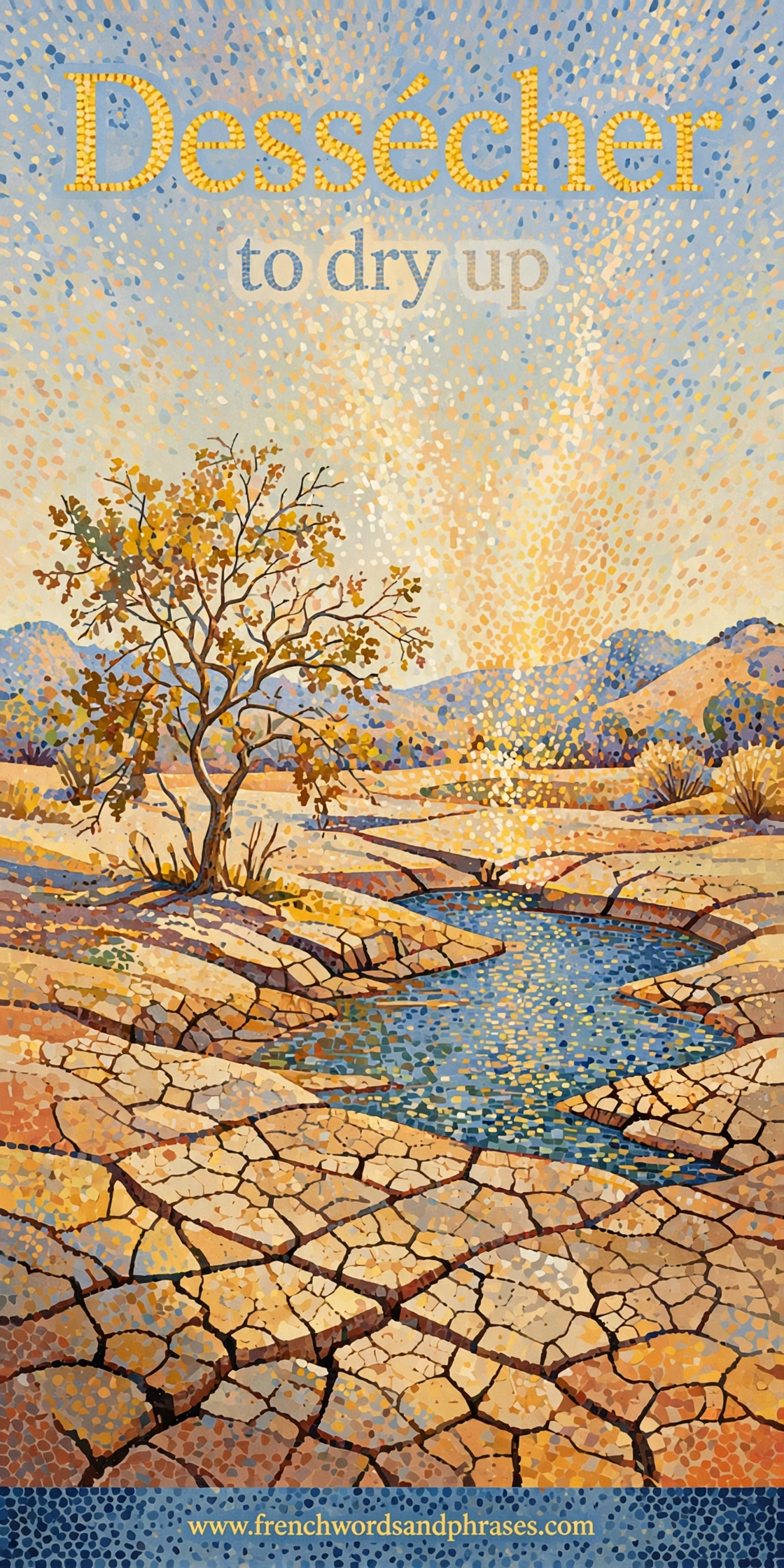
A pond shrinking to cracked mud in August, laundry stiff as boards on the line, lips cracked by the mountain wind — dessécher is the verb of moisture leaving: sun, wind and time pulling the water out of the world.
In this guide, you’ll learn how to conjugate dessécher in all the major French tenses and moods. Explore complete conjugation tables, French examples, English translations, and practice quizzes.
Understanding the French Verb Dessécher
Dessécher is a regular French verb belonging to the first group of verbs, those ending in-er.
It means to dry up. It works transitively (le soleil dessèche la terre), intransitively (l’étang dessèche en été) and reflexively (la plante se dessèche). Beyond ponds and laundry, French uses it of hearts and imaginations: un cœur desséché is a heart with no feeling left, une âme desséchée a soul gone arid — the metaphor of drought is never far away.
Verb classification: First group (-er)
Auxiliary verb: Avoir
Past participle: desséché
Present participle: desséchant
English equivalents: To dry up, to dry out, to parch; dessécher un marais — to drain a marsh dry; dessécher la peau — to dry out the skin; se dessécher — to dry out, to wither; un cœur desséché — a heart dried up, hardened; des herbes desséchées — dried herbs.
One important detail: dessécher is a céder-type verb — the é of the stem opens to è wherever the next syllable is mute: je dessèche, tu dessèches, il dessèche, ils dessèchent, and through the future and conditional: je dessècherai, je dessècherais. The é stays wherever the ending is sounded: nous desséchons, vous desséchez, je desséchais, en desséchant. It is a close cousin of sécher, to dry, with the intensive prefix dé-: dessécher is drying taken to the end — to dry up, completely.
Experience the Word
Dessécher is the verb of the cracked earth — what was wet, soft and alive, left too long under the sun.
Imagine a village pond in the Languedoc at the end of August. In June the frogs sang there; now the level drops a finger’s width a day, the mud cracks into plates, and les berges se dessèchent — the pond is drying up under a white sky.
Nothing dramatic, just sun and time. The pond has dried up — desséché, down to the last cracked plate of mud.
How to Conjugate Dessécher: Complete French Conjugation Guide
Let’s explore every major conjugation of dessécher, beginning with the indicative mood.
How to Conjugate Dessécher in the Indicative Mood
The indicative mood is used to express facts, observations, actions, and events.
How to Conjugate Dessécher in the Present Tense (Présent)
Used for actions happening now, habitual actions, and general truths.
| Subject | Conjugation |
|---|---|
| je | dessèche |
| tu | dessèches |
| il / elle | dessèche |
| nous | desséchons |
| vous | desséchez |
| ils / elles | dessèchent |
Example
Le soleil dessèche la terre en quelques jours.
The sun dries up the earth in a few days.
Quick Quiz 1
Complete the sentence:
Nous ______ les herbes à l’ombre du grenier.
Reveal the answer
desséchons
Nous desséchons les herbes à l’ombre du grenier.
We dry the herbs in the shade of the attic.
How to Conjugate Dessécher in the Passé Composé
Used for completed actions in the past. Dessécher takes the auxiliary verb avoir.
| Subject | Conjugation |
|---|---|
| j’ | ai desséché |
| tu | as desséché |
| il / elle | a desséché |
| nous | avons desséché |
| vous | avez desséché |
| ils / elles | ont desséché |
Example
La canicule a desséché les champs de blé.
The heatwave dried up the wheat fields.
How to Conjugate Dessécher in the Imparfait (Imperfect Tense)
Used for habitual past actions, descriptions, and ongoing situations in the past.
| Subject | Conjugation |
|---|---|
| je | desséchais |
| tu | desséchais |
| il / elle | desséchait |
| nous | desséchions |
| vous | desséchiez |
| ils / elles | desséchaient |
Example
Chaque été, le vent desséchait les collines.
Every summer, the wind used to parch the hills.
Quick Quiz 2
Choose the correct form:
The drought dried up the well.
La sécheresse ______ le puits. (a desséché / est desséchée)
Reveal the answer
a desséché
La sécheresse a desséché le puits.
Dessécher takes avoir.
How to Conjugate Dessécher in the Plus-que-parfait
Used to describe an action that had already been completed before another past event.
| Subject | Conjugation |
|---|---|
| j’ | avais desséché |
| tu | avais desséché |
| il / elle | avait desséché |
| nous | avions desséché |
| vous | aviez desséché |
| ils / elles | avaient desséché |
Example
La sécheresse avait desséché le puits du village.
The drought had dried up the village well.
How to Conjugate Dessécher in the Passé Simple
Primarily used in formal writing, literature, and historical narratives. It is rarely used in everyday conversation.
| Subject | Conjugation |
|---|---|
| je | desséchai |
| tu | desséchas |
| il / elle | dessécha |
| nous | desséchâmes |
| vous | desséchâtes |
| ils / elles | desséchèrent |
Example
Le mistral dessécha les vignes en une semaine.
The mistral dried up the vines in one week.
How to Conjugate Dessécher in the Passé Antérieur
A literary tense used to express an action completed immediately before another past action, generally in the passé simple.
| Subject | Conjugation |
|---|---|
| j’ | eus desséché |
| tu | eus desséché |
| il / elle | eut desséché |
| nous | eûmes desséché |
| vous | eûtes desséché |
| ils / elles | eurent desséché |
Example
Quand le soleil eut desséché la mare, les grenouilles disparurent.
When the sun had dried up the pond, the frogs disappeared.
How to Conjugate Dessécher in the Future Tense (Futur Simple)
Used to describe actions that will take place in the future.
| Subject | Conjugation |
|---|---|
| je | dessècherai |
| tu | dessècheras |
| il / elle | dessèchera |
| nous | dessècherons |
| vous | dessècherez |
| ils / elles | dessècheront |
Example
Sans pluie, la rivière dessèchera avant septembre.
Without rain, the river will dry up before September.
How to Conjugate Dessécher in the Futur Antérieur (Future Perfect)
Used for an action that will have been completed before a particular point in the future.
| Subject | Conjugation |
|---|---|
| j’ | aurai desséché |
| tu | auras desséché |
| il / elle | aura desséché |
| nous | aurons desséché |
| vous | aurez desséché |
| ils / elles | auront desséché |
Example
À la fin de l’été, le soleil aura desséché toutes les mares.
By the end of summer, the sun will have dried up all the ponds.
How to Conjugate Dessécher in the Near Future (Futur Proche)
Used to describe something that is going to happen soon. Formed with aller + infinitive.
| Subject | Conjugation |
|---|---|
| je | vais dessécher |
| tu | vas dessécher |
| il / elle | va dessécher |
| nous | allons dessécher |
| vous | allez dessécher |
| ils / elles | vont dessécher |
Example
Ce vent chaud va dessécher ta peau.
This hot wind is going to dry out your skin.
How to Conjugate Dessécher in the Conditional Mood
The conditional mood expresses what would happen under certain circumstances. It is also frequently used to make polite requests or express wishes.
How to Conjugate Dessécher in the Present Conditional
| Subject | Conjugation |
|---|---|
| je | dessècherais |
| tu | dessècherais |
| il / elle | dessècherait |
| nous | dessècherions |
| vous | dessècheriez |
| ils / elles | dessècheraient |
Example
Un été sans pluie dessècherait les sources de la montagne.
A rainless summer would dry up the mountain springs.
How to Conjugate Dessécher in the Past Conditional
| Subject | Conjugation |
|---|---|
| j’ | aurais desséché |
| tu | aurais desséché |
| il / elle | aurait desséché |
| nous | aurions desséché |
| vous | auriez desséché |
| ils / elles | auraient desséché |
Example
L’irrigation aurait desséché moins de terres avec de meilleurs canaux.
Irrigation would have dried out less land with better canals.
Dessécher in the Literary Past Conditional Form
This less common literary form uses the imperfect subjunctive of avoir.
| Subject | Conjugation |
|---|---|
| j’ | eusse desséché |
| tu | eusses desséché |
| il / elle | eût desséché |
| nous | eussions desséché |
| vous | eussiez desséché |
| ils / elles | eussent desséché |
Example
Le soleil eût desséché la plaine entière sans la rivière.
The sun would have dried up the whole plain without the river.
How to Conjugate Dessécher in the Subjunctive Mood
The subjunctive is used to express wishes, emotions, doubts, necessity, and uncertainty. It frequently follows expressions such as il faut que (it is necessary that) or bien que (although).
How to Conjugate Dessécher in the Present Subjunctive
| Subject | Conjugation |
|---|---|
| que je | dessèche |
| que tu | dessèches |
| qu’il / qu’elle | dessèche |
| que nous | desséchions |
| que vous | desséchiez |
| qu’ils / qu’elles | dessèchent |
Example
Je crains que la chaleur dessèche les jeunes plants.
I fear the heat will dry out the young plants.
Quick Quiz 3
Complete the sentence using the subjunctive:
Je crains que le vent ______ ta peau.
Reveal the answer
dessèche
Je crains que le vent dessèche ta peau.
I fear the wind will dry out your skin.
How to Conjugate Dessécher in the Imperfect Subjunctive
A literary tense, rarely encountered in modern spoken French.
| Subject | Conjugation |
|---|---|
| que je | desséchasse |
| que tu | desséchasses |
| qu’il / qu’elle | desséchât |
| que nous | desséchassions |
| que vous | desséchassiez |
| qu’ils / qu’elles | desséchassent |
Example
Il fallait arroser pour que la terre ne se desséchât pas.
Watering was needed so the earth would not dry out.
How to Conjugate Dessécher in the Pluperfect Subjunctive
A literary construction used to express an action completed before another past action.
| Subject | Conjugation |
|---|---|
| que j’ | eusse desséché |
| que tu | eusses desséché |
| qu’il / qu’elle | eût desséché |
| que nous | eussions desséché |
| que vous | eussiez desséché |
| qu’ils / qu’elles | eussent desséché |
Example
On disait que la sécheresse eût desséché tous les puits du pays.
It was said the drought had dried up all the wells in the land.
How to Conjugate Dessécher in the Past Subjunctive
| Subject | Conjugation |
|---|---|
| que j’ | aie desséché |
| que tu | aies desséché |
| qu’il / qu’elle | ait desséché |
| que nous | ayons desséché |
| que vous | ayez desséché |
| qu’ils / qu’elles | aient desséché |
Example
Je suis désolé que le soleil ait desséché tes rosiers.
I am sorry the sun dried out your rose bushes.
How to Conjugate Dessécher in the Imperative
The imperative is used to give commands, instructions, invitations, or suggestions. Subject pronouns are omitted.
How to Conjugate Dessécher in the Present Imperative
| Person | Conjugation |
|---|---|
| (tu) | dessèche |
| (nous) | desséchons |
| (vous) | desséchez |
Example
Ne dessèche pas ces herbes au soleil, mets-les à l’ombre !
Do not dry these herbs in the sun, put them in the shade!
Quick Quiz 4
How would you say Dry up this marsh (tu form)?
Reveal the answer
Dessèche ce marais !
French Participles of Dessécher
Participles are verb forms that can be used in compound tenses and other grammatical constructions.
Present Participle of Dessécher
desséchant
En desséchant le marais, on a chassé les oiseaux.
By draining the marsh dry, they drove away the birds.
Past Participle of Dessécher
desséché
Desséchée par le vent, la terre se fendille de partout.
Dried up by the wind, the earth is cracking everywhere.
Dessécher in Everyday French: Real-Life Examples
Now that you know the conjugations, let’s see how dessécher appears in everyday French.
Example 1 — Present
Le soleil dessèche la terre.
The sun dries up the earth.
Example 2 — Passé composé
La canicule a desséché les champs.
The heatwave dried up the fields.
Example 3 — Imparfait
Le vent desséchait les collines.
The wind used to parch the hills.
Example 4 — Future
La rivière dessèchera avant septembre.
The river will dry up before September.
Example 5 — Conditional
Un été sans pluie dessècherait les sources.
A rainless summer would dry up the springs.
Example 6 — Imperative
Ne dessèche pas les herbes au soleil !
Do not dry the herbs in the sun!
Beyond Translation: The Meaning of Dessécher
English dry up needs two words; French dessécher does it in one, and reaches further — into the heart.
A dried-up pond and a dried-up soul obey the same verb.
French moralists loved it: un cœur desséché par l’ambition, a heart dried up by ambition. From sec, dry, the verb keeps the whole family in view — la sécheresse is the drought, and dessécher is the drought at work.
How to Remember the French Verb Dessécher
Remember it this way: Dessécher is about the village pond cracking into plates of mud in August.
- Céder-type spelling: je dessèche with è, but nous desséchons with é.
- Stronger than sécher: dessécher is to dry UP, completely, to the last drop.
- Watch the figurative sense: un cœur desséché, a heart with no feeling left.
The key idea is the village pond cracking into plates of mud in August.
Test Your Knowledge of Dessécher
Let’s see how much you’ve learned. Try answering these questions before revealing the answers.
Question 1
Why does je dessèche have a grave accent but nous desséchons an acute one?
Reveal the answer
The céder-type rule — é becomes è before a mute syllable (je dessèche), and stays é where the ending is sounded (nous desséchons).
Question 2
How do you say The sun dries up the earth in French?
Reveal the answer
Le soleil dessèche la terre.
Question 3
Translate: The heatwave dried up the fields.
Reveal the answer
La canicule a desséché les champs.
Question 4
What is the past participle of dessécher?
Reveal the answer
Desséché.
Question 5
Complete the sentence:
Je crains que la chaleur ______ les jeunes plants.
Reveal the answer
dessèche
Je crains que la chaleur dessèche les jeunes plants.
I fear the heat will dry out the young plants.
Your Final Challenge
Can You Use It?
How would you say this in French?
The pond is drying up under the white sky, and the frogs wait for rain in silence.
Reveal the answer
L’étang dessèche sous le ciel blanc, et les grenouilles attendent la pluie en silence.
The pond is drying up under the white sky, and the frogs wait for rain in silence.
A little French. A little curiosity. A richer everyday life.
LEARN FRENCH ONE WORD AT A TIME