A French Word to Live By
Translate Désagréable to English
/de.za.ɡʁe.abl/
Désagréable means unpleasant.
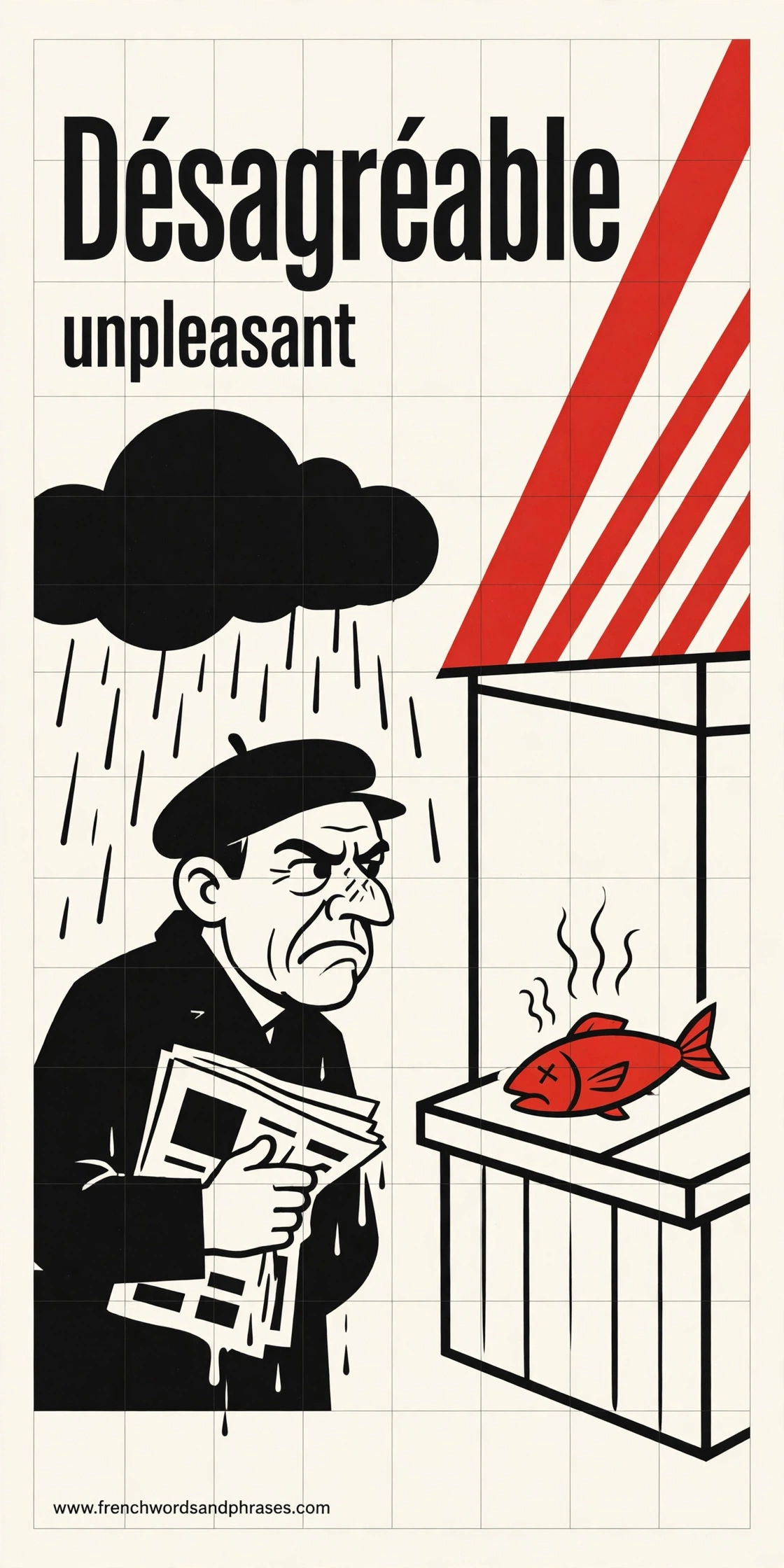
The waiting room smells of damp coats, the neon tube flickers, and the man behind the desk answers without looking up. Nothing terrible has happened — and yet everything is, precisely, désagréable. It is the adjective of low-grade misery: unpleasant people, weather, smells and surprises.
In this guide, you’ll learn what désagréable means in English, why its feminine is exactly the same word, where it stands in the sentence, and how it is simply agréable with its head turned away. Explore French examples, English translations, and practice quizzes.
Understanding the French Adjective Désagréable
Désagréable is a French adjective of discomfort, everyday and precise. It is invariable in gender, because it already ends in -e: un homme désagréable, une odeur désagréable, des surprises désagréables. It is built transparently: dés-, the undoing prefix, plus agréable, pleasant — the pleasant, cancelled.
It means unpleasant — of people, things and sensations alike: un ton désagréable, an unpleasant tone; une surprise désagréable, an unpleasant surprise; un goût désagréable, an unpleasant taste; il est désagréable avec les clients, he is unpleasant with customers. It is milder than horrible and ruder than décevant: the word for everything that makes a moment grate — a smell, a voice, a duty, a person having a bad day at your expense.
Type: Adjective of discomfort — unpleasant people, things, sensations
Answers the question: What is it like? — unpleasant, disagreeable
Changes form: Invariable in gender — désagréable for him and for her; plural désagréables
English equivalents: Unpleasant; disagreeable, nasty (of tastes, smells).
One important usage detail: of a person, désagréable judges behaviour more than character — elle a été désagréable avec moi, she was unpleasant to me (today, on this occasion). For the noun, French says un désagrément, an inconvenience or annoyance: les désagréments du voyage, the unpleasantnesses of the journey.
Experience the Word
Désagréable is the adjective of the grain of sand — nothing broken, nothing tragic, and yet the whole shoe of the day hurts.
Imagine the night train in August: a seat that will not recline, a window that will not open, a neighbour’s music leaking through one earphone for six hours. Aucun drame — and yet le voyage a été désagréable from the first kilometre to the last, a masterpiece of small miseries.
You have not just called something bad. You have named the grating itself — désagréable, pleasantness with the sign reversed.
How to Use Désagréable in French: Complete Guide
Let’s explore how désagréable works in French, beginning with the whole word on one card.
Désagréable at a Glance
Before the details, here is the whole word on one card.
The Whole Word on One Card
Meaning, type, position and forms — désagréable in four lines.
| Point | Désagréable |
|---|---|
| Meaning | unpleasant — grating on the senses, the mood or the company |
| Type | adjective of discomfort — everyday |
| Usual position | after the noun — une odeur désagréable |
| Form | désagréable for both genders — désagréables in the plural |
Example
Une odeur désagréable montait de la cave.
An unpleasant smell rose from the cellar.
The Four Forms of Désagréable
Désagréable already ends in -e, so masculine and feminine are identical; only the plural adds an s.
| Form | Désagréable | Example |
|---|---|---|
| Masculine singular | désagréable | un ton désagréable — an unpleasant tone |
| Feminine singular | désagréable | une surprise désagréable — an unpleasant surprise |
| Masculine plural | désagréables | des bruits désagréables — unpleasant noises |
| Feminine plural | désagréables | des odeurs désagréables — unpleasant smells |
Example
Des surprises désagréables nous attendaient à l’arrivée.
Unpleasant surprises awaited us on arrival.
Quick Quiz 1
What is the feminine of désagréable?
Reveal the answer
désagréable
Une surprise désagréable — the word already ends in -e, so the feminine changes nothing.
An unpleasant surprise.
The Feminine of Désagréable: The Same Word
Désagréable keeps one single form for him and for her, like all adjectives ending in -e.
| Situation | Example |
|---|---|
| Masculine | un goût désagréable — an unpleasant taste |
| Feminine | une sensation désagréable — identical: the -e is already there |
| Why | adjectives ending in -e do not change for the feminine |
| The plural | add s — des sensations désagréables, unpleasant sensations |
Example
Une sensation désagréable l’a saisi dans le froid.
An unpleasant sensation seized him in the cold.
Where Désagréable Goes: After the Noun
Désagréable follows the noun it describes, and with people it often travels with avec: désagréable avec les clients.
| Pattern | Example |
|---|---|
| After the noun | un bruit désagréable — an unpleasant noise |
| After être | il est désagréable — he is unpleasant |
| With people | désagréable avec les clients — unpleasant with customers |
| Before the noun | une désagréable surprise — only in elevated style |
Example
Le fonctionnaire a été désagréable avec tout le monde.
The clerk was unpleasant with everybody.
Quick Quiz 2
How do you say ‘an unpleasant smell’ — une désagréable odeur or une odeur désagréable?
Reveal the answer
une odeur désagréable
Désagréable stands after the noun in ordinary French.
An unpleasant smell.
More Désagréable: Comparing with Désagréable
Désagréable compares the regular way, with plus, moins and aussi — a scale of grating.
| Degree | Example |
|---|---|
| As unpleasant as | aussi désagréable que — as unpleasant as |
| More unpleasant | plus désagréable — more unpleasant |
| Less unpleasant | moins désagréable — less unpleasant |
| The most unpleasant (masc.) | le plus désagréable — le plus désagréable des voyages |
| The most unpleasant (fem.) | la plus désagréable — la plus désagréable des surprises |
Example
C’est la surprise la plus désagréable de la journée.
It is the most unpleasant surprise of the day.
Everyday Expressions with Désagréable
Désagréable names the small miseries of daily life — smells, tones, surprises and clerks.
| Expression | In English |
|---|---|
| une surprise désagréable | an unpleasant surprise |
| un goût désagréable | an unpleasant taste |
| être désagréable avec quelqu’un | to be unpleasant to someone |
| un désagrément | an inconvenience, an annoyance (the noun) |
| une sensation désagréable | an unpleasant feeling |
| un ton désagréable | an unpleasant, rude tone |
Example
Ce médicament laisse un goût désagréable.
This medicine leaves an unpleasant taste.
Quick Quiz 3
What does un désagrément mean?
Reveal the answer
An inconvenience, an annoyance
Un désagrément — the noun of the family: les désagréments du voyage, the unpleasant sides of the journey.
An annoyance.
Désagréable and Its Neighbours
Désagréable keeps company with the other words of discomfort — and faces its smiling opposite.
| French | In English |
|---|---|
| agréable | pleasant — the exact opposite |
| pénible | painful, trying — stronger |
| déplaisant | unpleasant, displeasing — literary cousin |
| infect | foul, disgusting — much stronger |
| grossier | rude, coarse — of manners |
| charmant | charming — the pleasant opposite for people |
Example
Agréable le matin, désagréable le soir : la journée a tourné.
Pleasant in the morning, unpleasant in the evening: the day turned.
Watch Out: The Traps Around Désagréable
The traps here are spelling — the word is dés-agréable, with its accent and its s — and the behaviour-versus-character judgement for people.
| Trap | The truth |
|---|---|
| Spelling | désagréable — dés- plus agréable: keep the é and the single s of the prefix |
| The feminine | une odeur désagréable — no extra -e, no new form |
| People | être désagréable avec quelqu’un judges today’s behaviour, not a whole character |
| The plural | des bruits désagréables — the plural still adds s |
Example
Elle n’est pas méchante, elle a été désagréable ce matin, c’est tout.
She is not nasty, she was unpleasant this morning, that’s all.
Quick Quiz 4
How do you say ‘unpleasant surprises’?
Reveal the answer
des surprises désagréables
Désagréable follows the noun and takes the plural s: désagréables.
Unpleasant surprises.
Désagréable in Everyday French: Real-Life Examples
Now that you know the word, let’s see how désagréable appears in everyday French.
Example 1 — A smell
Il y a une odeur désagréable dans la cuisine.
There is an unpleasant smell in the kitchen.
Example 2 — A surprise
Quelle surprise désagréable, la voiture est en panne !
What an unpleasant surprise, the car has broken down!
Example 3 — A clerk
Le vendeur a été désagréable avec les clients.
The salesman was unpleasant with the customers.
Example 4 — A taste
Ce sirop a un goût désagréable.
This syrup has an unpleasant taste.
Example 5 — Weather
Il fait un temps désagréable, froid et humide.
The weather is unpleasant, cold and damp.
Example 6 — A duty
C’est une tâche désagréable, mais nécessaire.
It is an unpleasant task, but a necessary one.
Beyond Translation: The Meaning of Désagréable
Désagréable wears its recipe on its face: dés-, the great French undoing prefix (défaire, débrancher, désobéir), bolted onto agréable, pleasant. The word is therefore a small machine for reversing pleasure — and French uses it with surgical fairness, for everything from a smell to a civil servant. Its noun, un désagrément, became the polite word of travel and administration: the official name for everything that goes mildly wrong.
Désagréable is the adjective of the grating moment — unpleasantness measured exactly, without drama.
Learn it beside agréable, its mirror, and pénible for the days when grating turns to pain.
How to Remember the French Adjective Désagréable
Remember it this way: Désagréable is the unpleasant adjective — agréable with dés- in front, one form for him and for her.
- You build it yourself — désagréable, c’est dés- plus agréable, le plaisir défait.
- You learn it once for both genders — un ton désagréable, une odeur désagréable.
- You judge the moment, not the person — être désagréable avec quelqu’un, ce jour-là.
The key idea is désagréable means unpleasant; invariable in gender; opposite of agréable.
Test Your Knowledge of Désagréable
Let’s see how much you’ve learned. Try answering these questions before revealing the answers.
Question 1
What does désagréable mean?
Reveal the answer
Unpleasant — grating on the senses, the mood or the company.
Question 2
What is the feminine of désagréable?
Reveal the answer
désagréable — unchanged: the word already ends in -e.
Question 3
Translate: There is an unpleasant smell in the kitchen.
Reveal the answer
Il y a une odeur désagréable dans la cuisine.
Question 4
Complete the sentence:
Des surprises ______ nous attendaient.
Reveal the answer
désagréables
Des surprises désagréables nous attendaient.
Unpleasant surprises awaited us.
Question 5
What is the exact opposite of désagréable?
Reveal the answer
agréable — pleasant: désagréable is agréable with the dés- prefix undoing it.
Your Final Challenge
Can You Use It?
How would you say this in French?
“What an unpleasant surprise, the car has broken down!”
Reveal the answer
Quelle surprise désagréable, la voiture est en panne !
What an unpleasant surprise, the car has broken down!
A little French. A little curiosity. A richer everyday life.
LEARN FRENCH ONE WORD AT A TIME