A French Word to Live By
Translate Amusant to English
/a.my.zɑ̃/
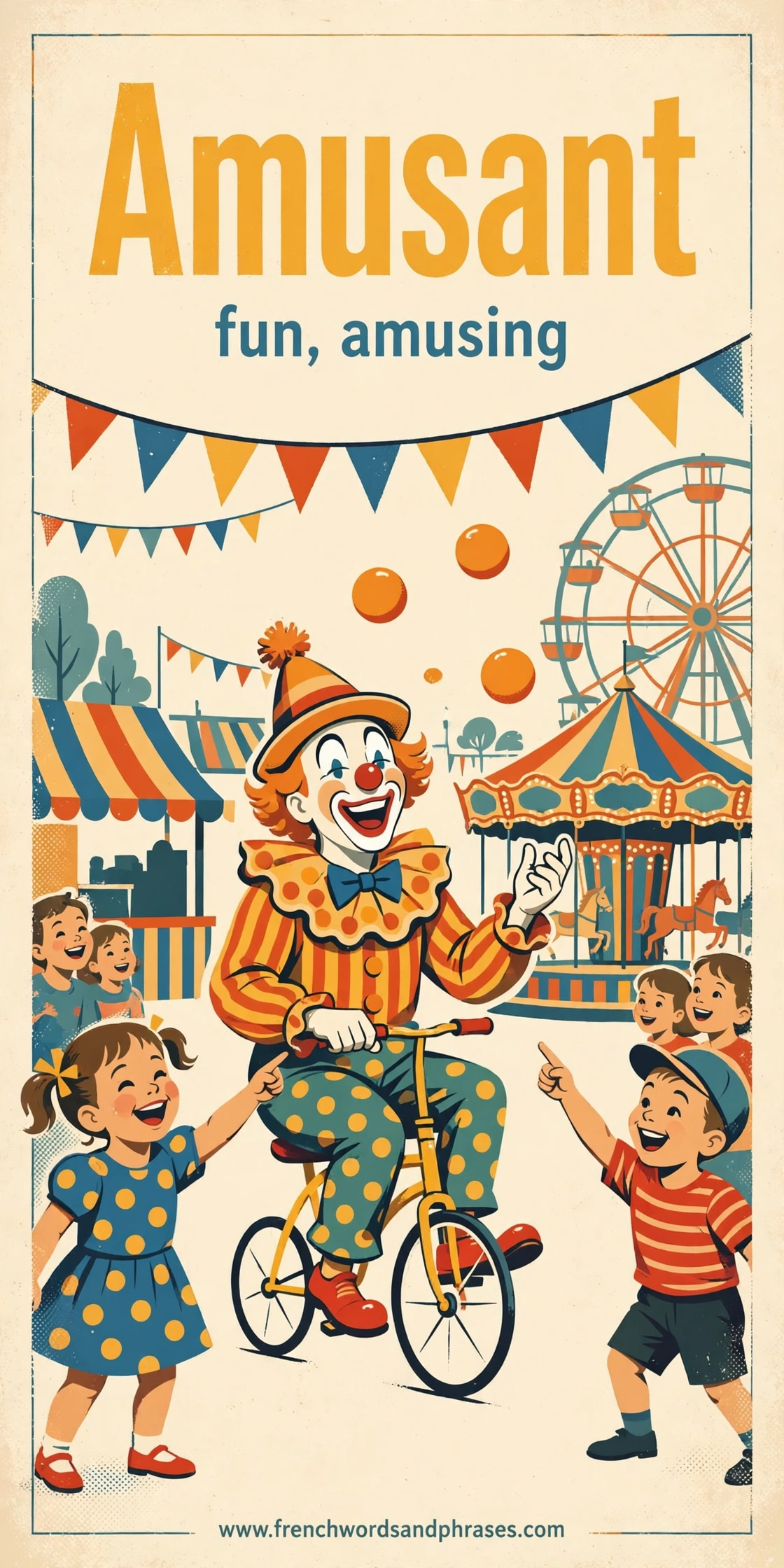
Amusant means fun, amusing.
The puppet misses the chair, the dog steals the hat, and thirty children dissolve into laughter at exactly the same second. « C’est amusant ! » Amusant is the adjective of fun itself: amusing, entertaining, the quality that makes faces open and shoulders shake.
In this guide, you’ll learn what amusant means in English, how its feminine amusante is formed, where it stands in the sentence, and how it differs from drôle, its funnier cousin. Explore French examples, English translations, and practice quizzes.
Understanding the French Adjective Amusant
Amusant is a French adjective of entertainment, everyday and cheerful. Its feminine is amusante: un jeu amusant, une histoire amusante, des enfants amusants. It is the present participle of amuser, to amuse, turned adjective — the thing that is amusing you right now. Amuser itself hides the word muse: to divert the mind, to keep it pleasantly busy.
It means fun, amusing, entertaining: un film amusant, a fun film; une anecdote amusante, an amusing anecdote; ce n’est pas amusant, it’s not funny, it’s no fun — the reproach of every rained-off picnic. Amusant is broader and gentler than drôle: drôle makes you laugh out loud; amusant entertains and diverts, with or without laughter. A museum visit can be amusante without a single joke.
Type: Adjective of entertainment — fun, amusing; everyday
Answers the question: What is it like? — fun, amusing, entertaining
Changes form: Feminine amusante — amusant / amusante; plurals amusants / amusantes
English equivalents: Fun; amusing, entertaining.
One important usage detail: choose between amusant and drôle by the smile’s size — drôle is funny, ha-ha; amusant is fun and diverting. And ce n’est pas amusant is the standard complaint when fun curdles into chore: déménager, ce n’est pas amusant — moving house is no fun.
Experience the Word
Amusant is the adjective of the afternoon that passes too fast — the game, the story and the uncle who does all the voices.
Imagine the village school fête in the rain that never came: races in sacks, a tombola of unlikely prizes, and the mayor in a false moustache losing at skittles to a six-year-old. Tout était amusant, say the parents on the walk home — nothing was hilarious, and nobody wanted it to end.
You have not just called something funny. You have certified the diversion — amusant, time happily stolen.
How to Use Amusant in French: Complete Guide
Let’s explore how amusant works in French, beginning with the whole word on one card.
Amusant at a Glance
Before the details, here is the whole word on one card.
The Whole Word on One Card
Meaning, type, position and forms — amusant in four lines.
| Point | Amusant |
|---|---|
| Meaning | fun, amusing — entertaining and diverting |
| Type | adjective of entertainment — everyday, cheerful |
| Usual position | after the noun — un jeu amusant |
| Form | amusant / amusante — amusants / amusantes in the plural |
Example
Un jeu amusant occupe les enfants tout l’après-midi.
A fun game keeps the children busy all afternoon.
The Four Forms of Amusant
Amusant adds the feminine -e in the regular way: amusant, amusante, and an s for the plurals.
| Form | Amusant | Example |
|---|---|---|
| Masculine singular | amusant | un film amusant — a fun film |
| Feminine singular | amusante | une histoire amusante — an amusing story |
| Masculine plural | amusants | des jeux amusants — fun games |
| Feminine plural | amusantes | des anecdotes amusantes — amusing anecdotes |
Example
Des anecdotes amusantes ont égayé le dîner.
Amusing anecdotes brightened the dinner.
Quick Quiz 1
What is the feminine of amusant?
Reveal the answer
amusante
Une histoire amusante — add the feminine -e to amusant.
An amusing story.
The Feminine of Amusant: Amusante
Amusante is formed by the simplest rule in French: add -e, and the silent t is heard.
| Situation | Example |
|---|---|
| Masculine | un spectacle amusant — an entertaining show |
| Feminine | une pièce amusante — an amusing play |
| Why | the regular feminine adds -e to the -ant ending |
| The plural | add s — des pièces amusantes, amusing plays |
Example
Une pièce amusante a fait rire toute la salle.
An amusing play made the whole audience laugh.
Where Amusant Goes: After the Noun
Amusant follows the noun it describes, like most French adjectives, and it sits naturally after être.
| Pattern | Example |
|---|---|
| After the noun | un livre amusant — a fun book |
| After être | c’est amusant — it’s fun |
| Negated | ce n’est pas amusant — it’s no fun |
| Before the noun | un amusant livre — not in everyday French |
Example
Ce jeu est amusant pour les petits et les grands.
This game is fun for young and old.
Quick Quiz 2
How do you say ‘an amusing story’ — une amusante histoire or une histoire amusante?
Reveal the answer
une histoire amusante
Amusant stands after the noun, in its feminine form amusante.
An amusing story.
More Amusant: Comparing with Amusant
Amusant compares the regular way, with plus, moins and aussi — a scale of fun.
| Degree | Example |
|---|---|
| As fun as | aussi amusant que — as fun as |
| More fun | plus amusant — more fun, more amusing |
| Less fun | moins amusant — less fun |
| The most fun (masc.) | le plus amusant — le plus amusant des jeux |
| The most fun (fem.) | la plus amusante — la plus amusante des histoires |
Example
C’est le jeu le plus amusant de la fête.
It is the most fun game at the fête.
Everyday Expressions with Amusant
Amusant certifies the good moments of daily life — games, films, stories and afternoons.
| Expression | In English |
|---|---|
| c’est amusant | it’s fun, it’s amusing |
| ce n’est pas amusant | it’s no fun, it’s not funny |
| un jeu amusant | a fun game |
| une histoire amusante | an amusing story |
| s’amuser | to have fun, enjoy oneself (the verb) |
| l’amusement | amusement, fun (the noun) |
Example
Les enfants s’amusent avec un jeu très amusant.
The children are having fun with a very fun game.
Quick Quiz 3
What does ce n’est pas amusant mean?
Reveal the answer
It’s not funny / it’s no fun
Ce n’est pas amusant — the standard complaint when a game or a task turns into a chore.
It’s no fun.
Amusant and Its Neighbours
Amusant keeps company with the other words of fun — each with its own size of smile.
| French | In English |
|---|---|
| drôle | funny — makes you laugh out loud |
| divertissant | entertaining, diverting — formal cousin |
| marrant | funny, a laugh — familiar cousin |
| plaisant | pleasant, agreeable — gentler |
| ennuyeux | boring — the opposite |
| amusant | fun, amusing — between drôle and plaisant |
Example
Drôle fait rire, amusant fait passer le temps en souriant.
Drôle makes you laugh, amusant makes time pass with a smile.
Watch Out: The Traps Around Amusant
The traps here are the feminine amusante and the choice against drôle: not everything amusant is hilarious.
| Trap | The truth |
|---|---|
| The feminine | une histoire amusante — add -e; the t is then pronounced |
| Drôle or amusant | drôle = funny, ha-ha; amusant = fun, diverting — a museum can be amusant without jokes |
| The complaint | ce n’est pas amusant = it’s no fun — the phrase for fun turned chore |
| The verb | s’amuser = to have fun: on s’est bien amusés, we had a great time |
Example
Le spectacle n’était pas drôle, mais il était amusant du début à la fin.
The show was not hilarious, but it was entertaining from start to finish.
Quick Quiz 4
How do you say ‘fun games’?
Reveal the answer
des jeux amusants
Amusant follows the noun and takes the plural s: amusants.
Fun games.
Amusant in Everyday French: Real-Life Examples
Now that you know the word, let’s see how amusant appears in everyday French.
Example 1 — A game
Ce jeu de cartes est très amusant.
This card game is great fun.
Example 2 — A story
Elle a raconté une histoire amusante.
She told an amusing story.
Example 3 — A film
C’est un film amusant pour toute la famille.
It’s a fun film for the whole family.
Example 4 — No fun
Attendre sous la pluie, ce n’est pas amusant.
Waiting in the rain is no fun.
Example 5 — Children
Les enfants ont trouvé un jeu amusant dans le jardin.
The children found a fun game in the garden.
Example 6 — An evening
La soirée était amusante, nous avons bien ri.
The evening was fun, we laughed a lot.
Beyond Translation: The Meaning of Amusant
Amusant hides a museum inside it: amuser was built on muser, to idle and daydream, with the muse of the arts looking on — to amuse is to keep the mind pleasantly occupied, as a muse would. French has kept the word generous: where English fun shrinks to jokes, amusant covers the whole territory of time well spent, from the puppet show to the card game to the uncle doing the voices.
Amusant is the adjective of time happily stolen — diversion certified, with or without laughter.
Learn it beside drôle and divertissant, and you can grade every French entertainment from the giggle to the gala.
How to Remember the French Adjective Amusant
Remember it this way: Amusant is the fun adjective — amusant for him, amusante for her, broader and gentler than drôle.
- You learn the pair together — un jeu amusant, une histoire amusante.
- You grade the smile — drôle fait rire, amusant divertit.
- You complain with it — ce n’est pas amusant, quand le plaisir devient corvée.
The key idea is amusant / amusante means fun, amusing; drôle = funny (ha-ha).
Test Your Knowledge of Amusant
Let’s see how much you’ve learned. Try answering these questions before revealing the answers.
Question 1
What does amusant mean?
Reveal the answer
Fun, amusing — entertaining and diverting.
Question 2
What is the feminine of amusant?
Reveal the answer
amusante — add the feminine -e.
Question 3
Translate: This card game is great fun.
Reveal the answer
Ce jeu de cartes est très amusant.
Question 4
Complete the sentence:
Elle a raconté une histoire ______.
Reveal the answer
amusante
Elle a raconté une histoire amusante.
She told an amusing story.
Question 5
What is the difference between drôle and amusant?
Reveal the answer
Drôle makes you laugh out loud; amusant entertains — fun and diverting, with or without jokes.
Your Final Challenge
Can You Use It?
How would you say this in French?
“A fun game keeps the children busy all afternoon.”
Reveal the answer
Un jeu amusant occupe les enfants tout l’après-midi.
A fun game keeps the children busy all afternoon.
A little French. A little curiosity. A richer everyday life.
LEARN FRENCH ONE WORD AT A TIME