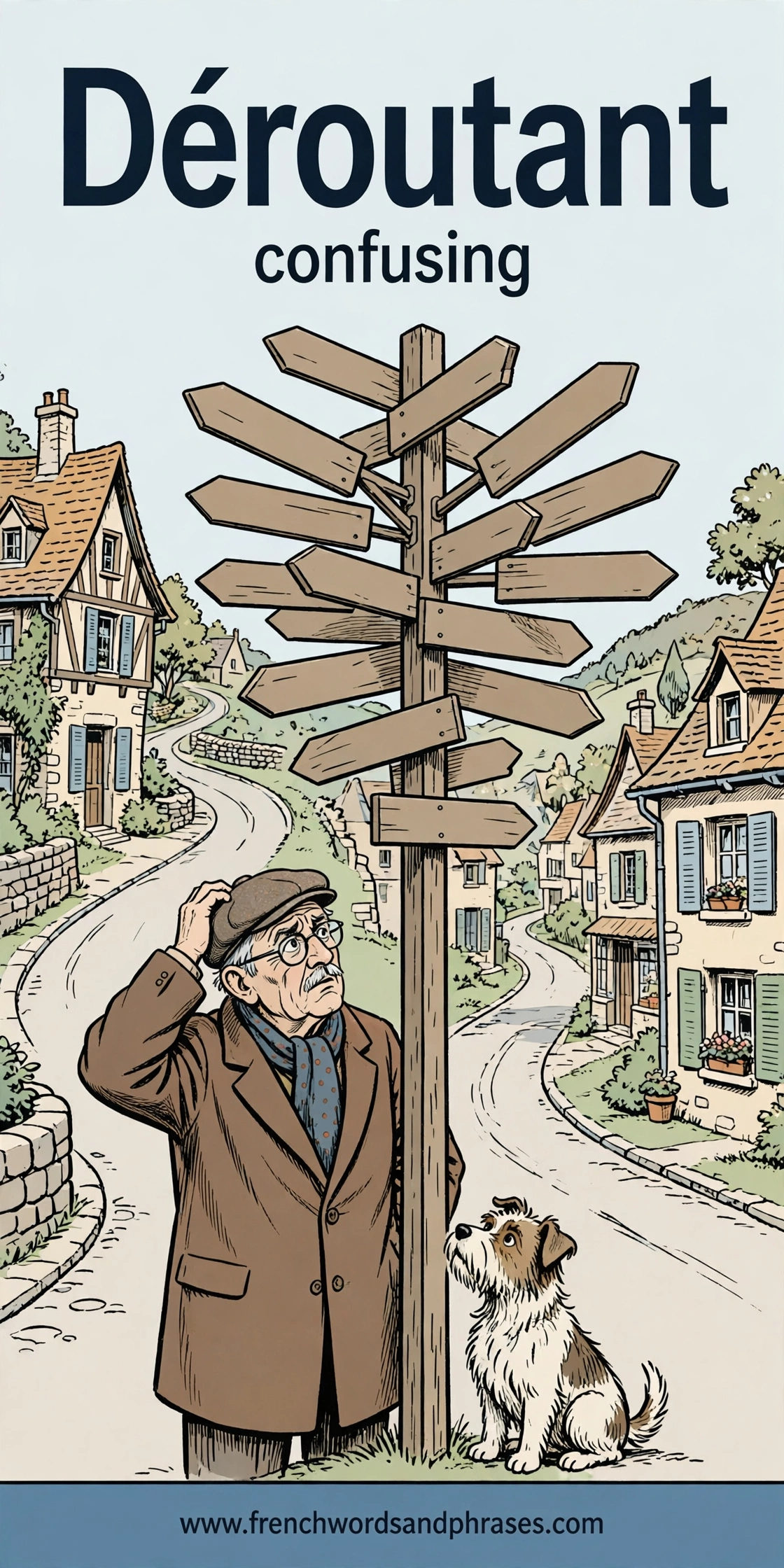
A French Word to Live By
Translate Déroutant to English
/de.ʁu.tɑ̃/
Déroutant means confusing.
Third time in ten minutes, the calm voice of the satnav announces « recalcul en cours » — recalculating — and the little map spins like a compass in a storm. Left was right a moment ago; the motorway exit has moved to another département. Nothing is broken, and yet nothing makes sense. The French word for that spinning feeling is déroutant — literally, de-routing.
In this guide, you’ll learn what déroutant means in English, how it grew out of the word for a road, how its feminine is formed, and why French uses it for answers, silences and behaviour that knock you off your mental route. Explore French examples, English translations, and practice quizzes.
Understanding the French Adjective Déroutant
Déroutant is a French adjective of quality — the adjective of confusion. It comes from dérouter, to reroute, to throw off course, and it agrees like the -ant family: déroutant, déroutante, déroutants, déroutantes. Whatever déroutant describes has pushed you off the route you were following in your head.
It means confusing, disconcerting, baffling: un comportement déroutant, baffling behaviour; une réponse déroutante, a confusing answer; un silence déroutant, a disconcerting silence. It is stronger and more personal than a simple ‘difficult’: a déroutant thing does not just resist understanding, it leaves you standing at a crossroads with no signposts.
Type: Adjective of quality — confusion
Answers the question: What is it like? — confusing
Changes form: Yes — déroutant, déroutante, déroutants, déroutantes
English equivalents: Confusing; disconcerting; baffling.
One important usage detail: déroutant stands AFTER the noun — une réponse déroutante — and it describes the thing that confuses. The traveller who has been thrown off course is dérouté; a flight that has been diverted is also dérouté.
Experience the Word
Déroutant is the adjective of the museum room where the paintings seem to be watching you, of the colleague who answers a question about budgets with a long story about his grandfather’s bees.
Imagine arriving in a village where every street is named after a flower and every house is number thirteen. The map is correct, the sun is shining, and yet you are perfectly, pleasantly lost. That is déroutant at its gentlest.
You have not just said that something is hard to follow. You have said it moved the road while you were walking on it.
How to Use Déroutant in French: Complete Guide
Let’s explore how déroutant works in French, beginning with the whole word on one card.
Déroutant at a Glance
Before the details, here is the whole word on one card.
The Whole Word on One Card
Meaning, type, position and forms — déroutant in four lines.
| Point | Déroutant |
|---|---|
| Meaning | confusing |
| Type | adjective of quality — confusion and disorientation |
| Usual position | after the noun — une réponse déroutante |
| Form | déroutant / déroutante / déroutants / déroutantes |
Example
Sa réponse était vraiment déroutante.
His answer was really confusing.
The Four Forms of Déroutant
Déroutant agrees with the noun it describes — answers, silences, behaviour and changes are its favourite company.
| Form | Déroutant | Example |
|---|---|---|
| Masculine singular | déroutant | un comportement déroutant — baffling behaviour |
| Feminine singular | déroutante | une réponse déroutante — a confusing answer |
| Masculine plural | déroutants | des changements déroutants — confusing changes |
| Feminine plural | déroutantes | des instructions déroutantes — confusing instructions |
Example
Ces instructions déroutantes ont créé des retards déroutants.
These confusing instructions created baffling delays.
Quick Quiz 1
Which form of déroutant goes with réponse (feminine)?
Reveal the answer
déroutante
Une réponse déroutante.
A confusing answer.
Déroutante: The Feminine Where the T Wakes Up
The -ant family builds its feminine in -ante: the final t, silent in déroutant, is pronounced in déroutante — your ear hears the feminine arrive.
| Situation | Example |
|---|---|
| The rule | -ant becomes -ante — déroutant → déroutante |
| The sound | the t is silent in déroutant, pronounced in déroutante |
| Masculine plural | déroutants — des signes déroutants |
| Feminine plural | déroutantes — des réponses déroutantes |
Example
Elle a donné une explication déroutante.
She gave a confusing explanation.
Where Déroutant Goes: After the Noun
Déroutant follows the noun it describes, and it is just as comfortable after être, where c’est déroutant has become the natural verdict on modern life.
| Pattern | Example |
|---|---|
| After the noun | un silence déroutant — a disconcerting silence |
| After être | c’est déroutant — it’s confusing |
| With an adverb | vraiment déroutant — really baffling |
| Before the noun | une déroutante réponse — not in everyday French |
Example
Au début, ce nouveau système est déroutant pour tout le monde.
At first, this new system is confusing for everyone.
Quick Quiz 2
Where does déroutant stand — before or after the noun?
Reveal the answer
After
Une réponse déroutante, un silence déroutant.
A confusing answer, a disconcerting silence.
More Confusing: Comparing with Déroutant
Déroutant compares the regular way, with plus, moins and aussi — the superlative is a prize no instruction manual wants to win.
| Degree | Example |
|---|---|
| As confusing as | aussi déroutant que — as confusing as |
| More confusing | plus déroutant — more confusing |
| Less confusing | moins déroutant — less confusing |
| The most confusing (masc.) | le plus déroutant — le plus déroutant des plans |
| The most confusing (fem.) | la plus déroutante — la plus déroutante des réponses |
Example
Le nouveau plan du métro est plus déroutant que l’ancien.
The new metro map is more confusing than the old one.
Everyday Expressions with Déroutant
French reaches for déroutant whenever the world stops following its own instructions — in behaviour, in answers, and in silences that say too much.
| Expression | In English |
|---|---|
| un comportement déroutant | baffling behaviour |
| une réponse déroutante | a confusing, disconcerting answer |
| un silence déroutant | a disconcerting silence |
| c’est déroutant | it’s confusing, it’s disconcerting |
| au premier abord déroutant | confusing at first sight |
| un changement déroutant | a bewildering change |
Example
Son comportement déroutant a surpris toute l’équipe.
His baffling behaviour surprised the whole team.
Quick Quiz 3
What does c’est déroutant mean?
Reveal the answer
It’s confusing
C’est déroutant, la rue a changé de nom.
It’s confusing, the street has changed its name.
Déroutant and Its Neighbours
Déconcertant is the closest twin — what déroutant does to your route, déconcertant does to your composure. Troublant adds a shadow of worry, and perplexe belongs to the person, not the thing.
| French | In English |
|---|---|
| déconcertant | disconcerting, unsettling — the closest twin |
| troublant | disturbing, unsettling — with a touch of worry |
| confus | muddled, confused — of explanations and accounts |
| surprenant | surprising — without the lost feeling |
| perplexe | puzzled, perplexed — for the person who feels it |
| clair | clear — the opposite |
Example
Son récit confus était vraiment déconcertant.
His muddled account was really disconcerting.
Watch Out: The Traps Around Déroutant
Keep the family apart: déroutant throws you off course, dérouté is where you end up — and at the airport, dérouté is a flight that has literally changed its route.
| Trap | The truth |
|---|---|
| déroutant vs dérouté | déroutant = the confusing cause; dérouté = the person or flight thrown off course |
| The literal sense | un vol dérouté is a diverted flight — the verb dérouter really does reroute |
| For people | a person who feels confused is perplexe or dérouté, not ‘déroutant’ — déroutant describes their behaviour |
| Spelling | the feminine is déroutante with -ante, never ‘-ente’ |
Example
Le vol dérouté a atterri à Lyon, et les passagers étaient perplexes.
The diverted flight landed in Lyon, and the passengers were puzzled.
Quick Quiz 4
How do you say ‘a confusing answer’?
Reveal the answer
une réponse déroutante
Une réponse déroutante ne répond à rien.
A confusing answer answers nothing.
Déroutant in Everyday French: Real-Life Examples
Now that you know the word, let’s see how déroutant appears in everyday French.
Example 1 — In the car
Ce nouveau plan de la ville est déroutant.
This new map of the town is confusing.
Example 2 — At work
Son comportement est déroutant depuis lundi.
His behaviour has been baffling since Monday.
Example 3 — With new software
Au début, ce logiciel est déroutant, puis on s’habitue.
At first, this software is confusing, then you get used to it.
Example 4 — In a meeting
Elle a donné une réponse déroutante.
She gave a disconcerting answer.
Example 5 — At the station
Ces annonces sont déroutantes, quel quai pour Lyon ?
These announcements are confusing, which platform for Lyon?
Example 6 — Between friends
C’est déroutant, il ne répond plus à mes messages.
It’s disconcerting, he doesn’t answer my messages any more.
Beyond Translation: The Meaning of Déroutant
Under déroutant you can still see the road: la route. Déroutant is what knocks you off it — not broken, not blocked, simply elsewhere than where the map promised. French chose a traveller’s word for confusion, and it shows in the feeling: not stupidity, not failure, just a missing signpost.
To say déroutant in French is to say: the world moved the road while I was walking on it.
It is the politest word for confusion ever invented — it blames the route, never the traveller.
How to Remember the French Adjective Déroutant
Remember it this way: Déroutant is the adjective that moves the road — it describes the confusing thing, never the traveller it confuses.
- You hear la route inside it — dé-rout-ant, the thing that de-routes you.
- You put it after the noun — une réponse déroutante, un silence déroutant.
- You keep the family apart — the thing is déroutant, the traveller is dérouté.
The key idea is déroutant = the confusing cause that knocks you off your route; dérouté = the one knocked off it.
Test Your Knowledge of Déroutant
Let’s see how much you’ve learned. Try answering these questions before revealing the answers.
Question 1
What does déroutant mean?
Reveal the answer
Confusing — also disconcerting and baffling.
Question 2
What is the feminine of déroutant?
Reveal the answer
déroutante — the -ant becomes -ante, and the t is pronounced.
Question 3
Translate: a confusing answer.
Reveal the answer
Une réponse déroutante.
Question 4
Complete the sentence:
C’est ______ , je ne comprends plus rien.
Reveal the answer
déroutant
C’est déroutant, je ne comprends plus rien.
It’s confusing, I don’t understand anything any more.
Question 5
What is the difference between déroutant and dérouté?
Reveal the answer
Déroutant is the cause; dérouté is the result — a confusing answer (déroutante) leaves a traveller dérouté, and a flight dérouté has been diverted.
Your Final Challenge
Can You Use It?
How would you say this in French?
“At first, this new software is confusing.”
Reveal the answer
Au début, ce nouveau logiciel est déroutant.
At first, this new software is confusing.
A little French. A little curiosity. A richer everyday life.
LEARN FRENCH ONE WORD AT A TIME