A French Word to Live By
Translate Depuis très longtemps to English
/də.pɥi tʁɛ lɔ̃.tɑ̃/
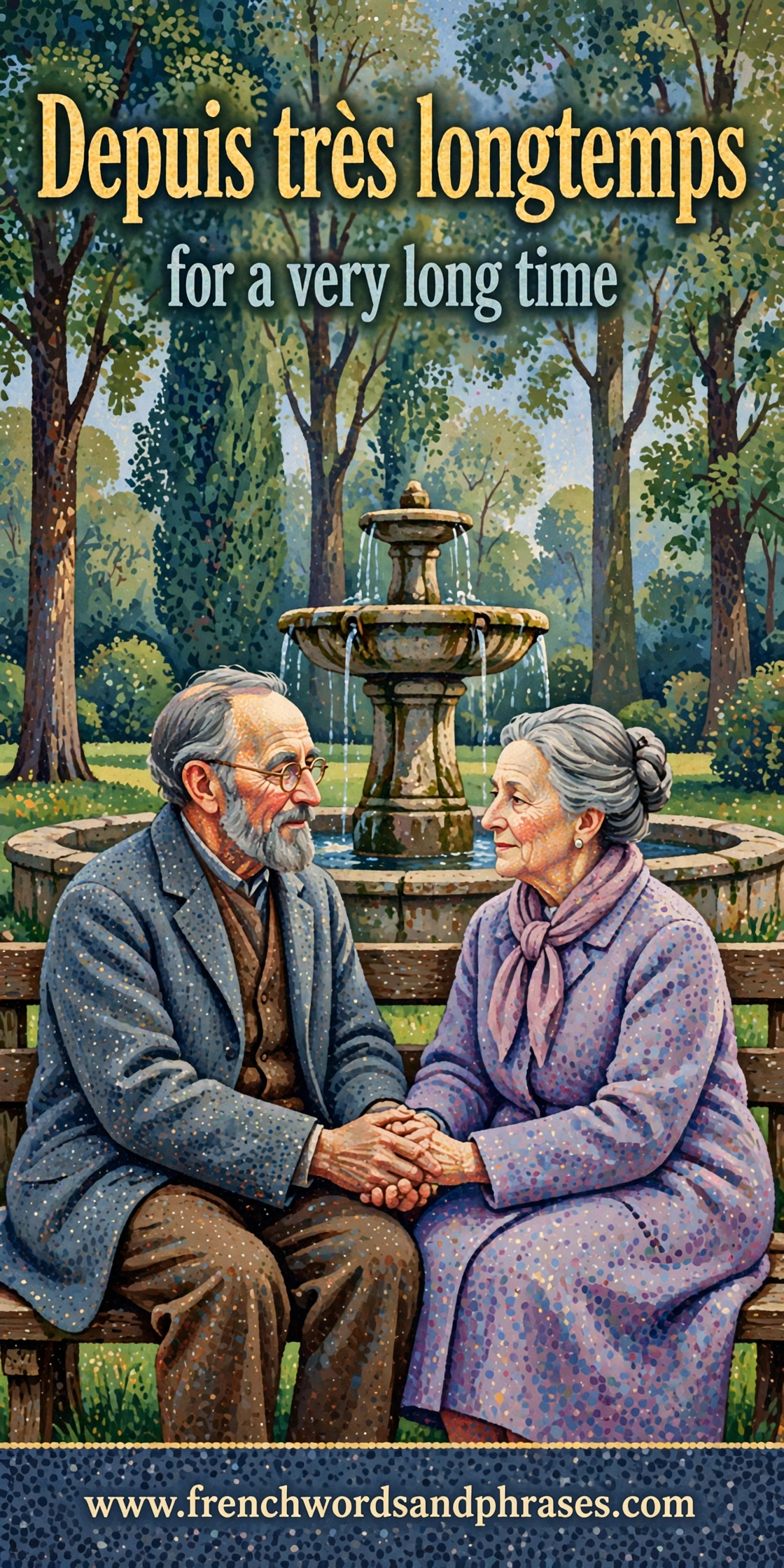
Depuis très longtemps means for a very long time — since long ago, and still going.
The notary opens the dusty file, adjusts his glasses, and looks over them at the two brothers disputing the orchard. « Messieurs, » he sighs, « cette affaire dure depuis très longtemps. » Nobody in the room can even remember the first apple that started it.
Let’s explore how depuis très longtemps works in French, beginning with the whole phrase on one card.
Understanding the French Phrase Depuis très longtemps
Depuis très longtemps is a French everyday phrase built from depuis (since, for — a preposition that has its own page on this site) and très longtemps (very long — longtemps, a very long time, strengthened by très). Depuis reaches back to a starting point in the past and stretches the line all the way into the present: whatever it describes began long ago and has not stopped.
It means for a very long time. Je le connais depuis très longtemps — I have known him for a very long time. Ils habitent ici depuis très longtemps — they have lived here for a very long time. The phrase measures durations that have outgrown exact numbers: nobody counts the years any more, and the present tense carries the whole weight, because the thing is still true now.
Type: Everyday phrase — long duration (depuis + très longtemps)
Answers the need: Saying that something began long ago and continues into the present
Register: Neutral — everywhere, in speech and writing
Strength: Immense but unmeasured — longer than anyone cares to count
One important usage detail, the great French tense rule: with depuis, the verb stays in the PRESENT for things still going on — je travaille ici depuis très longtemps, I have worked here for a very long time. English reaches for the perfect (have worked); French keeps the present, because the action never left it. The past tense with depuis would mean the thing is finished.
Experience the Word
Depuis très longtemps is the phrase of old friendships, old houses and old grudges — everything in life that began before the records and shows no sign of stopping.
Imagine the lighthouse keeper showing a visitor the lamp room. « Elle tourne depuis très longtemps, » he says, patting the brass like an old dog, « et elle tournera encore après moi. » The phrase fits the lamp exactly: a beginning nobody witnessed, a present that simply continues.
English says for a very long time with a sigh built in. French builds the sigh from depuis — since — the little word that turns a start date into a bridge to today.
How to Use Depuis très longtemps in French: Complete Guide
Let’s explore how depuis très longtemps works in French, beginning with the whole phrase on one card.
Depuis très longtemps at a Glance
The Whole Phrase on One Card
Real meaning, literal picture, English twin and register — depuis très longtemps in five lines.
| Point | Depuis très longtemps |
|---|---|
| What it really means | for a very long time — begun long ago, still true now |
| Word for word | since very long — depuis (since) + très (very) + longtemps (a long time) |
| English equivalent | for a very long time / for ages |
| Register | neutral — safe everywhere |
| Use it for | old friendships, long habits, situations that simply continue |
Example
Je le connais depuis très longtemps.
I have known him for a very long time.
Word by Word: Building the Long Bridge
Three pieces — take them one by one and the long stretch from past to present appears.
| Word | Literal meaning | Its job in the phrase |
|---|---|---|
| depuis | since, for | the bridge-builder: it ties a past beginning to the present moment |
| très | very | the strengthener — it stretches the duration past counting |
| longtemps | a long time | the long stretch itself: long + temps, time |
Example
Ils se connaissent depuis très longtemps.
They have known each other for a very long time.
Quick Quiz 1
Which tense does French use with depuis for something still going on?
Reveal the answer
The present — je travaille ici depuis très longtemps. French keeps the present because the action never stopped; English switches to have worked.
Elle attend depuis très longtemps.
She has been waiting for a very long time.
When You Say It: The Long-Continuing Moments
Depuis très longtemps fires at moments like these — wherever a beginning is lost in the past and the present carries on.
| Situation | Example |
|---|---|
| An old friendship | on se connaît depuis très longtemps — we have known each other for ages |
| A long residence | ils habitent ici depuis très longtemps — they have lived here for a very long time |
| A habit | il fume depuis très longtemps — he has smoked for a very long time |
| A wait | j’attends depuis très longtemps — I have been waiting for a very long time |
| A situation | ça dure depuis très longtemps — it has been going on for a very long time |
Example
Cette maison appartient à la famille depuis très longtemps.
This house has belonged to the family for a very long time.
Make It Yours: The Depuis Ladder
Depuis takes any length of time — climb the ladder and feel the stretch grow.
| Form | French | In English |
|---|---|---|
| A moment | depuis un moment | for a while (already) |
| Some time | depuis quelque temps | for some time |
| A long time | depuis longtemps | for a long time |
| A very long time | depuis très longtemps | for a very long time |
| A precise span | depuis dix ans | for ten years, since ten years ago |
Example
Il pleut depuis longtemps, presque depuis toujours.
It has been raining for a long time, almost forever.
Quick Quiz 2
Say it in French, the French way: I have lived here for a very long time — present or past tense?
Reveal the answer
Present — j’habite ici depuis très longtemps. The living is still happening, so French refuses the past tense.
J’habite ici depuis très longtemps.
I have lived here for a very long time.
Everyday Expressions: Building on the Bridge
Depuis très longtemps slots into these everyday frames — each one ready to use as it stands.
| Frame | In English |
|---|---|
| depuis longtemps déjà | for a long time already — with the sigh included |
| depuis toujours | since always, forever — the maximal form: je l’aime depuis toujours |
| ça fait très longtemps que… | it’s been a very long time since / that… — the spoken twin construction |
| depuis des années | for years — the measurable middle of the ladder |
| depuis quand ? | since when? / how long? — the question the phrase answers |
Example
Ça fait très longtemps qu’on ne s’est pas vus !
It’s been a very long time since we last saw each other!
Close Cousins: The Other Long Durations
French stretches time in several ways — depuis très longtemps is the bridge from a lost beginning; its cousins measure, total or look forward.
| Expression | The difference |
|---|---|
| depuis très longtemps | for a very long time — begun in the past, still going, present tense |
| pendant très longtemps | for a very long time — a finished stretch, measured whole: il a voyagé pendant très longtemps |
| il y a très longtemps | a very long time ago — a point in the past, not a duration |
| pour toujours | forever — the future stretch, the mirror image of depuis |
| depuis toujours | since always — the same bridge, stretched to the limit |
Example
Il y a très longtemps, ils sont arrivés ; depuis très longtemps, ils sont chez eux ici.
A very long time ago, they arrived; for a very long time now, they have been at home here.
Quick Quiz 3
Which cousin means a very long time AGO: depuis très longtemps or il y a très longtemps?
Reveal the answer
Il y a très longtemps — that is a point in the past. Depuis très longtemps is a duration that reaches the present.
Il y a très longtemps, ce village n’avait pas de route.
A very long time ago, this village had no road.
Depuis très longtemps and Its Neighbours
The long-time shelf around the phrase — memories, patience and old things.
| French | In English |
|---|---|
| le souvenir | the memory |
| la patience | patience — what long durations demand |
| une habitude | a habit |
| ancien | old, former — les anciens amis, the old friends |
| la durée | the duration, the length of time |
Example
Les anciens amis se comprennent depuis très longtemps.
Old friends have understood each other for a very long time.
Watch Out: The Traps Around Depuis très longtemps
The traps: the English tense reaching across, and depuis confused with its neighbours.
| Trap | The truth |
|---|---|
| « j’ai habité ici depuis très longtemps » (for still living here) | for a continuing state, French keeps the present: j’habite ici depuis très longtemps |
| depuis vs pendant | depuis bridges to now; pendant measures a finished block of time |
| depuis vs il y a | depuis très longtemps = for a very long time; il y a très longtemps = a very long time ago |
| dropping très | depuis longtemps is fine but weaker — très is the whole point of this phrase |
Example
Je travaille ici depuis très longtemps — au présent, parce que j’y suis encore.
I have worked here for a very long time — in the present tense, because I am still here.
Quick Quiz 4
True or false: with depuis, a finished action and a continuing action use the same tense.
Reveal the answer
False — continuing actions take the present with depuis (j’attends depuis très longtemps); the past tenses step in only when the thing is over.
Elle a attendu pendant des heures, hier.
She waited for hours, yesterday. (finished — pendant, past tense)
Depuis très longtemps in Everyday French: Real-Life Examples
Now that you know the word, let’s see how depuis très longtemps appears in everyday French.
Example 1 — An old friend
Je le connais depuis très longtemps.
I have known him for a very long time.
Example 2 — A home
Ils habitent ce village depuis très longtemps.
They have lived in this village for a very long time.
Example 3 — A wait
Nous attendons depuis très longtemps.
We have been waiting for a very long time.
Example 4 — A craft
Elle fait ce métier depuis très longtemps.
She has done this job for a very long time.
Example 5 — A situation
Ça dure depuis très longtemps, cette histoire.
It has been going on for a very long time, this business.
Example 6 — A machine
Cette horloge marche depuis très longtemps.
This clock has been working for a very long time.
Beyond Translation: The Meaning of Depuis très longtemps
There comes a point in every long thing — a friendship, a marriage, a grudge, a lamp kept lit — where the beginning stops being a date and becomes a legend. Depuis très longtemps is the phrase French keeps for exactly that point: the numbers have been honourably retired, and only the continuing remains.
To say depuis très longtemps is to measure time the way life actually feels it — not in years, but in still.
And its grammar is its philosophy: the present tense, held open by depuis, because the story the phrase tells has not finished telling itself.
How to Remember the French Phrase Depuis très longtemps
Remember it this way: Depuis très longtemps means for a very long time — depuis bridges a lost beginning to the present, and the verb stays in the present tense.
- You keep the present — j’habite ici depuis très longtemps, never the past for what still goes on.
- You split the twins — depuis très longtemps is a duration; il y a très longtemps is a point, long ago.
- You climb the ladder — depuis un moment, depuis longtemps, depuis très longtemps, depuis toujours.
The key idea is depuis très longtemps means for a very long time — present tense with depuis; il y a = ago.
Test Your Knowledge of Depuis très longtemps
Let’s see how much you’ve learned. Try answering these questions before revealing the answers.
Question 1
What does depuis très longtemps mean?
Reveal the answer
For a very long time — begun long ago and still continuing.
Question 2
Which tense goes with depuis for something still going on?
Reveal the answer
The present — j’attends depuis très longtemps, I have been waiting for a very long time.
Question 3
Translate: I have known him for a very long time.
Reveal the answer
Je le connais depuis très longtemps.
Question 4
What does il y a très longtemps mean, and how is it different?
Reveal the answer
A very long time ago — a point in the past; depuis très longtemps is a duration reaching the present.
Question 5
Complete the sentence:
Elle travaille ici depuis très ______. (for a very long time)
Reveal the answer
longtemps
Elle travaille ici depuis très longtemps.
She has worked here for a very long time.
Your Final Challenge
Can You Use It?
How would you say this in French?
“I have known him for a very long time.”
Reveal the answer
Je le connais depuis très longtemps.
I have known him for a very long time.
A little French. A little curiosity. A richer everyday life.
LEARN FRENCH ONE WORD AT A TIME