A French Word to Live By
How to Conjugate Décréter in French
/de.kʁe.te/
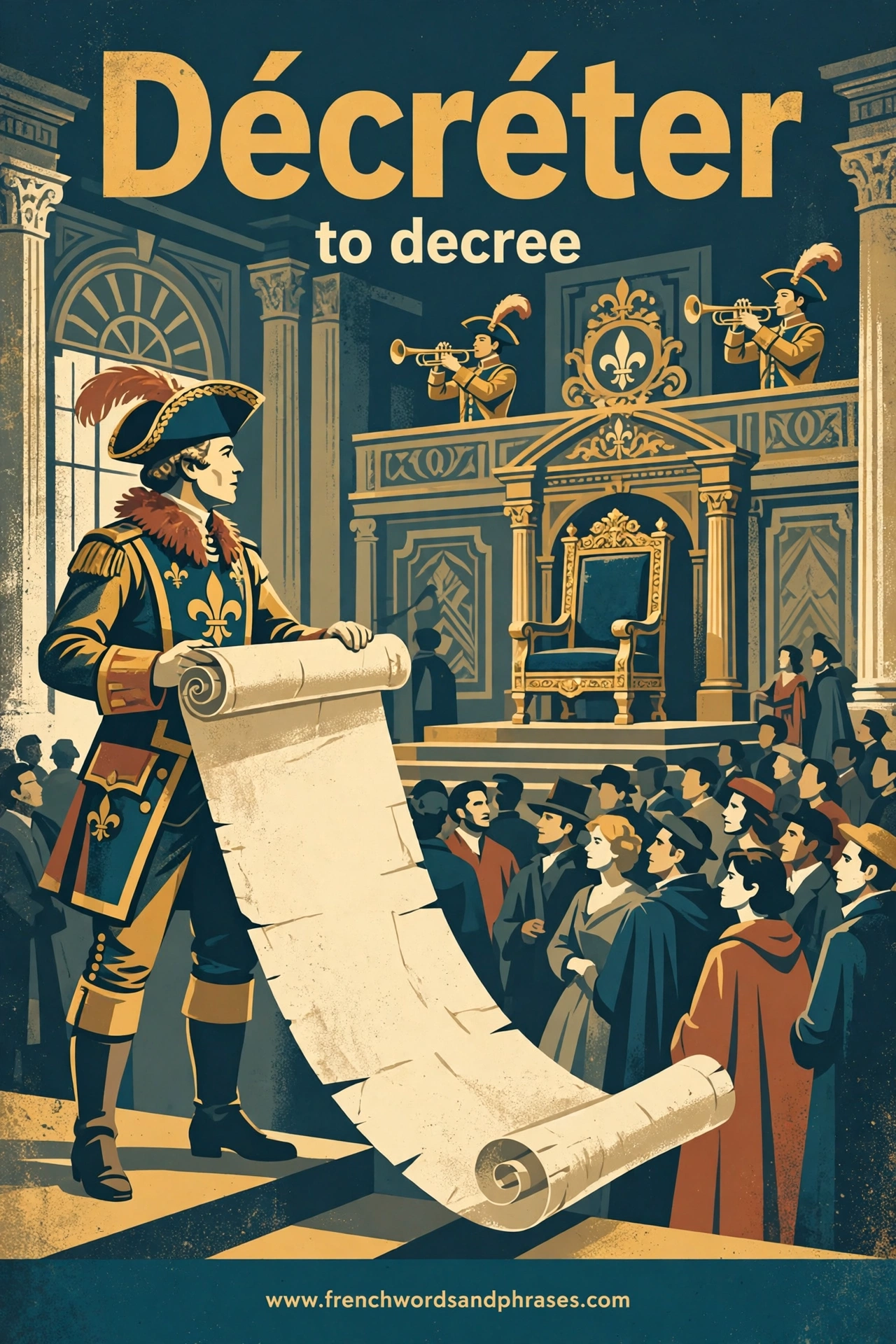
Décréter means to decree — to order something officially, by decree.
A signature at midnight, a seal pressed into hot wax, an official text read out to a waiting country — décréter is the verb of authority deciding, the moment a decision becomes law by a single signature.
In this guide, you’ll learn how to conjugate décréter in all the major French tenses and moods. Explore complete conjugation tables, French examples, English translations, and practice quizzes.
Understanding the French Verb Décréter
Décréter is a regular French verb belonging to the first group of verbs, those ending in -er.
It means to decree. It is commonly used for governments decreeing emergency measures, prefects and mayors decreeing closures and curfews, judges and councils decreeing decisions, and — with a smile — for anyone at home or at work who lays down the law as if signing an official text.
Verb classification: First group (-er)
Auxiliary verb: Avoir
Past participle: décrété
Present participle: décrétant
English equivalents: To decree, to order by decree; un décret — a decree; décréter l’état d’urgence — to declare a state of emergency.
One important detail: décréter is the verb of un décret, a decree — in France a real instrument of government, signed by the president or a minister and published in the Journal officiel. Watch the stem vowel: the é softens to è before a silent ending — je décrète, ils décrètent — but keeps its é where the ending is heard: nous décrétons, vous décrétez. The verb also lives at home, figuratively: elle a décrété que le dimanche serait jour de repos — she decreed that Sundays would be rest days, and nobody argued.
Experience the Word
Décréter is the verb of the signature that settles things — no debate, no vote in the room, just authority speaking once.
Imagine a prefecture during a stormy night. Rivers are rising, roads are flooding, and at two in the morning the prefect signs one page: l’état d’urgence est décrété. By dawn, the whole department is living under new rules.
Nothing was discussed in the square or voted in the hall. It was decreed — decided from above, in a single act.
How to Conjugate Décréter: Complete French Conjugation Guide
Let’s explore every major conjugation of décréter, beginning with the indicative mood.
How to Conjugate Décréter in the Indicative Mood
The indicative mood is used to express facts, observations, actions, and events.
How to Conjugate Décréter in the Present Tense (Présent)
Used for actions happening now, habitual actions, and general truths.
| Subject | Conjugation |
|---|---|
| je | décrète |
| tu | décrètes |
| il / elle | décrète |
| nous | décrétons |
| vous | décrétez |
| ils / elles | décrètent |
Example
Le gouvernement décrète l’état d’urgence après la tempête.
The government decrees a state of emergency after the storm.
Quick Quiz 1
Complete the sentence:
Nous ______ la journée de samedi chômée.
Reveal the answer
décrétons
Nous décrétons la journée de samedi chômée.
We decree the Saturday a non-working day.
How to Conjugate Décréter in the Passé Composé
Used for completed actions in the past. Décréter takes the auxiliary verb avoir.
| Subject | Conjugation |
|---|---|
| j’ | ai décrété |
| tu | as décrété |
| il / elle | a décrété |
| nous | avons décrété |
| vous | avez décrété |
| ils / elles | ont décrété |
Example
Le gouvernement a décrété l’état d’urgence après les inondations.
The government decreed a state of emergency after the floods.
How to Conjugate Décréter in the Imparfait (Imperfect Tense)
Used for habitual past actions, descriptions, and ongoing situations in the past.
| Subject | Conjugation |
|---|---|
| je | décrétais |
| tu | décrétais |
| il / elle | décrétait |
| nous | décrétions |
| vous | décrétiez |
| ils / elles | décrétaient |
Example
Chaque hiver, la préfecture décrétait la fermeture des cols de montagne.
Every winter, the prefecture used to decree the closure of the mountain passes.
Quick Quiz 2
Choose the correct form:
The government decreed the measure.
Le gouvernement ______ la mesure. (a décrété / est décrété)
Reveal the answer
a décrété
Le gouvernement a décrété la mesure.
Décréter takes avoir.
How to Conjugate Décréter in the Plus-que-parfait
Used to describe an action that had already been completed before another past event.
| Subject | Conjugation |
|---|---|
| j’ | avais décrété |
| tu | avais décrété |
| il / elle | avait décrété |
| nous | avions décrété |
| vous | aviez décrété |
| ils / elles | avaient décrété |
Example
Le maire avait décrété le couvre-feu avant même les manifestations.
The mayor had decreed the curfew even before the demonstrations.
How to Conjugate Décréter in the Passé Simple
Primarily used in formal writing, literature, and historical narratives. It is rarely used in everyday conversation.
| Subject | Conjugation |
|---|---|
| je | décrétai |
| tu | décrétas |
| il / elle | décréta |
| nous | décrétâmes |
| vous | décrétâtes |
| ils / elles | décrétèrent |
Example
Le roi décréta la construction d’un nouveau palais.
The king decreed the construction of a new palace.
How to Conjugate Décréter in the Passé Antérieur
A literary tense used to express an action completed immediately before another past action, generally in the passé simple.
| Subject | Conjugation |
|---|---|
| j’ | eus décrété |
| tu | eus décrété |
| il / elle | eut décrété |
| nous | eûmes décrété |
| vous | eûtes décrété |
| ils / elles | eurent décrété |
Example
Quand le conseil eut décrété la mesure, la séance fut levée.
When the council had decreed the measure, the session was adjourned.
How to Conjugate Décréter in the Future Tense (Futur Simple)
Used to describe actions that will take place in the future.
| Subject | Conjugation |
|---|---|
| je | décrèterai |
| tu | décrèteras |
| il / elle | décrètera |
| nous | décrèterons |
| vous | décrèterez |
| ils / elles | décrèteront |
Example
Le président décrètera bientôt de nouvelles mesures.
The president will soon decree new measures.
How to Conjugate Décréter in the Futur Antérieur (Future Perfect)
Used for an action that will have been completed before a particular point in the future.
| Subject | Conjugation |
|---|---|
| j’ | aurai décrété |
| tu | auras décrété |
| il / elle | aura décrété |
| nous | aurons décrété |
| vous | aurez décrété |
| ils / elles | auront décrété |
Example
À la fin du mois, le ministre aura décrété trois réformes.
By the end of the month, the minister will have decreed three reforms.
How to Conjugate Décréter in the Near Future (Futur Proche)
Used to describe something that is going to happen soon. Formed with aller + infinitive.
| Subject | Conjugation |
|---|---|
| je | vais décréter |
| tu | vas décréter |
| il / elle | va décréter |
| nous | allons décréter |
| vous | allez décréter |
| ils / elles | vont décréter |
Example
Le préfet va décréter la fermeture des routes ce soir.
The prefect is going to decree the closure of the roads this evening.
How to Conjugate Décréter in the Conditional Mood
The conditional mood expresses what would happen under certain circumstances. It is also frequently used to make polite requests or express wishes.
How to Conjugate Décréter in the Present Conditional
| Subject | Conjugation |
|---|---|
| je | décrèterais |
| tu | décrèterais |
| il / elle | décrèterait |
| nous | décrèterions |
| vous | décrèteriez |
| ils / elles | décrèteraient |
Example
Sans l’accord du conseil, le maire ne décrèterait rien.
Without the council’s agreement, the mayor would decree nothing.
How to Conjugate Décréter in the Past Conditional
| Subject | Conjugation |
|---|---|
| j’ | aurais décrété |
| tu | aurais décrété |
| il / elle | aurait décrété |
| nous | aurions décrété |
| vous | auriez décrété |
| ils / elles | auraient décrété |
Example
Le gouvernement aurait décrété le confinement plus tôt avec de meilleurs chiffres.
The government would have decreed the lockdown earlier with better figures.
Décréter in the Literary Past Conditional Form
This less common literary form uses the imperfect subjunctive of avoir.
| Subject | Conjugation |
|---|---|
| j’ | eusse décrété |
| tu | eusses décrété |
| il / elle | eût décrété |
| nous | eussions décrété |
| vous | eussiez décrété |
| ils / elles | eussent décrété |
Example
Le roi eût décrété la paix dès le premier automne.
The king would have decreed peace in the very first autumn.
How to Conjugate Décréter in the Subjunctive Mood
The subjunctive is used to express wishes, emotions, doubts, necessity, and uncertainty. It frequently follows expressions such as il faut que (it is necessary that) or bien que (although).
How to Conjugate Décréter in the Present Subjunctive
| Subject | Conjugation |
|---|---|
| que je | décrète |
| que tu | décrètes |
| qu’il / qu’elle | décrète |
| que nous | décrétions |
| que vous | décrétiez |
| qu’ils / qu’elles | décrètent |
Example
Il faut que le préfet décrète la fermeture des routes.
The prefect must decree the closure of the roads.
Quick Quiz 3
Complete the sentence using the subjunctive:
Il faut que vous ______ cette fermeture.
Reveal the answer
décrétiez
Il faut que vous décrétiez cette fermeture.
You must decree this closure.
How to Conjugate Décréter in the Imperfect Subjunctive
A literary tense, rarely encountered in modern spoken French.
| Subject | Conjugation |
|---|---|
| que je | décrétasse |
| que tu | décrétasses |
| qu’il / qu’elle | décrétât |
| que nous | décrétassions |
| que vous | décrétassiez |
| qu’ils / qu’elles | décrétassent |
Example
Le peuple exigeait que le roi décrétât la paix.
The people demanded that the king decree peace.
How to Conjugate Décréter in the Pluperfect Subjunctive
A literary construction used to express an action completed before another past action.
| Subject | Conjugation |
|---|---|
| que j’ | eusse décrété |
| que tu | eusses décrété |
| qu’il / qu’elle | eût décrété |
| que nous | eussions décrété |
| que vous | eussiez décrété |
| qu’ils / qu’elles | eussent décrété |
Example
On raconta que le ministre eût décrété la mesure en une nuit.
It was said that the minister had decreed the measure in a single night.
How to Conjugate Décréter in the Past Subjunctive
| Subject | Conjugation |
|---|---|
| que j’ | aie décrété |
| que tu | aies décrété |
| qu’il / qu’elle | ait décrété |
| que nous | ayons décrété |
| que vous | ayez décrété |
| qu’ils / qu’elles | aient décrété |
Example
Je suis surpris que le maire ait décrété un couvre-feu.
I am surprised the mayor decreed a curfew.
How to Conjugate Décréter in the Imperative
The imperative is used to give commands, instructions, invitations, or suggestions. Subject pronouns are omitted.
How to Conjugate Décréter in the Present Imperative
| Person | Conjugation |
|---|---|
| (tu) | décrète |
| (nous) | décrétons |
| (vous) | décrétez |
Example
Décrétez la fête, monsieur le maire, et que le village danse !
Decree the festival, Mr Mayor, and let the village dance!
Quick Quiz 4
How would you say Decree the festival (vous form)?
Reveal the answer
Décrétez la fête !
French Participles of Décréter
Participles are verb forms that can be used in compound tenses and other grammatical constructions.
Present Participle of Décréter
décrétant
En décrétant le couvre-feu, le préfet espérait calmer la ville.
By decreeing the curfew, the prefect hoped to calm the town.
Past Participle of Décréter
décrété
Décrété en une nuit, l’état d’urgence dura trois semaines.
Decreed in a single night, the state of emergency lasted three weeks.
Décréter in Everyday French: Real-Life Examples
Now that you know the conjugations, let’s see how décréter appears in everyday French.
Example 1 — Present
Le ministre décrète de nouvelles règles.
The minister decrees new rules.
Example 2 — Passé composé
Elle a décrété que le dimanche serait jour de repos.
She decreed that Sunday would be a day of rest.
Example 3 — Imparfait
Le préfet décrétait la fermeture des cols chaque hiver.
The prefect used to decree the closure of the passes every winter.
Example 4 — Future
Le gouvernement décrètera bientôt la mesure.
The government will soon decree the measure.
Example 5 — Conditional
À ta place, je ne décrèterais rien sans avis.
In your place, I would decree nothing without advice.
Example 6 — Imperative
Décrétez, monsieur le maire, nous vous écoutons !
Decree, Mr Mayor, we are listening!
Beyond Translation: The Meaning of Décréter
English decree sounds like emperors and old courts; French décréter is everyday government.
Un décret is a working tool of the Republic.
Ministers décrètent on Monday and the country obeys on Tuesday — and the same verb, borrowed for the kitchen table, turns a mother’s decision about Sundays into a tiny act of state.
How to Remember the French Verb Décréter
Remember it this way: Décréter is about the signature at midnight — authority deciding in one act.
- Un décret is the paper; décréter is the signing of it.
- The é softens to è before silent endings: je décrète, ils décrètent — but nous décrétons.
- Regular -er: je décrète, nous décrétons, past participle décrété.
The key idea is the signature at midnight — authority deciding in one act.
Test Your Knowledge of Décréter
Let’s see how much you’ve learned. Try answering these questions before revealing the answers.
Question 1
What is un décret?
Reveal the answer
A decree — an official order, signed by the president, a minister or a prefect.
Question 2
How do you say The government decreed a state of emergency in French?
Reveal the answer
Le gouvernement a décrété l’état d’urgence.
Question 3
Translate: The mayor decreed the curfew.
Reveal the answer
Le maire a décrété le couvre-feu.
Question 4
What is the past participle of décréter?
Reveal the answer
Décrété.
Question 5
Complete the sentence:
Il faut que le préfet ______ la fermeture des routes.
Reveal the answer
décrète
Il faut que le préfet décrète la fermeture des routes.
The prefect must decree the closure of the roads.
Your Final Challenge
Can You Use It?
How would you say this in French?
The mayor decrees the village festival, and everyone comes out into the street.
Reveal the answer
Le maire décrète la fête du village, et tout le monde sort dans la rue.
The mayor decrees the village festival, and everyone comes out into the street.
A little French. A little curiosity. A richer everyday life.
LEARN FRENCH ONE WORD AT A TIME