A French Word to Live By
How to Conjugate Déborder in French
/de.bɔʁ.de/
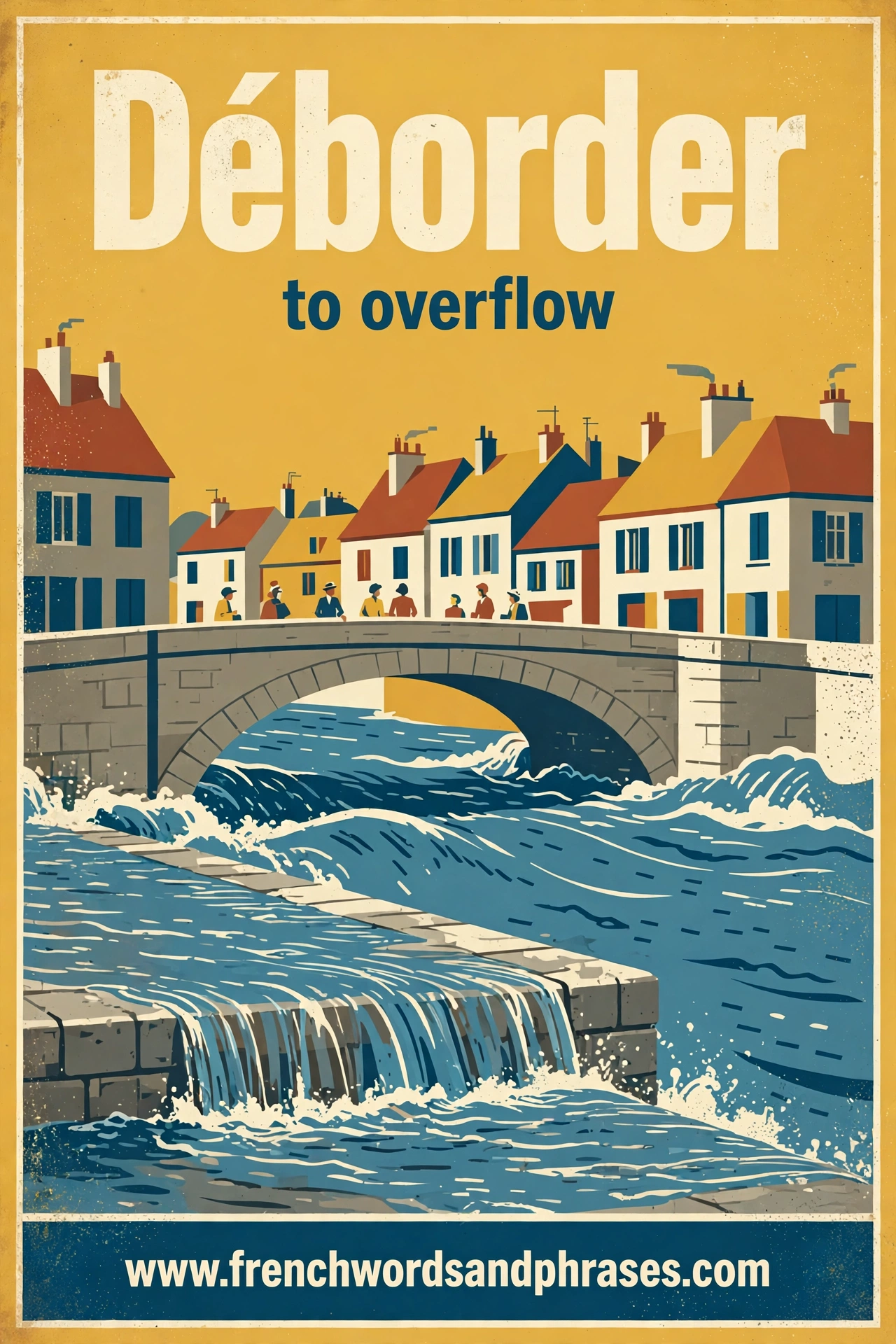
Déborder means to overflow, to spill over, or to brim over.
A river after the rain, a glass filled one drop too far, a pot of milk left on the stove — water and milk do not ask permission before they go too far. In French, that going-too-far is déborder.
In this guide, you’ll learn how to conjugate déborder in all the major French tenses and moods. Explore complete conjugation tables, French examples, English translations, and practice quizzes.
Understanding the French Verb Déborder
Déborder is a regular French verb belonging to the first group of verbs, those ending in -er.
It means to overflow, to spill over, or to brim over. It is used for rivers, milk, glasses and bathwater that spill over their edges, and figuratively for feelings and work that spill over too: déborder de joie, déborder d’énergie — and être débordé de travail, to be snowed under.
Verb classification: First group (-er)
Auxiliary verb: Avoir or être, depending on the construction
Past participle: débordé
Present participle: débordant
English equivalents: To overflow, to spill over, to boil over, to be overwhelmed.
One important detail: déborder is conjugated with avoir for the overflowing itself — la rivière a débordé (the river overflowed). You will also meet être débordé — je suis débordé de travail — but there débordé works as an adjective meaning snowed under or overwhelmed, not as the auxiliary of the overflowing event. The tables on this page use avoir.
Experience the Word
Déborder is the verb of one drop too many — the moment a container says enough and the contents go looking for somewhere else.
Imagine a pot of milk on a winter stove. It warms, it sighs, it rises — and then, while you answer the door, it climbs the sides and runs hissing over the edge.
You have not just made a mess. The milk has boiled over — and breakfast is now on the stove.
How to Conjugate Déborder: Complete French Conjugation Guide
Let’s explore every major conjugation of déborder, beginning with the indicative mood.
How to Conjugate Déborder in the Indicative Mood
The indicative mood is used to express facts, observations, actions, and events.
How to Conjugate Déborder in the Present Tense (Présent)
Used for actions happening now, habitual actions, and general truths.
| Subject | Conjugation |
|---|---|
| je | déborde |
| tu | débordes |
| il / elle | déborde |
| nous | débordons |
| vous | débordez |
| ils / elles | débordent |
Example
La rivière déborde après la pluie.
The river overflows after the rain.
Quick Quiz 1
Complete the sentence:
Les rivières ______ souvent au printemps.
Reveal the answer
débordent
Les rivières débordent souvent au printemps.
Rivers often overflow in spring.
How to Conjugate Déborder in the Passé Composé
Used for completed actions in the past. Déborder takes the auxiliary verb avoir or être, depending on the construction.
| Subject | Conjugation |
|---|---|
| j’ | ai débordé |
| tu | as débordé |
| il / elle | a débordé |
| nous | avons débordé |
| vous | avez débordé |
| ils / elles | ont débordé |
Example
Le lait a débordé sur la cuisinière.
The milk boiled over on the stove.
How to Conjugate Déborder in the Imparfait (Imperfect Tense)
Used for habitual past actions, descriptions, and ongoing situations in the past.
| Subject | Conjugation |
|---|---|
| je | débordais |
| tu | débordais |
| il / elle | débordait |
| nous | débordions |
| vous | débordiez |
| ils / elles | débordaient |
Example
Chaque printemps, le fleuve débordait dans les champs.
Every spring, the river used to overflow into the fields.
Quick Quiz 2
Choose the correct form:
The milk boiled over.
Le lait ______ sur la cuisinière. (a débordé / est débordé)
Reveal the answer
a débordé
Le lait a débordé sur la cuisinière.
The boiling over is an event, so déborder takes avoir; est débordé would mean the milk was snowed under, which makes no sense.
How to Conjugate Déborder in the Plus-que-parfait
Used to describe an action that had already been completed before another past event.
| Subject | Conjugation |
|---|---|
| j’ | avais débordé |
| tu | avais débordé |
| il / elle | avait débordé |
| nous | avions débordé |
| vous | aviez débordé |
| ils / elles | avaient débordé |
Example
La baignoire avait débordé et inondé la salle de bain.
The bath had overflowed and flooded the bathroom.
How to Conjugate Déborder in the Passé Simple
Primarily used in formal writing, literature, and historical narratives. It is rarely used in everyday conversation.
| Subject | Conjugation |
|---|---|
| je | débordai |
| tu | débordas |
| il / elle | déborda |
| nous | débordâmes |
| vous | débordâtes |
| ils / elles | débordèrent |
Example
Le fleuve déborda trois jours de suite.
The river overflowed three days in a row.
How to Conjugate Déborder in the Passé Antérieur
A literary tense used to express an action completed immediately before another past action, generally in the passé simple.
| Subject | Conjugation |
|---|---|
| j’ | eus débordé |
| tu | eus débordé |
| il / elle | eut débordé |
| nous | eûmes débordé |
| vous | eûtes débordé |
| ils / elles | eurent débordé |
Example
Dès que la rivière eut débordé, on évacua le village.
As soon as the river had overflowed, the village was evacuated.
How to Conjugate Déborder in the Future Tense (Futur Simple)
Used to describe actions that will take place in the future.
| Subject | Conjugation |
|---|---|
| je | déborderai |
| tu | déborderas |
| il / elle | débordera |
| nous | déborderons |
| vous | déborderez |
| ils / elles | déborderont |
Example
Si la pluie continue, le ruisseau débordera.
If the rain continues, the stream will overflow.
How to Conjugate Déborder in the Futur Antérieur (Future Perfect)
Used for an action that will have been completed before a particular point in the future.
| Subject | Conjugation |
|---|---|
| j’ | aurai débordé |
| tu | auras débordé |
| il / elle | aura débordé |
| nous | aurons débordé |
| vous | aurez débordé |
| ils / elles | auront débordé |
Example
À ce rythme, la casserole aura débordé avant ton retour.
At this rate, the saucepan will have boiled over before you return.
How to Conjugate Déborder in the Near Future (Futur Proche)
Used to describe something that is going to happen soon. Formed with aller + infinitive.
| Subject | Conjugation |
|---|---|
| je | vais déborder |
| tu | vas déborder |
| il / elle | va déborder |
| nous | allons déborder |
| vous | allez déborder |
| ils / elles | vont déborder |
Example
Attention, ton verre va déborder !
Careful, your glass is going to overflow!
How to Conjugate Déborder in the Conditional Mood
The conditional mood expresses what would happen under certain circumstances. It is also frequently used to make polite requests or express wishes.
How to Conjugate Déborder in the Present Conditional
| Subject | Conjugation |
|---|---|
| je | déborderais |
| tu | déborderais |
| il / elle | déborderait |
| nous | déborderions |
| vous | déborderiez |
| ils / elles | déborderaient |
Example
Sans la digue, le lac déborderait chaque année.
Without the dyke, the lake would overflow every year.
How to Conjugate Déborder in the Past Conditional
| Subject | Conjugation |
|---|---|
| j’ | aurais débordé |
| tu | aurais débordé |
| il / elle | aurait débordé |
| nous | aurions débordé |
| vous | auriez débordé |
| ils / elles | auraient débordé |
Example
Le lait aurait débordé si tu ne l’avais pas surveillé.
The milk would have boiled over if you had not watched it.
Déborder in the Literary Past Conditional Form
This less common literary form uses the imperfect subjunctive of avoir or être, depending on the construction.
| Subject | Conjugation |
|---|---|
| j’ | eusse débordé |
| tu | eusses débordé |
| il / elle | eût débordé |
| nous | eussions débordé |
| vous | eussiez débordé |
| ils / elles | eussent débordé |
Example
La rivière eût débordé sans les travaux de l’automne.
The river would have overflowed without the autumn works.
How to Conjugate Déborder in the Subjunctive Mood
The subjunctive is used to express wishes, emotions, doubts, necessity, and uncertainty. It frequently follows expressions such as il faut que (it is necessary that) or bien que (although).
How to Conjugate Déborder in the Present Subjunctive
| Subject | Conjugation |
|---|---|
| que je | déborde |
| que tu | débordes |
| qu’il / qu’elle | déborde |
| que nous | débordions |
| que vous | débordiez |
| qu’ils / qu’elles | débordent |
Example
Je crains que le lait ne déborde.
I am afraid the milk will boil over.
Quick Quiz 3
Complete the sentence using the subjunctive:
Je crains que le lait ne ______.
Reveal the answer
déborde
Je crains que le lait ne déborde.
I am afraid the milk will boil over.
How to Conjugate Déborder in the Imperfect Subjunctive
A literary tense, rarely encountered in modern spoken French.
| Subject | Conjugation |
|---|---|
| que je | débordasse |
| que tu | débordasses |
| qu’il / qu’elle | débordât |
| que nous | débordassions |
| que vous | débordassiez |
| qu’ils / qu’elles | débordassent |
Example
Elle surveillait la casserole pour que le lait ne débordât pas.
She watched the saucepan so the milk would not boil over.
How to Conjugate Déborder in the Pluperfect Subjunctive
A literary construction used to express an action completed before another past action.
| Subject | Conjugation |
|---|---|
| que j’ | eusse débordé |
| que tu | eusses débordé |
| qu’il / qu’elle | eût débordé |
| que nous | eussions débordé |
| que vous | eussiez débordé |
| qu’ils / qu’elles | eussent débordé |
Example
Il regrettait que la rivière eût débordé deux fois cet hiver.
He regretted that the river had overflowed twice that winter.
How to Conjugate Déborder in the Past Subjunctive
| Subject | Conjugation |
|---|---|
| que j’ | aie débordé |
| que tu | aies débordé |
| qu’il / qu’elle | ait débordé |
| que nous | ayons débordé |
| que vous | ayez débordé |
| qu’ils / qu’elles | aient débordé |
Example
C’est fâcheux que la baignoire ait débordé.
It is a nuisance that the bath overflowed.
How to Conjugate Déborder in the Imperative
The imperative is used to give commands, instructions, invitations, or suggestions. Subject pronouns are omitted.
How to Conjugate Déborder in the Present Imperative
| Person | Conjugation |
|---|---|
| (tu) | déborde |
| (nous) | débordons |
| (vous) | débordez |
Example
Débordez d’énergie, les enfants !
Burst with energy, children!
Quick Quiz 4
How would you say Burst with energy, using the vous form?
Reveal the answer
Débordez d’énergie !
French Participles of Déborder
Participles are verb forms that can be used in compound tenses and other grammatical constructions.
Present Participle of Déborder
débordant
En débordant, la rivière a coupé la route.
As it overflowed, the river cut off the road.
Past Participle of Déborder
débordé
Je suis débordé de travail cette semaine.
I am snowed under with work this week.
Déborder in Everyday French: Real-Life Examples
Now that you know the conjugations, let’s see how déborder appears in everyday French.
Example 1 — Present
Mon agenda déborde cette semaine.
My diary is overflowing this week.
Example 2 — Passé composé — avoir
Le verre a débordé sur la nappe.
The glass overflowed onto the tablecloth.
Example 3 — Passé composé — être (adjective)
Nous sommes débordés au bureau.
We are snowed under at the office.
Example 4 — Imparfait
Elle débordait de joie à l’idée de partir.
She was bursting with joy at the idea of leaving.
Example 5 — Future
La rivière débordera si la pluie ne s’arrête pas.
The river will overflow if the rain does not stop.
Example 6 — Conditional
Je déborderais d’énergie si je dormais mieux.
I would overflow with energy if I slept better.
Beyond Translation: The Meaning of Déborder
English says overflow for a river and boil over for milk; French déborder carries both, plus everything that spills out of a person — joy, energy, anger, a diary full of appointments.
And déborder has a secret second life.
Say je suis débordé and nobody pictures a river: you are snowed under with work, the participle dressed as an adjective with être, while the spilling itself stays with avoir — le lait a débordé.
How to Remember the French Verb Déborder
Remember it this way: Déborder is about overflowing — avoir for the spill, être débordé only as the adjective ‘snowed under’.
- The spilling takes avoir — la rivière a débordé (the river overflowed).
- Être débordé is the participle as an adjective: je suis débordé means I am snowed under, not that I overflowed.
- Use it figuratively too — déborder de joie, to brim over with joy.
The key idea is overflowing — avoir for the spill, être débordé only as the adjective ‘snowed under’.
Test Your Knowledge of Déborder
Let’s see how much you’ve learned. Try answering these questions before revealing the answers.
Question 1
When does déborder take avoir, and when do you see être débordé?
Reveal the answer
Avoir for the overflowing itself — la rivière a débordé. Être débordé is the participle used as an adjective meaning snowed under or overwhelmed — je suis débordé de travail.
Question 2
How do you say the glass will overflow in French?
Reveal the answer
Le verre débordera.
Question 3
Translate: The milk boiled over on the stove.
Reveal the answer
Le lait a débordé sur la cuisinière.
Question 4
What is the past participle of déborder?
Reveal the answer
Débordé.
Question 5
Complete the sentence:
Si la pluie continue, la rivière ______.
Reveal the answer
débordera
Si la pluie continue, la rivière débordera.
If the rain continues, the river will overflow.
Your Final Challenge
Can You Use It?
How would you say this in French?
The river overflowed after the storm.
Reveal the answer
La rivière a débordé après l’orage.
The river overflowed after the storm.
A little French. A little curiosity. A richer everyday life.
LEARN FRENCH ONE WORD AT A TIME