
A French Word to Live By
Translate De peur que to English
/də pœʁ kə/
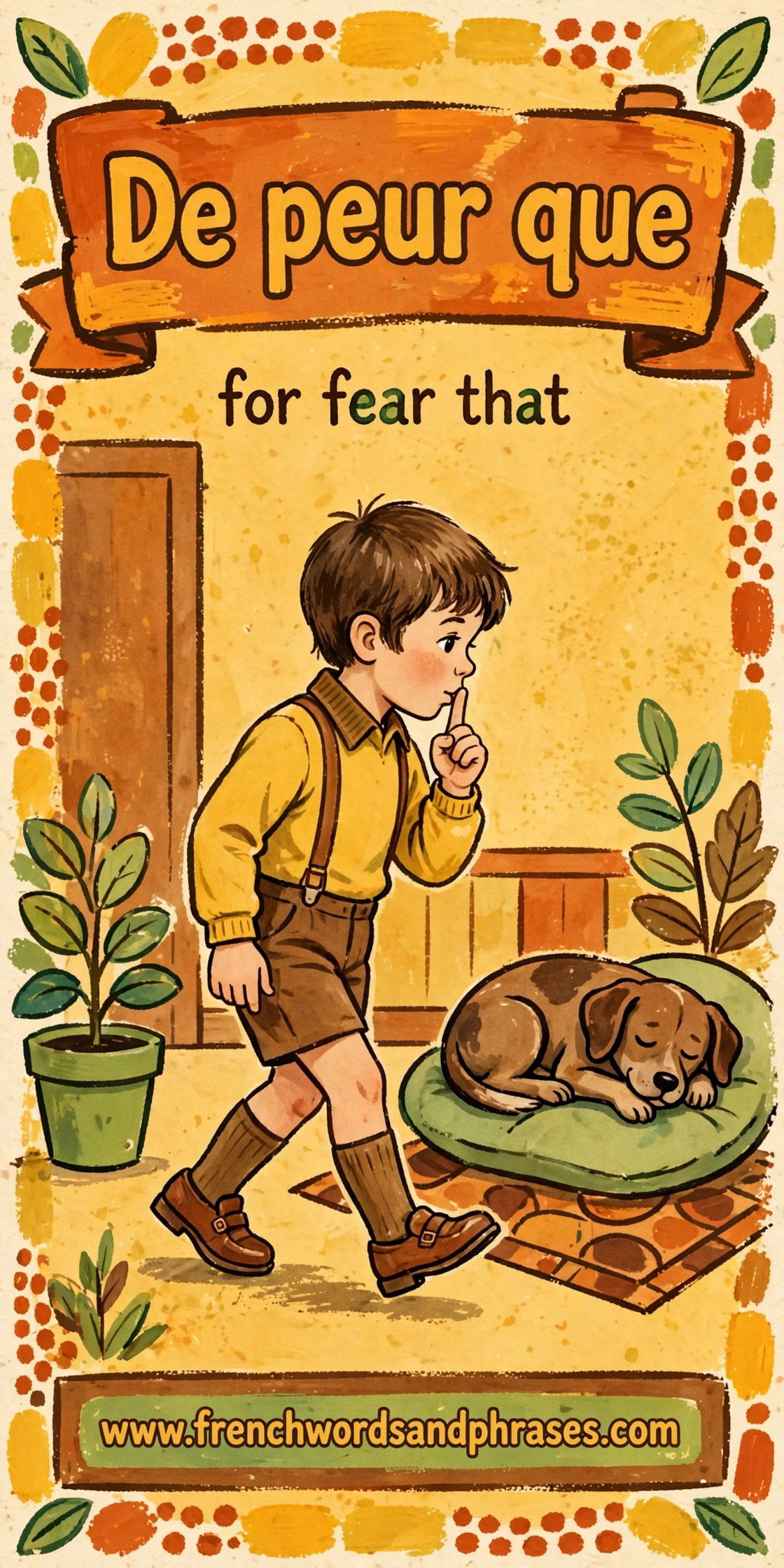
De peur que means for fear that.
A little girl at the funfair holds her balloon with both hands, knuckles white. Her brother laughs: « tu le tiens de peur qu’il ne s’envole ! » — you’re holding it for fear it’ll fly away. De peur que is that grip, turned into grammar: the everyday French way of saying what you’re afraid might happen.
In this guide, you’ll learn what de peur que means in English, how it introduces the event you hope will NOT happen, why it takes the subjunctive, and when its little ne appears and disappears. You’ll also meet its formal twin de crainte que and its infinitive form de peur de. Explore French examples, English translations, and practice quizzes.
Understanding the French Conjunction De peur que
De peur que is a French subordinating conjunction of fear — the everyday, spoken member of the fear family. It introduces a clause naming the unwanted event that a precaution is meant to keep away.
It means for fear that, or lest. After de peur que comes a complete clause in the subjunctive, and that clause names the thing you do NOT want: elle tient son verre à deux mains de peur qu’il ne glisse — she holds her glass in both hands for fear it might slip. The main clause is what you do; the de peur que clause is what you’re afraid of.
Type: Subordinating conjunction — fear and prevention
Answers the question: De peur de quoi ? — For fear of what happening?
What follows it: A full clause: subject + verb
Mood after it: Subjunctive — with an optional ne explétif
One important usage detail: de peur que has a twin for same-subject situations, de peur de + infinitive, and you will hear it everywhere — de peur de tomber, for fear of falling. The ne explétif (de peur qu’il ne pleuve) belongs to careful writing; in relaxed speech it often drops away, leaving the subjunctive to do the work alone.
Experience the Word
De peur que is the conjunction of the protective reflex — the hand that grabs, the voice that lowers, the step that slows down.
Imagine a father crossing a busy street, his daughter’s hand suddenly tight in his: « je te tiens fort, de peur qu’une voiture n’arrive trop vite ».
You have not just described a worry. You have shown love doing its quiet arithmetic.
How to Use De peur que in French: Complete Guide
Let’s explore how de peur que works in French, beginning with the whole word on one card.
De peur que at a Glance
Before the details, here is the whole word on one card.
The Whole Word on One Card
Meaning, job, pattern and mood — de peur que in four lines.
| Point | De peur que |
|---|---|
| Meaning | for fear that — lest |
| Job | introduces the unwanted event a precaution guards against |
| What follows | a full clause — subject + verb |
| Mood | subjunctive, with an optional ne explétif |
Example
Elle tient son verre à deux mains de peur qu’il ne glisse.
She holds her glass in both hands for fear it might slip.
How De peur que Links: The Precaution First, the Fear After
De peur que joins what you do to what you’re afraid of: precaution in the main clause, feared event in the clause that follows.
| Pattern | Example |
|---|---|
| precaution + de peur que + feared event | il baisse la voix de peur que le bébé ne se réveille — he lowers his voice for fear the baby might wake |
| with ne explétif | de peur qu’elle ne soit déjà couchée — for fear she might already be in bed |
| without ne (relaxed speech) | de peur que le magasin ferme — for fear the shop might close |
| the fear clause first (for emphasis) | de peur qu’on ne l’entende, elle a refermé la porte — for fear of being heard, she closed the door again |
Example
Il n’ose pas téléphoner de peur qu’elle ne soit déjà couchée.
He doesn’t dare phone for fear she might already be in bed.
Quick Quiz 1
After de peur que, is the verb in the indicative or the subjunctive?
Reveal the answer
The subjunctive — the feared event hasn’t happened and may never happen.
De peur qu’il ne pleuve.
For fear that it might rain.
The Mood Question: Subjunctive — and a Ne That Comes and Goes
Fear deals in shadows, not facts, so the verb after de peur que is always in the subjunctive. The ne explétif is a formal ornament: written French loves it, spoken French often leaves it out — the meaning never changes.
| Verb | Subjunctive after de peur que |
|---|---|
| être (to be) | de peur qu’il ne soit trop tard — for fear it might be too late |
| pleuvoir (to rain) | de peur qu’il ne pleuve pendant la randonnée — for fear it might rain during the hike |
| venir (to come) | de peur qu’elle ne vienne trop tôt — for fear she might come too early |
| faire (to do) | de peur que tu ne fasses une bêtise — for fear you might do something silly |
| pouvoir (to be able) | de peur qu’on ne puisse pas entrer — for fear we might not be able to get in |
Example
Il vérifie la météo de peur qu’il ne pleuve pendant la randonnée.
He checks the forecast for fear it might rain during the hike.
Where De peur que Goes: Right Behind the Precaution
De peur que normally follows the main clause, glued to the precaution it explains. For emphasis it can move to the front, and que elides before a vowel.
| Position | Example |
|---|---|
| After the main clause | elle cache le chocolat de peur que les enfants ne le trouvent — she hides the chocolate for fear the children might find it |
| Opening the sentence (emphasis) | de peur de réveiller le chat, elle marche sur la pointe des pieds — for fear of waking the cat, she walks on tiptoe |
| Elision before a vowel | de peur qu’il, de peur qu’on — que becomes qu’ |
| Register | everyday and neutral — at home in speech and writing alike |
Example
Ils se sont dépêchés de peur que le magasin ne ferme.
They hurried for fear the shop might close.
Quick Quiz 2
In de peur qu’il ne pleuve, does the speaker fear rain — or fear NO rain?
Reveal the answer
The speaker fears rain — the ne is explétif and negates nothing.
Elle prend un parapluie de peur qu’il ne pleuve.
She takes an umbrella for fear that it might rain.
Everyday Expressions with De peur que
De peur que lives inside a busy family — above all its infinitive twin, which French speakers use dozens of times a day.
| Expression | In English |
|---|---|
| de peur de + infinitive | for fear of… (same subject) — de peur de tomber |
| de peur qu’il ne soit trop tard | for fear it might be too late |
| par peur de | out of fear of (+ noun) |
| avoir peur que | to be afraid that… (a feeling, not a precaution) |
| de peur d’oublier | for fear of forgetting |
Example
De peur d’oublier, elle note tout dans un petit carnet.
For fear of forgetting, she writes everything down in a little notebook.
Close Cousins: De peur que, De crainte que, De peur de, Pour éviter que
Same fear, four outfits. De peur que is the everyday one; its cousins differ in register, in structure, or in angle.
| Word | The difference |
|---|---|
| de peur que | the everyday fear conjunction; subjunctive, ne optional |
| de crainte que | the formal, written twin — same meaning, subjunctive, ne usual |
| de peur de | + infinitive when the subject is the same: de peur de tomber |
| pour éviter que | ‘so that it doesn’t happen’ — prevention seen from the solution side; subjunctive |
| au cas où | ‘in case’ — a cool-headed precaution, followed by the conditional |
Example
De peur de tomber, l’enfant se tient à la rampe ; sa mère le suit de peur qu’il ne glisse.
For fear of falling, the child holds the railing; his mother follows him for fear he might slip.
Quick Quiz 3
Which cousin of de peur que is its formal, written twin?
Reveal the answer
de crainte que.
Il se tut de crainte qu’on ne l’entende.
He fell silent for fear that he might be heard.
De peur que and Its Neighbours
Fear and caution keep close company — and one famous neighbour works by a completely different rule.
| French | In English |
|---|---|
| de crainte que | for fear that (formal twin) |
| pour éviter que | to prevent, so that… doesn’t happen |
| au cas où | in case (+ conditional) |
| sinon | otherwise, or else |
| attention à | watch out for, mind |
Example
Attention au verglas, sinon tu vas glisser.
Mind the ice, otherwise you’ll slip.
Watch Out: The Traps Around De peur que
The classic traps: the wrong mood, a misread ne, and a clause where an infinitive belongs.
| Trap | The truth |
|---|---|
| indicative after de peur que | never: the feared event is unreal — subjunctive, de peur qu’il ne vienne |
| reading the ne as a negation | the fear is that the event WILL happen; the ne changes nothing |
| de peur que + infinitive | impossible — same subject? de peur de + infinitive |
| confusing it with avoir peur que | avoir peur que states a feeling; de peur que explains a precaution |
Example
Elle retient son souffle de peur que le bébé ne se réveille.
She holds her breath for fear the baby might wake up.
Quick Quiz 4
‘For fear of waking the cat’ (same subject throughout) — de peur que or de peur de?
Reveal the answer
de peur de + infinitive.
De peur de réveiller le chat, elle marche sur la pointe des pieds.
For fear of waking the cat, she walks on tiptoe.
De peur que in Everyday French: Real-Life Examples
Now that you know the word, let’s see how de peur que appears in everyday French.
Example 1 — At the funfair
Elle tient son ballon à deux mains de peur qu’il ne s’envole.
She holds her balloon in both hands for fear it might fly away.
Example 2 — A late phone call
Il n’ose pas téléphoner de peur qu’elle ne soit déjà couchée.
He doesn’t dare phone for fear she might already be in bed.
Example 3 — Before closing time
Ils se sont dépêchés de peur que le magasin ne ferme.
They hurried for fear the shop might close.
Example 4 — Hidden treasure
Elle cache le chocolat de peur que les enfants ne le trouvent.
She hides the chocolate for fear the children might find it.
Example 5 — Checking the sky
Il vérifie la météo de peur qu’il ne pleuve pendant la randonnée.
He checks the forecast for fear it might rain during the hike.
Example 6 — On tiptoe
De peur de réveiller le chat, elle marche sur la pointe des pieds.
For fear of waking the cat, she walks on tiptoe.
Beyond Translation: The Meaning of De peur que
English says for fear that for the meaning of de peur que — and English speakers feel its logic at once, because peur is the plain, beating-heart word for fear. Where de crainte que dresses the worry in formal clothes, de peur que rolls up its sleeves: it is the grip on the balloon string, the hand tightened around a child’s hand.
De peur que is fear translated instantly into care — the precaution IS the feeling, made visible.
Learn this phrase and you learn something tender about French: its grammar of fear is mostly a grammar of looking after people.
How to Remember the French Conjunction De peur que
Remember it this way: De peur que is the protective reflex in phrase form — everyday, warm, and always followed by the subjunctive.
- You name the thing you don’t want — de peur qu’il ne pleuve, the rain you’re dressing against.
- You choose the subjunctive — the feared event is a shadow, not a fact.
- You switch to de peur de + infinitive when the subject stays the same — de peur de tomber.
The key idea is de peur que = for fear that + subjunctive — the everyday fear phrase, twin of formal de crainte que.
Test Your Knowledge of De peur que
Let’s see how much you’ve learned. Try answering these questions before revealing the answers.
Question 1
What does de peur que mean?
Reveal the answer
For fear that — lest: it introduces the unwanted event a precaution guards against.
Question 2
Which mood follows de peur que?
Reveal the answer
The subjunctive — de peur qu’il ne pleuve.
Question 3
Translate: He lowers his voice for fear that the baby might wake up.
Reveal the answer
Il baisse la voix de peur que le bébé ne se réveille.
Question 4
When do you use de peur de instead of de peur que?
Reveal the answer
When the subject is the same — de peur de + infinitive: de peur de tomber.
Question 5
Complete the sentence:
Elle tient son verre de peur qu’il ne ______. (glisser)
Reveal the answer
glisse
Elle tient son verre de peur qu’il ne glisse.
She holds her glass for fear it might slip.
Your Final Challenge
Can You Use It?
How would you say this in French?
“He lowers his voice for fear that the baby might wake up.”
Reveal the answer
Il baisse la voix de peur que le bébé ne se réveille.
He lowers his voice for fear that the baby might wake up.
A little French. A little curiosity. A richer everyday life.
LEARN FRENCH ONE WORD AT A TIME




