
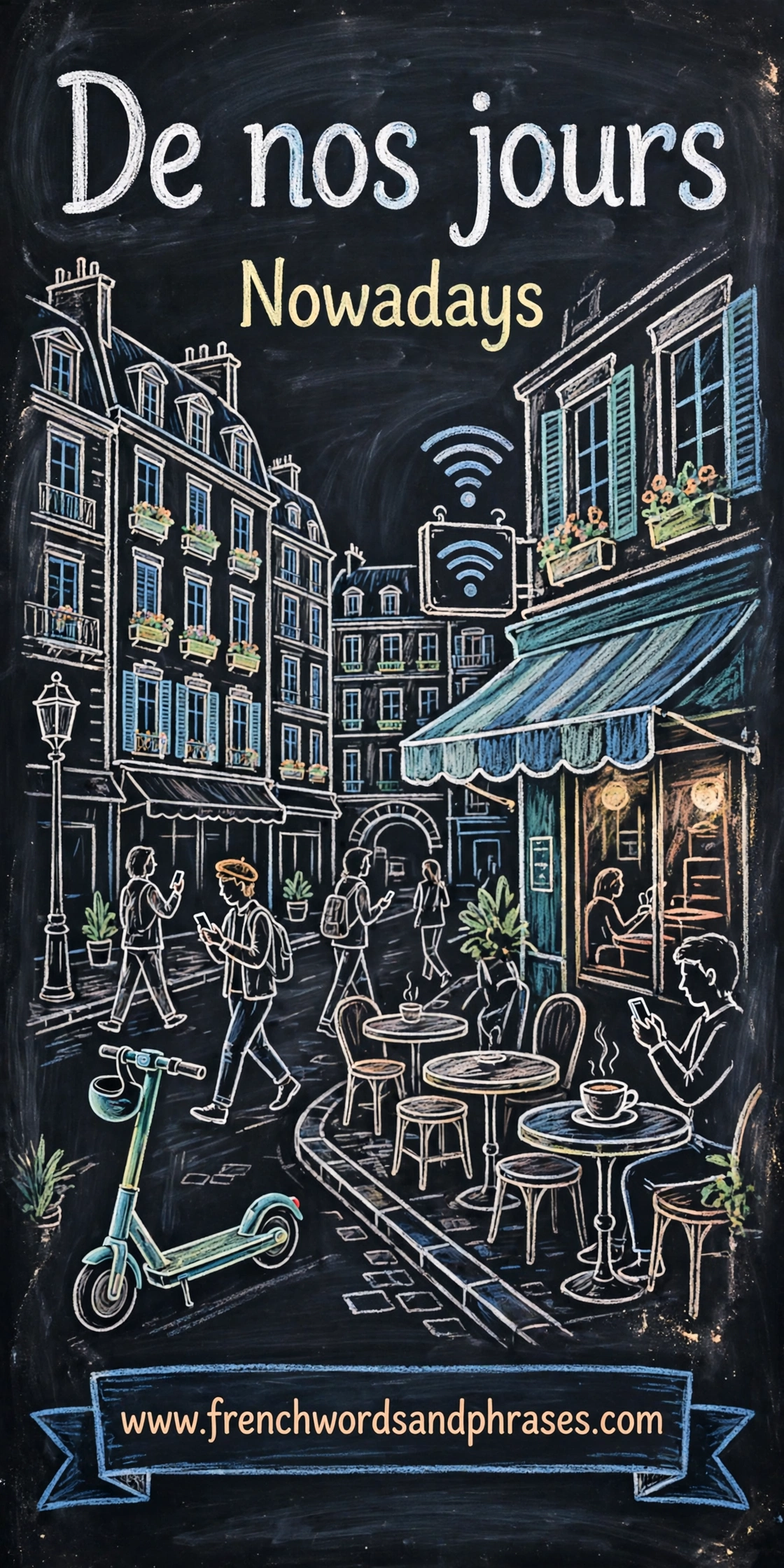
A French Word to Live By
Translate De nos jours to English
/də no ʒuʁ/
De nos jours means nowadays.
A grandmother in a village near Dijon watches her grandson pay for his coffee with a telephone. She shakes her head, half amazed, half amused, and delivers the verdict every generation eventually delivers: de nos jours, tout va trop vite — nowadays, everything goes too fast.
Let’s explore how de nos jours works in French, beginning with the whole phrase on one card.
Understanding the French Phrase De nos jours
De nos jours is a French time phrase — a little adverbial expression built from de (of), nos (our) and jours (days). It does not point at a moment; it opens a window onto a whole era: the days we are living in now.
It means nowadays — in our time, in the present age. It is the phrase of comparisons between then and now: prices, telephones, children, manners, the speed of life. Where en ce moment covers this minute, de nos jours covers this generation.
Type: Time phrase — de + nos + jours, ‘of our days’
Answers the need: Talking about the present era and how it differs from the past
Register: Neutral — conversation, articles and speeches alike, often with a sigh or a smile
Strength: Everyday — comparisons, complaints and wonders about modern life
One important usage detail: de nos jours measures an era, not a moment. For something true this very minute — the shop is shut, it is raining — French uses en ce moment or actuellement. De nos jours is the wide shot; en ce moment is the close-up.
Experience the Word
De nos jours is the phrase of the family lunch — the moment an older voice compares the price of bread, the length of skirts or the patience of children with how things used to be.
Imagine the small theatre of it: a grandparent holds a smartphone like a warm potato, a grandchild rescues it with two taps, and the whole table laughs as the words arrive, right on cue — de nos jours !
The phrase carries a mood as much as a meaning: wonder, nostalgia, gentle complaint. It rarely just reports the present; it weighs it against the past.
How to Use De nos jours in French: Complete Guide
Let’s explore how de nos jours works in French, beginning with the whole phrase on one card.
De nos jours at a Glance
The Whole Phrase on One Card
Real meaning, literal building blocks, English twin and register — de nos jours in five lines.
| Point | De nos jours |
|---|---|
| What it really means | nowadays — in the era we are living in |
| Word for word | of our days (de + nos + jours) |
| English equivalent | nowadays / in this day and age |
| Register | neutral — often with nostalgia, wonder or a gentle complaint |
| Use it for | comparing generations, prices, technology, habits and manners |
Example
De nos jours, un téléphone fait tout.
Nowadays, a phone does everything.
Word by Word: Building the Era
Three small words — and together they claim a whole age as ours.
| Word | Literal meaning | Its job in the phrase |
|---|---|---|
| de | of / from | the little peg that hangs the phrase on time: ‘of…’ |
| nos | our | the possessive — this era belongs to us, the people speaking |
| jours | days | jours is always plural here — not one day, but the run of our days |
Example
Les enfants de nos jours ne jouent plus dehors comme avant.
Children nowadays no longer play outside like before.
Quick Quiz 1
What does jours mean on its own, and why is it plural here?
Reveal the answer
Days — and it is plural because the phrase covers the whole run of our days, an era, not a single day.
De nos jours, tout va plus vite.
Nowadays, everything goes faster.
When You Say It: The Comparison Moments
De nos jours appears whenever the present is weighed against the past.
| Situation | Example |
|---|---|
| Comparing generations | de nos jours, les jeunes vivent chez leurs parents plus longtemps — nowadays, young people live with their parents longer |
| Marvelling at technology | de nos jours, on parle à l’autre bout du monde en une seconde — nowadays, you talk to the other side of the world in a second |
| Complaining about prices | de nos jours, tout coûte plus cher — nowadays, everything costs more |
| Noticing habits change | de nos jours, on n’écrit plus de lettres — nowadays, people no longer write letters |
| Praising the present | de nos jours, les trains sont plus rapides et plus propres — nowadays, trains are faster and cleaner |
Example
De nos jours, on peut travailler de n’importe où.
Nowadays, you can work from anywhere.
Make It Yours: Bending the Era
The phrase settles at the head of a sentence, or wraps itself around the people it describes.
| Form | French | In English |
|---|---|---|
| Plain, at the head | de nos jours, tout a changé | nowadays, everything has changed |
| Around a group | les jeunes de nos jours | young people nowadays |
| With a habit | de nos jours, on mange moins de pain | nowadays, people eat less bread |
| Still true now | de nos jours encore, on danse dans les villages | even nowadays, people dance in the villages |
| Then and now together | de nos jours comme autrefois, le pain se fait à la main | nowadays as in the old days, bread is made by hand |
| The verdict | c’est la vie de nos jours | that’s life nowadays |
Example
Les étudiants de nos jours ont tout sur leur téléphone.
Students nowadays have everything on their phones.
Quick Quiz 2
You want to say the bakery is shut right now, at this minute. Which phrase fits — de nos jours or en ce moment?
Reveal the answer
En ce moment — de nos jours covers an era, not a moment.
En ce moment, la boulangerie est fermée.
At the moment, the bakery is closed.
Everyday Expressions: Building on the Era
De nos jours grows a family of comparison frames — learn these and every then-and-now conversation opens.
| Frame | In English |
|---|---|
| de nos jours, tout est plus cher | nowadays, everything is more expensive |
| les enfants de nos jours | children nowadays |
| de nos jours, on travaille à distance | nowadays, people work remotely |
| de nos jours, personne ne lit les journaux | nowadays, nobody reads newspapers |
| de nos jours comme autrefois | nowadays, as in the old days |
| de nos jours, avec Internet… | nowadays, with the Internet… |
Example
De nos jours, avec Internet, on réserve tout en ligne.
Nowadays, with the Internet, you book everything online.
Close Cousins: The Other Era Words
French keeps a shelf of present-age phrases — each with its own width of time.
| Expression | The difference |
|---|---|
| aujourd’hui | today — this single day; in modern speech it can stretch to ‘these days’, but its home is the day itself |
| à notre époque | in our era — the same idea as de nos jours, a touch more formal and written |
| en ce moment | at the moment — minutes and days, not an era |
| maintenant | now — the immediate present, a point, not a period |
| autrefois | in the old days — the mirror opposite: the era that is gone |
Example
Autrefois on écrivait des lettres ; de nos jours, on envoie des messages.
In the old days people wrote letters; nowadays, they send messages.
Quick Quiz 3
What is the classic opposite of de nos jours — the phrase for the era that has vanished?
Reveal the answer
Autrefois — in the old days, formerly.
Autrefois, il n’y avait pas de téléphones portables.
In the old days, there were no mobile phones.
De nos jours and Its Neighbours
The era family at a glance — from this minute to the vanished age.
| French | In English |
|---|---|
| de nos jours | nowadays |
| aujourd’hui | today / these days |
| à notre époque | in our era |
| en ce moment | at the moment |
| autrefois | in the old days |
| jadis | long ago, in days of old (literary) |
Example
Jadis on voyageait à cheval ; de nos jours, on prend l’avion.
Long ago people travelled by horse; nowadays, they take the plane.
Watch Out: The Traps Around De nos jours
Three traps wait around this gentle phrase — step round them.
| Trap | The truth |
|---|---|
| Building it word for word from English | ‘in our days’ with dans is wrong — the French peg is de: de nos jours |
| Using it for this minute | de nos jours is an era; for the present moment say en ce moment |
| Dropping the plural | jours keeps its -s — the phrase is about many days, never ‘de nos jour’ |
| Reading nos as ‘nose’ | nos /no/ means our — it has nothing to do with the nez on your face |
Example
De nos jours, en ce moment même, tout le monde regarde son téléphone.
Nowadays, at this very moment, everyone is looking at their phone.
Quick Quiz 4
True or false: de nos jours can describe the next five minutes.
Reveal the answer
False — it paints a whole era. Five minutes belong to en ce moment or dans cinq minutes.
De nos jours, les trains sont rapides.
Nowadays, trains are fast.
De nos jours in Everyday French: Real-Life Examples
Now that you know the word, let’s see how de nos jours appears in everyday French.
Example 1 — The grandparents
De nos jours, les enfants ont un téléphone à dix ans !
Nowadays, children have a phone at ten years old!
Example 2 — Technology
De nos jours, on peut voir ses petits-enfants en vidéo, même à l’autre bout du monde.
Nowadays, you can see your grandchildren on video, even on the other side of the world.
Example 3 — At the market
De nos jours, même les tomates coûtent une fortune en hiver.
Nowadays, even tomatoes cost a fortune in winter.
Example 4 — Young people
Les jeunes de nos jours voyagent beaucoup plus que nous à leur âge.
Young people nowadays travel much more than we did at their age.
Example 5 — At work
De nos jours, la moitié de mon équipe travaille à la maison.
Nowadays, half of my team works from home.
Example 6 — A gentle complaint
De nos jours, tout va trop vite, on n’a plus le temps de se parler.
Nowadays, everything goes too fast, people no longer have time to talk to each other.
Beyond Translation: The Meaning of De nos jours
There is a quiet claim inside de nos jours: the era is ours. English ‘nowadays’ just points at the calendar; French takes possession — nos jours, our days, the days that belong to us and that we will one day describe to grandchildren. That is why the phrase so often arrives with a comparison: to name our days is already to measure them against the days before.
How to Remember the French Phrase De nos jours
Remember it this way: De nos jours looks at the present through a wide window — not this minute, but this age: our days, the days we are living in.
- You hear nos jours and think of a whole generation — the phrase never fits inside a single day.
- You keep it for comparisons — prices, habits, telephones: wherever autrefois is hiding nearby.
- You leave the minute hand to en ce moment — de nos jours is the wide shot, en ce moment the close-up.
The key idea is de nos jours means nowadays — de + nos + jours, the era we live in, seen as one long present.
Test Your Knowledge of De nos jours
Let’s see how much you’ve learned. Try answering these questions before revealing the answers.
Question 1
What does de nos jours mean?
Reveal the answer
Nowadays — in the era we are living in.
Question 2
Word for word, what does de nos jours say?
Reveal the answer
Of our days — de (of) + nos (our) + jours (days).
Question 3
What is the classic opposite of de nos jours?
Reveal the answer
Autrefois — in the old days.
Question 4
You want to say the shop is closed at this very moment. Why is de nos jours wrong?
Reveal the answer
Because it covers an era, not a moment — for the moment, say en ce moment.
Question 5
Complete the sentence:
______ ______, tout le monde paie avec son téléphone. (Nowadays, everyone pays with their phone.)
Reveal the answer
De nos jours — De nos jours, tout le monde paie avec son téléphone.
Your Final Challenge
Can You Use It?
How would you say this in French?
“Nowadays, everyone pays with their phone.”
Reveal the answer
De nos jours, tout le monde paie avec son téléphone.
Nowadays, everyone pays with their phone.
A little French. A little curiosity. A richer everyday life.
LEARN FRENCH ONE WORD AT A TIME




