
A French Word to Live By
Translate De crainte que to English
/də kʁɛ̃t kə/
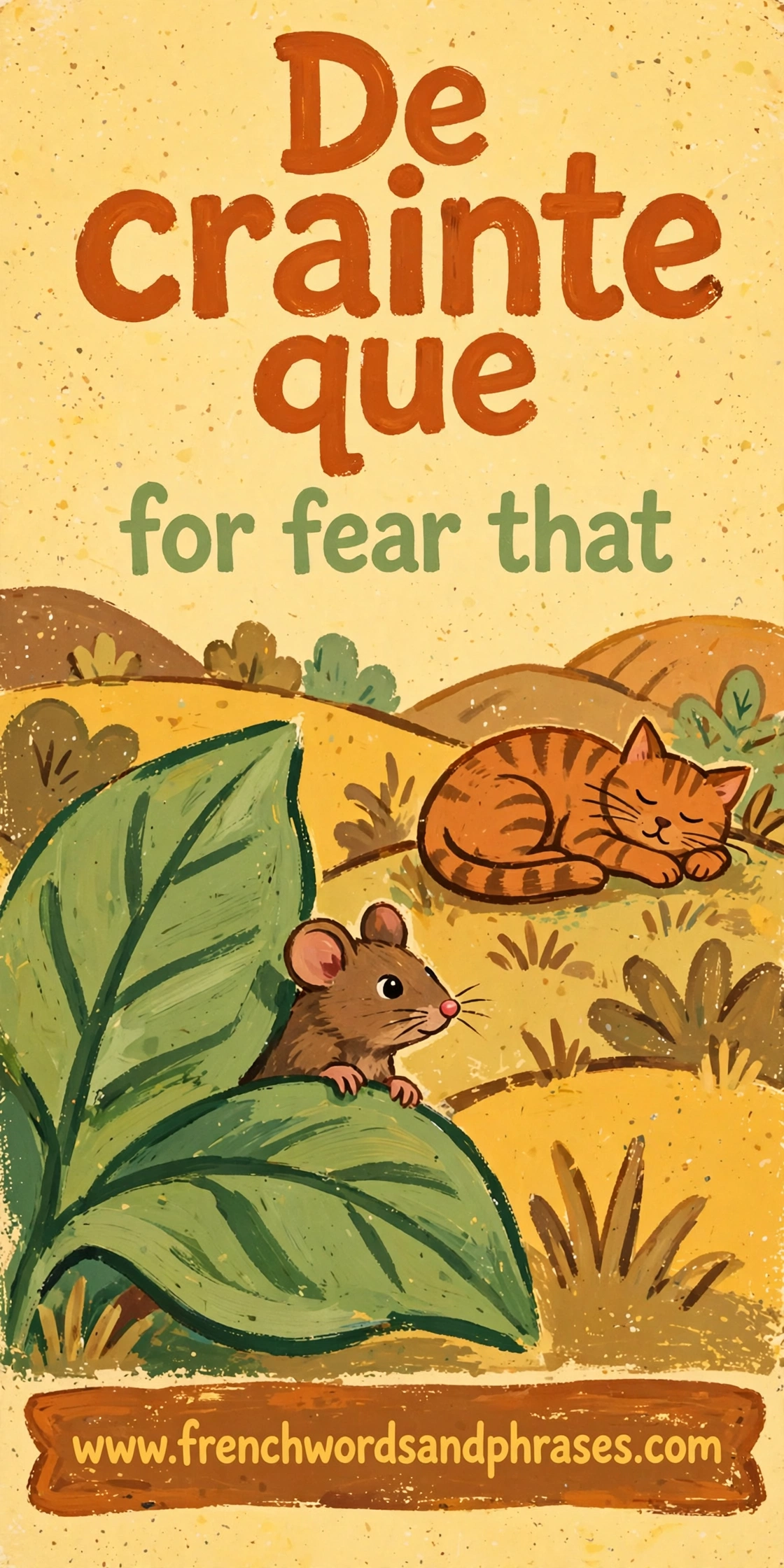
De crainte que means for fear that.
A mother watches her son climb the old apple tree and calls up, half laughing, half serious: « descends, de crainte que tu ne tombes ! » French has a whole phrase built for that flutter of worry — the fear of what might happen, spoken out loud precisely so that it won’t.
In this guide, you’ll learn what de crainte que means in English, how it introduces the very thing you hope will NOT happen, why it takes the subjunctive, and what that curious extra ne is doing there. You’ll also see how it differs from its twin de peur que. Explore French examples, English translations, and practice quizzes.
Understanding the French Conjunction De crainte que
De crainte que is a French subordinating conjunction of fear — a slightly formal, written member of the family that includes de peur que. It introduces a clause naming the unwanted event that someone is acting to prevent.
It means for fear that, or lest. After de crainte que comes a complete clause in the subjunctive, and the event in that clause is the one you do NOT want: il parle doucement de crainte qu’on ne l’entende — he speaks quietly for fear that he might be heard. The main clause is the precaution; the de crainte que clause is the worry.
Type: Subordinating conjunction — fear and prevention
Answers the question: De crainte de quoi ? — For fear of what happening?
What follows it: A full clause: subject + verb
Mood after it: Subjunctive — often with a ne explétif
Listen for the ghost of a negative: de crainte que often carries a little ne that means nothing on its own — de crainte qu’il ne pleuve, for fear it might rain. This ne explétif is a fossil of the fear itself, and it does NOT make the clause negative. In careful writing it is elegant; in speech it often disappears, and de peur que takes over.
Experience the Word
De crainte que is the conjunction of the careful heart — it names the disaster quietly, in order to keep it away.
Imagine a librarian wrapping an old book in soft cloth: « je le protège de crainte que la lumière ne l’abîme » — I protect it for fear the light might damage it.
You have not just expressed a fear. You have acted against it.
How to Use De crainte que in French: Complete Guide
Let’s explore how de crainte que works in French, beginning with the whole word on one card.
De crainte que at a Glance
Before the details, here is the whole word on one card.
The Whole Word on One Card
Meaning, job, pattern and mood — de crainte que in four lines.
| Point | De crainte que |
|---|---|
| Meaning | for fear that — lest |
| Job | introduces the unwanted event someone is guarding against |
| What follows | a full clause — subject + verb |
| Mood | subjunctive, often with ne explétif |
Example
Elle ferme la porte à clé de crainte qu’on n’entre pendant la nuit.
She locks the door for fear that someone might come in during the night.
How De crainte que Links: The Precaution First, the Worry After
De crainte que glues a precaution to its worry: first what you do, then the event you are doing it to avoid.
| Pattern | Example |
|---|---|
| precaution + de crainte que + feared event | il chuchote de crainte qu’on ne l’entende — he whispers for fear of being heard |
| with ne explétif | de crainte qu’il ne soit trop tard — for fear that it might be too late |
| without ne (lighter style) | de crainte que tu ne tombes — for fear that you might fall |
| two different subjects | elle retient l’enfant de crainte qu’il ne traverse seul — she holds the child back for fear he might cross on his own |
Example
Nous partons tôt de crainte qu’il n’y ait trop de monde.
We’re leaving early for fear that it might be too crowded.
Quick Quiz 1
After de crainte que, is the verb in the indicative or the subjunctive?
Reveal the answer
The subjunctive — the feared event is not a fact, only a shadow.
De crainte qu’il ne pleuve.
For fear that it might rain.
The Mood Question: Subjunctive — and the Little Ne That Means Nothing
Fear looks at something that has not happened and may never happen, so the verb goes into the subjunctive. Formal French then adds a decorative ne — the ne explétif — which negates nothing at all.
| Verb | Subjunctive after de crainte que |
|---|---|
| être (to be) | de crainte qu’il ne soit trop tard — for fear it might be too late |
| avoir (there is) | de crainte qu’il n’y ait un problème — for fear there might be a problem |
| pleuvoir (to rain) | de crainte qu’il ne pleuve — for fear it might rain |
| venir (to come) | de crainte qu’elle ne vienne — for fear she might come |
| faire (to do) | de crainte que tu ne fasses une erreur — for fear you might make a mistake |
Example
Il emporte un parapluie de crainte qu’il ne pleuve ce soir.
He takes an umbrella for fear that it might rain this evening.
Where De crainte que Goes: After the Precaution
De crainte que normally follows the main clause — precaution first, worry second. In careful writing it can open the sentence for effect, and que elides before a vowel.
| Position | Example |
|---|---|
| After the main clause | elle se tait de crainte qu’on ne la juge — she says nothing for fear of being judged |
| Opening the sentence (written style) | de crainte qu’on ne le voie, il a attendu la nuit — for fear of being seen, he waited for nightfall |
| Elision before a vowel | de crainte qu’il, de crainte qu’on — que becomes qu’ |
| Register | formal and written; de peur que is its everyday twin |
Example
De crainte qu’on ne la reconnaisse, elle portait de grandes lunettes de soleil.
For fear that she might be recognised, she wore big sunglasses.
Quick Quiz 2
In de crainte qu’il ne pleuve, is the feared event ‘it rains’ or ‘it doesn’t rain’?
Reveal the answer
The feared event is ‘it rains’ — the ne is explétif and negates nothing.
Il reste à la maison de crainte qu’il ne pleuve.
He stays home for fear that it might rain.
Everyday Expressions with De crainte que
Around de crainte que lives a whole family of fear phrases — including its infinitive form for when the subject stays the same.
| Expression | In English |
|---|---|
| de crainte de + infinitive | for fear of… (same subject) — de crainte de tomber |
| de crainte qu’il ne soit trop tard | for fear it might be too late |
| agis vite, de crainte que… | act fast, lest… |
| par crainte de | out of fear of (+ noun or infinitive) |
| de crainte d’oublier | for fear of forgetting |
Example
De crainte de rater le train, elle a dormi près de la gare.
For fear of missing the train, she slept near the station.
Close Cousins: De crainte que, De peur que, De peur de, Pour éviter que
French fears come in several strengths and registers. De crainte que is the dressed-up one — here is the family portrait.
| Word | The difference |
|---|---|
| de crainte que | formal, written twin; subjunctive, usually with ne explétif |
| de peur que | the same meaning, a touch more everyday; subjunctive, ne optional |
| de peur de / de crainte de | + infinitive when the subject is the same on both sides |
| pour éviter que | ‘so that it doesn’t happen’ — the practical, modern prevention word; subjunctive |
| avoir peur que | states a fear (j’ai peur qu’il pleuve) rather than a precaution |
Example
De peur qu’il ne glisse, elle lui tient la main ; de crainte de glisser elle-même, elle marche lentement.
For fear that he might slip, she holds his hand; for fear of slipping herself, she walks slowly.
Quick Quiz 3
Why does elle se tait de crainte de dire une bêtise use de crainte de + infinitive instead of de crainte que?
Reveal the answer
Because the subject is the same — she is silent, and she would say the silly thing.
Elle se tait de crainte de dire une bêtise.
She says nothing for fear of saying something silly.
De crainte que and Its Neighbours
Precautions and warnings travel together: here are the words that keep de crainte que company, and one that works quite differently.
| French | In English |
|---|---|
| de peur que | for fear that (everyday twin) |
| pour éviter que | to prevent, so that… doesn’t happen |
| au cas où | in case — followed by the conditional, not the subjunctive |
| sinon | otherwise, or else |
| prudemment | carefully — the adverb of the same spirit |
Example
Prends ton manteau, au cas où il ferait froid.
Take your coat, in case it turns cold.
Watch Out: The Traps Around De crainte que
Four traps: the wrong mood, a misread ne, an impossible infinitive, and a register slip.
| Trap | The truth |
|---|---|
| indicative after de crainte que | the feared event is not a fact: subjunctive — de crainte qu’il ne vienne, never ‘de crainte qu’il vient’ |
| reading the ne as a real negative | it changes nothing: the fear is still that the event WILL happen |
| de crainte que + infinitive | impossible — with the same subject, switch to de crainte de + infinitive |
| using it in casual chat | de crainte que belongs to careful prose; in conversation de peur que / de peur de sounds natural |
Example
Il vérifie deux fois la serrure de crainte qu’on ne la force.
He checks the lock twice for fear that someone might force it.
Quick Quiz 4
‘For fear of falling’, said about the same person who is holding on — de crainte que or de crainte de?
Reveal the answer
de crainte de + infinitive — same subject, no second clause.
Il se tient de crainte de tomber.
He holds on for fear of falling.
De crainte que in Everyday French: Real-Life Examples
Now that you know the word, let’s see how de crainte que appears in everyday French.
Example 1 — A mother’s warning
Tiens-toi bien, de crainte que tu ne tombes.
Hold on tight, for fear that you might fall.
Example 2 — At the office
Elle envoie le rapport ce soir de crainte que le directeur ne le demande demain matin.
She sends the report this evening for fear that the director might ask for it tomorrow morning.
Example 3 — In the garden
Il arrose les jeunes plantes de crainte qu’elles ne meurent de soif.
He waters the young plants for fear that they might die of thirst.
Example 4 — A careful driver
Elle ralentit dans le village de crainte qu’un enfant ne traverse soudain.
She slows down in the village for fear that a child might suddenly cross.
Example 5 — At the museum
Le gardien parle à voix basse de crainte qu’on ne dérange les visiteurs.
The guard speaks in a low voice for fear of disturbing the visitors.
Example 6 — Before the exam
Ils révisent encore un peu de crainte que l’examen ne soit difficile.
They revise a little more for fear that the exam might be difficult.
Beyond Translation: The Meaning of De crainte que
English says for fear that — or the old-fashioned lest — for the meaning of de crainte que, and lest is the clue to its character. This is a phrase with good manners and old bones: crainte is a dignified, almost trembling kind of fear, not the jump-scare of peur.
To act de crainte que is to let a worry steer your hands — quietly, before anything goes wrong.
French keeps two registers of fear: peur for the heart, crainte for the head. When you choose de crainte que, your fear is wearing a suit.
How to Remember the French Conjunction De crainte que
Remember it this way: De crainte que is worry dressed formally — it names the thing you hope will never happen.
- You picture the unwanted event — de crainte qu’il ne pleuve, the rain you are guarding against.
- You choose the subjunctive — the feared event is not a fact, only a shadow.
- You spot the little ne — it is decorative, a fossil of fear, and it negates nothing.
The key idea is de crainte que = for fear that + subjunctive (with its decorative ne), the formal twin of de peur que.
Test Your Knowledge of De crainte que
Let’s see how much you’ve learned. Try answering these questions before revealing the answers.
Question 1
What does de crainte que mean?
Reveal the answer
For fear that — lest: it introduces the unwanted event someone is guarding against.
Question 2
Which mood follows de crainte que?
Reveal the answer
The subjunctive — de crainte qu’il ne soit trop tard.
Question 3
Translate: Speak quietly, for fear that the baby might wake.
Reveal the answer
Parle doucement, de crainte que le bébé ne se réveille.
Question 4
What does the ne do in ‘de crainte qu’il ne pleuve’?
Reveal the answer
Nothing — it is a ne explétif. The fear is still that it WILL rain.
Question 5
Complete the sentence:
Il ferme les volets de crainte que le vent ne ______ les vitres. (casser)
Reveal the answer
casse
Il ferme les volets de crainte que le vent ne casse les vitres.
He closes the shutters for fear the wind might break the windows.
Your Final Challenge
Can You Use It?
How would you say this in French?
“She whispers for fear that the children might hear her.”
Reveal the answer
Elle chuchote de crainte que les enfants ne l’entendent.
She whispers for fear that the children might hear her.
A little French. A little curiosity. A richer everyday life.
LEARN FRENCH ONE WORD AT A TIME




