A French Word to Live By
How to Conjugate Croître in French
/kʁwatʁ/
Croître means to grow, to increase — to become bigger, taller or more numerous, as plants, rivers, prices and populations do.
Sunflowers turning towards the light, a river swelling after the rains, a village becoming a town street by street — croître is the verb of growth measured and watched: of everything that increases, slowly and surely, in size or in number.
In this guide, you’ll learn how to conjugate croître in all the major French tenses and moods. Explore complete conjugation tables, French examples, English translations, and practice quizzes.
Understanding the French Verb Croître
Croître is an irregular French verb ending in -oître — the circumflex marks a lost s (croistre) and survives wherever the i is followed by a t or an s in the old spelling: je croîs, il croît, crû.
It means to grow, to increase. In the synonym table, croître is a synonym of grandir — and the two divide growth between them. Grandir is what children and people do, growing up and growing taller, and it is already on the site. Croître is growth as a process and a measurement: plants, rivers in flood, hair and nails, prices, populations, tensions. Economists live on its noun, la croissance — growth itself.
Verb classification: Irregular (-oître)
Auxiliary verb: Avoir
Past participle: crû
Present participle: croissant
English equivalents: To grow, to increase; croître vite — to grow fast; la population croît — the population is growing; les prix croissent — prices are rising; faire croître — to make grow; la croissance — growth.
One important detail: croître wears its history on its head. The circumflex marks a lost s — Old French croistre — and it survives wherever the i stood before a t or an s: je croîs, il croît, the whole future (je croîtrai) and the past participle crû. That participle matters: crû, with the circumflex, is ‘grown’ — while cru without it means raw, or is the participle of croire, believed. Le niveau a crû — the level has risen; le poisson cru — the raw fish. One small hat, two different worlds.
Experience the Word
Croître is the verb of the measuring stick and the river gauge — growth you can watch, count and chart.
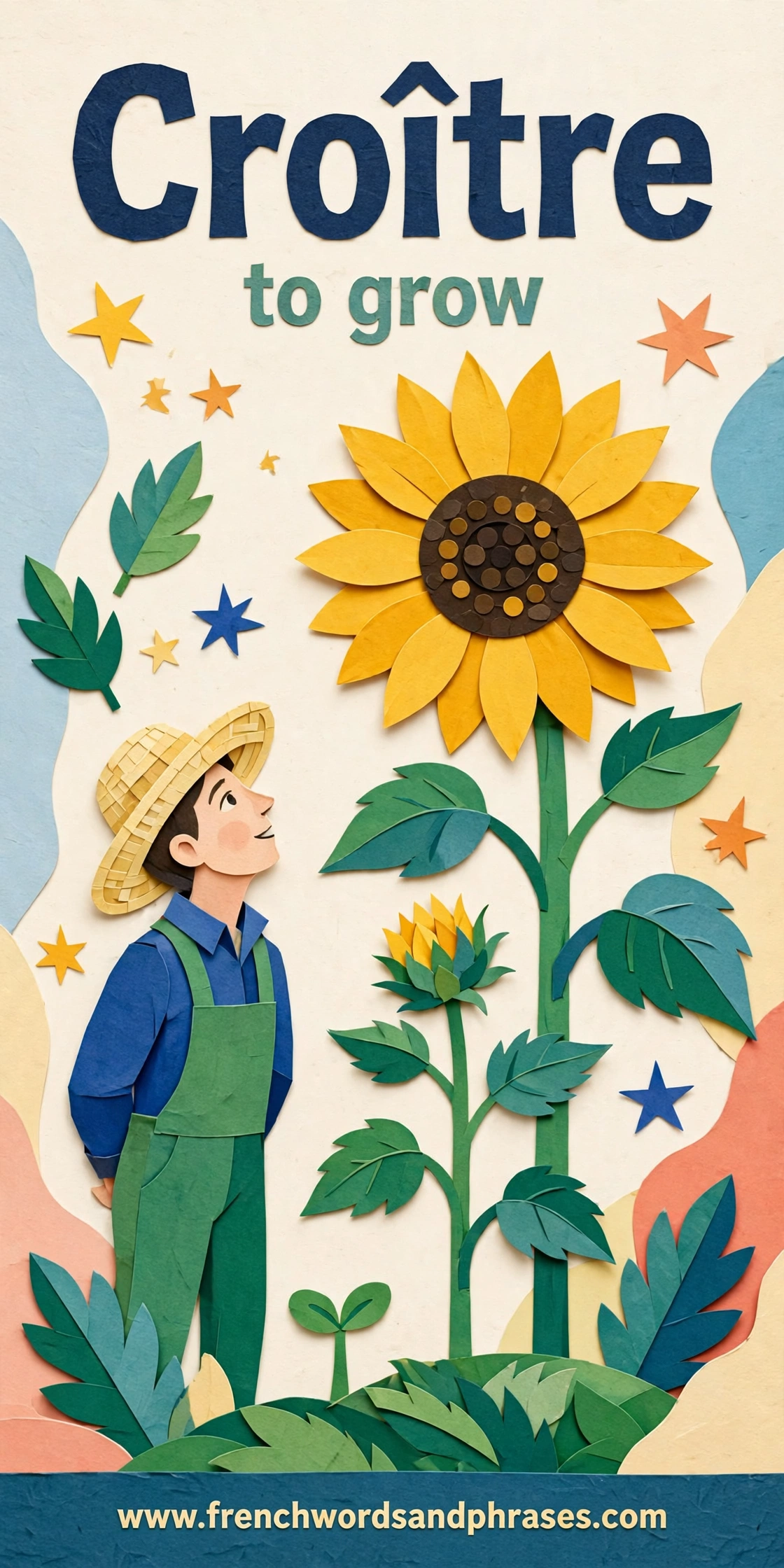
Imagine a grandfather marking a sunflower against the garden wall each Sunday of summer. In June it reaches his knee; in July his waist; by August it looks down on him — il a crû de deux mètres, and the pencil marks on the wall are the proof.
The flower has not been fed a miracle. It has grown — crû — a little every day, which is how all growth happens.
How to Conjugate Croître: Complete French Conjugation Guide
Let’s explore every major conjugation of croître, beginning with the indicative mood.
How to Conjugate Croître in the Indicative Mood
The indicative mood is used to express facts, observations, actions, and events.
How to Conjugate Croître in the Present Tense (Présent)
Used for actions happening now, habitual actions, and general truths.
| Subject | Conjugation |
|---|---|
| je | croîs |
| tu | croîs |
| il / elle | croît |
| nous | croissons |
| vous | croissez |
| ils / elles | croissent |
Example
Les tournesols croissent vite au printemps.
The sunflowers grow fast in spring.
Quick Quiz 1
Complete the sentence:
Les tournesols ______ vite au printemps.
Reveal the answer
croissent
Les tournesols croissent vite au printemps.
The sunflowers grow fast in spring.
How to Conjugate Croître in the Passé Composé
Used for completed actions in the past. Croître takes the auxiliary verb avoir.
| Subject | Conjugation |
|---|---|
| j’ | ai crû |
| tu | as crû |
| il / elle | a crû |
| nous | avons crû |
| vous | avez crû |
| ils / elles | ont crû |
Example
La population a crû de dix mille âmes en cinq ans.
The population grew by ten thousand souls in five years.
How to Conjugate Croître in the Imparfait (Imperfect Tense)
Used for habitual past actions, descriptions, and ongoing situations in the past.
| Subject | Conjugation |
|---|---|
| je | croissais |
| tu | croissais |
| il / elle | croissait |
| nous | croissions |
| vous | croissiez |
| ils / elles | croissaient |
Example
Le lierre croissait le long du mur de la cour.
The ivy grew along the courtyard wall.
Quick Quiz 2
Choose the correct form:
The population has grown.
La population ______. (a crû / est crû)
Reveal the answer
a crû
La population a crû.
Croître takes avoir — and the participle keeps its circumflex: crû.
How to Conjugate Croître in the Plus-que-parfait
Used to describe an action that had already been completed before another past event.
| Subject | Conjugation |
|---|---|
| j’ | avais crû |
| tu | avais crû |
| il / elle | avait crû |
| nous | avions crû |
| vous | aviez crû |
| ils / elles | avaient crû |
Example
La tension avait crû toute la semaine avant la réunion.
The tension had grown all week before the meeting.
How to Conjugate Croître in the Passé Simple
Primarily used in formal writing, literature, and historical narratives. It is rarely used in everyday conversation.
| Subject | Conjugation |
|---|---|
| je | crûs |
| tu | crûs |
| il / elle | crût |
| nous | crûmes |
| vous | crûtes |
| ils / elles | crûrent |
Example
En un été, le rosier crût d’un mètre.
In one summer, the rose bush grew by a metre.
How to Conjugate Croître in the Passé Antérieur
A literary tense used to express an action completed immediately before another past action, generally in the passé simple.
| Subject | Conjugation |
|---|---|
| j’ | eus crû |
| tu | eus crû |
| il / elle | eut crû |
| nous | eûmes crû |
| vous | eûtes crû |
| ils / elles | eurent crû |
Example
Quand la foule eut crû jusqu’à remplir la place, le concert commença.
When the crowd had grown until it filled the square, the concert began.
How to Conjugate Croître in the Future Tense (Futur Simple)
Used to describe actions that will take place in the future.
| Subject | Conjugation |
|---|---|
| je | croîtrai |
| tu | croîtras |
| il / elle | croîtra |
| nous | croîtrons |
| vous | croîtrez |
| ils / elles | croîtront |
Example
Ces plantes croîtront mieux à la lumière.
These plants will grow better in the light.
How to Conjugate Croître in the Futur Antérieur (Future Perfect)
Used for an action that will have been completed before a particular point in the future.
| Subject | Conjugation |
|---|---|
| j’ | aurai crû |
| tu | auras crû |
| il / elle | aura crû |
| nous | aurons crû |
| vous | aurez crû |
| ils / elles | auront crû |
Example
À la fin de l’année, les prix auront encore crû.
By the end of the year, prices will have risen again.
How to Conjugate Croître in the Near Future (Futur Proche)
Used to describe something that is going to happen soon. Formed with aller + infinitive.
| Subject | Conjugation |
|---|---|
| je | vais croître |
| tu | vas croître |
| il / elle | va croître |
| nous | allons croître |
| vous | allez croître |
| ils / elles | vont croître |
Example
Ton entreprise va croître si tu continues ainsi.
Your business is going to grow if you carry on like this.
How to Conjugate Croître in the Conditional Mood
The conditional mood expresses what would happen under certain circumstances. It is also frequently used to make polite requests or express wishes.
How to Conjugate Croître in the Present Conditional
| Subject | Conjugation |
|---|---|
| je | croîtrais |
| tu | croîtrais |
| il / elle | croîtrait |
| nous | croîtrions |
| vous | croîtriez |
| ils / elles | croîtraient |
Example
Avec plus de pluie, les légumes croîtraient plus vite.
With more rain, the vegetables would grow faster.
How to Conjugate Croître in the Past Conditional
| Subject | Conjugation |
|---|---|
| j’ | aurais crû |
| tu | aurais crû |
| il / elle | aurait crû |
| nous | aurions crû |
| vous | auriez crû |
| ils / elles | auraient crû |
Example
Les ventes auraient crû sans la crise.
Sales would have grown without the crisis.
Croître in the Literary Past Conditional Form
This less common literary form uses the imperfect subjunctive of avoir.
| Subject | Conjugation |
|---|---|
| j’ | eusse crû |
| tu | eusses crû |
| il / elle | eût crû |
| nous | eussions crû |
| vous | eussiez crû |
| ils / elles | eussent crû |
Example
La vigne eût crû jusqu’au toit sans la taille d’hiver.
The vine would have grown up to the roof without the winter pruning.
How to Conjugate Croître in the Subjunctive Mood
The subjunctive is used to express wishes, emotions, doubts, necessity, and uncertainty. It frequently follows expressions such as il faut que (it is necessary that) or bien que (although).
How to Conjugate Croître in the Present Subjunctive
| Subject | Conjugation |
|---|---|
| que je | croisse |
| que tu | croisses |
| qu’il / qu’elle | croisse |
| que nous | croissions |
| que vous | croissiez |
| qu’ils / qu’elles | croissent |
Example
Il est normal que les plantes croissent vite à cet âge du jardin.
It is normal for plants to grow fast at this stage of the garden.
Quick Quiz 3
Complete the sentence using the subjunctive:
Il est normal que les enfants ______ vite à cet âge.
Reveal the answer
croissent
Il est normal que les enfants croissent vite à cet âge.
It is normal for children to grow fast at that age.
How to Conjugate Croître in the Imperfect Subjunctive
A literary tense, rarely encountered in modern spoken French.
| Subject | Conjugation |
|---|---|
| que je | crûsse |
| que tu | crûsses |
| qu’il / qu’elle | crût |
| que nous | crûssions |
| que vous | crûssiez |
| qu’ils / qu’elles | crûssent |
Example
On ne s’attendait pas que la rivière crût si vite.
Nobody expected the river to rise so fast.
How to Conjugate Croître in the Pluperfect Subjunctive
A literary construction used to express an action completed before another past action.
| Subject | Conjugation |
|---|---|
| que j’ | eusse crû |
| que tu | eusses crû |
| qu’il / qu’elle | eût crû |
| que nous | eussions crû |
| que vous | eussiez crû |
| qu’ils / qu’elles | eussent crû |
Example
On racontait que la forêt eût crû sur les ruines.
People said the forest had grown over the ruins.
How to Conjugate Croître in the Past Subjunctive
| Subject | Conjugation |
|---|---|
| que j’ | aie crû |
| que tu | aies crû |
| qu’il / qu’elle | ait crû |
| que nous | ayons crû |
| que vous | ayez crû |
| qu’ils / qu’elles | aient crû |
Example
Je suis étonné que ton fils ait tant crû en un an.
I am amazed your son has grown so much in a year.
How to Conjugate Croître in the Imperative
The imperative is used to give commands, instructions, invitations, or suggestions. Subject pronouns are omitted.
How to Conjugate Croître in the Present Imperative
| Person | Conjugation |
|---|---|
| (tu) | croîs |
| (nous) | croissons |
| (vous) | croissez |
Example
Croîs vite, mon petit arbre, nous t’attendons !
Grow quickly, my little tree, we are waiting for you!
Quick Quiz 4
How would you say Grow quickly, my little tree (tu form)?
Reveal the answer
Croîs vite, mon petit arbre !
French Participles of Croître
Participles are verb forms that can be used in compound tenses and other grammatical constructions.
Present Participle of Croître
croissant
En croissant, le chiot est devenu un grand chien doux.
While growing, the puppy became a big, gentle dog.
Past Participle of Croître
crû
Crûe de vingt centimètres, la rivière menaçait les quais.
Swollen by twenty centimetres, the river threatened the quays.
Croître in Everyday French: Real-Life Examples
Now that you know the conjugations, let’s see how croître appears in everyday French.
Example 1 — Present
Les tournesols croissent vite au printemps.
The sunflowers grow fast in spring.
Example 2 — Passé composé
La population a crû en cinq ans.
The population grew in five years.
Example 3 — Imparfait
Le lierre croissait le long du mur.
The ivy grew along the wall.
Example 4 — Future
Ces plantes croîtront mieux à la lumière.
These plants will grow better in the light.
Example 5 — Conditional
Les légumes croîtraient plus vite avec la pluie.
The vegetables would grow faster with rain.
Example 6 — Imperative
Croîs vite, mon petit arbre !
Grow quickly, my little tree!
Beyond Translation: The Meaning of Croître
English speakers meet croître every day without knowing it: croissant is its present participle — the ‘growing’ moon, the crescent, whose name the pastry borrowed.
And its noun runs the modern world.
La croissance is growth — of children, of gardens, and above all of economies: la croissance économique is the phrase on every French front page. Even wine keeps a family member: un cru is a vineyard’s growth, the wine that grew in one named place.
How to Remember the French Verb Croître
Remember it this way: Croître is about the sunflower outgrowing the grandfather, pencil marks on the garden wall.
- The circumflex marks a lost s: croistre → croître, and it stays in je croîs, il croît, je croîtrai, crû.
- Crû with the hat means grown; cru without it means raw — or ‘believed’, from croire.
- Grandir is for people growing up; croître is growth measured — plants, rivers, prices, populations.
The key idea is the sunflower outgrowing the grandfather, pencil marks on the garden wall.
Test Your Knowledge of Croître
Let’s see how much you’ve learned. Try answering these questions before revealing the answers.
Question 1
What does the circumflex in croître mark?
Reveal the answer
A lost s — Old French croistre; it survives in je croîs, il croît, je croîtrai and the participle crû.
Question 2
How do you say The population grew in five years in French?
Reveal the answer
La population a crû en cinq ans.
Question 3
Translate: The sunflowers grow fast in spring.
Reveal the answer
Les tournesols croissent vite au printemps.
Question 4
What is the past participle of croître, and how does it differ from cru?
Reveal the answer
Crû (grown) — with the circumflex; cru without it means raw, or ‘believed’ from croire.
Question 5
Complete the sentence:
Il est normal que les plantes ______ au printemps.
Reveal the answer
croissent
Il est normal que les plantes croissent au printemps.
It is normal for plants to grow in spring.
Your Final Challenge
Can You Use It?
How would you say this in French?
Everything grows at its own pace: the vine, the river, and even gardeners’ patience.
Reveal the answer
Tout croît à son rythme : la vigne, la rivière, et même la patience des jardiniers.
Everything grows at its own pace: the vine, the river, and even gardeners’ patience.
A little French. A little curiosity. A richer everyday life.
LEARN FRENCH ONE WORD AT A TIME