A French Word to Live By
Translate Couper l’herbe sous le pied de quelqu’un to English
/ku.pe lɛʁb su lə pje də kɛl.kœ̃/
Couper l’herbe sous le pied de quelqu’un means to cut the ground from under someone — to steal their advantage by acting first.
All week you have been preparing your idea for the Monday meeting — the slides, the figures, the perfect opening line. At nine o’clock your colleague stands up first, smiles, and presents exactly your project as his own. You sit there with your notes cooling in your hands. He has not argued with you or beaten you fairly. « Il m’a coupé l’herbe sous le pied. »
Let’s explore how couper l’herbe sous le pied de quelqu’un works in French, beginning with the whole phrase on one card.
Understanding the French Phrase Couper l’herbe sous le pied de quelqu’un
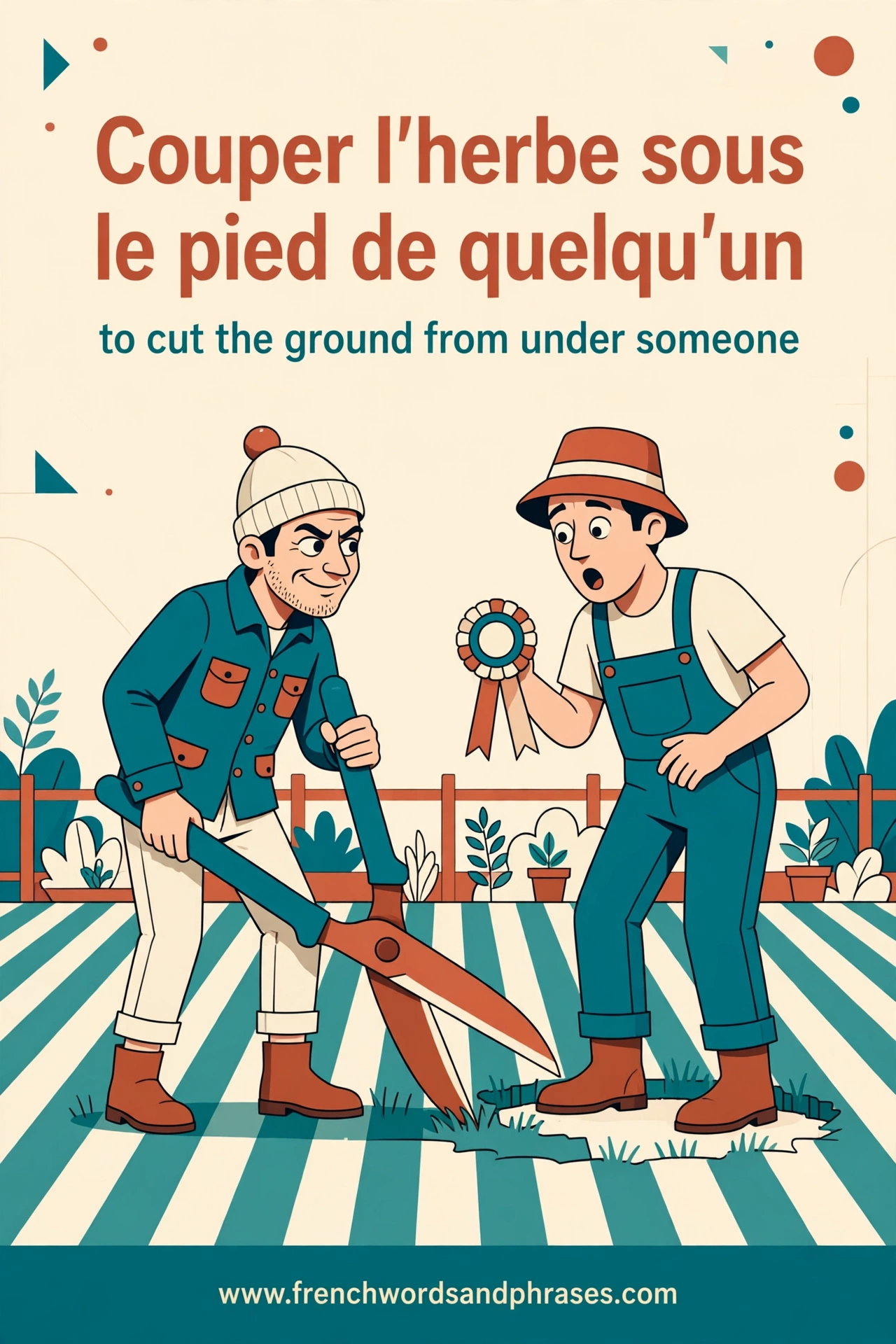
Couper l’herbe sous le pied de quelqu’un is a French idiomatic expression built from couper (to cut), l’herbe (the grass), sous (under) and le pied (the foot). The picture is a mower passing exactly where someone is standing: the ground they were counting on disappears beneath them, because someone else got there first.
It means to cut the ground from under someone — to steal their advantage by doing first what they were about to do, or by saying first what they were about to say. The victim is left standing with nothing to stand on: the idea is announced, the job is taken, the argument is used up. It is the classic phrase for being scooped.
Type: Idiomatic expression — rivalry (verb + image + à-style object)
Answers the need: Saying someone beat you to it and took your advantage away
Register: Neutral — everyday speech and writing, mildly rueful or annoyed
Strength: Sharp — a real loss of position, not a friendly race
One important usage detail: the person robbed comes after de — couper l’herbe sous le pied de Marie, or with a pronoun, lui couper l’herbe sous le pied. You will also hear the plural, couper l’herbe sous les pieds de quelqu’un; both forms are correct and mean exactly the same. The phrase is often said afterwards, with a sigh, by the one who was scooped.
Experience the Word
Couper l’herbe sous le pied de quelqu’un is competition caught in a single garden image — the mower has passed, and the grass you were standing on is gone.
Imagine the young journalist with the story of the year in her notebook, opening the morning paper to find a rival’s name above her own investigation. Nothing was stolen from her desk. The theft happened in time, not in space: someone simply moved first.
French is honest about ambition here. The phrase does not call the winner a thief — it just notes that the ground has moved.
How to Use Couper l’herbe sous le pied de quelqu’un in French: Complete Guide
Let’s explore how couper l’herbe sous le pied de quelqu’un works in French, beginning with the whole phrase on one card.
Couper l’herbe sous le pied de quelqu’un at a Glance
The Whole Phrase on One Card
Real meaning, literal picture, English twin and register — couper l’herbe sous le pied de quelqu’un in five lines.
| Point | Couper l’herbe sous le pied de quelqu’un |
|---|---|
| What it really means | to cut the ground from under someone — to beat them to it and steal their advantage |
| Word for word | to cut the grass under someone’s foot |
| English equivalent | to cut the ground from under someone / to steal their thunder |
| Register | neutral — rueful, sometimes admiring, rarely furious |
| Use it for | scooped ideas, pre-empted announcements, rivals who move first |
Example
Elle allait proposer la même idée, mais son collègue lui a coupé l’herbe sous le pied.
She was about to suggest the same idea, but her colleague cut the ground from under her.
Word by Word: Building the Scoop
Five small pieces — take them one by one and the mower starts its pass.
| Word | Literal meaning | Its job in the phrase |
|---|---|---|
| couper | to cut | the mower’s action — swift, clean, and already done |
| l’herbe | the grass | the ground of the idea — what the victim was standing on |
| sous | under | the exact spot: not beside the victim, beneath them |
| le pied | the foot | the victim’s footing — French often says les pieds, the sense is the same |
| de quelqu’un | of someone | names the person who loses the ground |
Example
Il m’a coupé l’herbe sous le pied en annonçant le projet le premier.
He cut the ground from under me by announcing the project first.
Quick Quiz 1
In the picture inside the phrase, what exactly disappears from under the victim?
Reveal the answer
The grass they were standing on — the ground of their plan, mown away by someone who moved first.
Le concurrent a coupé l’herbe sous le pied de toute l’équipe.
The rival cut the ground from under the whole team.
When You Say It: The Scooped Moments
Couper l’herbe sous le pied fires at moments like these — your move was ready, and someone else made it.
| Situation | Example |
|---|---|
| At work | il m’a coupé l’herbe sous le pied avec ma propre idée — he beat me to it with my own idea |
| In an argument | elle lui a coupé l’herbe sous le pied en citant le chiffre exact — she floored him by quoting the exact figure |
| In politics | le ministre a coupé l’herbe sous le pied de l’opposition — the minister stole the opposition’s thunder |
| Among friends | je voulais réserver la maison, mais elle m’a coupé l’herbe sous le pied — I wanted to book the house, but she beat me to it |
| In sport | le jeune joueur a coupé l’herbe sous le pied du champion — the young player upstaged the champion |
Example
Le journal rival nous a coupé l’herbe sous le pied en publiant l’histoire hier soir.
The rival newspaper cut the ground from under us by publishing the story last night.
Make It Yours: The Scoop for Every Victim
The victim hangs on the end with de — or steps forward as a pronoun before the verb.
| Form | French | In English |
|---|---|---|
| He scooped me | il m’a coupé l’herbe sous le pied | he cut the ground from under me |
| She scooped him | elle lui a coupé l’herbe sous le pied | she cut the ground from under him |
| Naming the victim | couper l’herbe sous le pied de son rival | to cut the ground from under your rival |
| Plural variant | couper l’herbe sous les pieds de quelqu’un | the same phrase with both feet |
| Before it happens | il va me couper l’herbe sous le pied | he’s going to beat me to it |
| Question | qui t’a coupé l’herbe sous le pied ? | who beat you to it? |
Example
Méfie-toi : elle va te couper l’herbe sous le pied si tu attends demain.
Watch out: she’ll cut the ground from under you if you wait until tomorrow.
Quick Quiz 2
Singular or plural — is it sous le pied or sous les pieds?
Reveal the answer
Both are correct — the singular is the classic form, the plural is heard everywhere too; the meaning does not change.
Il lui a coupé l’herbe sous les pieds dès la première réunion.
He cut the ground from under him at the very first meeting.
Everyday Expressions: Building on the Scoop
Couper l’herbe sous le pied de quelqu’un slots into these everyday frames — each one ready to use as it stands.
| Frame | In English |
|---|---|
| couper l’herbe sous le pied de quelqu’un | to cut the ground from under someone |
| lui couper l’herbe sous le pied | to beat him/her to it, to scoop them |
| se faire couper l’herbe sous le pied | to get scooped — the victim’s version |
| couper l’herbe sous le pied d’un concurrent | to wrong-foot a competitor |
| avant qu’on ne lui coupe l’herbe sous le pied | before someone beats him/her to it |
Example
Elle s’est fait couper l’herbe sous le pied par une collègue plus rapide.
She got scooped by a quicker colleague.
Close Cousins: The Other Ways to Be Beaten to It
French has a whole shelf of rivalry phrases — the grass is the scooped one; its cousins run faster, burn politeness, or take the wind away.
| Expression | The difference |
|---|---|
| couper l’herbe sous le pied de quelqu’un | to cut the ground from under someone — their own plan used against them |
| prendre quelqu’un de vitesse | to outpace someone — to win purely by being quicker |
| brûler la politesse à quelqu’un | to beat someone to it rudely — to push in without ceremony |
| devancer quelqu’un | to get ahead of someone — plain and neutral, no malice |
| voler la vedette à quelqu’un | to steal the limelight from someone — the stage version of the scoop |
Example
Le stagiaire a pris tout le monde de vitesse et présenté le dossier le premier.
The intern outpaced everyone and presented the file first.
Quick Quiz 3
Which cousin means winning purely by speed, with no stolen idea — couper l’herbe or prendre de vitesse?
Reveal the answer
Prendre de vitesse — pure pace. Couper l’herbe means the victim’s own ground, idea or argument was taken from under them.
Le coureur l’a pris de vitesse dans la dernière ligne droite.
The runner outpaced him on the final straight.
Couper l’herbe sous le pied and Its Neighbours
The rivalry shelf around the phrase — from the idea itself to the rival who used it first.
| French | In English |
|---|---|
| une idée | an idea |
| un rival, un concurrent | a rival, a competitor |
| prendre de l’avance | to get a head start |
| être le premier à | to be the first to |
| voler la vedette | to steal the show |
| arriver trop tard | to arrive too late |
Example
Il est arrivé trop tard : la vedette lui avait échappé.
He arrived too late: the limelight had slipped away from him.
Watch Out: The Traps Around Couper l’herbe sous le pied
The traps: real gardening, the victim hidden in a pronoun, and a compliment hiding inside the complaint.
| Trap | The truth |
|---|---|
| the gardening trap | tondre la pelouse is mowing the lawn — couper l’herbe sous le pied is never about gardens in conversation |
| the pronoun moves | with a pronoun, the victim jumps before the verb: il lui a coupé l’herbe sous le pied — never after it |
| not always an insult | said of a quick rival, the phrase often carries respect — the winner played the game well |
| pied or pieds | both numbers live happily in the phrase; do not let anyone ‘correct’ you either way |
Example
Elle a tondu la pelouse le matin, puis coupé l’herbe sous le pied de son frère l’après-midi.
She mowed the lawn in the morning, then cut the ground from under her brother in the afternoon.
Quick Quiz 4
True or false: the phrase is always an accusation of cheating.
Reveal the answer
False — it often just admits the other person was quicker or smarter; rueful admiration is its most common tone.
Chapeau : il nous a coupé l’herbe sous le pied, et c’était bien joué.
Fair play: he cut the ground from under us, and it was well played.
Couper l’herbe sous le pied de quelqu’un in Everyday French: Real-Life Examples
Now that you know the word, let’s see how couper l’herbe sous le pied de quelqu’un appears in everyday French.
Example 1 — At the office
Mon collègue m’a coupé l’herbe sous le pied avec mon idée.
My colleague cut the ground from under me with my own idea.
Example 2 — The announcement
La mairie nous a coupé l’herbe sous le pied en annonçant le projet hier.
The town hall stole our thunder by announcing the project yesterday.
Example 3 — The house hunt
Un autre acheteur leur a coupé l’herbe sous le pied.
Another buyer beat them to it.
Example 4 — The debate
Elle a coupé l’herbe sous le pied de son adversaire dès la première question.
She wrong-footed her opponent from the very first question.
Example 5 — The warning
Dépêche-toi, ou le voisin va te couper l’herbe sous le pied.
Hurry up, or the neighbour will beat you to it.
Example 6 — The confession
Je me suis fait couper l’herbe sous le pied, voilà tout.
I got scooped, that’s all there is to it.
Beyond Translation: The Meaning of Couper l’herbe sous le pied de quelqu’un
English cuts the ground from under people too, but its favourite picture is thunder — steal someone’s thunder, as if success were weather. French keeps its feet on the lawn: a mower, a strip of grass, and the small shock of standing on ground that is suddenly shorter than you left it.
To couper l’herbe sous le pied de quelqu’un is to win by timing — the idea stays the same, only its owner changes.
That is why the phrase stings so precisely: nothing was taken from you but the order of events, and in ambition, order is everything.
How to Remember the French Phrase Couper l’herbe sous le pied de quelqu’un
Remember it this way: Couper l’herbe sous le pied de quelqu’un is the mower’s pass of rivalry — the strip of grass your plan was standing on, gone before you speak.
- You picture the mower — one clean pass, and the grass beneath the victim’s foot is simply gone.
- You place the victim with de — sous le pied de Marie — or as a pronoun before the verb: il lui a coupé l’herbe.
- You allow both numbers — le pied in the classic form, les pieds in everyday speech, same scoop either way.
The key idea is couper l’herbe sous le pied de quelqu’un means to cut the ground from under someone — to beat them to their own idea.
Test Your Knowledge of Couper l’herbe sous le pied de quelqu’un
Let’s see how much you’ve learned. Try answering these questions before revealing the answers.
Question 1
What does couper l’herbe sous le pied de quelqu’un mean?
Reveal the answer
To cut the ground from under someone — to beat them to it and take away their advantage.
Question 2
What is the literal, word-for-word meaning?
Reveal the answer
To cut the grass under someone’s foot — the mower passes exactly where the victim is standing.
Question 3
How do you say ‘he cut the ground from under me’?
Reveal the answer
Il m’a coupé l’herbe sous le pied — the victim becomes a pronoun placed before the verb.
Question 4
What is the difference between couper l’herbe sous le pied and prendre quelqu’un de vitesse?
Reveal the answer
Prendre de vitesse is pure speed — winning by being quicker. Couper l’herbe means the victim’s own idea, argument or ground was used first.
Question 5
Complete the sentence:
Son rival lui a coupé l’______ sous le pied. (His rival cut the ground from under him.)
Reveal the answer
herbe
Son rival lui a coupé l’herbe sous le pied.
His rival cut the ground from under him.
Your Final Challenge
Can You Use It?
How would you say this in French?
“Her colleague cut the ground from under her.”
Reveal the answer
Son collègue lui a coupé l’herbe sous le pied.
Her colleague cut the ground from under her.
A little French. A little curiosity. A richer everyday life.
LEARN FRENCH ONE WORD AT A TIME