A French Word to Live By
How to Conjugate Comprendre in French
/kɔ̃.pʁɑ̃dʁ/
Comprendre means to understand.
A word, a look, a whole situation — suddenly it makes sense. That moment when confusion turns into clarity is comprendre.
In this guide, you’ll learn how to conjugate comprendre in all the major French tenses and moods. Explore complete conjugation tables, French examples, English translations, and practice quizzes.
Understanding the French Verb Comprendre
Comprendre is an irregular French verb belonging to the third group of verbs, those ending in -prendre.
It means to understand. It is commonly used to understand words, people, and situations. It can also mean to include, as in a price that includes something.
Verb classification: Third group (irregular -prendre verb)
Auxiliary verb: Avoir
Past participle: compris
Present participle: comprenant
English equivalents: To understand.
One important spelling detail: the stem changes in the present tense — je comprends, nous comprenons, ils comprennent — and the past participle is compris.
Experience the Word
Comprendre is more than hearing words. It is grasping what they mean, and what the person saying them really wants you to know.
Imagine listening to a friend explain a difficult idea in French. At first the words go past you, then one example makes everything clear, and you nod — you understand.
You have not just heard something. You have understood it.
How to Conjugate Comprendre: Complete French Conjugation Guide
Let’s explore every major conjugation of comprendre, beginning with the indicative mood.
How to Conjugate Comprendre in the Indicative Mood
The indicative mood is used to express facts, observations, actions, and events.
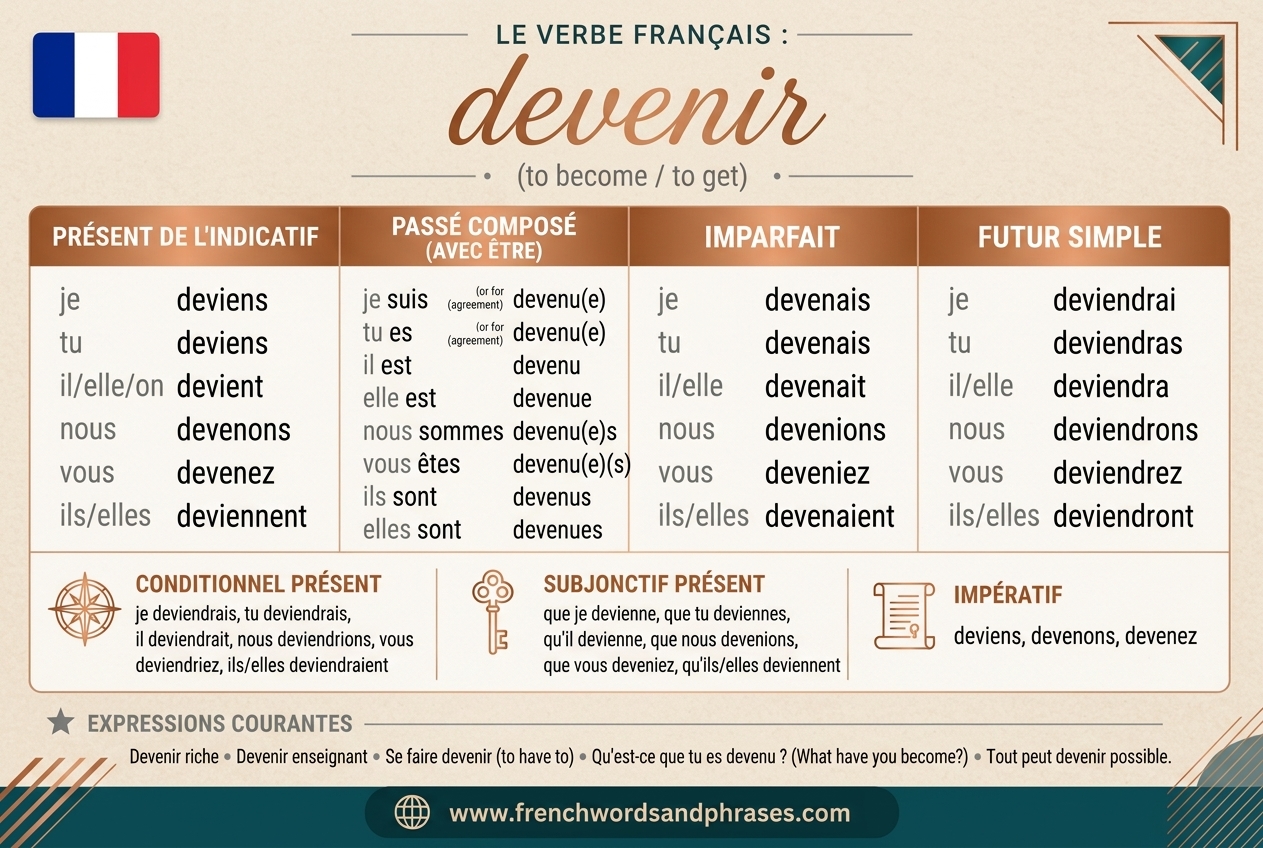
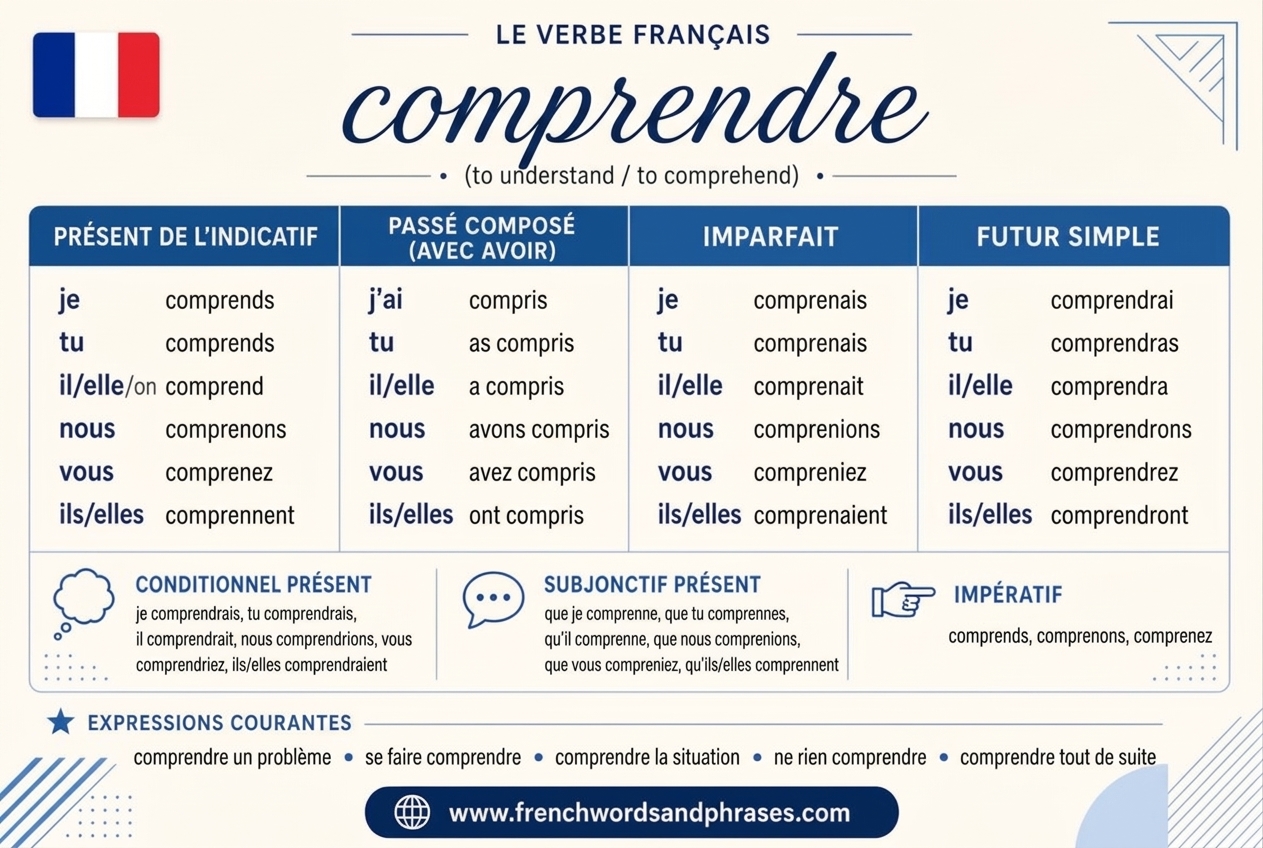
How to Conjugate Comprendre in the Present Tense (Présent)
Used for actions happening now, habitual actions, and general truths.
| Subject | Conjugation |
|---|---|
| je | comprends |
| tu | comprends |
| il / elle | comprend |
| nous | comprenons |
| vous | comprenez |
| ils / elles | comprennent |
Example
Je comprends la leçon.
I understand the lesson.
Quick Quiz 1
Complete the sentence:
Nous ______ la leçon aujourd’hui.
Reveal the answer
comprenons
Nous comprenons la leçon aujourd’hui.
We understand the lesson today.
How to Conjugate Comprendre in the Passé Composé
Used for completed actions in the past. Comprendre takes the auxiliary verb avoir.
| Subject | Conjugation |
|---|---|
| j’ | ai compris |
| tu | as compris |
| il / elle | a compris |
| nous | avons compris |
| vous | avez compris |
| ils / elles | ont compris |
Example
J’ai compris ton message.
I understood your message.
How to Conjugate Comprendre in the Imparfait (Imperfect Tense)
Used for habitual past actions, descriptions, and ongoing situations in the past.
| Subject | Conjugation |
|---|---|
| je | comprenais |
| tu | comprenais |
| il / elle | comprenait |
| nous | comprenions |
| vous | compreniez |
| ils / elles | comprenaient |
Example
Quand j’étais jeune, je comprenais mal le français.
When I was young, I understood French poorly.
Quick Quiz 2
Choose the correct form:
When we were children, we used to understand very little French.
Quand nous étions enfants, nous ______ très peu le français.
Reveal the answer
comprenions
Quand nous étions enfants, nous comprenions très peu le français.
How to Conjugate Comprendre in the Plus-que-parfait
Used to describe an action that had already been completed before another past event.
| Subject | Conjugation |
|---|---|
| j’ | avais compris |
| tu | avais compris |
| il / elle | avait compris |
| nous | avions compris |
| vous | aviez compris |
| ils / elles | avaient compris |
Example
J’avais déjà compris la règle avant l’examen.
I had already understood the rule before the exam.
How to Conjugate Comprendre in the Passé Simple
Primarily used in formal writing, literature, and historical narratives. It is rarely used in everyday conversation.
| Subject | Conjugation |
|---|---|
| je | compris |
| tu | compris |
| il / elle | comprit |
| nous | comprîmes |
| vous | comprîtes |
| ils / elles | comprirent |
Example
Il comprit enfin la vérité.
He finally understood the truth.
How to Conjugate Comprendre in the Passé Antérieur
A literary tense used to express an action completed immediately before another past action, generally in the passé simple.
| Subject | Conjugation |
|---|---|
| j’ | eus compris |
| tu | eus compris |
| il / elle | eut compris |
| nous | eûmes compris |
| vous | eûtes compris |
| ils / elles | eurent compris |
Example
Dès qu’il eut compris le problème, il trouva une solution.
As soon as he had understood the problem, he found a solution.
How to Conjugate Comprendre in the Future Tense (Futur Simple)
Used to describe actions that will take place in the future.
| Subject | Conjugation |
|---|---|
| je | comprendrai |
| tu | comprendras |
| il / elle | comprendra |
| nous | comprendrons |
| vous | comprendrez |
| ils / elles | comprendront |
Example
Demain, tu comprendras mieux.
Tomorrow, you will understand better.
How to Conjugate Comprendre in the Futur Antérieur (Future Perfect)
Used for an action that will have been completed before a particular point in the future.
| Subject | Conjugation |
|---|---|
| j’ | aurai compris |
| tu | auras compris |
| il / elle | aura compris |
| nous | aurons compris |
| vous | aurez compris |
| ils / elles | auront compris |
Example
À midi, j’aurai déjà compris le texte.
By noon, I will already have understood the text.
How to Conjugate Comprendre in the Near Future (Futur Proche)
Used to describe something that is going to happen soon. Formed with aller + infinitive.
| Subject | Conjugation |
|---|---|
| je | vais comprendre |
| tu | vas comprendre |
| il / elle | va comprendre |
| nous | allons comprendre |
| vous | allez comprendre |
| ils / elles | vont comprendre |
Example
Je vais comprendre avec un peu de pratique.
I am going to understand with a little practice.
How to Conjugate Comprendre in the Conditional Mood
The conditional mood expresses what would happen under certain circumstances. It is also frequently used to make polite requests or express wishes.
How to Conjugate Comprendre in the Present Conditional
| Subject | Conjugation |
|---|---|
| je | comprendrais |
| tu | comprendrais |
| il / elle | comprendrait |
| nous | comprendrions |
| vous | comprendriez |
| ils / elles | comprendraient |
Example
Je comprendrais mieux si tu parlais lentement.
I would understand better if you spoke slowly.
How to Conjugate Comprendre in the Past Conditional
| Subject | Conjugation |
|---|---|
| j’ | aurais compris |
| tu | aurais compris |
| il / elle | aurait compris |
| nous | aurions compris |
| vous | auriez compris |
| ils / elles | auraient compris |
Example
J’aurais compris si tu avais expliqué.
I would have understood if you had explained.
Comprendre in the Literary Past Conditional Form
This less common literary form uses the imperfect subjunctive of avoir.
| Subject | Conjugation |
|---|---|
| j’ | eusse compris |
| tu | eusses compris |
| il / elle | eût compris |
| nous | eussions compris |
| vous | eussiez compris |
| ils / elles | eussent compris |
Example
Il eût compris plus vite s’il avait écouté.
He would have understood faster if he had listened.
How to Conjugate Comprendre in the Subjunctive Mood
The subjunctive is used to express wishes, emotions, doubts, necessity, and uncertainty. It frequently follows expressions such as il faut que (it is necessary that) or bien que (although).
How to Conjugate Comprendre in the Present Subjunctive
| Subject | Conjugation |
|---|---|
| que je | comprenne |
| que tu | comprennes |
| qu’il / qu’elle | comprenne |
| que nous | comprenions |
| que vous | compreniez |
| qu’ils / qu’elles | comprennent |
Example
Il faut que je comprenne ce mot.
I need to understand this word.
Quick Quiz 3
Complete the sentence using the subjunctive:
Il faut que nous ______ ce mot.
Reveal the answer
comprenions
Il faut que nous comprenions ce mot.
We need to understand this word.
How to Conjugate Comprendre in the Imperfect Subjunctive
A literary tense, rarely encountered in modern spoken French.
| Subject | Conjugation |
|---|---|
| que je | comprisse |
| que tu | comprisses |
| qu’il / qu’elle | comprît |
| que nous | comprissions |
| que vous | comprissiez |
| qu’ils / qu’elles | comprissent |
Example
Il souhaitait qu’elle comprît la situation.
He wished that she would understand the situation.
How to Conjugate Comprendre in the Pluperfect Subjunctive
A literary construction used to express an action completed before another past action.
| Subject | Conjugation |
|---|---|
| que j’ | eusse compris |
| que tu | eusses compris |
| qu’il / qu’elle | eût compris |
| que nous | eussions compris |
| que vous | eussiez compris |
| qu’ils / qu’elles | eussent compris |
Example
Il regrettait que nous eussions compris si tard.
He regretted that we had understood so late.
How to Conjugate Comprendre in the Past Subjunctive
| Subject | Conjugation |
|---|---|
| que j’ | aie compris |
| que tu | aies compris |
| qu’il / qu’elle | ait compris |
| que nous | ayons compris |
| que vous | ayez compris |
| qu’ils / qu’elles | aient compris |
Example
Je suis heureux que tu aies compris mon idée.
I am happy that you understood my idea.
How to Conjugate Comprendre in the Imperative
The imperative is used to give commands, instructions, invitations, or suggestions. Subject pronouns are omitted.
How to Conjugate Comprendre in the Present Imperative
| Person | Conjugation |
|---|---|
| (tu) | comprends |
| (nous) | comprenons |
| (vous) | comprenez |
Example
Comprends bien la question avant de répondre !
Understand the question well before answering!
Quick Quiz 4
How would you say Understand the question, using the tu form?
Reveal the answer
Comprends la question !
French Participles of Comprendre
Participles are verb forms that can be used in compound tenses and other grammatical constructions.
Present Participle of Comprendre
comprenant
En comprenant la règle, j’ai pu continuer.
By understanding the rule, I was able to continue.
Past Participle of Comprendre
compris
Nous avons compris le film.
We understood the film.
Comprendre in Everyday French: Real-Life Examples
Now that you know the conjugations, let’s see how comprendre appears in everyday French.
Example 1 — Present
Je comprends ton point de vue.
I understand your point of view.
Example 2 — Passé composé
Nous avons compris la question.
We understood the question.
Example 3 — Imparfait
Elle comprenait toujours tout de suite.
She always understood right away.
Example 4 — Future
Ils comprendront demain.
They will understand tomorrow.
Example 5 — Conditional
Je comprendrais mieux avec un exemple.
I would understand better with an example.
Example 6 — Subjunctive
Bien que nous comprenions la règle, nous faisons des erreurs.
Although we understand the rule, we make mistakes.
Beyond Translation: The Meaning of Comprendre
English has one word, understand, for the meaning of comprendre, but the French word also carries the idea of taking something in fully.
Taking it in.
To comprendre is to grasp an idea, to follow a story, or to see why someone feels a certain way. It evokes clarity after confusion, and connection after listening.
How to Remember the French Verb Comprendre
Remember it this way: Comprendre is about understanding, and taking an idea in fully.
- You listen to a lesson and it finally makes sense — tu comprends la leçon.
- You read a message twice and then it clicks — tu as compris.
- You ask someone to speak slowly so you can follow — tu comprendrais mieux.
The key idea is understanding, and taking an idea in fully.
Test Your Knowledge of Comprendre
Let’s see how much you’ve learned. Try answering these questions before revealing the answers.
Question 1
What auxiliary verb is used with comprendre in compound tenses?
Reveal the answer
Avoir
Question 2
How do you say I will understand in French?
Reveal the answer
Je comprendrai.
Question 3
Translate: We understood the film.
Reveal the answer
Nous avons compris le film.
Question 4
What is the present participle of comprendre?
Reveal the answer
Comprenant.
Question 5
Complete the sentence:
Si tu parlais lentement, je ______ mieux.
Reveal the answer
comprendrais
Si tu parlais lentement, je comprendrais mieux.
If you spoke slowly, I would understand better.
Your Final Challenge
Can You Use It?
How would you say this in French?
Tomorrow, I want to understand this text in French.
Reveal the answer
Demain, je veux comprendre ce texte en français.
Tomorrow, I want to understand this text in French.
A little French. A little curiosity. A richer everyday life.
LEARN FRENCH ONE WORD AT A TIME