A French Word to Live By
Translate Chercher midi à quatorze heures to English
/ʃɛʁ.ʃe mi.di a ka.tɔʁ.z‿œʁ/
Chercher midi à quatorze heures means to overcomplicate things — to look for difficulties where there are none.
The form asks for a name, a date and a signature. Your colleague has been studying it for twenty minutes, has phoned two departments and is now drafting a question about the ink colour. You lean over, gently: « Tu cherches midi à quatorze heures, là. »
Let’s explore how chercher midi à quatorze heures works in French, beginning with the whole phrase on one card.
Understanding the French Phrase Chercher midi à quatorze heures
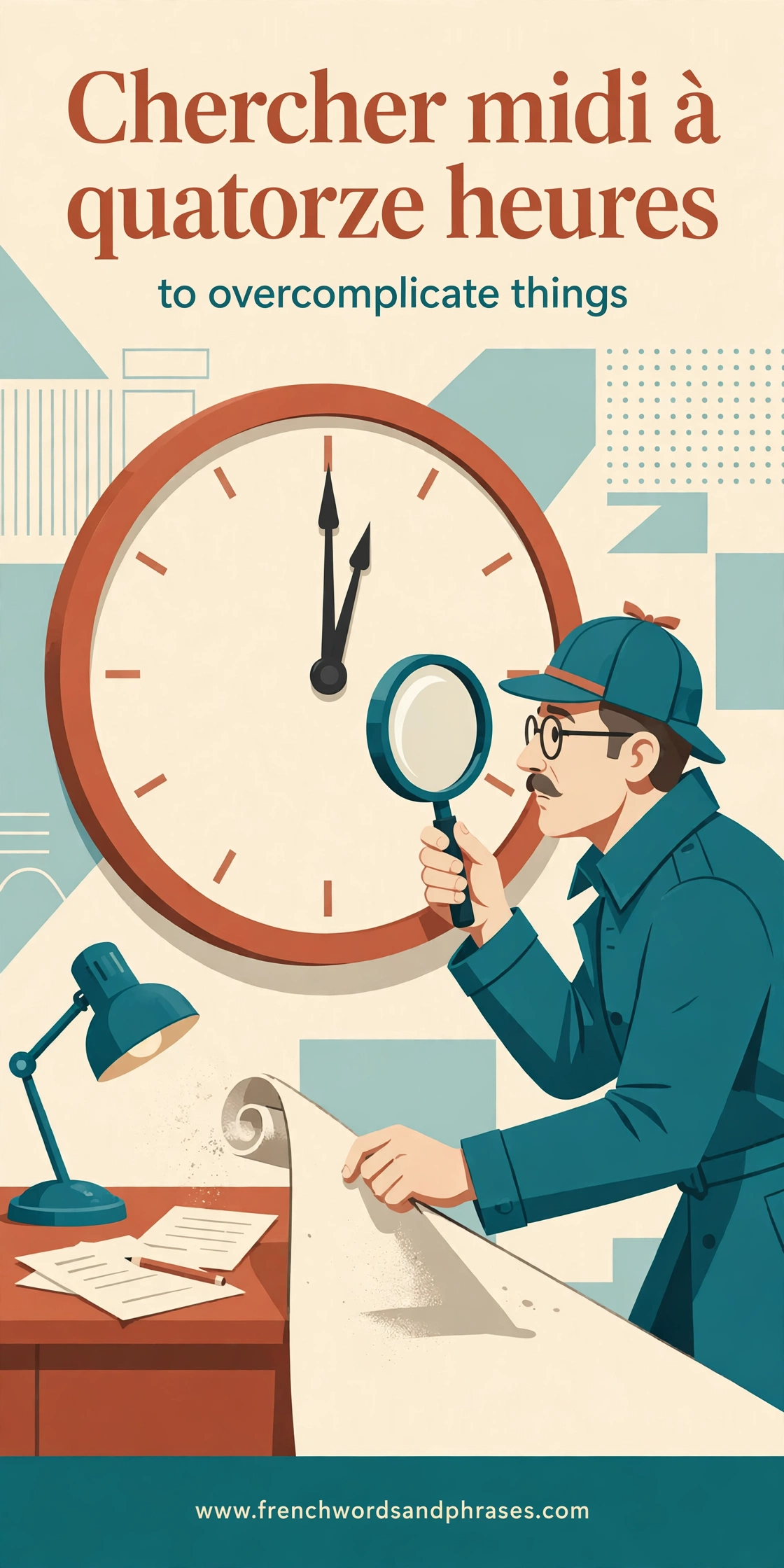
Chercher midi à quatorze heures is a French idiomatic expression built from chercher (to look for), midi (midday, twelve o’clock) and quatorze heures (two in the afternoon — 14:00 in the French 24-hour clock). The seeker is looking for noon at two o’clock: it was there earlier, it is gone, and the search itself is the mistake.
It means to make things complicated on purpose or by habit — to look for difficulties, subtleties and problems where everything is simple. The form was easy, the instruction was clear, the answer was obvious: the person chercher midi à quatorze heures invents the maze and then walks it, seriously and at length.
Type: Idiomatic expression — overcomplicating (verb + time phrase)
Answers the need: Teasing or reproaching someone who makes simple things complicated
Register: Neutral to playful — a classic, safe in most company
Strength: Gentle — usually a tease or mild rebuke, not an insult
One important usage detail: the phrase is most often aimed at a person in the present — tu cherches midi à quatorze heures ! — as a fond reproach: stop complicating this. It describes a habit of mind, not a single hard task: a genuinely difficult problem is not midi à quatorze heures, because the difficulty is real. The phrase only fits when the complication is home-made.
Experience the Word
Chercher midi à quatorze heures is the portrait of the helpful mind defeating itself — looking so hard for the catch that it walks past the open door.
Imagine asking a man the time and receiving a lecture on clocks. Imagine the recipe that says ‘add water’ and the cook researching which water. Everyone knows this person; most of us have been this person before coffee. The phrase survives because the comedy is eternal: noon was at noon, the answer was on the first page, and the search party has been out for hours.
French teasing is often a small philosophy lesson. This one teaches that intelligence, aimed wrongly, is just a longer road to the same place.
How to Use Chercher midi à quatorze heures in French: Complete Guide
Let’s explore how chercher midi à quatorze heures works in French, beginning with the whole phrase on one card.
Chercher midi à quatorze heures at a Glance
The Whole Phrase on One Card
Real meaning, literal picture, English twin and register — chercher midi à quatorze heures in five lines.
| Point | Chercher midi à quatorze heures |
|---|---|
| What it really means | to overcomplicate things, to look for problems where there are none |
| Word for word | to look for midday at two in the afternoon — noon is not there any more |
| English equivalent | to make things complicated / to look for trouble where there is none |
| Register | neutral to playful — a gentle tease or mild rebuke |
| Use it for | home-made complications: invented difficulties, needless subtleties, mazes built around open doors |
Example
La consigne est simple, ne cherche pas midi à quatorze heures.
The instruction is simple, don’t go looking for complications.
Word by Word: Building the Wrong Search
Three pieces — a search, a time, and a two-hour mistake.
| Word | Literal meaning | Its job in the phrase |
|---|---|---|
| chercher | to look for, to seek | the active searching — the person’s mind is working hard, in the wrong place |
| midi | midday, noon | twelve o’clock — the simple, obvious thing that was there at its proper time |
| à quatorze heures | at two in the afternoon | 14:00 on the French clock — two hours too late; the wrong place to look |
Example
Midi, c’est à midi, pas à quatorze heures.
Noon is at noon, not at two o’clock.
Quick Quiz 1
Why is looking for midi at quatorze heures a lost cause?
Reveal the answer
Because midi is twelve o’clock — at 14:00, two in the afternoon, noon has been and gone. The searcher is looking in the wrong time entirely.
À quatorze heures, midi est déjà passé.
At two o’clock, noon has already gone by.
When You Say It: The Overcomplicating Moments
Chercher midi à quatorze heures fires at moments like these — the answer was simple, and someone is building a maze around it.
| Situation | Example |
|---|---|
| A simple form | tu cherches midi à quatorze heures, signe juste ici — you’re overcomplicating it, just sign here |
| A clear instruction | la recette dit deux œufs, pas besoin de chercher midi à quatorze heures — the recipe says two eggs, no need to overthink it |
| A meeting | il cherche toujours midi à quatorze heures — he always looks for complications |
| About yourself | je cherche midi à quatorze heures, la réponse était évidente — I’m overcomplicating it, the answer was obvious |
| Gentle advice | ne cherche pas midi à quatorze heures, fais simple — don’t overcomplicate it, keep it simple |
Example
Elle cherche midi à quatorze heures pour un simple mot de passe.
She’s overcomplicating a simple password.
Make It Yours: The Search for Every Seeker
Chercher is a regular -er verb — the tease bends to any person and tense.
| Form | French | In English |
|---|---|---|
| Teasing you | tu cherches midi à quatorze heures | you’re overcomplicating things |
| About him | il cherche midi à quatorze heures | he looks for problems where there are none |
| Advice | ne cherche pas midi à quatorze heures | don’t overcomplicate it |
| Past | elle a cherché midi à quatorze heures | she made it complicated for nothing |
| About myself | je cherche midi à quatorze heures | I’m overthinking this |
| Habit | ils cherchent toujours midi à quatorze heures | they always look for complications |
Example
On a cherché midi à quatorze heures alors que la porte était ouverte.
We overcomplicated everything while the door was standing open.
Quick Quiz 2
What time is quatorze heures in ordinary English?
Reveal the answer
Two in the afternoon — French official time counts to 24: 14h is 2 p.m., two hours after midi.
Le train part à quatorze heures précises.
The train leaves at two o’clock sharp.
Everyday Expressions: Building on the Wrong Search
Chercher midi à quatorze heures slots into these everyday frames — each one ready to use as it stands.
| Frame | In English |
|---|---|
| chercher midi à quatorze heures | to overcomplicate things |
| ne pas chercher midi à quatorze heures | to keep it simple, to not overthink |
| pourquoi faire compliqué ? | why make it complicated? |
| faire simple | to keep it simple |
| se compliquer la vie | to make life hard for oneself |
Example
Fais simple : ne cherche pas midi à quatorze heures.
Keep it simple: don’t go looking for complications.
Close Cousins: The Other Ways to Complicate
French has a family of phrases for home-made difficulty — each cousin complicates in its own style.
| Expression | The difference |
|---|---|
| chercher midi à quatorze heures | to overcomplicate — looking for noon at 2 p.m., difficulty invented wholesale |
| chercher la petite bête | to nitpick — hunting for the tiny flaw in something that works |
| se compliquer la vie | to make life hard for oneself — the general habit, no clock involved |
| se noyer dans un verre d’eau | to drown in a glass of water — panicking over a tiny problem |
| couper les cheveux en quatre | to split hairs — over-refining distinctions that don’t matter |
Example
Entre chercher la petite bête et midi à quatorze heures, il est champion.
Between nitpicking and overcomplicating, he’s the champion.
Quick Quiz 3
A colleague panics completely over a tiny, solvable problem. Which cousin fits — chercher midi à quatorze heures or se noyer dans un verre d’eau?
Reveal the answer
Se noyer dans un verre d’eau — drowning in a glass of water is panic out of proportion; midi à quatorze heures is complication out of proportion.
Calme-toi, tu te noies dans un verre d’eau.
Calm down, you’re drowning in a glass of water.
Chercher midi à quatorze heures and Its Neighbours
The clock shelf around the phrase — noons, hours and the south of France.
| French | In English |
|---|---|
| midi | noon, midday — also, capitalised, the South of France: le Midi |
| minuit | midnight — the other twelve o’clock |
| quatorze heures | 2 p.m. — fourteen hours in the 24-hour clock |
| à l’heure | on time |
| en avance / en retard | early / late |
| une complication | a complication — the thing the seeker manufactures |
Example
À midi pile, tout le village déjeune.
At noon sharp, the whole village has lunch.
Watch Out: The Traps Around Chercher midi à quatorze heures
The traps: a noon that is also a region, and difficulty that must be invented to qualify.
| Trap | The truth |
|---|---|
| midi has two lives | le Midi is the sunny South of France; in the phrase, midi is simply noon, twelve o’clock |
| real problems don’t count | if the task is genuinely hard, the phrase is unfair — it only fits home-made complications |
| the 24-hour clock | quatorze heures is written 14h in timetables; English ‘two o’clock’ needs the p.m. made clear |
| word for word in English | ‘to look for noon at two o’clock’ is a riddle in English — say to overcomplicate things |
Example
Il passe ses vacances dans le Midi, mais au bureau, il cherche midi à quatorze heures.
He holidays in the South of France, but at the office he overcomplicates everything.
Quick Quiz 4
True or false: the phrase can describe a genuinely difficult engineering problem.
Reveal the answer
False — it only fits invented difficulty. A real problem is just a real problem; midi à quatorze heures is a maze built around an open door.
Ce dossier est simple, ne cherche pas midi à quatorze heures.
This file is simple, don’t overcomplicate it.
Chercher midi à quatorze heures in Everyday French: Real-Life Examples
Now that you know the word, let’s see how chercher midi à quatorze heures appears in everyday French.
Example 1 — At the office
Tu cherches midi à quatorze heures, le bouton est juste là.
You’re overcomplicating it, the button is right there.
Example 2 — Cooking
La recette est simple, ne cherchons pas midi à quatorze heures.
The recipe is simple, let’s not overcomplicate it.
Example 3 — A confession
Je cherche midi à quatorze heures, la solution était sous mes yeux.
I’m overthinking it, the solution was right in front of me.
Example 4 — A meeting
Il cherche toujours midi à quatorze heures, même pour choisir un café.
He always overcomplicates things, even choosing a coffee.
Example 5 — Advice to a friend
Ne cherche pas midi à quatorze heures, appelle-le, tout simplement.
Don’t overcomplicate it, just call him.
Example 6 — Travel plans
On a cherché midi à quatorze heures alors qu’un train direct existait.
We made it complicated when a direct train existed.
Beyond Translation: The Meaning of Chercher midi à quatorze heures
English overcomplicates ‘things’ — a grey, general fog. French sends you to the clock: noon exists, it has a time, and you are looking for it two hours late, in perfect seriousness. The precision is the comedy — the phrase even respects the 24-hour clock, quatorze heures, like a railway timetable of wasted effort.
Chercher midi à quatorze heures is the most punctual nonsense in French: the search is organised, thorough, and aimed at a time that has passed.
Every office, kitchen and committee in France keeps the phrase within reach, because every office, kitchen and committee contains the person it describes — often, on honest days, ourselves.
How to Remember the French Phrase Chercher midi à quatorze heures
Remember it this way: Chercher midi à quatorze heures is the search party setting out at two o’clock sharp to find noon — organised, serious, and two hours too late.
- You check the clock — midi is twelve, quatorze heures is two: the search is late by design.
- You only aim it at invented difficulty — real problems are exempt; the maze must be home-made.
- You keep the antidote beside it — fais simple: keep it simple, the open door is right there.
The key idea is chercher midi à quatorze heures means to overcomplicate things — looking for noon at two in the afternoon.
Test Your Knowledge of Chercher midi à quatorze heures
Let’s see how much you’ve learned. Try answering these questions before revealing the answers.
Question 1
What does chercher midi à quatorze heures mean?
Reveal the answer
To overcomplicate things — to look for difficulties and problems where there are none.
Question 2
What are midi and quatorze heures?
Reveal the answer
Midi is noon, twelve o’clock; quatorze heures is two in the afternoon — 14:00 in the 24-hour clock.
Question 3
When does the phrase NOT fit?
Reveal the answer
When the difficulty is real — the phrase only describes home-made, invented complications.
Question 4
Which cousin means to panic over a tiny problem?
Reveal the answer
Se noyer dans un verre d’eau — to drown in a glass of water.
Question 5
Complete the sentence:
Tu cherches ______ à quatorze heures, la réponse est évidente. (You’re overcomplicating it, the answer is obvious.)
Reveal the answer
midi
Tu cherches midi à quatorze heures, la réponse est évidente.
You’re overcomplicating it, the answer is obvious.
Your Final Challenge
Can You Use It?
How would you say this in French?
“Don’t overcomplicate it, the answer is simple.”
Reveal the answer
Ne cherche pas midi à quatorze heures, la réponse est simple.
Don’t overcomplicate it, the answer is simple.
A little French. A little curiosity. A richer everyday life.
LEARN FRENCH ONE WORD AT A TIME