A French Word to Live By
Translate Ce n’est pas ma tasse de thé to English
/sə nɛ pa ma tas də te/
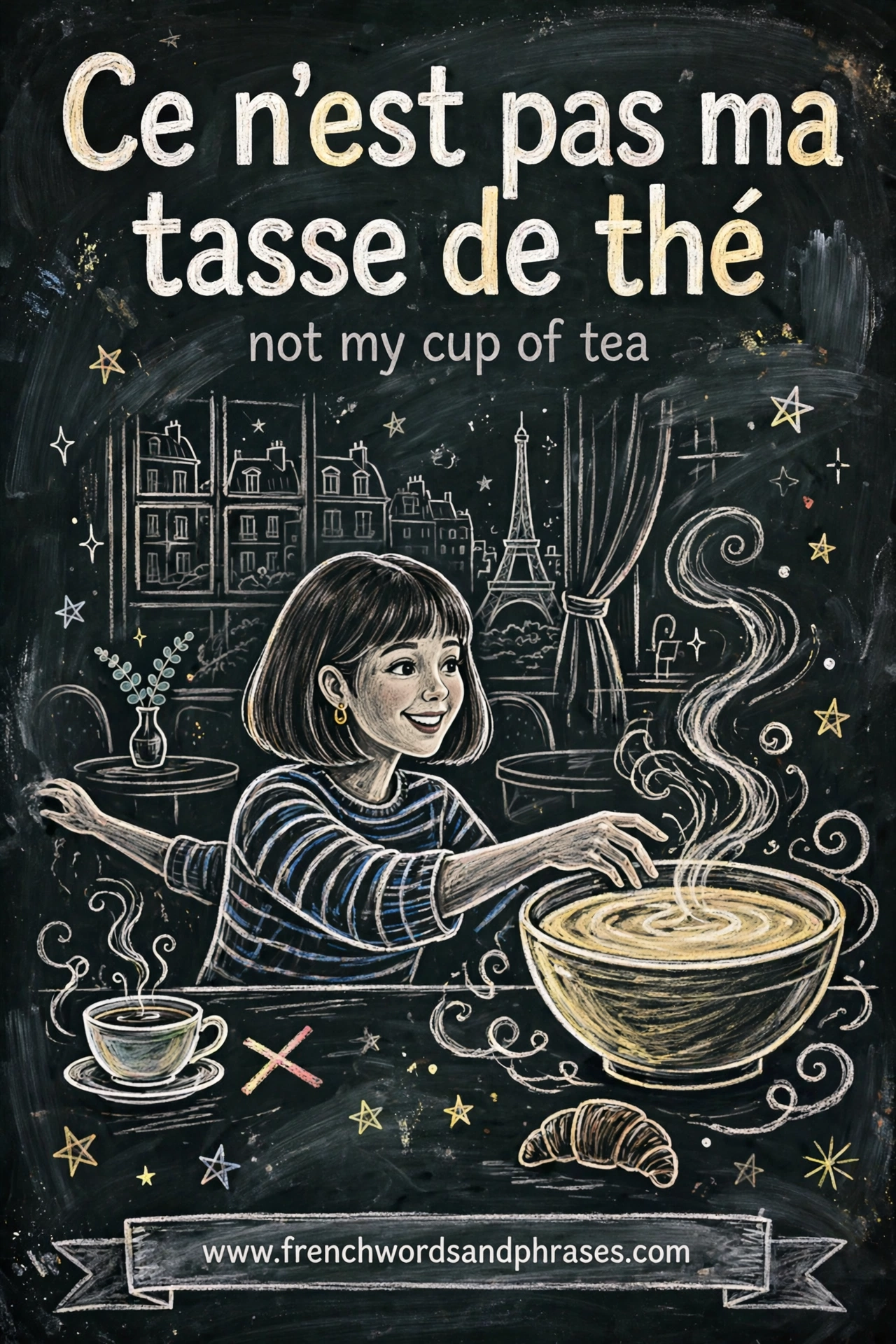
Ce n’est pas ma tasse de thé means not my cup of tea — not something I enjoy or am interested in.
The whole office is going to the karaoke bar on Friday, and everyone is thrilled — except you. You smile, you are happy for them, but singing into a microphone in front of the accounts department is simply not your pleasure. The French way to decline with charm: « Le karaoké, ce n’est pas ma tasse de thé. »
Let’s explore how ce n’est pas ma tasse de thé works in French, beginning with the whole phrase on one card.
Understanding the French Phrase Ce n’est pas ma tasse de thé
Ce n’est pas ma tasse de thé is a French idiomatic expression built from ce n’est pas (it is not), ma tasse (my cup) and de thé (of tea). It says, politely, that something is not to your taste — a French borrowing of the English ‘not my cup of tea’, now fully at home in French.
It means it’s not my cup of tea — I do not enjoy it, it does not interest me, it is not for me. Nobody is serving tea: the cup stands for taste itself, for the things a person savours. The phrase is a soft refusal, a way of saying no to an activity, a style, a subject — without insulting anyone who loves it.
Type: Idiomatic expression — taste and preference (a negative comparison)
Answers the need: Declining something politely — it’s not for me, without giving offence
Register: Neutral and gentle — safe everywhere, in speech and writing
Strength: Mild — a preference, not a disgust; it leaves the thing itself unjudged
One important usage detail: the cup belongs to the speaker — ma tasse de thé — and it changes owner with the person: ce n’est pas ta tasse de thé, ce n’est pas sa tasse de thé. It is used far more in the negative than the positive; c’est ma tasse de thé exists but sounds like a calque played for a smile. The phrase crossed the Channel from English, and French speakers know it and enjoy the borrowing.
Experience the Word
Ce n’est pas ma tasse de thé is the politest no in the French language — a refusal served in a teacup.
Imagine the invitations we all receive: the five-a-side football, the opera, the all-night coding session, the silent retreat. Some are simply not brewed for us. The phrase lets you step back without stepping on anyone — it blames your taste, never their choice.
French borrowed this one from English and kept the china intact. It is proof that a good refusal, like a good tea, travels well.
How to Use Ce n’est pas ma tasse de thé in French: Complete Guide
Let’s explore how ce n’est pas ma tasse de thé works in French, beginning with the whole phrase on one card.
Ce n’est pas ma tasse de thé at a Glance
The Whole Phrase on One Card
Real meaning, literal picture, English twin and register — ce n’est pas ma tasse de thé in five lines.
| Point | Ce n’est pas ma tasse de thé |
|---|---|
| What it really means | it’s not my cup of tea — I don’t enjoy it, it’s not for me |
| Word for word | it is not my cup of tea — the same picture as in English |
| English equivalent | not my cup of tea / not my thing |
| Register | neutral and gentle — a soft refusal, safe everywhere |
| Use it for | activities, styles, subjects and scenes that are not your taste |
Example
Les films d’horreur, ce n’est pas ma tasse de thé.
Horror films are not my cup of tea.
Word by Word: Building the Teacup
Five small pieces — take them one by one and the refusal pours itself.
| Word | Literal meaning | Its job in the phrase |
|---|---|---|
| ce n’est pas | it is not | the gentle denial — the whole phrase is a soft no |
| ma | my | the cup is personal — it changes with the speaker: ta tasse, sa tasse |
| tasse | a cup | the vessel of taste — what a person can savour |
| de | of | the little link that fills the cup |
| thé | tea | the borrowed English flavour of the whole expression |
Example
Chacun sa tasse de thé, comme on dit.
Each to their own cup of tea, as they say.
Quick Quiz 1
Where does ce n’est pas ma tasse de thé come from?
Reveal the answer
From English — French borrowed ‘not my cup of tea’ and kept it whole, cup, tea and all.
C’est un emprunt à l’anglais, cette tasse de thé.
This cup of tea is a borrowing from English.
When You Say It: The Gentle-Refusal Moments
Ce n’est pas ma tasse de thé fires at moments like these — an invitation or a fashion arrives, and it is simply not for you.
| Situation | Example |
|---|---|
| An invitation | le karaoké, ce n’est pas ma tasse de thé — karaoke is not my cup of tea |
| A film genre | les films d’horreur, ce n’est pas ma tasse de thé — horror films are not my cup of tea |
| A sport | le golf, ce n’est pas ma tasse de thé — golf is not my cup of tea |
| A fashion | ces couleurs, ce n’est pas ma tasse de thé — those colours are not my cup of tea |
| A subject | la politique au petit-déjeuner, ce n’est pas ma tasse de thé — politics at breakfast is not my cup of tea |
Example
Merci pour l’invitation, mais la randonnée à cinq heures du matin, ce n’est pas ma tasse de thé.
Thanks for the invitation, but hiking at five in the morning is not my cup of tea.
Make It Yours: The Cup for Every Person
The cup changes owner — ma, ta, sa — while the refusal stays just as gentle.
| Form | French | In English |
|---|---|---|
| Not mine | ce n’est pas ma tasse de thé | it’s not my cup of tea |
| Not yours | ce n’est pas ta tasse de thé | it’s not your cup of tea |
| Not his/hers | ce n’est pas sa tasse de thé | it’s not his/her cup of tea |
| Relaxed speech | c’est pas ma tasse de thé | it’s not my cup of tea (informal) |
| Question | ce n’est pas ta tasse de thé ? | it’s not your cup of tea? |
| With a smile | disons que ce n’est pas ma tasse de thé | let’s say it’s not my cup of tea |
Example
Je sais que tu aimes l’opéra, mais ce n’est pas sa tasse de thé, à lui.
I know you love opera, but it’s not his cup of tea.
Quick Quiz 2
How do you say ‘it’s not her cup of tea’ — ma tasse or sa tasse?
Reveal the answer
Sa tasse — the cup belongs to the person whose taste it is: ce n’est pas sa tasse de thé.
La danse classique, ce n’est pas sa tasse de thé.
Ballet is not her cup of tea.
Everyday Expressions: Building on the Teacup
Ce n’est pas ma tasse de thé slots into these everyday frames — each one ready to use as it stands.
| Frame | In English |
|---|---|
| ce n’est pas ma tasse de thé | it’s not my cup of tea |
| ce n’est pas ta tasse de thé | it’s not your cup of tea |
| ce n’est pas sa tasse de thé | it’s not his/her cup of tea |
| chacun sa tasse de thé | each to their own (taste) |
| disons que ce n’est pas ma tasse de thé | let’s say it’s not my cup of tea |
Example
Les réunions du lundi matin, ce n’est pas ma tasse de thé.
Monday morning meetings are not my cup of tea.
Close Cousins: The Other Ways to Say Not For Me
French has a whole shelf of not-for-me phrases — the teacup is the gentlest; its cousins are plainer, blunter or stronger.
| Expression | The difference |
|---|---|
| ce n’est pas ma tasse de thé | not my cup of tea — gentle, borrowed, blames only your taste |
| ce n’est pas mon truc | it’s not my thing — the plain everyday version, a touch more casual |
| ça ne me dit rien | it doesn’t appeal to me at all — literally ‘it says nothing to me’ |
| je ne suis pas fan | I’m not a fan — modern and mild, borrowed from English too |
| ça me laisse froid | it leaves me cold — stronger: no interest, no feeling |
| très peu pour moi | count me out — a firm, slightly old-fashioned refusal |
Example
Ce n’est pas mon truc, le camping ; disons que ce n’est pas ma tasse de thé.
Camping is not my thing; let’s say it’s not my cup of tea.
Quick Quiz 3
Which cousin is the plain, everyday ‘it’s not my thing’ — ce n’est pas mon truc or très peu pour moi?
Reveal the answer
Ce n’est pas mon truc — truc is the everyday word for a thing. Très peu pour moi is a firmer ‘count me out’.
Les jeux vidéo, ce n’est pas mon truc.
Video games are not my thing.
Ce n’est pas ma tasse de thé and Its Neighbours
The taste shelf around the phrase — liking, loving, and politely passing.
| French | In English |
|---|---|
| les goûts | tastes — les goûts et les couleurs, tastes and colours |
| adorer | to love, to adore |
| ne pas être fan de | to not be a fan of |
| détester | to hate, to detest |
| chacun ses goûts | each to their own taste |
| passer son tour | to sit this one out, to pass |
Example
Chacun ses goûts : elle adore le jazz, moi ce n’est pas ma tasse de thé.
Each to their own taste: she loves jazz, me, it’s not my cup of tea.
Watch Out: The Traps Around Ce n’est pas ma tasse de thé
The traps: a cup with the wrong owner, a positive form that sounds like a joke, and a refusal that is gentler than it looks.
| Trap | The truth |
|---|---|
| the owner’s trap | ma tasse is only yours — for her taste it must be sa tasse de thé; the cup always belongs to the person |
| the positive sounds playful | c’est ma tasse de thé is understood, but French lives in the negative here; the positive sounds like a deliberate wink at English |
| it is not an insult | the phrase judges your taste, not the thing — it is one of the safest refusals in French |
| word for word is fine here | for once, the English twin is exact — not my cup of tea, word for word, because French borrowed it |
Example
Ce n’est pas sa tasse de thé, et c’est très bien comme ça.
It’s not her cup of tea, and that’s perfectly fine.
Quick Quiz 4
True or false: ce n’est pas ma tasse de thé is a rude way to refuse an invitation.
Reveal the answer
False — it is one of the gentlest refusals in French: it blames your taste, never the invitation.
Merci quand même, mais ce n’est pas ma tasse de thé.
Thanks anyway, but it’s not my cup of tea.
Ce n’est pas ma tasse de thé in Everyday French: Real-Life Examples
Now that you know the word, let’s see how ce n’est pas ma tasse de thé appears in everyday French.
Example 1 — The karaoke night
Le karaoké, ce n’est pas ma tasse de thé.
Karaoke is not my cup of tea.
Example 2 — Horror films
Les films d’horreur, ce n’est pas ma tasse de thé.
Horror films are not my cup of tea.
Example 3 — Early mornings
Se lever à cinq heures, ce n’est pas ma tasse de thé.
Getting up at five is not my cup of tea.
Example 4 — About a colleague
Les grandes réunions, ce n’est pas sa tasse de thé.
Big meetings are not his cup of tea.
Example 5 — Spicy food
La cuisine très épicée, ce n’est pas ma tasse de thé.
Very spicy food is not my cup of tea.
Example 6 — Each to their own
Chacun sa tasse de thé : toi le foot, moi les livres.
Each to their own cup of tea: you football, me books.
Beyond Translation: The Meaning of Ce n’est pas ma tasse de thé
Most idioms guard their borders; this one crossed the Channel with a passport. English invented the cup of tea as the measure of pleasure, and French — the language of coffee — adopted it whole, because the picture is perfect: taste is personal, a cup is small and private, and nobody has to drink what is not brewed for them.
To say ce n’est pas ma tasse de thé is to refuse without a single sharp edge — the no arrives in a teacup.
Keep it for the invitations you decline with love: it lets the other person’s pleasure stay exactly as sweet as it was.
How to Remember the French Phrase Ce n’est pas ma tasse de thé
Remember it this way: Ce n’est pas ma tasse de thé is the refusal that arrives in a teacup — borrowed from English, gentle in both languages.
- You picture the cup — taste is a drink brewed for one person, and this one was not brewed for you.
- You change the owner, not the cup — ma tasse for you, sa tasse for her: the cup belongs to the taster.
- You keep it negative — French lives in ce n’est pas; the positive sounds like a joke about English.
The key idea is ce n’est pas ma tasse de thé means not my cup of tea — a gentle refusal that blames only your taste.
Test Your Knowledge of Ce n’est pas ma tasse de thé
Let’s see how much you’ve learned. Try answering these questions before revealing the answers.
Question 1
What does ce n’est pas ma tasse de thé mean?
Reveal the answer
Not my cup of tea — I do not enjoy it, it is not for me.
Question 2
Where does the phrase come from?
Reveal the answer
From English — French borrowed ‘not my cup of tea’ whole, and it is now fully at home in French.
Question 3
How do you say ‘it’s not her cup of tea’?
Reveal the answer
Ce n’est pas sa tasse de thé — the cup belongs to the person whose taste it is.
Question 4
What is the difference between ce n’est pas ma tasse de thé and ce n’est pas mon truc?
Reveal the answer
Very little — mon truc is the plainer, more casual everyday version; the teacup is the gentler, more charming one.
Question 5
Complete the sentence:
Le camping, ce n’est pas ma ______ de thé. (Camping is not my cup of tea.)
Reveal the answer
tasse
Le camping, ce n’est pas ma tasse de thé.
Camping is not my cup of tea.
Your Final Challenge
Can You Use It?
How would you say this in French?
“Karaoke is not my cup of tea.”
Reveal the answer
Le karaoké, ce n’est pas ma tasse de thé.
Karaoke is not my cup of tea.
A little French. A little curiosity. A richer everyday life.
LEARN FRENCH ONE WORD AT A TIME