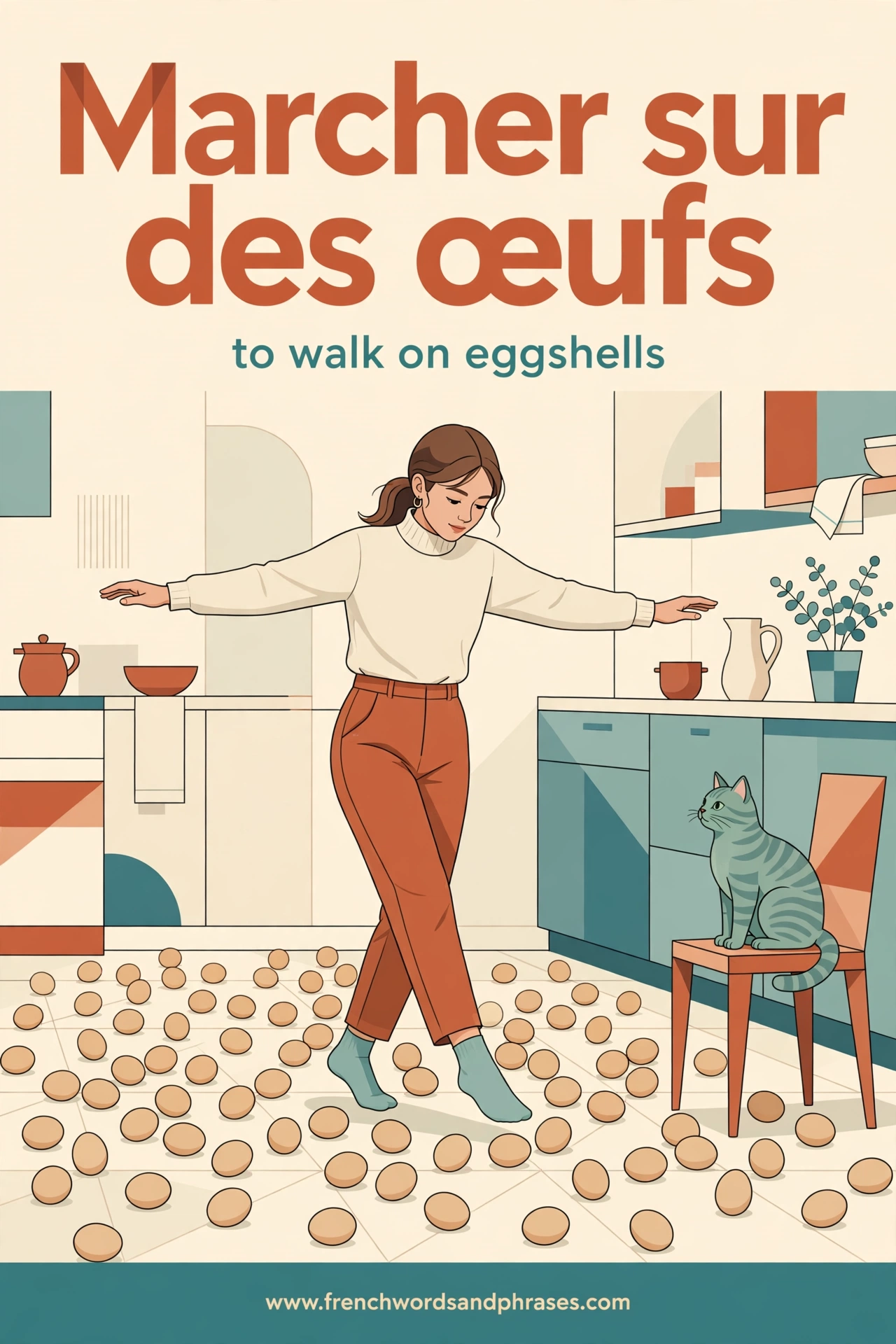
A French Word to Live By
Translate Ce ne sont pas mes oignons to English
/sə nə sɔ̃ pa me zɔ.ɲɔ̃/
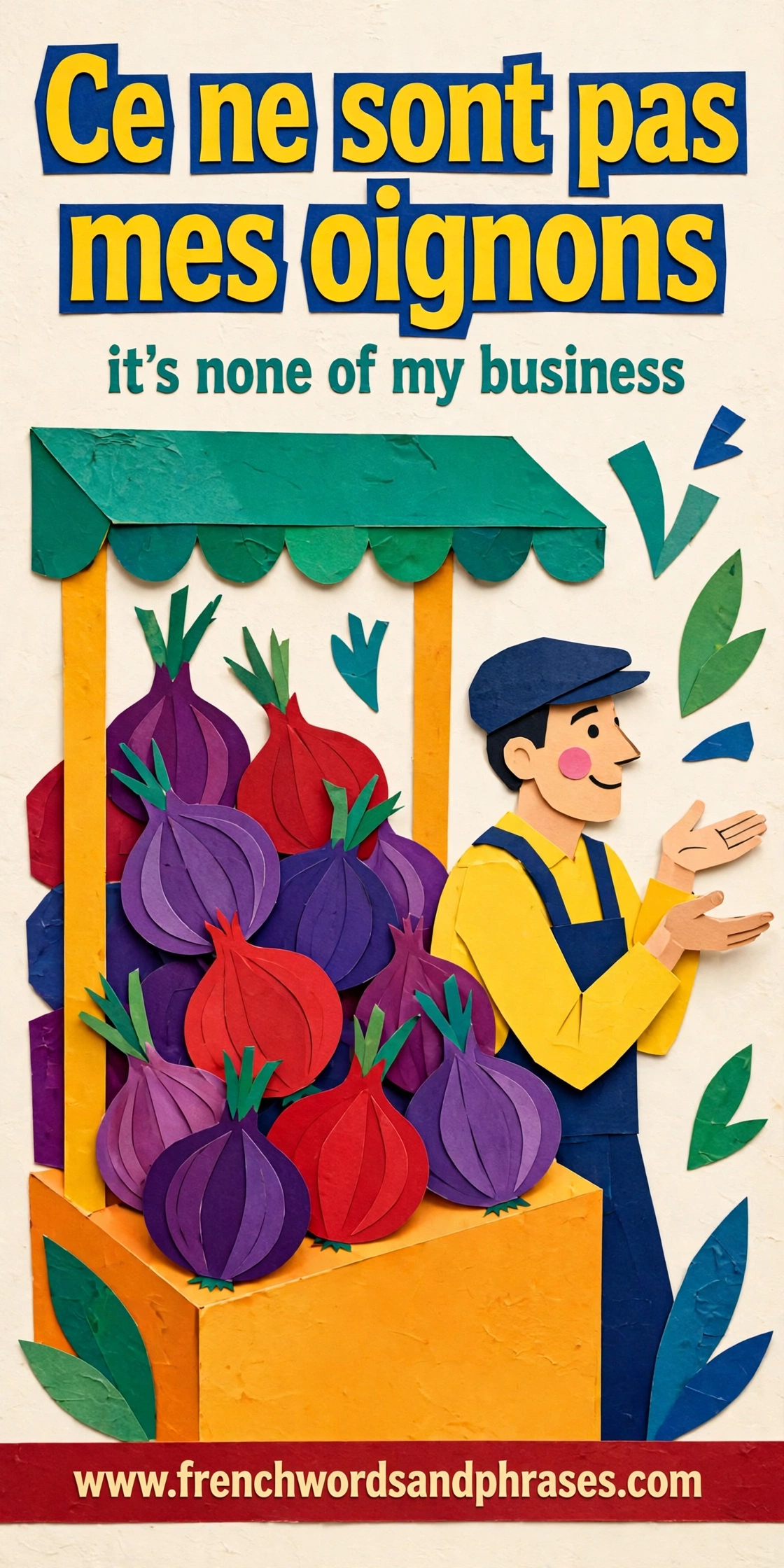
Ce ne sont pas mes oignons means it’s none of my business — a brisk way of saying a matter does not concern you.
Two neighbours are deep in an argument over the fence about a hedge, a cat and a parking space, and both keep turning to you for support. You raise both hands, step back towards your own gate and deliver the classic French exit line: « Ce ne sont pas mes oignons. »
Let’s explore how ce ne sont pas mes oignons works in French, beginning with the whole phrase on one card.
Understanding the French Phrase Ce ne sont pas mes oignons
Ce ne sont pas mes oignons is a French idiomatic expression built from ce (this), ne… pas (the negation), mes (my) and oignons (onions). It is the familiar French way of declaring that something is none of your business — you refuse to be drawn in.
It means it’s none of my business — the matter does not concern me and I want no part of it. Nobody is cooking: the onions are your patch of ground, your own affairs, the things you tend. What grows in someone else’s row is theirs to weed. Said of your own involvement, it is a polite retreat; said about someone else — ce ne sont pas tes oignons — it becomes a sharp ‘mind your own business’.
Type: Idiomatic expression — boundaries (ce ne sont pas + mes + noun)
Answers the need: Refusing to be drawn into a matter that is not yours
Register: Informal, familiar — everyday speech; brisk but not rude about yourself
Strength: Firm — a closed gate, not an invitation to argue
One important usage detail: the possessive does all the work — ce ne sont pas mes oignons (not my business), ce ne sont pas tes oignons (mind your own business — much sharper), ce ne sont pas nos oignons (not our affair). The plural sont and oignons never change. A softer cousin exists for staying out gently: je ne m’en mêle pas, I keep out of it.
Experience the Word
Ce ne sont pas mes oignons is the art of the graceful exit — hands up, step back, garden gate closed.
Imagine the village café when the talk turns to who said what about the mayor’s fence. Everyone leans in. The oldest man at the counter leans back, folds his newspaper, and closes the subject with five words about onions. He will live to a hundred, that man.
French draws the boundary with a vegetable. Your affairs are your onions — you peel them, you cry over them, and nobody else gets a say.
How to Use Ce ne sont pas mes oignons in French: Complete Guide
Let’s explore how ce ne sont pas mes oignons works in French, beginning with the whole phrase on one card.
Ce ne sont pas mes oignons at a Glance
The Whole Phrase on One Card
Real meaning, literal picture, English twin and register — ce ne sont pas mes oignons in five lines.
| Point | Ce ne sont pas mes oignons |
|---|---|
| What it really means | it’s none of my business — the matter does not concern me |
| Word for word | these are not my onions |
| English equivalent | it’s none of my business / that’s not my concern |
| Register | informal, familiar — a brisk everyday exit line |
| Use it for | other people’s quarrels, gossip, disputes you refuse to join |
Example
Leur dispute ne me regarde pas : ce ne sont pas mes oignons.
Their quarrel is nothing to do with me: it’s none of my business.
Word by Word: Building the Boundary
Five small pieces — take them one by one and the gate swings shut.
| Word | Literal meaning | Its job in the phrase |
|---|---|---|
| ce | this, these | points at the whole matter under discussion |
| ne… sont pas | are not | the plural negation — sont because oignons is plural |
| mes | my | the possessive that draws the line around your own affairs |
| oignons | onions | your patch, your business — the things you tend and answer for |
Example
Ce ne sont pas tes oignons, laisse-les se débrouiller.
It’s none of your business, let them sort it out themselves.
Quick Quiz 1
Why onions? What do the oignons stand for in the phrase?
Reveal the answer
Your own affairs — the patch of life you tend yourself, like a row of onions in your garden.
Occupe-toi de tes oignons et laisse les miens tranquilles.
Mind your own onions and leave mine alone.
When You Say It: The Stepping-Back Moments
Ce ne sont pas mes oignons fires at moments like these — someone tries to pull you in, and you decline.
| Situation | Example |
|---|---|
| Neighbours quarrelling | leur histoire de haie, ce ne sont pas mes oignons — their hedge business is none of my concern |
| Office politics | qui sera promu ? ce ne sont pas mes oignons — who gets promoted? not my business |
| Family gossip | les affaires de mon frère, ce ne sont pas mes oignons — my brother’s affairs are none of my business |
| Being asked to judge | ne me demande pas de choisir : ce ne sont pas mes oignons — don’t ask me to choose: it’s not my affair |
| About a couple | leurs disputes de couple, ce ne sont pas nos oignons — their couple’s quarrels are none of our business |
Example
Je ne prends pas parti : ce ne sont pas mes oignons.
I’m not taking sides: it’s none of my business.
Make It Yours: The Onions for Every Person
Only the possessive changes — mes, tes, ses, nos, vos, leurs — the onions stay plural.
| Form | French | In English |
|---|---|---|
| Not my business | ce ne sont pas mes oignons | it’s none of my business |
| Not your business | ce ne sont pas tes oignons | it’s none of your business — sharp, a warning |
| Not his or her business | ce ne sont pas ses oignons | it’s none of his or her business |
| Not our business | ce ne sont pas nos oignons | it’s none of our business |
| Not their business | ce ne sont pas leurs oignons | it’s none of their business |
| The command form | occupe-toi de tes oignons | mind your own business |
Example
Ce ne sont pas leurs oignons, mais ils écoutent quand même.
It’s none of their business, but they listen anyway.
Quick Quiz 2
Said to you — ce ne sont pas tes oignons — is it a retreat or a rebuke?
Reveal the answer
A rebuke — with tes, the phrase tells you to mind your own business. With mes, it is your own polite retreat.
Ce ne sont pas tes oignons, merci.
It’s none of your business, thank you.
Everyday Expressions: Building on the Onions
Ce ne sont pas mes oignons slots into these everyday frames — each one ready to use as it stands.
| Frame | In English |
|---|---|
| ce ne sont pas mes oignons | it’s none of my business |
| occupe-toi de tes oignons | mind your own business — the classic command |
| mêle-toi de tes oignons | keep your nose out of it — even blunter |
| ce ne sont pas nos oignons | it’s none of our business |
| ce sont ses oignons | that’s his or her lookout — let them deal with it |
Example
Occupe-toi de tes oignons et tout ira mieux.
Mind your own business and everything will go better.
Close Cousins: The Other Ways to Stay Out
French has a whole shelf of boundary phrases — the oignons are the familiar ones; its cousins soften, formalise or sharpen the line.
| Expression | The difference |
|---|---|
| ce ne sont pas mes oignons | none of my business — familiar, brisk, a little humorous |
| ça ne me regarde pas | it’s nothing to do with me — plainer, a touch more formal |
| je ne m’en mêle pas | I keep out of it — you decline to get involved, gently |
| mêle-toi de ce qui te regarde | mind what concerns you — the rebuke, full length |
| chacun ses affaires | each to his own affairs — the principle stated calmly |
Example
Ça ne me regarde pas, et je ne m’en mêle pas.
It’s nothing to do with me, and I’m keeping out of it.
Quick Quiz 3
You want to decline a colleague’s dispute politely, without vegetables. Which cousin do you choose?
Reveal the answer
Ça ne me regarde pas — the same boundary in plain clothes, safe in any company.
Pardon, mais ça ne me regarde pas.
Sorry, but that’s nothing to do with me.
Ce ne sont pas mes oignons and Its Neighbours
The boundary shelf around the phrase — from the onion itself to the nose that stays out.
| French | In English |
|---|---|
| un oignon | an onion |
| une affaire | a matter, a piece of business |
| se mêler de | to meddle in, to get involved in |
| regarder quelqu’un | to concern someone — ça te regarde, it’s your business |
| chacun chez soi | each in his own home — live and let live |
| le potager | the vegetable garden — where the onions grow |
Example
Chacun ses affaires, chacun chez soi, et tout le monde est content.
Each to his own affairs, each in his own home, and everyone is happy.
Watch Out: The Traps Around Ce ne sont pas mes oignons
The traps: a soup ingredient, a singular that breaks the phrase, and a tone that changes with one small word.
| Trap | The truth |
|---|---|
| the kitchen trap | mes oignons in a recipe is just cooking — the idiom needs the full ce ne sont pas frame and a human dispute |
| the singular trap | never ce n’est pas mon oignon — the idiom is fixed in the plural: ce ne sont pas mes oignons |
| tone flips with the possessive | mes is a polite retreat; tes is a rebuke — choose the wrong one and you start the quarrel you were avoiding |
| too familiar for formal writing | in a letter or a report, write cela ne me concerne pas — keep the onions for speech |
Example
En réunion, dis « cela ne me concerne pas » plutôt que « ce ne sont pas mes oignons ».
In a meeting, say ‘that does not concern me’ rather than ‘it’s not my onions’.
Quick Quiz 4
True or false: the phrase works in the singular — ce n’est pas mon oignon.
Reveal the answer
False — the idiom is fixed in the plural: ce ne sont pas mes oignons.
Non, ce ne sont pas mes oignons.
No, it’s none of my business.
Ce ne sont pas mes oignons in Everyday French: Real-Life Examples
Now that you know the word, let’s see how ce ne sont pas mes oignons appears in everyday French.
Example 1 — Over the fence
Leur dispute de voisinage, ce ne sont pas mes oignons.
Their neighbourly dispute is none of my business.
Example 2 — At the café
Qui a dit quoi au maire ? Ce ne sont pas mes oignons.
Who said what to the mayor? None of my business.
Example 3 — The sharp reply
Ce ne sont pas tes oignons, occupe-toi des tiens.
It’s none of your business, mind your own.
Example 4 — At work
Les promotions des autres, ce ne sont pas mes oignons.
Other people’s promotions are none of my business.
Example 5 — The family rule
Entre frères et sœurs, on répète : ce ne sont pas nos oignons.
Between brothers and sisters, we repeat: it’s none of our business.
Example 6 — Closing the subject
Bref, ce ne sont pas mes oignons, parlons d’autre chose.
Anyway, it’s none of my business, let’s talk about something else.
Beyond Translation: The Meaning of Ce ne sont pas mes oignons
Every culture guards its boundaries, but the guards wear different clothes. English minds its own business like a shopkeeper; French tends its own onions like a gardener. The French picture is kinder and funnier — your affairs are not commerce, they are a crop: they need your hands, they make you cry when you peel them, and they are absolutely not the neighbour’s to harvest.
To say ce ne sont pas mes oignons is to hand a quarrel back to its owners with a smile.
Keep the phrase for speech, keep it warm, and aim the tes version only when you truly mean it.
How to Remember the French Phrase Ce ne sont pas mes oignons
Remember it this way: Ce ne sont pas mes oignons is the garden fence of French — your affairs grow on your side, and you decline to weed anyone else’s.
- You picture your row of onions — your business is what you grow and tend; the neighbour’s row is his.
- You keep the plural frozen — ce ne sont pas mes oignons, never a singular oignon.
- You watch the possessive — mes retreats politely, tes rebukes: one word flips the tone.
The key idea is ce ne sont pas mes oignons means it’s none of my business — my affairs are my onions.
Test Your Knowledge of Ce ne sont pas mes oignons
Let’s see how much you’ve learned. Try answering these questions before revealing the answers.
Question 1
What does ce ne sont pas mes oignons mean?
Reveal the answer
It’s none of my business — the matter does not concern me and I refuse to be drawn in.
Question 2
What is the literal, word-for-word meaning?
Reveal the answer
These are not my onions — the onions stand for your own affairs, the patch you tend yourself.
Question 3
How do you tell someone to mind their own business?
Reveal the answer
Ce ne sont pas tes oignons — or even blunter, occupe-toi de tes oignons.
Question 4
What is the difference between the mes and tes versions?
Reveal the answer
Mes is your own polite retreat; tes is a rebuke — the possessive alone flips the tone of the phrase.
Question 5
Complete the sentence:
Leur querelle, ce ne sont pas ______ oignons. (Their quarrel is none of my business.)
Reveal the answer
mes
Leur querelle, ce ne sont pas mes oignons.
Their quarrel is none of my business.
Your Final Challenge
Can You Use It?
How would you say this in French?
“It’s none of my business.”
Reveal the answer
Ce ne sont pas mes oignons.
It’s none of my business.
A little French. A little curiosity. A richer everyday life.
LEARN FRENCH ONE WORD AT A TIME