A French Word to Live By
How to Conjugate Briller in French
/bʁi.je/
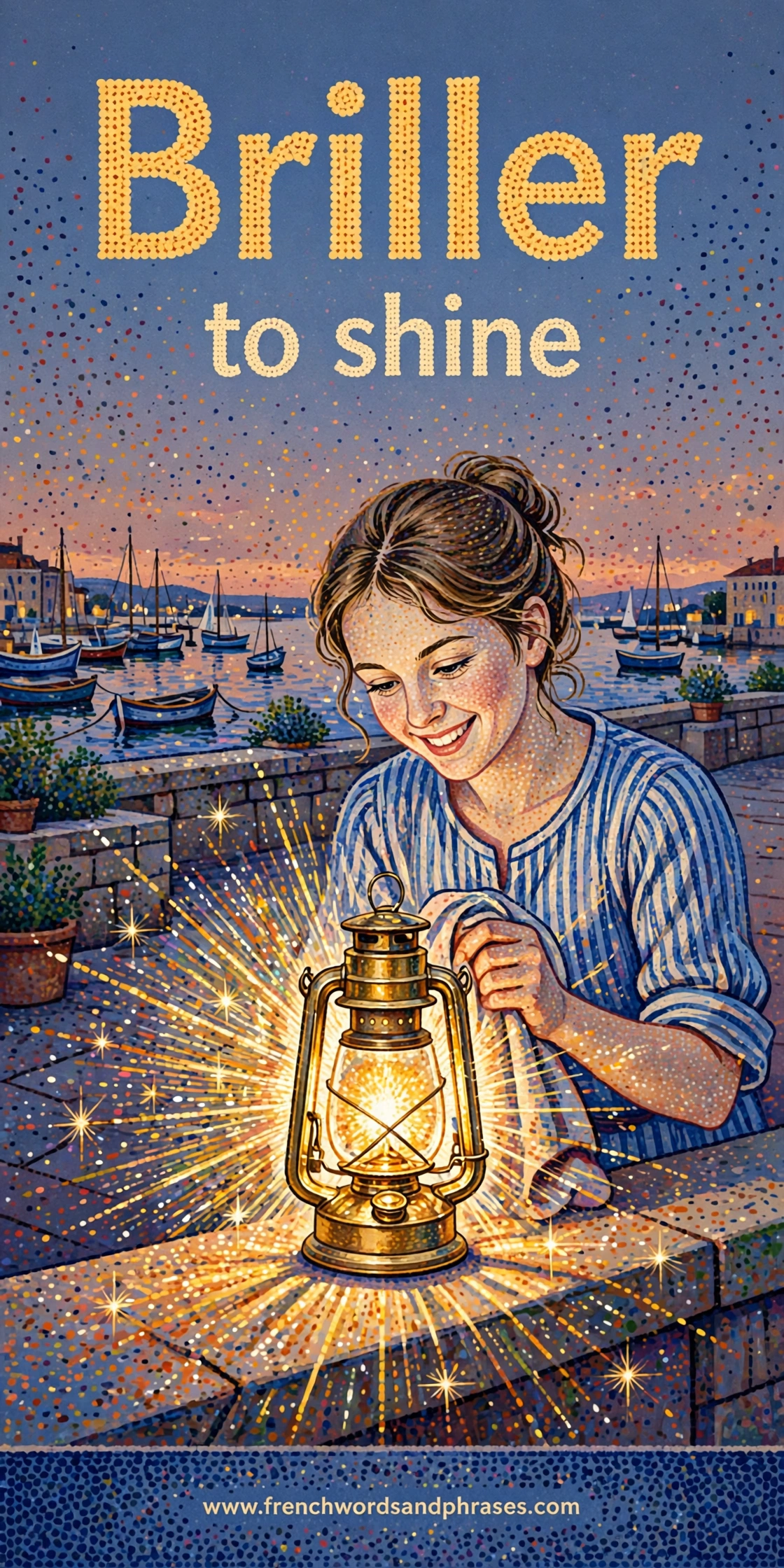
Briller means to shine — to give off light, and to stand out brilliantly among others.
A star over a dark field, a polished diamond in a jeweller’s window, a student whose essay lights up the classroom — briller is the verb of shining, in the sky, on the stage, and in society.
In this guide, you’ll learn how to conjugate briller in all the major French tenses and moods. Explore complete conjugation tables, French examples, English translations, and practice quizzes.
Understanding the French Verb Briller
Briller is a regular French verb belonging to the first group of verbs, those ending in-er.
It means to shine. It is commonly used of stars, eyes, jewels and polished surfaces, and just as often of people: a candidate brille à l’oral, a hostess brille en société, a wit brille dans la conversation — wherever excellence catches the light, briller is the verb.
Verb classification: First group (-er)
Auxiliary verb: Avoir
Past participle: brillé
Present participle: brillant
English equivalents: To shine, to glitter, to sparkle; briller de mille feux — to shine with a thousand lights; briller en société — to shine in society; briller par son absence — to be conspicuous by one’s absence (ironic); les yeux lui brillent — his eyes are shining.
One important detail: briller keeps its double l in every form — je brille, nous brillons, je brillais, brillé — like a light doubled. The trap is not spelling but the famous irony of briller par son absence: to shine by one’s absence is the polite, cutting way to say someone conspicuously failed to turn up. And remember that briller itself is intransitive — eyes, stars and students shine; you cannot ‘briller’ an object.
Experience the Word
Briller is the verb of catching the light — some things emit it, and some people seem to.
Imagine a village hall on prize-giving day. Names are called, polite applause rises and falls — then one girl walks up for the third time, and the whole room leans forward: elle brille, and everyone present can feel the difference between doing well and shining.
She has not boasted or performed. She has shone — brillé, the way a star does, simply by being brighter.
How to Conjugate Briller: Complete French Conjugation Guide
Let’s explore every major conjugation of briller, beginning with the indicative mood.
How to Conjugate Briller in the Indicative Mood
The indicative mood is used to express facts, observations, actions, and events.
How to Conjugate Briller in the Present Tense (Présent)
Used for actions happening now, habitual actions, and general truths.
| Subject | Conjugation |
|---|---|
| je | brille |
| tu | brilles |
| il / elle | brille |
| nous | brillons |
| vous | brillez |
| ils / elles | brillent |
Example
Les étoiles brillent au-dessus de la vallée.
The stars are shining above the valley.
Quick Quiz 1
Complete the sentence:
Nous ______ quand nous sommes bien préparés.
Reveal the answer
brillons
Nous brillons quand nous sommes bien préparés.
We shine when we are well prepared.
How to Conjugate Briller in the Passé Composé
Used for completed actions in the past. Briller takes the auxiliary verb avoir.
| Subject | Conjugation |
|---|---|
| j’ | ai brillé |
| tu | as brillé |
| il / elle | a brillé |
| nous | avons brillé |
| vous | avez brillé |
| ils / elles | ont brillé |
Example
Elle a brillé à l’examen de fin d’année.
She shone in the end-of-year exam.
How to Conjugate Briller in the Imparfait (Imperfect Tense)
Used for habitual past actions, descriptions, and ongoing situations in the past.
| Subject | Conjugation |
|---|---|
| je | brillais |
| tu | brillais |
| il / elle | brillait |
| nous | brillions |
| vous | brilliez |
| ils / elles | brillaient |
Example
Le soleil brillait sur la mer calme.
The sun was shining on the calm sea.
Quick Quiz 2
Choose the correct form:
The sun was shining.
Le soleil ______. (brillait / brillerait)
Reveal the answer
brillait
Le soleil brillait.
Brillait is the imparfait — the shining was in progress.
How to Conjugate Briller in the Plus-que-parfait
Used to describe an action that had already been completed before another past event.
| Subject | Conjugation |
|---|---|
| j’ | avais brillé |
| tu | avais brillé |
| il / elle | avait brillé |
| nous | avions brillé |
| vous | aviez brillé |
| ils / elles | avaient brillé |
Example
Il avait brillé pendant tout le concours.
He had shone throughout the whole competition.
How to Conjugate Briller in the Passé Simple
Primarily used in formal writing, literature, and historical narratives. It is rarely used in everyday conversation.
| Subject | Conjugation |
|---|---|
| je | brillai |
| tu | brillas |
| il / elle | brilla |
| nous | brillâmes |
| vous | brillâtes |
| ils / elles | brillèrent |
Example
Un éclair brilla dans le ciel noir.
A flash of lightning shone in the black sky.
How to Conjugate Briller in the Passé Antérieur
A literary tense used to express an action completed immediately before another past action, generally in the passé simple.
| Subject | Conjugation |
|---|---|
| j’ | eus brillé |
| tu | eus brillé |
| il / elle | eut brillé |
| nous | eûmes brillé |
| vous | eûtes brillé |
| ils / elles | eurent brillé |
Example
Dès que le soleil eut brillé, la neige commença à fondre.
As soon as the sun had shone, the snow began to melt.
How to Conjugate Briller in the Future Tense (Futur Simple)
Used to describe actions that will take place in the future.
| Subject | Conjugation |
|---|---|
| je | brillerai |
| tu | brilleras |
| il / elle | brillera |
| nous | brillerons |
| vous | brillerez |
| ils / elles | brilleront |
Example
Ce soir, la lune brillera sur le lac.
Tonight, the moon will shine on the lake.
How to Conjugate Briller in the Futur Antérieur (Future Perfect)
Used for an action that will have been completed before a particular point in the future.
| Subject | Conjugation |
|---|---|
| j’ | aurai brillé |
| tu | auras brillé |
| il / elle | aura brillé |
| nous | aurons brillé |
| vous | aurez brillé |
| ils / elles | auront brillé |
Example
À la fin du spectacle, elle aura brillé dans trois rôles.
By the end of the show, she will have shone in three roles.
How to Conjugate Briller in the Near Future (Futur Proche)
Used to describe something that is going to happen soon. Formed with aller + infinitive.
| Subject | Conjugation |
|---|---|
| je | vais briller |
| tu | vas briller |
| il / elle | va briller |
| nous | allons briller |
| vous | allez briller |
| ils / elles | vont briller |
Example
Regarde, ses yeux vont briller quand elle verra le cadeau.
Look, her eyes are going to shine when she sees the present.
How to Conjugate Briller in the Conditional Mood
The conditional mood expresses what would happen under certain circumstances. It is also frequently used to make polite requests or express wishes.
How to Conjugate Briller in the Present Conditional
| Subject | Conjugation |
|---|---|
| je | brillerais |
| tu | brillerais |
| il / elle | brillerait |
| nous | brillerions |
| vous | brilleriez |
| ils / elles | brilleraient |
Example
Avec plus de travail, il brillerait en mathématiques.
With more work, he would shine in mathematics.
How to Conjugate Briller in the Past Conditional
| Subject | Conjugation |
|---|---|
| j’ | aurais brillé |
| tu | aurais brillé |
| il / elle | aurait brillé |
| nous | aurions brillé |
| vous | auriez brillé |
| ils / elles | auraient brillé |
Example
Elle aurait brillé sur scène avec un meilleur rôle.
She would have shone on stage with a better role.
Briller in the Literary Past Conditional Form
This less common literary form uses the imperfect subjunctive of avoir.
| Subject | Conjugation |
|---|---|
| j’ | eusse brillé |
| tu | eusses brillé |
| il / elle | eût brillé |
| nous | eussions brillé |
| vous | eussiez brillé |
| ils / elles | eussent brillé |
Example
Il eût brillé en société plutôt que de rester seul.
He would have shone in society rather than stay alone.
How to Conjugate Briller in the Subjunctive Mood
The subjunctive is used to express wishes, emotions, doubts, necessity, and uncertainty. It frequently follows expressions such as il faut que (it is necessary that) or bien que (although).
How to Conjugate Briller in the Present Subjunctive
| Subject | Conjugation |
|---|---|
| que je | brille |
| que tu | brilles |
| qu’il / qu’elle | brille |
| que nous | brillions |
| que vous | brilliez |
| qu’ils / qu’elles | brillent |
Example
Je veux que tu brilles le jour de l’examen.
I want you to shine on exam day.
Quick Quiz 3
Complete the sentence using the subjunctive:
Il faut que vous ______ à l’entretien.
Reveal the answer
brilliez
Il faut que vous brilliez à l’entretien.
You must shine at the interview.
How to Conjugate Briller in the Imperfect Subjunctive
A literary tense, rarely encountered in modern spoken French.
| Subject | Conjugation |
|---|---|
| que je | brillasse |
| que tu | brillasses |
| qu’il / qu’elle | brillât |
| que nous | brillassions |
| que vous | brillassiez |
| qu’ils / qu’elles | brillassent |
Example
On espérait que le soleil brillât pour la fête.
People hoped the sun would shine for the festival.
How to Conjugate Briller in the Pluperfect Subjunctive
A literary construction used to express an action completed before another past action.
| Subject | Conjugation |
|---|---|
| que j’ | eusse brillé |
| que tu | eusses brillé |
| qu’il / qu’elle | eût brillé |
| que nous | eussions brillé |
| que vous | eussiez brillé |
| qu’ils / qu’elles | eussent brillé |
Example
On racontait qu’elle eût brillé dans tous les salons de Paris.
People said she had shone in all the Paris salons.
How to Conjugate Briller in the Past Subjunctive
| Subject | Conjugation |
|---|---|
| que j’ | aie brillé |
| que tu | aies brillé |
| qu’il / qu’elle | ait brillé |
| que nous | ayons brillé |
| que vous | ayez brillé |
| qu’ils / qu’elles | aient brillé |
Example
Je suis fier qu’elle ait brillé au concours.
I am proud she shone in the competition.
How to Conjugate Briller in the Imperative
The imperative is used to give commands, instructions, invitations, or suggestions. Subject pronouns are omitted.
How to Conjugate Briller in the Present Imperative
| Person | Conjugation |
|---|---|
| (tu) | brille |
| (nous) | brillons |
| (vous) | brillez |
Example
Brille de tous tes feux ce soir !
Shine with all your lights tonight!
Quick Quiz 4
How would you say Shine tonight (tu form)?
Reveal the answer
Brille ce soir !
French Participles of Briller
Participles are verb forms that can be used in compound tenses and other grammatical constructions.
Present Participle of Briller
brillant
En brillant ainsi, la lampe attirait les papillons.
Shining like that, the lamp attracted the moths.
Past Participle of Briller
brillé
Après avoir brillé toute la nuit, l’étoile s’éteignit à l’aube.
After shining all night, the star went out at dawn.
Briller in Everyday French: Real-Life Examples
Now that you know the conjugations, let’s see how briller appears in everyday French.
Example 1 — Present
Les étoiles brillent ce soir.
The stars are shining tonight.
Example 2 — Passé composé
Elle a brillé à l’examen.
She shone in the exam.
Example 3 — Imparfait
Le soleil brillait sur la mer.
The sun was shining on the sea.
Example 4 — Future
La lune brillera sur le lac.
The moon will shine on the lake.
Example 5 — Conditional
Il brillerait avec plus de travail.
He would shine with more work.
Example 6 — Imperative
Brille ce soir, c’est ton moment !
Shine tonight, it is your moment!
Beyond Translation: The Meaning of Briller
English to shine and brilliant meet inside briller — its adjective brillant means both shining and brilliant, and as a noun un brillant is a cut diamond.
One phrase is pure French irony.
Briller par son absence — to shine by one’s absence — descends from Tacitus and is now the standard needle for the guest who never arrived: the only person at the party who managed to shine was the one who stayed away.
How to Remember the French Verb Briller
Remember it this way: Briller is about the star over the valley — and the student lighting up the classroom.
- Two l’s, always: brille, brillons, brillé — like a light doubled.
- Literal and social: the star shines, the student shines, and the absent guest brille par son absence.
- Regular -er with avoir: elle a brillé à l’examen.
The key idea is the star over the valley — and the student lighting up the classroom.
Test Your Knowledge of Briller
Let’s see how much you’ve learned. Try answering these questions before revealing the answers.
Question 1
What does briller par son absence mean?
Reveal the answer
To be conspicuous by one’s absence — the ironic compliment paid to the person who did not turn up.
Question 2
How do you say The stars are shining tonight in French?
Reveal the answer
Les étoiles brillent ce soir.
Question 3
Translate: She shone in the exam.
Reveal the answer
Elle a brillé à l’examen.
Question 4
What is the past participle of briller?
Reveal the answer
Brillé.
Question 5
Complete the sentence:
Je veux que tu ______ le jour du concours.
Reveal the answer
brilles
Je veux que tu brilles le jour du concours.
I want you to shine on the day of the competition.
Your Final Challenge
Can You Use It?
How would you say this in French?
The stars shine over the valley, and each one seems to watch over a sleeping house.
Reveal the answer
Les étoiles brillent sur la vallée, et chacune semble veiller sur une maison endormie.
The stars shine over the valley, and each one seems to watch over a sleeping house.
A little French. A little curiosity. A richer everyday life.
LEARN FRENCH ONE WORD AT A TIME