A French Word to Live By
How to Conjugate Branler in French
/bʁɑ̃.le/
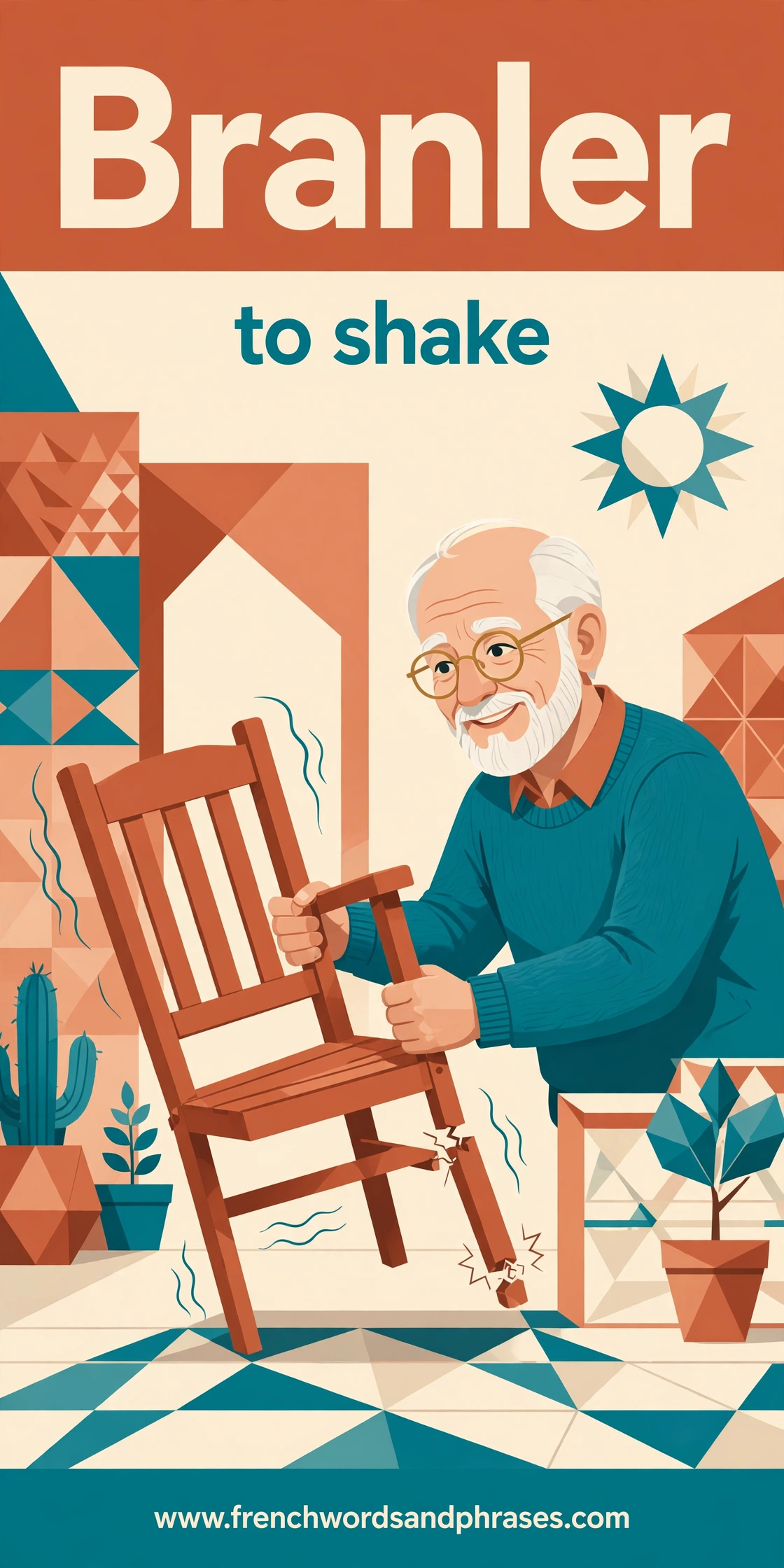
Branler means to shake or wobble — to move unsteadily from side to side, like a loose tooth or a doubtful head.
A loose tooth worrying in its gum, an old man’s head wagging slowly at bad news, a chair leg an inch too short — branler is the verb of the unsteady shake, and its most famous home is the phrase branler dans le manche: loose in the handle, about to give way.
In this guide, you’ll learn how to conjugate branler in all the major French tenses and moods. Explore complete conjugation tables, French examples, English translations, and practice quizzes.
Understanding the French Verb Branler
Branler is a regular French verb belonging to the first group of verbs, those ending in-er.
It means to shake. It is commonly used for loose teeth, wobbly furniture and ladders, and for the slow head-shake of doubt or disapproval; its idiom branler dans le manche — originally a tool loose in its handle — describes anything shaky and near collapse, from a government to a garden shed.
Verb classification: First group (-er)
Auxiliary verb: Avoir
Past participle: branlé
Present participle: branlant
English equivalents: To shake, to wobble, to be loose; branler la tête — to shake one’s head slowly, in doubt or disapproval; une dent qui branle — a loose tooth; branler dans le manche — to be shaky, on the point of falling apart; branler de peur — to tremble with fear (old-fashioned).
One important detail: in modern French branler is mostly met intransitive — things branlent by themselves: la dent branle, la table branle — or in the fixed gesture branler la tête, to shake one’s head. Handle the reflexive with care: se branler has a coarse slang sense today, which is why the plain verb lives quietly in its set phrases. For a vigorous deliberate shaking, French usually prefers secouer, and for shaking something’s foundations, ébranler.
Experience the Word
Branler is the verb of things not properly fixed — the wobble that announces a fall.
Imagine a six-year-old at breakfast, working a loose tooth with her tongue: elle branle, elle branle, and the whole table is watching it instead of the toast. By lunch the tooth will be under her pillow — branler is always the last stage before something comes away.
It has not fallen yet. It is shaking — branlant, loose in its socket, living on borrowed time.
How to Conjugate Branler: Complete French Conjugation Guide
Let’s explore every major conjugation of branler, beginning with the indicative mood.
How to Conjugate Branler in the Indicative Mood
The indicative mood is used to express facts, observations, actions, and events.
How to Conjugate Branler in the Present Tense (Présent)
Used for actions happening now, habitual actions, and general truths.
| Subject | Conjugation |
|---|---|
| je | branle |
| tu | branles |
| il / elle | branle |
| nous | branlons |
| vous | branlez |
| ils / elles | branlent |
Example
La dent de lait branle, elle va tomber.
The milk tooth is loose, it is going to fall out.
Quick Quiz 1
Complete the sentence:
La marche ______ sous nos pieds.
Reveal the answer
branle
La marche branle sous nos pieds.
The step wobbles under our feet.
How to Conjugate Branler in the Passé Composé
Used for completed actions in the past. Branler takes the auxiliary verb avoir.
| Subject | Conjugation |
|---|---|
| j’ | ai branlé |
| tu | as branlé |
| il / elle | a branlé |
| nous | avons branlé |
| vous | avez branlé |
| ils / elles | ont branlé |
Example
La table a branlé toute la soirée sur ce plancher inégal.
The table wobbled all evening on that uneven floor.
How to Conjugate Branler in the Imparfait (Imperfect Tense)
Used for habitual past actions, descriptions, and ongoing situations in the past.
| Subject | Conjugation |
|---|---|
| je | branlais |
| tu | branlais |
| il / elle | branlait |
| nous | branlions |
| vous | branliez |
| ils / elles | branlaient |
Example
Le vieillard branlait la tête à chaque nouvelle annonce.
The old man shook his head at each new announcement.
Quick Quiz 2
Choose the correct form:
The shelf wobbled all evening.
L’étagère ______ toute la soirée. (a branlé / est branlée)
Reveal the answer
a branlé
L’étagère a branlé toute la soirée.
Branler takes avoir.
How to Conjugate Branler in the Plus-que-parfait
Used to describe an action that had already been completed before another past event.
| Subject | Conjugation |
|---|---|
| j’ | avais branlé |
| tu | avais branlé |
| il / elle | avait branlé |
| nous | avions branlé |
| vous | aviez branlé |
| ils / elles | avaient branlé |
Example
La marche avait branlé longtemps avant de céder.
The step had wobbled for a long time before giving way.
How to Conjugate Branler in the Passé Simple
Primarily used in formal writing, literature, and historical narratives. It is rarely used in everyday conversation.
| Subject | Conjugation |
|---|---|
| je | branlai |
| tu | branlas |
| il / elle | branla |
| nous | branlâmes |
| vous | branlâtes |
| ils / elles | branlèrent |
Example
Il branla la tête et ne répondit rien.
He shook his head and answered nothing.
How to Conjugate Branler in the Passé Antérieur
A literary tense used to express an action completed immediately before another past action, generally in the passé simple.
| Subject | Conjugation |
|---|---|
| j’ | eus branlé |
| tu | eus branlé |
| il / elle | eut branlé |
| nous | eûmes branlé |
| vous | eûtes branlé |
| ils / elles | eurent branlé |
Example
Quand la chaise eut branlé une dernière fois, elle s’effondra.
When the chair had wobbled one last time, it collapsed.
How to Conjugate Branler in the Future Tense (Futur Simple)
Used to describe actions that will take place in the future.
| Subject | Conjugation |
|---|---|
| je | branlerai |
| tu | branleras |
| il / elle | branlera |
| nous | branlerons |
| vous | branlerez |
| ils / elles | branleront |
Example
Si tu ne serres pas la vis, l’étagère branlera.
If you do not tighten the screw, the shelf will wobble.
How to Conjugate Branler in the Futur Antérieur (Future Perfect)
Used for an action that will have been completed before a particular point in the future.
| Subject | Conjugation |
|---|---|
| j’ | aurai branlé |
| tu | auras branlé |
| il / elle | aura branlé |
| nous | aurons branlé |
| vous | aurez branlé |
| ils / elles | auront branlé |
Example
Quand tu reviendras, la table aura branlé pendant tout le repas.
When you come back, the table will have wobbled through the whole meal.
How to Conjugate Branler in the Near Future (Futur Proche)
Used to describe something that is going to happen soon. Formed with aller + infinitive.
| Subject | Conjugation |
|---|---|
| je | vais branler |
| tu | vas branler |
| il / elle | va branler |
| nous | allons branler |
| vous | allez branler |
| ils / elles | vont branler |
Example
Attention, cette marche va branler sous ton pied.
Careful, that step is going to wobble under your foot.
How to Conjugate Branler in the Conditional Mood
The conditional mood expresses what would happen under certain circumstances. It is also frequently used to make polite requests or express wishes.
How to Conjugate Branler in the Present Conditional
| Subject | Conjugation |
|---|---|
| je | branlerais |
| tu | branlerais |
| il / elle | branlerait |
| nous | branlerions |
| vous | branleriez |
| ils / elles | branleraient |
Example
Avec un pied plus court, la chaise branlerait encore.
With one shorter leg, the chair would still wobble.
How to Conjugate Branler in the Past Conditional
| Subject | Conjugation |
|---|---|
| j’ | aurais branlé |
| tu | aurais branlé |
| il / elle | aurait branlé |
| nous | aurions branlé |
| vous | auriez branlé |
| ils / elles | auraient branlé |
Example
Il aurait branlé la tête devant une telle sottise.
He would have shaken his head at such foolishness.
Branler in the Literary Past Conditional Form
This less common literary form uses the imperfect subjunctive of avoir.
| Subject | Conjugation |
|---|---|
| j’ | eusse branlé |
| tu | eusses branlé |
| il / elle | eût branlé |
| nous | eussions branlé |
| vous | eussiez branlé |
| ils / elles | eussent branlé |
Example
Elle eût branlé la tête plutôt que d’approuver.
She would have shaken her head rather than approve.
How to Conjugate Branler in the Subjunctive Mood
The subjunctive is used to express wishes, emotions, doubts, necessity, and uncertainty. It frequently follows expressions such as il faut que (it is necessary that) or bien que (although).
How to Conjugate Branler in the Present Subjunctive
| Subject | Conjugation |
|---|---|
| que je | branle |
| que tu | branles |
| qu’il / qu’elle | branle |
| que nous | branlions |
| que vous | branliez |
| qu’ils / qu’elles | branlent |
Example
Je ne crois pas que cette dent branle encore longtemps.
I do not think this tooth will stay loose much longer.
Quick Quiz 3
Complete the sentence using the subjunctive:
Il craint que l’échelle ______ sous son poids.
Reveal the answer
branle
Il craint que l’échelle branle sous son poids.
He fears the ladder will wobble under his weight.
How to Conjugate Branler in the Imperfect Subjunctive
A literary tense, rarely encountered in modern spoken French.
| Subject | Conjugation |
|---|---|
| que je | branlasse |
| que tu | branlasses |
| qu’il / qu’elle | branlât |
| que nous | branlassions |
| que vous | branlassiez |
| qu’ils / qu’elles | branlassent |
Example
Il craignait que l’échelle branlât sous son poids.
He feared the ladder would wobble under his weight.
How to Conjugate Branler in the Pluperfect Subjunctive
A literary construction used to express an action completed before another past action.
| Subject | Conjugation |
|---|---|
| que j’ | eusse branlé |
| que tu | eusses branlé |
| qu’il / qu’elle | eût branlé |
| que nous | eussions branlé |
| que vous | eussiez branlé |
| qu’ils / qu’elles | eussent branlé |
Example
On disait que la vieille tour eût branlé pendant la tempête.
People said the old tower had swayed during the storm.
How to Conjugate Branler in the Past Subjunctive
| Subject | Conjugation |
|---|---|
| que j’ | aie branlé |
| que tu | aies branlé |
| qu’il / qu’elle | ait branlé |
| que nous | ayons branlé |
| que vous | ayez branlé |
| qu’ils / qu’elles | aient branlé |
Example
Je suis étonné que la table ait branlé à ce point.
I am amazed the table wobbled that much.
How to Conjugate Branler in the Imperative
The imperative is used to give commands, instructions, invitations, or suggestions. Subject pronouns are omitted.
How to Conjugate Branler in the Present Imperative
| Person | Conjugation |
|---|---|
| (tu) | branle |
| (nous) | branlons |
| (vous) | branlez |
Example
Ne branle pas la table, les verres vont tomber !
Do not shake the table, the glasses will fall!
Quick Quiz 4
How would you say Do not shake the ladder (tu form)?
Reveal the answer
Ne branle pas l’échelle !
French Participles of Branler
Participles are verb forms that can be used in compound tenses and other grammatical constructions.
Present Participle of Branler
branlant
En branlant la tête, le juge montra son désaccord.
Shaking his head, the judge showed his disagreement.
Past Participle of Branler
branlé
Branlé par le vent toute la nuit, le volet finit par se détacher.
Shaken by the wind all night, the shutter finally came loose.
Branler in Everyday French: Real-Life Examples
Now that you know the conjugations, let’s see how branler appears in everyday French.
Example 1 — Present
La dent branle, elle va tomber.
The tooth is loose, it is going to fall out.
Example 2 — Passé composé
La table a branlé pendant tout le repas.
The table wobbled through the whole meal.
Example 3 — Imparfait
Il branlait la tête en écoutant.
He shook his head as he listened.
Example 4 — Future
L’étagère branlera si tu ne la fixes pas.
The shelf will wobble if you do not fix it.
Example 5 — Conditional
La chaise branlerait avec un pied cassé.
The chair would wobble with a broken leg.
Example 6 — Imperative
Ne branle pas l’échelle !
Do not shake the ladder!
Beyond Translation: The Meaning of Branler
English to shake is broader and stronger; branler is the small, ominous wobble of things coming loose — its adjective branlant describes shaky chairs and shaky regimes alike.
Its family has gone further than it has.
Ébranler — to shake hard, to undermine — is the everyday power verb: ébranler une certitude, ébranler un empire. And the sailor’s hammock, le branle, gives le branle-bas, the commotion when everything is suddenly on the move.
How to Remember the French Verb Branler
Remember it this way: Branler is about the loose tooth wobbling in its gum.
- Picture a loose tooth: une dent qui branle — that wobble is the whole verb.
- Its home phrase is branler dans le manche — loose in the handle, about to fall apart.
- Regular -er: je branle, nous branlons, past participle branlé; for a strong shake, French prefers secouer or ébranler.
The key idea is the loose tooth wobbling in its gum.
Test Your Knowledge of Branler
Let’s see how much you’ve learned. Try answering these questions before revealing the answers.
Question 1
What does une dent qui branle mean?
Reveal the answer
A loose tooth — one that wobbles and is about to fall out.
Question 2
How do you say He shook his head in French?
Reveal the answer
Il a branlé la tête.
Question 3
Translate: The table is wobbling.
Reveal the answer
La table branle.
Question 4
What is the past participle of branler?
Reveal the answer
Branlé.
Question 5
Complete the sentence:
Je ne crois pas que cette chaise ______ encore longtemps.
Reveal the answer
branle
Je ne crois pas que cette chaise branle encore longtemps.
I do not think this chair will wobble much longer.
Your Final Challenge
Can You Use It?
How would you say this in French?
The tooth has been wobbling since morning, and by noon it is already asleep under the pillow.
Reveal the answer
La dent branle depuis le matin, et à midi, elle dort déjà sous l’oreiller.
The tooth has been wobbling since morning, and by noon it is already asleep under the pillow.
A little French. A little curiosity. A richer everyday life.
LEARN FRENCH ONE WORD AT A TIME