A French Word to Live By
Translate Branche to English
/bʁɑ̃ʃ/
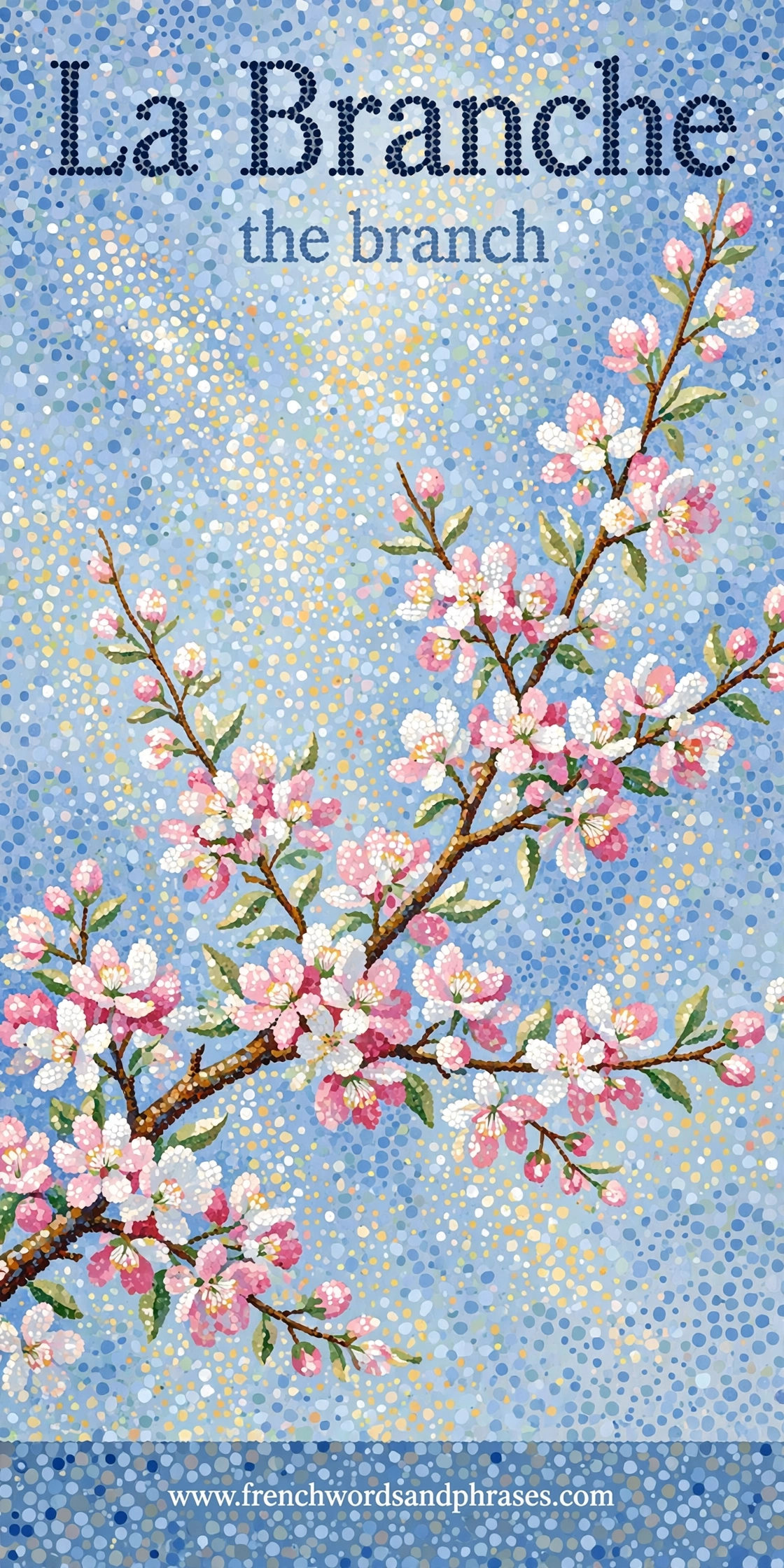
La branche means the branch.
A sparrow lands at the very tip, the whole end dances, and three cherries swing like little bells. Everything in a tree happens out at the edges — on la branche, the tree’s outstretched arm.
In this guide, you’ll learn what branche means in English, how to use it with its articles, how to form its plural, and how it appears in everyday French. Explore French examples, English translations, and practice quizzes.
Understanding the French Noun Branche
Branche is a feminine French noun, learned with its article: la branche, une branche. The plural adds an -s: les branches — and the word reaches far beyond trees, into families, companies and even your glasses.
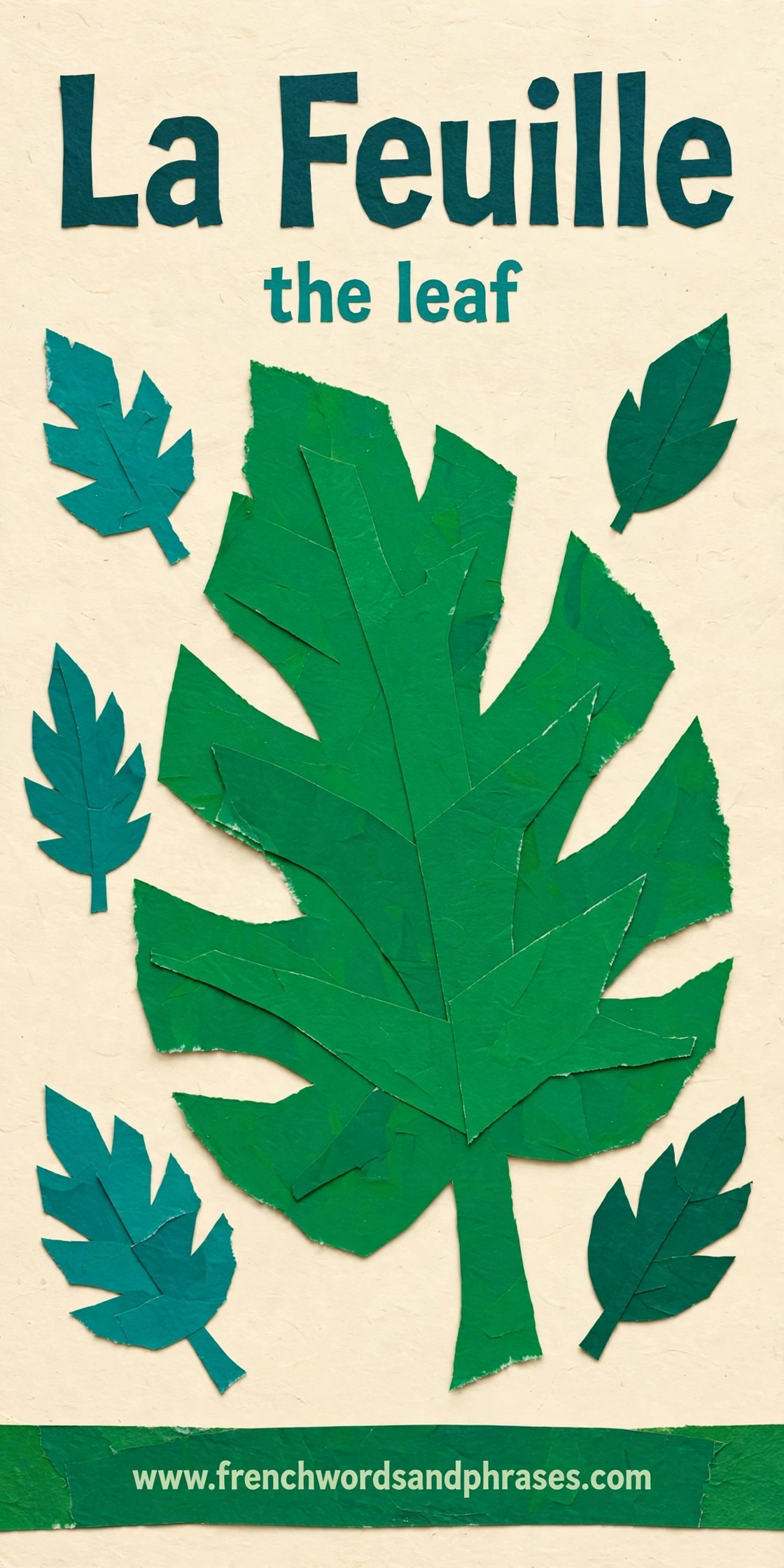
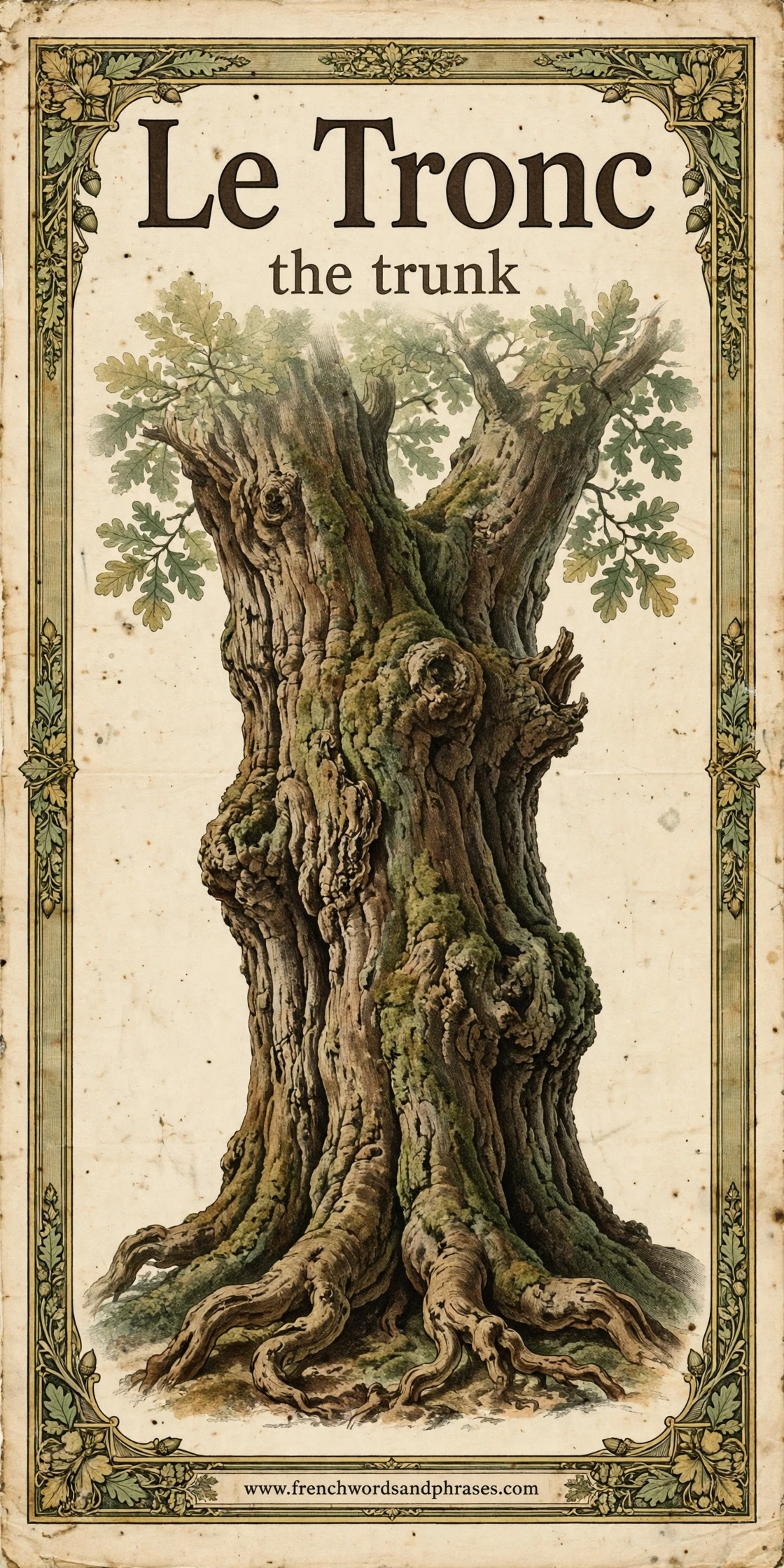
It means the branch — one of the woody arms that grow out of le tronc (the trunk) and carry les feuilles (the leaves), the flowers and the fruit. French also uses branche for a branch of a family or a business, and for the arm of a pair of glasses: une branche de lunettes.
Gender: Feminine
Definite article: la — la branche (the branch)
Indefinite article: une — une branche (a branch)
Plural: les branches
Not the same word: branché (with an accent) means plugged in, or trendy
Also means: a branch of a family or firm; the arm of a pair of glasses
One neighbour word to keep apart: branché, with an accent on the e, is an adjective — a phone that is plugged in, or a person who is trendy and switched-on. La branche is the noun, the branch itself. A telephone can be branché; only a tree grows des branches.
Experience the Word
Branche is more than a part of a tree. It is where the tree meets the world — where blossom opens, fruit ripens and birds hold their morning meetings.
Imagine an orchard in May: branches bowed under white blossom, bees working the length of each one, and a swing hanging from the strongest of them all.
You have not just seen a piece of a tree. You have seen the tree reaching out — feeding, flowering, offering.
How to Use Branche in French: Complete Guide
Let’s explore how branche works in French, beginning with its articles — a feminine noun, from the cherry tree to the family tree.
Branche with the Definite Article (La, Les)
Used for a particular branch — the one holding the nest, the swing, or the best apples.
| Form | French |
|---|---|
| Singular | la branche |
| Plural | les branches |
Example
La branche du cerisier touche presque le sol.
The cherry tree’s branch almost touches the ground.
Branche with the Indefinite Article (Une, Des)
Used for a branch in general — any branch, one branch among many.
| Form | French |
|---|---|
| Singular | une branche |
| Plural | des branches |
Example
Une branche casse sous le poids de la neige.
A branch breaks under the weight of the snow.
Branche with the Partitive and Quantities (Des, Une brassée de…)
Branches are countable, so French gathers them by the armful and the pile rather than taking « some » of them.
| Quantity | French |
|---|---|
| some branches | des branches |
| an armful of branches | une brassée de branches |
| a pile of branches | un tas de branches |
| many branches | beaucoup de branches |
| a single branch | une seule branche |
Example
Le jardinier ramasse des branches après la taille.
The gardener gathers up branches after the pruning.
Quick Quiz 1
Complete the sentence:
______ branche la plus haute porte le nid. (The)
Reveal the answer
La
La branche la plus haute porte le nid.
The highest branch holds the nest — branche is feminine, so the is la.
The Plural of Branche
Branche adds an -s in the plural — les branches, the whole crown of the tree.
| Number | French |
|---|---|
| Singular | la branche |
| Plural | les branches |
Example
Les branches du saule pleureur touchent l’eau.
The weeping willow’s branches touch the water.
Branche with Possessive Adjectives (Ma, Ta, Sa…)
Possessives agree with the noun — branche is feminine, so it takes ma, ta, sa.
| Owner | French |
|---|---|
| my | ma branche |
| your (tu) | ta branche |
| his / her / its | sa branche |
| our | notre branche |
| your (vous) | votre branche |
| their | leur branche |
Example
Le merle chante sur sa branche préférée.
The blackbird is singing on its favourite branch.
Quick Quiz 2
Complete the sentence:
Le pommier étend ______ branches au-dessus de la clôture. (its)
Reveal the answer
ses
Le pommier étend ses branches au-dessus de la clôture.
The apple tree stretches its branches over the fence — ses, the plural of sa.
Branche with Demonstrative Adjectives (Cette, Ces)
Used to point at a branch: cette branche, this branch here.
| Form | French |
|---|---|
| Singular | cette branche |
| Plural | ces branches |
Example
Cette branche morte doit être coupée.
This dead branch must be cut off.
Branche with Adjectives
Adjectives agree with branche — feminine forms, mostly after the noun.
| Adjective | With Branche |
|---|---|
| longue (long) | une longue branche |
| fine (thin) | une branche fine |
| morte (dead) | une branche morte |
| basse (low) | une branche basse |
| fleurie (in blossom) | une branche fleurie |
Example
Une longue branche de glycine grimpe le long du mur.
A long wisteria branch climbs along the wall.
Quick Quiz 3
Complete the sentence:
Cette branche est trop ______ pour porter le hamac. (thin)
Reveal the answer
fine
Cette branche est trop fine pour porter le hamac.
This branch is too thin to hold the hammock.
Everyday Expressions with Branche
Glasses, families and one famous warning — branche reaches well beyond the tree.
| Expression | In English |
|---|---|
| une branche d’arbre | a tree branch |
| une branche de lunettes | an arm of a pair of glasses |
| s’accrocher aux branches | to clutch at branches — to hang on desperately |
| couper la branche sur laquelle on est assis | to cut off the branch you’re sitting on — to shoot yourself in the foot |
| la branche aînée | the elder branch of a family |
| une branche morte | a dead branch |
Example
Il a critiqué son patron en public : il a coupé la branche sur laquelle il était assis.
He criticised his boss in public: he cut off the branch he was sitting on.
Words from the Same Family as Branche
Twigs, plugs and ramifications — the wide family of branche.
| French | In English |
|---|---|
| le rameau | the twig, the small branch |
| le branchage | branches collectively, brushwood |
| branchu | branchy, full of branches |
| se brancher | to plug in, to connect |
| débrancher | to unplug |
| la ramification | the ramification, the branching out |
Example
Un rameau n’est qu’une petite branche.
A rameau is just a small branch.
Quick Quiz 4
What does s’accrocher aux branches mean?
Reveal the answer
To clutch at branches — to hang on desperately when everything is going wrong.
Sans argent et sans travail, il s’accroche aux branches.
With no money and no job, he is hanging on as best he can.
Branche in Everyday French: Real-Life Examples
Now that you know the word, let’s see how branche appears in everyday French.
Example 1 — In the garden
Une branche du pommier est couverte de fleurs.
A branch of the apple tree is covered in blossom.
Example 2 — After the wind
Des branches cassées jonchent le jardin ce matin.
Broken branches are strewn over the garden this morning.
Example 3 — A bird’s perch
Le rouge-gorge chante sur la branche du lilas.
The robin is singing on the lilac branch.
Example 4 — Pruning day
Mon père coupe les branches mortes du rosier.
My father is cutting the dead branches off the rose bush.
Example 5 — At the optician’s
La branche de mes lunettes est cassée.
The arm of my glasses is broken.
Example 6 — The swing
Nous accrochons la balançoire à la grosse branche du chêne.
We’re hanging the swing from the big oak branch.
Beyond Translation: The Meaning of Branche
The branche is France’s favourite picture of connection. Family trees are drawn with branches — la branche aînée, la branche cadette — and peace itself arrives carrying one: le rameau d’olivier, the olive branch. Even knowledge was once drawn as a tree, each science a branch reaching out from one trunk of learning.
To say branche is to name the part that reaches, offers and connects.
It evokes blossom in May and fruit in September, the swing and the nest — and the old warning every French child hears: don’t cut the branch you’re sitting on.
How to Remember the French Noun Branche
Remember it this way: Branche is the branch — feminine: la branche, the tree’s arm reaching out into the light.
- Picture an arm — la branche is the tree’s arm, stretched out to the sun.
- Your glasses wear them too — une branche de lunettes is the arm that hooks over your ear.
- Keep the neighbours apart — branché is plugged in or trendy; la branche grows on trees.
The key idea is la branche — the tree’s outstretched arm.
Test Your Knowledge of Branche
Let’s see how much you’ve learned. Try answering these questions before revealing the answers.
Question 1
Is branche masculine or feminine?
Reveal the answer
Feminine — la branche, une branche.
Question 2
Translate: The branch is covered in blossom.
Reveal the answer
La branche est couverte de fleurs.
Question 3
What is une branche de lunettes?
Reveal the answer
The arm of a pair of glasses — the part that rests on your ear.
Question 4
Complete the sentence:
______ branches du saule touchent l’eau.
Reveal the answer
Les
Les branches du saule touchent l’eau.
The willow’s branches touch the water.
Question 5
What is the difference between branche and branché?
Reveal the answer
Branche is the noun — a branch. Branché is an adjective — plugged in, or trendy.
Your Final Challenge
Can You Use It?
How would you say this in French?
“A branch fell during the storm.”
Reveal the answer
Une branche est tombée pendant la tempête.
A branch fell during the storm.
A little French. A little curiosity. A richer everyday life.
LEARN FRENCH ONE WORD AT A TIME