A French Word to Live By
Translate Bout to English
/bu/
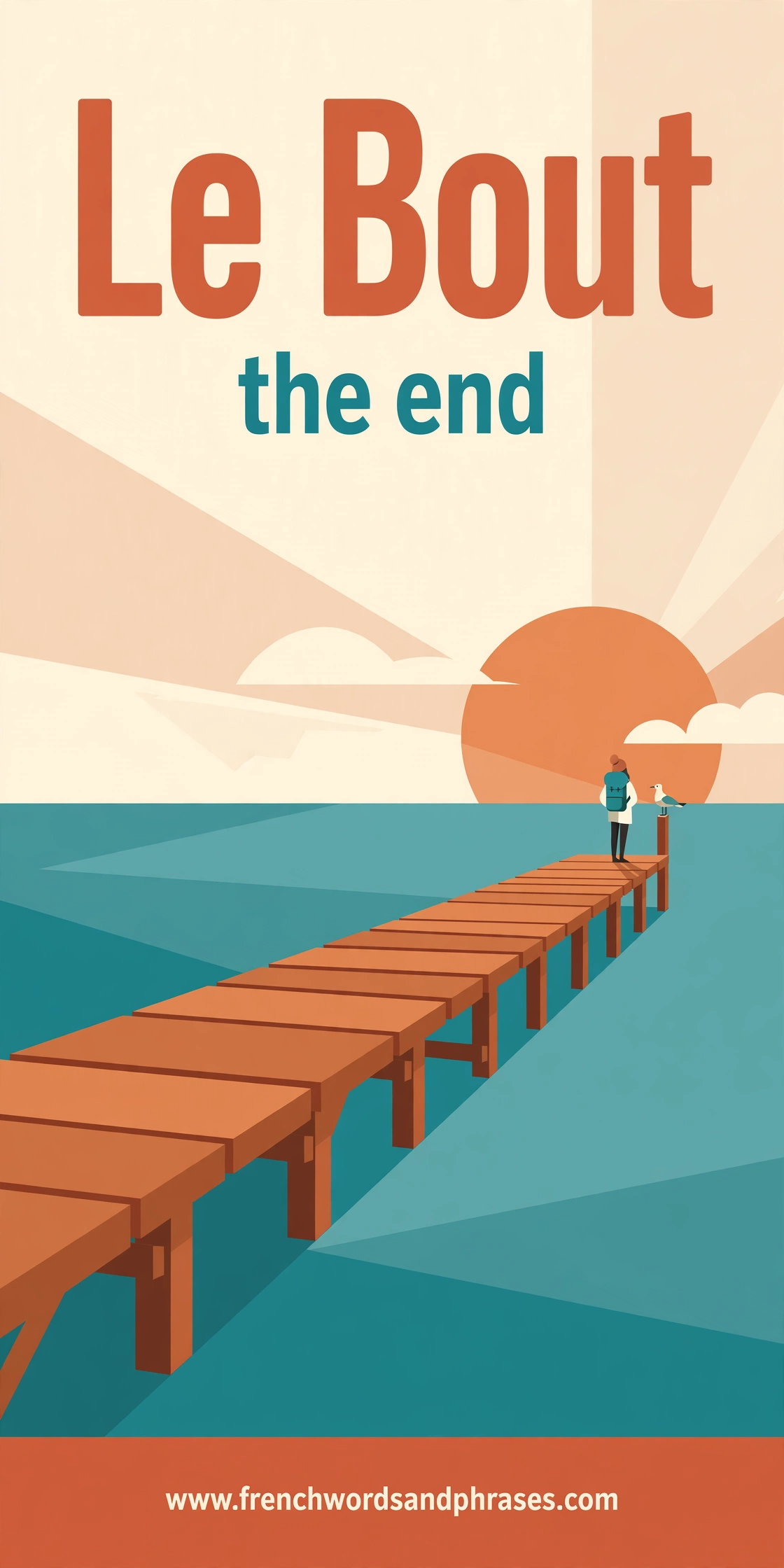
Le Bout means the end.
At the bakery, the assistant holds up the last baguette and asks: « Vous voulez le bout ou le milieu ? » The crusty end piece — some customers fight over it. That end, that tip, that final piece of something long is le bout, one of the hardest-working little words in French.
In this guide, you’ll learn what bout means in English, how to use it with its articles, how to form its plural, and how it appears in everyday French. Explore French examples, English translations, and practice quizzes.
Understanding the French Noun Bout
Bout is a masculine French noun: le bout, un bout. It names the end or tip of something — the end of a street, the tip of a finger, the end piece of a loaf. With de it becomes a measure: un bout de pain, a piece of bread. And it powers a crowd of everyday expressions, from au bout de (at the end of) to venir à bout de (to get the better of).
It means the end — the extremity of something long or extended. Le bout de la rue is the end of the street, le bout du doigt the fingertip, le bout du monde the ends of the earth. Followed by de, it measures out a piece: un bout de ficelle (a piece of string), un bout de chemin (a stretch of the way). Time obeys it too: au bout d’une heure — after an hour, at the end of an hour.
Gender: Masculine — le bout, un bout
Definite article: le — le bout (the end)
Indefinite article: un — un bout (an end; a piece, with de)
Plural: les bouts — a regular plural in -s
Register: Everyday and everywhere — one of the most useful nouns in French
English equivalents: The end, the tip; un bout de… = a piece of…
One important usage detail: au bout de works for space and time alike — au bout de la rue (at the end of the street) and au bout de dix minutes (after ten minutes). And on the telephone, the person you are speaking to is literally au bout du fil — at the end of the line.
Experience the Word
Bout is the word French reaches for whenever something runs out — of road, of string, of patience. It is modest and physical: you can hold un bout de ficelle in your hand, stand au bout du quai waving at a train, or chew le bout d’un crayon while you think. Few nouns travel so easily from the kitchen table to the map of the world.
It also measures endurance. To be à bout de souffle is to be out of breath; à bout de nerfs, at the end of your tether; au bout du rouleau, at the end of your resources. French draws the line of human limits with this one small word — the bout is where things finish, including us.
Yet the bout is not only an ending. Venir à bout de quelque chose — to come to the end of a difficulty — means to overcome it, to finish the monster off. Every long task has its bout, and reaching it is the whole story of effort.
How to Use Bout in French: Complete Guide
Let’s explore how bout works in French, beginning with its articles — masculine, regular, and endlessly useful.
Bout with the Definite Article (Le, Les)
Bout is masculine: le bout for the end in question, les bouts for both ends.
| Form | French |
|---|---|
| Masculine singular | le bout |
| Plural | les bouts |
| Both ends | les deux bouts — the two ends |
Example
Le bout de la rue est fermé pour travaux.
The end of the street is closed for roadworks.
Bout with the Indefinite Article (Un, Des)
Un bout alone is an end; un bout de plus a noun is a piece of something.
| Form | French |
|---|---|
| Masculine singular | un bout |
| Plural | des bouts |
| A piece of | un bout de pain — a piece of bread |
Example
Il reste un bout de fromage dans le frigo.
There is a piece of cheese left in the fridge.
Bout with Partitive and Quantities
This is bout’s home ground: un bout de measures out pieces — of bread, of string, of road, of time.
| Quantity | French |
|---|---|
| A piece of bread | un bout de pain |
| A piece of string | un bout de ficelle |
| A piece of wood | un bout de bois |
| A stretch of the way | un bout de chemin |
| A little piece of paper | un petit bout de papier |
Example
Elle a fait un bout de chemin avec nous.
She walked a stretch of the way with us.
Quick Quiz 1
Complete the sentence:
La pharmacie est ______ de la rue. (at the end of)
Reveal the answer
au bout
La pharmacie est au bout de la rue.
The pharmacy is at the end of the street.
The Plural of Bout
The plural adds a simple -s: les bouts — think of a rope, which has two.
| Number | French |
|---|---|
| Singular | le bout / un bout |
| Plural | les bouts / des bouts |
Example
Il tient les deux bouts de la corde.
He is holding both ends of the rope.
Bout with Possessive Adjectives (Mon, Ton, Son…)
Possessives usually arrive with a de-phrase attached — mon bout de pain, son bout de jardin.
| Owner | French |
|---|---|
| My | mon bout de pain |
| Your (tu) | ton bout de table |
| His / Her | son bout de jardin |
| Our | notre bout de chemin |
| Your (vous) | votre bout de ficelle |
| Their | leur bout de terrain |
Example
Chacun garde son bout de jardin bien propre.
Everyone keeps their own end of the garden tidy.
Quick Quiz 2
What does « au bout du fil » mean on the telephone?
Reveal the answer
At the other end of the line — the person you are talking to.
Il y a quelqu’un au bout du fil pour toi.
There is someone on the line for you.
Bout with Demonstrative Adjectives (Ce, Ces)
Ce bout points at one end; ces bouts at several — joiners and bakers use them all day.
| Form | French |
|---|---|
| This | ce bout |
| These | ces bouts |
| That one over there | ce bout-là |
Example
Ce bout de la baguette est pour moi !
This end of the baguette is for me!
Bout with Adjectives
Adjectives agree with masculine bout — petit bout is the phrase every French child hears.
| Adjective | With Bout |
|---|---|
| Little | un petit bout |
| Other | l’autre bout |
| Big, thick | un gros bout |
| Last | le dernier bout |
| Long | un long bout de chemin |
Example
Il ne reste qu’un petit bout de tarte.
Only a little piece of tart is left.
Quick Quiz 3
What does « venir à bout de » mean?
Reveal the answer
To overcome, to get through, to finish off — to come to the end of a difficulty.
Elle est venue à bout du problème.
She got the better of the problem.
Everyday Expressions with Bout
Bout finishes half the expressions in spoken French — learn these and you will hear it everywhere.
| Expression | In English |
|---|---|
| au bout de | at the end of; after (a time) |
| au bout du fil | on the line (telephone) |
| à bout de souffle | out of breath |
| venir à bout de | to overcome, to get through |
| le bout du monde | the ends of the earth |
| un bout de chou | a little cutie (a small child) |
Example
Au bout d’une heure, le train est enfin arrivé.
After an hour, the train finally arrived.
Words from the Same Family as Bout
The family is about finishing: verbs of ending up, outcomes, and even standing upright.
| French | In English |
|---|---|
| aboutir | to end up, to lead to |
| l’aboutissement | the outcome, the culmination |
| un embout | a tip, a nozzle, an end fitting |
| mettre bout à bout | to put end to end |
| debout | standing — from de + bout, standing on end |
| au bout du tunnel | at the end of the tunnel (seeing the light) |
Example
Après des mois de travail, le projet arrive à son aboutissement.
After months of work, the project is reaching its outcome.
Quick Quiz 4
Complete the sentence:
Après la course, il est à ______ de souffle. (out of)
Reveal the answer
bout
Après la course, il est à bout de souffle.
After the race, he is out of breath.
Bout in Everyday French: Real-Life Examples
Now that you know the word, let’s see how bout appears in everyday French.
Example 1 — At the bakery
Je prendrai le bout de la baguette, il est plus croustillant.
I’ll take the end of the baguette, it’s crispier.
Example 2 — On the road
Au bout de la rue, tournez à gauche.
At the end of the street, turn left.
Example 3 — On the telephone
Il y a un monsieur au bout du fil qui demande le directeur.
There is a gentleman on the line asking for the manager.
Example 4 — After the climb
Arrivés en haut, ils étaient à bout de souffle.
When they reached the top, they were out of breath.
Example 5 — With a toddler
Quel adorable bout de chou !
What an adorable little cutie!
Example 6 — Finishing the job
À deux, nous sommes venus à bout du déménagement.
Together, we got through the move.
Beyond Translation: The Meaning of Bout
Bout is a philosophy in one syllable. French uses the same word for the end of a baguette and the end of the world, for a piece of string and the limit of your strength. It teaches a way of seeing: everything extended — roads, ropes, days, lives — has a bout, and life is largely the art of reaching it well: au bout du chemin, au bout du fil, au bout du rouleau. Small word, whole landscape.
How to Remember the French Noun Bout
Remember it this way: Bout is the end — of the street, of the rope, of the baguette. Picture the crusty end piece everyone wants, and remember it is masculine: le bout, un bout.
- You reach the end of the street — au bout de la rue.
- You cut a piece of string — un bout de ficelle, a piece of string.
- You finish a hard task — venir à bout de, to come to the end of it, to overcome it.
The key idea is le bout — the end, and a piece of anything long.
Test Your Knowledge of Bout
Let’s see how much you’ve learned. Try answering these questions before revealing the answers.
Question 1
Is bout masculine or feminine?
Reveal the answer
Masculine — le bout, un bout.
Question 2
How do you say “a piece of bread”?
Reveal the answer
Un bout de pain — bout de measures out a piece.
Question 3
What does « au bout de dix minutes » mean?
Reveal the answer
After ten minutes — au bout de works for time as well as space.
Question 4
What is « un bout de chou »?
Reveal the answer
A term of endearment for a small child — literally a little end of cabbage.
Question 5
How do you say “both ends of the rope”?
Reveal the answer
Les deux bouts de la corde.
Your Final Challenge
Can You Use It?
How would you say this in French?
“At the end of the street, there is a bakery.”
Reveal the answer
Au bout de la rue, il y a une boulangerie.
At the end of the street, there is a bakery.
A little French. A little curiosity. A richer everyday life.
LEARN FRENCH ONE WORD AT A TIME