A French Word to Live By
How to Conjugate Bouler in French
/bu.le/
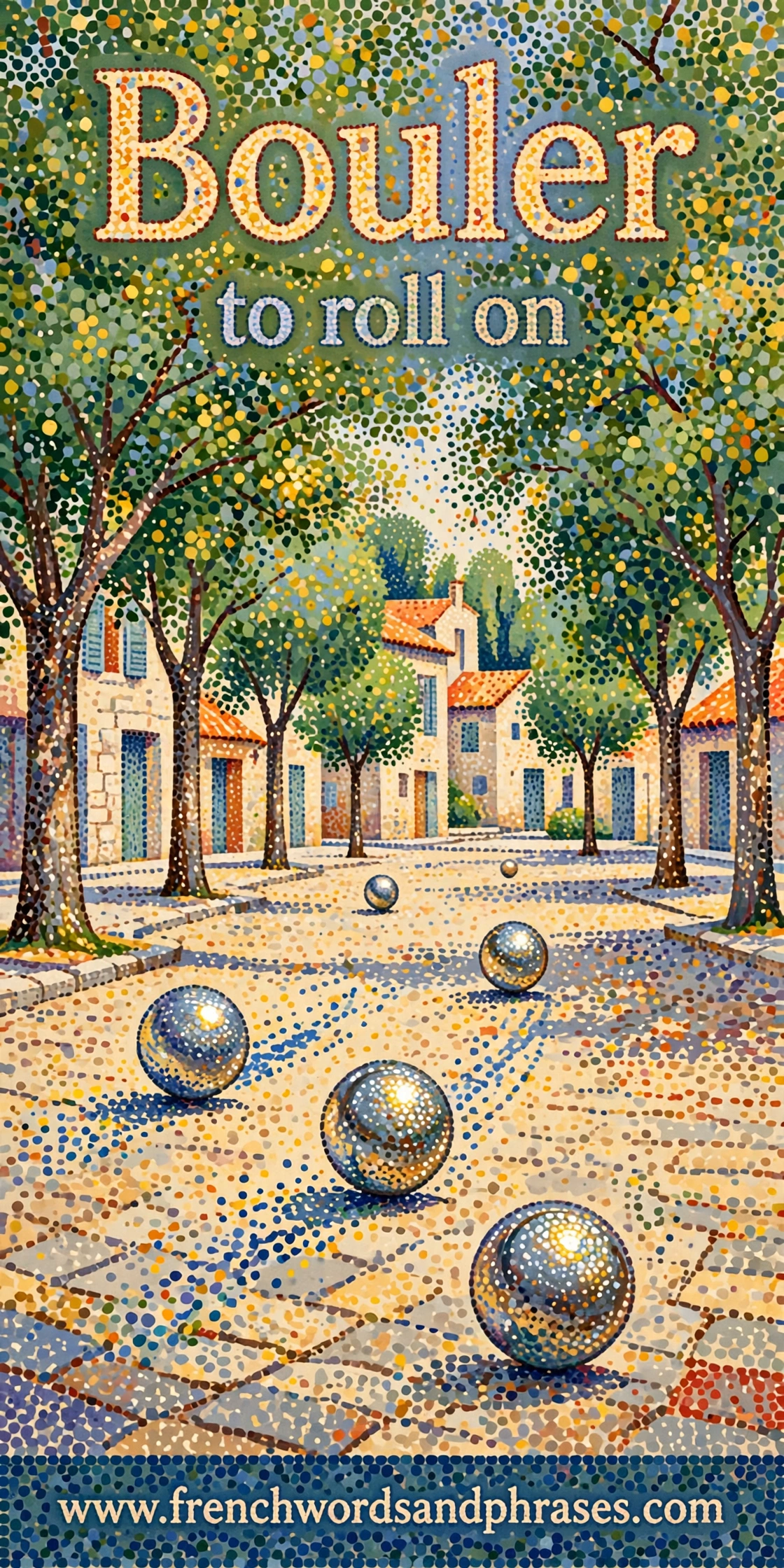
Bouler means to roll on — to keep rolling along like a ball, and in the south of France it is the very verb of pétanque: to throw the boule.
A marble escaping across the playground, a steel ball arcing through the Provençal sun towards the little jack — bouler is the verb of the rolling ball: whatever is round and moving boul(e), from a child’s game to the national sport of the village square.
In this guide, you’ll learn how to conjugate bouler in all the major French tenses and moods. Explore complete conjugation tables, French examples, English translations, and practice quizzes.
Understanding the French Verb Bouler
Bouler is a regular French verb belonging to the first group of verbs, those ending in-er.
It means to roll on. It is used of balls and round things rolling, in games of bowls and pétanque for delivering the boule, and occasionally, in familiar speech, for things rolling along smoothly — un projet qui boule, a project that is rolling nicely.
Verb classification: First group (-er)
Auxiliary verb: Avoir
Past participle: boulé
Present participle: boulant
English equivalents: To roll, to roll on; une boule — a ball, a bowl; bouler une boule — to roll a bowl (at pétanque); ça boule — it is rolling along nicely; rouler is the everyday verb for rolling — bouler belongs to balls, bowls and games.
One important detail: bouler is simply the verb of une boule, a ball, and it is perfectly regular: je boule, nous boulons, ils boulent, past participle boulé. It is narrower than rouler: rouler is the general verb of rolling (cars, stones, life itself), while bouler keeps the round object in view — marbles, bowls, pétanque boules. In Provence, tu boules ou tu pointes ? belongs to the same family of play.
Experience the Word
Bouler is the verb of the ball that will not stop — round, heavy and faithful to its line until friction or a better player says otherwise.
Imagine the village square at six in the evening. The old men are at pétanque; Marcel steps into the circle, swings his arm low and boule — the steel ball rolls, slows, kisses the little jack and stops dead, and the whole square applauds.
It was not thrown and it was not pushed. It rolled — boulé, smooth and true, all the way to the jack.
How to Conjugate Bouler: Complete French Conjugation Guide
Let’s explore every major conjugation of bouler, beginning with the indicative mood.
How to Conjugate Bouler in the Indicative Mood
The indicative mood is used to express facts, observations, actions, and events.
How to Conjugate Bouler in the Present Tense (Présent)
Used for actions happening now, habitual actions, and general truths.
| Subject | Conjugation |
|---|---|
| je | boule |
| tu | boules |
| il / elle | boule |
| nous | boulons |
| vous | boulez |
| ils / elles | boulent |
Example
La bille boule jusqu’au bord du trottoir.
The marble rolls all the way to the edge of the pavement.
Quick Quiz 1
Complete the sentence:
Nous ______ des billes dans la cour.
Reveal the answer
boulons
Nous boulons des billes dans la cour.
We are rolling marbles in the yard.
How to Conjugate Bouler in the Passé Composé
Used for completed actions in the past. Bouler takes the auxiliary verb avoir.
| Subject | Conjugation |
|---|---|
| j’ | ai boulé |
| tu | as boulé |
| il / elle | a boulé |
| nous | avons boulé |
| vous | avez boulé |
| ils / elles | ont boulé |
Example
Il a boulé sa dernière boule tout près du cochonnet.
He rolled his last bowl right next to the jack.
How to Conjugate Bouler in the Imparfait (Imperfect Tense)
Used for habitual past actions, descriptions, and ongoing situations in the past.
| Subject | Conjugation |
|---|---|
| je | boulais |
| tu | boulais |
| il / elle | boulait |
| nous | boulions |
| vous | bouliez |
| ils / elles | boulaient |
Example
Enfant, nous boulions des billes dans la cour de récréation.
As children, we used to roll marbles in the playground.
Quick Quiz 2
Choose the correct form:
The stone rolled to the bottom of the slope.
La pierre ______ jusqu’au bas de la pente. (a boulé / est boulée)
Reveal the answer
a boulé
La pierre a boulé jusqu’au bas de la pente.
Bouler takes avoir.
How to Conjugate Bouler in the Plus-que-parfait
Used to describe an action that had already been completed before another past event.
| Subject | Conjugation |
|---|---|
| j’ | avais boulé |
| tu | avais boulé |
| il / elle | avait boulé |
| nous | avions boulé |
| vous | aviez boulé |
| ils / elles | avaient boulé |
Example
La pierre avait boulé jusqu’au bas de la pente.
The stone had rolled to the bottom of the slope.
How to Conjugate Bouler in the Passé Simple
Primarily used in formal writing, literature, and historical narratives. It is rarely used in everyday conversation.
| Subject | Conjugation |
|---|---|
| je | boulai |
| tu | boulas |
| il / elle | boula |
| nous | boulâmes |
| vous | boulâtes |
| ils / elles | boulèrent |
Example
La boule boula doucement et s’arrêta contre le cochonnet.
The bowl rolled gently and stopped against the jack.
How to Conjugate Bouler in the Passé Antérieur
A literary tense used to express an action completed immediately before another past action, generally in the passé simple.
| Subject | Conjugation |
|---|---|
| j’ | eus boulé |
| tu | eus boulé |
| il / elle | eut boulé |
| nous | eûmes boulé |
| vous | eûtes boulé |
| ils / elles | eurent boulé |
Example
Quand la bille eut boulé sous le banc, l’enfant la chercha partout.
When the marble had rolled under the bench, the child looked for it everywhere.
How to Conjugate Bouler in the Future Tense (Futur Simple)
Used to describe actions that will take place in the future.
| Subject | Conjugation |
|---|---|
| je | boulerai |
| tu | bouleras |
| il / elle | boulera |
| nous | boulerons |
| vous | boulerez |
| ils / elles | bouleront |
Example
Demain, nous boulerons sur la place du village.
Tomorrow, we will play bowls in the village square.
How to Conjugate Bouler in the Futur Antérieur (Future Perfect)
Used for an action that will have been completed before a particular point in the future.
| Subject | Conjugation |
|---|---|
| j’ | aurai boulé |
| tu | auras boulé |
| il / elle | aura boulé |
| nous | aurons boulé |
| vous | aurez boulé |
| ils / elles | auront boulé |
Example
À la fin de la partie, il aura boulé vingt boules.
By the end of the game, he will have rolled twenty bowls.
How to Conjugate Bouler in the Near Future (Futur Proche)
Used to describe something that is going to happen soon. Formed with aller + infinitive.
| Subject | Conjugation |
|---|---|
| je | vais bouler |
| tu | vas bouler |
| il / elle | va bouler |
| nous | allons bouler |
| vous | allez bouler |
| ils / elles | vont bouler |
Example
Attention, la balle va bouler sous la voiture.
Careful, the ball is going to roll under the car.
How to Conjugate Bouler in the Conditional Mood
The conditional mood expresses what would happen under certain circumstances. It is also frequently used to make polite requests or express wishes.
How to Conjugate Bouler in the Present Conditional
| Subject | Conjugation |
|---|---|
| je | boulerais |
| tu | boulerais |
| il / elle | boulerait |
| nous | boulerions |
| vous | bouleriez |
| ils / elles | bouleraient |
Example
Avec plus d’élan, la boule boulerait jusqu’au fond.
With more swing, the bowl would roll to the very end.
How to Conjugate Bouler in the Past Conditional
| Subject | Conjugation |
|---|---|
| j’ | aurais boulé |
| tu | aurais boulé |
| il / elle | aurait boulé |
| nous | aurions boulé |
| vous | auriez boulé |
| ils / elles | auraient boulé |
Example
Elle aurait boulé plus loin sans ce caillou.
It would have rolled further without that pebble.
Bouler in the Literary Past Conditional Form
This less common literary form uses the imperfect subjunctive of avoir.
| Subject | Conjugation |
|---|---|
| j’ | eusse boulé |
| tu | eusses boulé |
| il / elle | eût boulé |
| nous | eussions boulé |
| vous | eussiez boulé |
| ils / elles | eussent boulé |
Example
La pierre eût boulé jusqu’à la rivière sans la haie.
The stone would have rolled as far as the river without the hedge.
How to Conjugate Bouler in the Subjunctive Mood
The subjunctive is used to express wishes, emotions, doubts, necessity, and uncertainty. It frequently follows expressions such as il faut que (it is necessary that) or bien que (although).
How to Conjugate Bouler in the Present Subjunctive
| Subject | Conjugation |
|---|---|
| que je | boule |
| que tu | boules |
| qu’il / qu’elle | boule |
| que nous | boulions |
| que vous | bouliez |
| qu’ils / qu’elles | boulent |
Example
Il faut que tu boules doucement, sans forcer.
You must roll it gently, without forcing.
Quick Quiz 3
Complete the sentence using the subjunctive:
Il faut que vous ______ sans forcer le geste.
Reveal the answer
bouliez
Il faut que vous bouliez sans forcer le geste.
You must roll without forcing the movement.
How to Conjugate Bouler in the Imperfect Subjunctive
A literary tense, rarely encountered in modern spoken French.
| Subject | Conjugation |
|---|---|
| que je | boulasse |
| que tu | boulasses |
| qu’il / qu’elle | boulât |
| que nous | boulassions |
| que vous | boulassiez |
| qu’ils / qu’elles | boulassent |
Example
On attendait que le joueur boulât sa dernière boule.
Everyone waited for the player to roll his last bowl.
How to Conjugate Bouler in the Pluperfect Subjunctive
A literary construction used to express an action completed before another past action.
| Subject | Conjugation |
|---|---|
| que j’ | eusse boulé |
| que tu | eusses boulé |
| qu’il / qu’elle | eût boulé |
| que nous | eussions boulé |
| que vous | eussiez boulé |
| qu’ils / qu’elles | eussent boulé |
Example
On racontait que la pierre eût boulé toute seule dans la nuit.
People said the stone had rolled all by itself in the night.
How to Conjugate Bouler in the Past Subjunctive
| Subject | Conjugation |
|---|---|
| que j’ | aie boulé |
| que tu | aies boulé |
| qu’il / qu’elle | ait boulé |
| que nous | ayons boulé |
| que vous | ayez boulé |
| qu’ils / qu’elles | aient boulé |
Example
Je suis content que tu aies boulé si près du but.
I am glad you rolled so close to the target.
How to Conjugate Bouler in the Imperative
The imperative is used to give commands, instructions, invitations, or suggestions. Subject pronouns are omitted.
How to Conjugate Bouler in the Present Imperative
| Person | Conjugation |
|---|---|
| (tu) | boule |
| (nous) | boulons |
| (vous) | boulez |
Example
Boule doucement, le cochonnet est tout près !
Roll it gently, the jack is very close!
Quick Quiz 4
How would you say Roll it gently (tu form)?
Reveal the answer
Boule doucement !
French Participles of Bouler
Participles are verb forms that can be used in compound tenses and other grammatical constructions.
Present Participle of Bouler
boulant
En boulant vers le cochonnet, la boule a frôlé celle de l’adversaire.
Rolling towards the jack, the bowl brushed the opponent’s.
Past Participle of Bouler
boulé
Boulée avec précision, la boule s’est arrêtée au millimètre près.
Rolled with precision, the bowl stopped to the nearest millimetre.
Bouler in Everyday French: Real-Life Examples
Now that you know the conjugations, let’s see how bouler appears in everyday French.
Example 1 — Present
La bille boule jusqu’au trottoir.
The marble rolls as far as the pavement.
Example 2 — Passé composé
Il a boulé tout près du cochonnet.
He rolled right next to the jack.
Example 3 — Imparfait
Nous boulions des billes à la récréation.
We used to roll marbles at break time.
Example 4 — Future
Demain, nous boulerons sur la place.
Tomorrow, we will play bowls in the square.
Example 5 — Conditional
Avec plus d’élan, elle boulerait plus loin.
With more swing, it would roll further.
Example 6 — Imperative
Boule doucement !
Roll it gently!
Beyond Translation: The Meaning of Bouler
English bowl — the game and the ball — is this very word, boule, borrowed centuries ago; French bouler is what the English bowler does.
Every boule wants to bouler.
The word stays close to its round mother: marbles, bowls, snowballs, even the round loaf called une boule de pain — where English separates ball, bowl and roll, French keeps one family turning together.
How to Remember the French Verb Bouler
Remember it this way: Bouler is about the steel boule rolling across the village square towards the jack.
- The verb of une boule: if it is round and it rolls, it boule.
- Narrower than rouler: bouler is for balls, marbles and pétanque bowls.
- Regular -er: je boule, nous boulons, past participle boulé.
The key idea is the steel boule rolling across the village square towards the jack.
Test Your Knowledge of Bouler
Let’s see how much you’ve learned. Try answering these questions before revealing the answers.
Question 1
How does bouler differ from rouler?
Reveal the answer
Rouler is the general verb of rolling; bouler keeps the ball in view — marbles, bowls and pétanque boules.
Question 2
How do you say He rolled his last bowl right next to the jack in French?
Reveal the answer
Il a boulé sa dernière boule tout près du cochonnet.
Question 3
Translate: The marble rolls all the way to the edge of the pavement.
Reveal the answer
La bille boule jusqu’au bord du trottoir.
Question 4
What is the past participle of bouler?
Reveal the answer
Boulé.
Question 5
Complete the sentence:
Il faut que tu ______ doucement, sans forcer.
Reveal the answer
boules
Il faut que tu boules doucement, sans forcer.
You must roll it gently, without forcing.
Your Final Challenge
Can You Use It?
How would you say this in French?
The last bowl rolls slowly through the evening dust, and the whole village holds its breath.
Reveal the answer
La dernière boule boule lentement dans la poussière du soir, et tout le village retient son souffle.
The last bowl rolls slowly through the evening dust, and the whole village holds its breath.
A little French. A little curiosity. A richer everyday life.
LEARN FRENCH ONE WORD AT A TIME