
A French Word to Live By
How to Conjugate Bouillir in French
/bu.jiʁ/
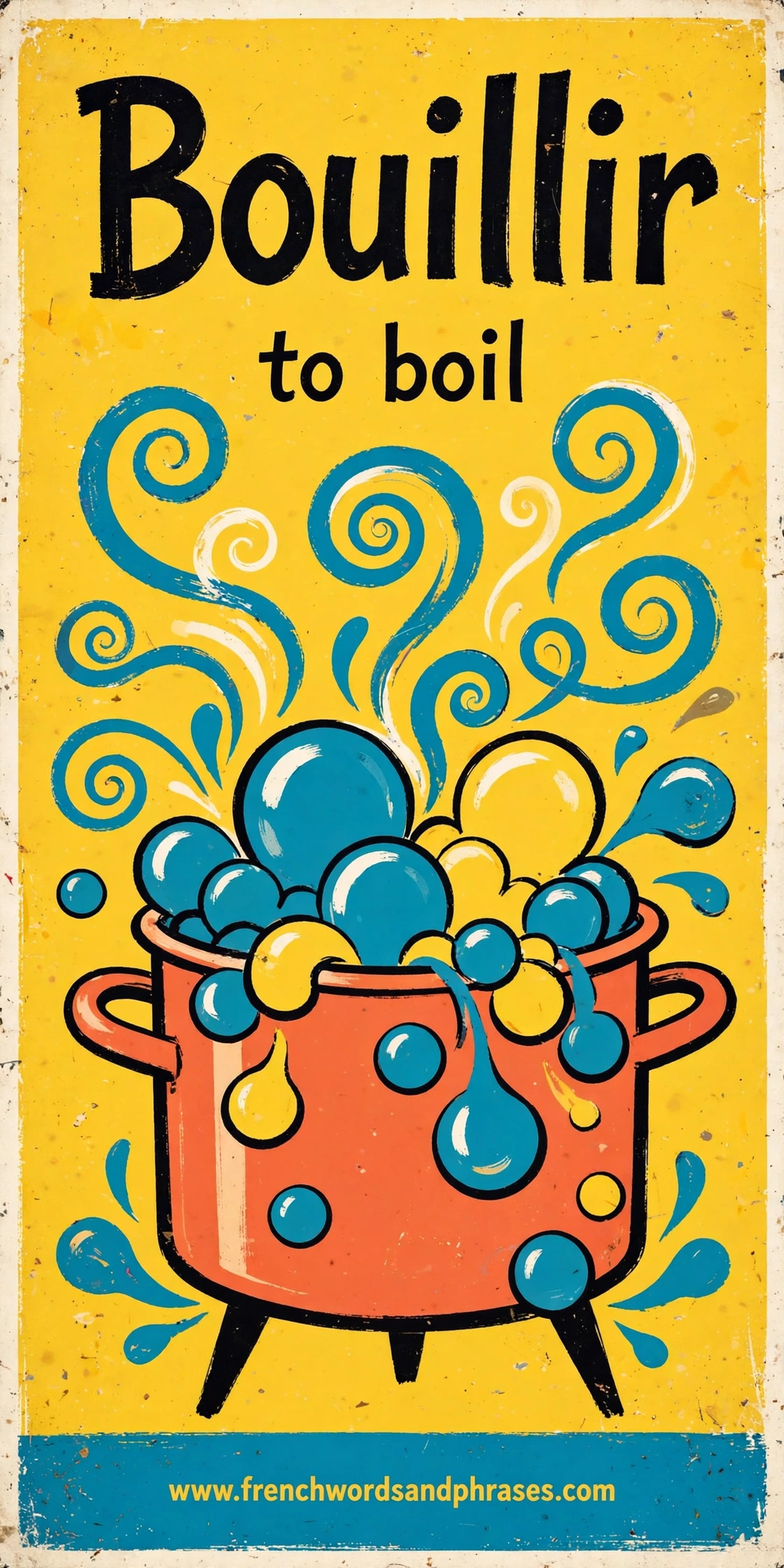
Bouillir means to boil.
A kettle singing on the stove, pasta water rolling at a full boil, milk rising dangerously in the pan — bouillir is the verb of water at one hundred degrees, and of everything that bubbles with it.
In this guide, you’ll learn how to conjugate bouillir in all the major French tenses and moods. Explore complete conjugation tables, French examples, English translations, and practice quizzes.
Understanding the French Verb Bouillir
Bouillir is an irregular French verb ending in -ir.
It means to boil. It is commonly used for water, milk, soup and stock coming to the boil (l’eau bout, faire bouillir l’eau), and figuratively for people seething (bouillir d’impatience, bouillir de colère).
Verb classification: Irregular (-ir)
Auxiliary verb: Avoir
Past participle: bouilli
Present participle: bouillant
English equivalents: To boil, to come to the boil; (figurative) to seethe, to boil with impatience or anger.
One important detail: bouillir changes its stem in the singular of the present tense. The -ill- melts away and leaves bou-: je bous, tu bous, il bout. The plural keeps the full stem: nous bouillons, vous bouillez, ils bouillent. The future is built on the whole infinitive (je bouillirai), and the past participle is bouilli. Note too that French cooks usually say faire bouillir l’eau — to bring the water to the boil — when a person does the heating.
Experience the Word
Bouillir is the verb of the watched pot — the moment still water breaks into bubbles and the kitchen fills with steam.
Imagine a farmhouse kitchen in winter. The big pot sits on the stove, the lid begins to dance, and the first bubbles race to the surface: ça bout. Dinner is on its way.
You have not just heated water. You have brought it to the boil — the point where cooking truly begins.
How to Conjugate Bouillir: Complete French Conjugation Guide
Let’s explore every major conjugation of bouillir, beginning with the indicative mood.
How to Conjugate Bouillir in the Indicative Mood
The indicative mood is used to express facts, observations, actions, and events.
How to Conjugate Bouillir in the Present Tense (Présent)
Used for actions happening now, habitual actions, and general truths.
| Subject | Conjugation |
|---|---|
| je | bous |
| tu | bous |
| il / elle | bout |
| nous | bouillons |
| vous | bouillez |
| ils / elles | bouillent |
Example
L’eau bout dans la bouilloire.
The water is boiling in the kettle.
Quick Quiz 1
Complete the sentence:
Nous ______ l’eau pour le thé.
Reveal the answer
bouillons
Nous bouillons l’eau pour le thé.
We are boiling the water for the tea.
How to Conjugate Bouillir in the Passé Composé
Used for completed actions in the past. Bouillir takes the auxiliary verb avoir.
| Subject | Conjugation |
|---|---|
| j’ | ai bouilli |
| tu | as bouilli |
| il / elle | a bouilli |
| nous | avons bouilli |
| vous | avez bouilli |
| ils / elles | ont bouilli |
Example
L’eau a bouilli pendant dix minutes.
The water boiled for ten minutes.
How to Conjugate Bouillir in the Imparfait (Imperfect Tense)
Used for habitual past actions, descriptions, and ongoing situations in the past.
| Subject | Conjugation |
|---|---|
| je | bouillais |
| tu | bouillais |
| il / elle | bouillait |
| nous | bouillions |
| vous | bouilliez |
| ils / elles | bouillaient |
Example
La soupe bouillait doucement sur le feu.
The soup was bubbling gently on the stove.
Quick Quiz 2
Choose the correct form:
The water has boiled.
L’eau ______ . (a bouilli / est bouillie)
Reveal the answer
a bouilli
L’eau a bouilli.
Bouillir takes avoir in the passé composé.
How to Conjugate Bouillir in the Plus-que-parfait
Used to describe an action that had already been completed before another past event.
| Subject | Conjugation |
|---|---|
| j’ | avais bouilli |
| tu | avais bouilli |
| il / elle | avait bouilli |
| nous | avions bouilli |
| vous | aviez bouilli |
| ils / elles | avaient bouilli |
Example
Le lait avait bouilli avant que je revienne dans la cuisine.
The milk had boiled before I came back into the kitchen.
How to Conjugate Bouillir in the Passé Simple
Primarily used in formal writing, literature, and historical narratives. It is rarely used in everyday conversation.
| Subject | Conjugation |
|---|---|
| je | bouillis |
| tu | bouillis |
| il / elle | bouillit |
| nous | bouillîmes |
| vous | bouillîtes |
| ils / elles | bouillirent |
Example
L’eau bouillit en quelques minutes.
The water boiled within a few minutes.
How to Conjugate Bouillir in the Passé Antérieur
A literary tense used to express an action completed immediately before another past action, generally in the passé simple.
| Subject | Conjugation |
|---|---|
| j’ | eus bouilli |
| tu | eus bouilli |
| il / elle | eut bouilli |
| nous | eûmes bouilli |
| vous | eûtes bouilli |
| ils / elles | eurent bouilli |
Example
Quand l’eau eut bouilli, il versa le café moulu.
When the water had boiled, he poured in the ground coffee.
How to Conjugate Bouillir in the Future Tense (Futur Simple)
Used to describe actions that will take place in the future.
| Subject | Conjugation |
|---|---|
| je | bouillirai |
| tu | bouilliras |
| il / elle | bouillira |
| nous | bouillirons |
| vous | bouillirez |
| ils / elles | bouilliront |
Example
L’eau bouillira dans cinq minutes.
The water will boil in five minutes.
How to Conjugate Bouillir in the Futur Antérieur (Future Perfect)
Used for an action that will have been completed before a particular point in the future.
| Subject | Conjugation |
|---|---|
| j’ | aurai bouilli |
| tu | auras bouilli |
| il / elle | aura bouilli |
| nous | aurons bouilli |
| vous | aurez bouilli |
| ils / elles | auront bouilli |
Example
À sept heures, l’eau aura bouilli et le thé sera prêt.
By seven o’clock, the water will have boiled and the tea will be ready.
How to Conjugate Bouillir in the Near Future (Futur Proche)
Used to describe something that is going to happen soon. Formed with aller + infinitive.
| Subject | Conjugation |
|---|---|
| je | vais bouillir |
| tu | vas bouillir |
| il / elle | va bouillir |
| nous | allons bouillir |
| vous | allez bouillir |
| ils / elles | vont bouillir |
Example
Attention, le lait va bouillir !
Careful, the milk is about to boil!
How to Conjugate Bouillir in the Conditional Mood
The conditional mood expresses what would happen under certain circumstances. It is also frequently used to make polite requests or express wishes.
How to Conjugate Bouillir in the Present Conditional
| Subject | Conjugation |
|---|---|
| je | bouillirais |
| tu | bouillirais |
| il / elle | bouillirait |
| nous | bouillirions |
| vous | bouilliriez |
| ils / elles | bouilliraient |
Example
À cette altitude, l’eau bouillirait à moins de cent degrés.
At this altitude, water would boil at less than a hundred degrees.
How to Conjugate Bouillir in the Past Conditional
| Subject | Conjugation |
|---|---|
| j’ | aurais bouilli |
| tu | aurais bouilli |
| il / elle | aurait bouilli |
| nous | aurions bouilli |
| vous | auriez bouilli |
| ils / elles | auraient bouilli |
Example
Le bouillon aurait bouilli plus vite avec un couvercle.
The stock would have boiled faster with a lid.
Bouillir in the Literary Past Conditional Form
This less common literary form uses the imperfect subjunctive of avoir.
| Subject | Conjugation |
|---|---|
| j’ | eusse bouilli |
| tu | eusses bouilli |
| il / elle | eût bouilli |
| nous | eussions bouilli |
| vous | eussiez bouilli |
| ils / elles | eussent bouilli |
Example
Il eût bouilli d’impatience en attendant la réponse.
He would have been seething with impatience while waiting for the answer.
How to Conjugate Bouillir in the Subjunctive Mood
The subjunctive is used to express wishes, emotions, doubts, necessity, and uncertainty. It frequently follows expressions such as il faut que (it is necessary that) or bien que (although).
How to Conjugate Bouillir in the Present Subjunctive
| Subject | Conjugation |
|---|---|
| que je | bouille |
| que tu | bouilles |
| qu’il / qu’elle | bouille |
| que nous | bouillions |
| que vous | bouilliez |
| qu’ils / qu’elles | bouillent |
Example
Il faut que l’eau bouille avant d’ajouter les pâtes.
The water must boil before you add the pasta.
Quick Quiz 3
Complete the sentence using the subjunctive:
Il faut que la soupe ______ doucement.
Reveal the answer
bouille
Il faut que la soupe bouille doucement.
The soup must boil gently.
How to Conjugate Bouillir in the Imperfect Subjunctive
A literary tense, rarely encountered in modern spoken French.
| Subject | Conjugation |
|---|---|
| que je | bouillisse |
| que tu | bouillisses |
| qu’il / qu’elle | bouillît |
| que nous | bouillissions |
| que vous | bouillissiez |
| qu’ils / qu’elles | bouillissent |
Example
Elle attendait que la soupe bouillît avant de la servir.
She was waiting for the soup to come to the boil before serving it.
How to Conjugate Bouillir in the Pluperfect Subjunctive
A literary construction used to express an action completed before another past action.
| Subject | Conjugation |
|---|---|
| que j’ | eusse bouilli |
| que tu | eusses bouilli |
| qu’il / qu’elle | eût bouilli |
| que nous | eussions bouilli |
| que vous | eussiez bouilli |
| qu’ils / qu’elles | eussent bouilli |
Example
Il doutait que l’eau eût bouilli si vite.
He doubted that the water had boiled so quickly.
How to Conjugate Bouillir in the Past Subjunctive
| Subject | Conjugation |
|---|---|
| que j’ | aie bouilli |
| que tu | aies bouilli |
| qu’il / qu’elle | ait bouilli |
| que nous | ayons bouilli |
| que vous | ayez bouilli |
| qu’ils / qu’elles | aient bouilli |
Example
Je suis content que l’eau ait bouilli à temps pour le thé.
I am glad the water boiled in time for the tea.
How to Conjugate Bouillir in the Imperative
The imperative is used to give commands, instructions, invitations, or suggestions. Subject pronouns are omitted.
How to Conjugate Bouillir in the Present Imperative
| Person | Conjugation |
|---|---|
| (tu) | bous |
| (nous) | bouillons |
| (vous) | bouillez |
Example
Bous, ma soupe, bous — mais ne déborde pas !
Boil, my soup, boil — but do not boil over!
Quick Quiz 4
How would you say Boil, using the tu form?
Reveal the answer
Bous !
French Participles of Bouillir
Participles are verb forms that can be used in compound tenses and other grammatical constructions.
Present Participle of Bouillir
bouillant
En bouillant, l’eau perd un peu de ses sels minéraux.
As it boils, water loses a few of its mineral salts.
Past Participle of Bouillir
bouilli
Une fois bouillie, l’eau peut servir à stériliser les bocaux.
Once boiled, the water can be used to sterilise the jars.
Bouillir in Everyday French: Real-Life Examples
Now that you know the conjugations, let’s see how bouillir appears in everyday French.
Example 1 — Present
L’eau bout, je mets les pâtes.
The water is boiling, I am putting the pasta in.
Example 2 — Passé composé
Le lait a bouilli et a débordé.
The milk boiled and boiled over.
Example 3 — Imparfait
Le bouillon bouillait à gros bouillons.
The stock was boiling in big rolling bubbles.
Example 4 — Future
Fais bouillir l’eau, elle bouillira vite.
Bring the water to the boil, it will boil quickly.
Example 5 — Conditional
Sans couvercle, la soupe bouillirait moins vite.
Without a lid, the soup would boil less quickly.
Example 6 — Imperative
Bouillez l’eau pendant une minute pour le thé !
Boil the water for one minute for the tea!
Beyond Translation: The Meaning of Bouillir
English boils water; the French cook more often fait bouillir — makes it boil — because in the kitchen a person heats and the water does the boiling. Bouillir itself belongs to the water, the milk and the soup.
And people boil too.
Bouillir d’impatience is to seethe with impatience, bouillir de colère to boil with anger — the same bubbles, rising in a person instead of a pot. Its present participle even became an adjective: bouillant, boiling hot.
How to Remember the French Verb Bouillir
Remember it this way: Bouillir is about water at the boil — bous/bout in the singular, bouilli as participle.
- The singular melts the stem — je bous, il bout — the plural keeps it whole: nous bouillons.
- Cooks command with faire — faire bouillir l’eau, to bring the water to the boil.
- People seethe with it too — bouillir d’impatience, to be seething with impatience.
The key idea is water at the boil — bous/bout in the singular, bouilli as participle.
Test Your Knowledge of Bouillir
Let’s see how much you’ve learned. Try answering these questions before revealing the answers.
Question 1
What happens to the stem of bouillir in je bous and il bout?
Reveal the answer
The -ill- melts away, leaving bou-: je bous, tu bous, il bout. The plural keeps the full stem — nous bouillons.
Question 2
How do you say The water is boiling in French?
Reveal the answer
L’eau bout.
Question 3
Translate: Bring the water to the boil.
Reveal the answer
Fais bouillir l’eau.
Question 4
What is the past participle of bouillir?
Reveal the answer
Bouilli.
Question 5
Complete the sentence:
Il faut que l’eau ______ avant d’ajouter le riz.
Reveal the answer
bouille
Il faut que l’eau bouille avant d’ajouter le riz.
The water must boil before you add the rice.
Your Final Challenge
Can You Use It?
How would you say this in French?
The water is boiling in the pot, and the pasta is only waiting for us.
Reveal the answer
L’eau bout dans la casserole, et les pâtes n’attendent que nous.
The water is boiling in the pot, and the pasta is only waiting for us.
A little French. A little curiosity. A richer everyday life.
LEARN FRENCH ONE WORD AT A TIME




