A French Word to Live By
How to Conjugate Bougonner in French
/bu.ɡɔ.ne/
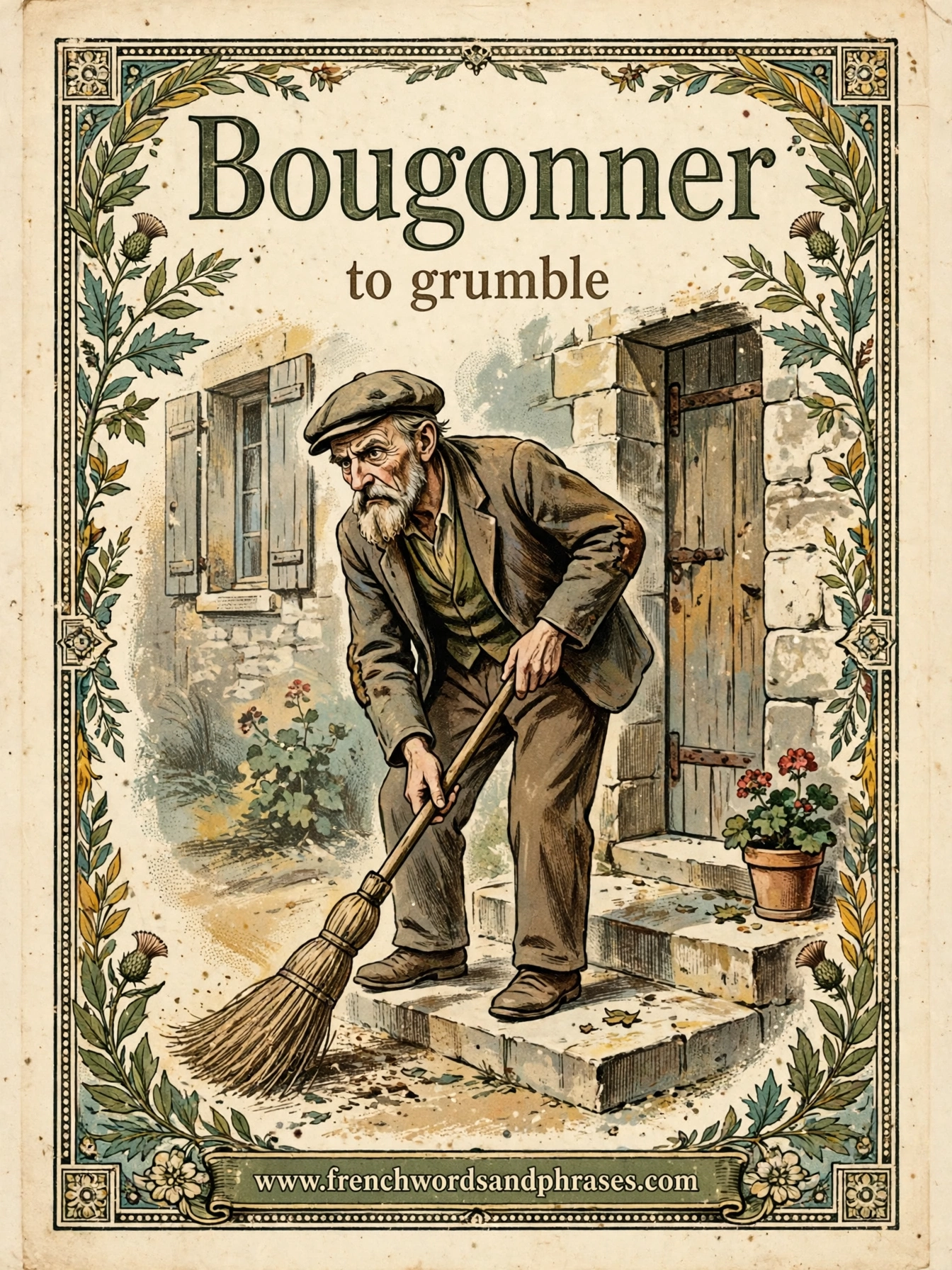
Bougonner means to grumble — to complain under your breath, half to yourself, in a low mutter that everyone can hear and nobody is meant to answer.
A grandfather at the kitchen table reading the newspaper and muttering at every headline, a queue at the post office sighing at the wait — bougonner is the verb of the low, continuous grumble: discontent that rumbles along without ever quite becoming a speech.
In this guide, you’ll learn how to conjugate bougonner in all the major French tenses and moods. Explore complete conjugation tables, French examples, English translations, and practice quizzes.
Understanding the French Verb Bougonner
Bougonner is a regular French verb belonging to the first group of verbs, those ending in-er.
It means to grumble. It is the everyday verb for muttered, half-hearted complaining — about the weather, the traffic, prices, the young, the government — usually without any wish to be answered, and often with a certain affection: le vieux bougonne, mais il a bon cœur.
Verb classification: First group (-er)
Auxiliary verb: Avoir
Past participle: bougonné
Present participle: bougonnant
English equivalents: To grumble, to mutter, to grouse; bougonner dans sa barbe — to grumble into one’s beard; un bougon — a grumbler, a grouch; bougonner contre le temps — to grumble about the weather; bougonner en travaillant — to grumble away while working.
One important detail: bougonner keeps its double -nn- in every form, after the noun un bougon, a grumbler: je bougonne, nous bougonnons, ils bougonnent, past participle bougonné. It is a verb of manner more than of words — what matters is the tone, low and continuous, so it loves companions like dans sa barbe (into his beard), tout seul (to himself) and sans arrêt (nonstop). For a formal complaint French uses se plaindre; bougonner is the unofficial soundtrack underneath.
Experience the Word
Bougonner is the verb of complaint as background music — never loud enough to argue with, never stopping long enough to forget.
Imagine the morning bus in November. Rain on the windows, the bus ten minutes late, and in the third row an old man bougonne at his newspaper — at the rain, at the bus company, at the century itself — quietly, rhythmically, almost happily, all the way to his stop.
He has demanded nothing and changed nothing. He has grumbled — bougonné, under his breath, all the way into town.
How to Conjugate Bougonner: Complete French Conjugation Guide
Let’s explore every major conjugation of bougonner, beginning with the indicative mood.
How to Conjugate Bougonner in the Indicative Mood
The indicative mood is used to express facts, observations, actions, and events.
How to Conjugate Bougonner in the Present Tense (Présent)
Used for actions happening now, habitual actions, and general truths.
| Subject | Conjugation |
|---|---|
| je | bougonne |
| tu | bougonnes |
| il / elle | bougonne |
| nous | bougonnons |
| vous | bougonnez |
| ils / elles | bougonnent |
Example
Il bougonne contre la pluie depuis ce matin.
He has been grumbling about the rain since this morning.
Quick Quiz 1
Complete the sentence:
Nous ______ contre les retards de train.
Reveal the answer
bougonnons
Nous bougonnons contre les retards de train.
We are grumbling about the train delays.
How to Conjugate Bougonner in the Passé Composé
Used for completed actions in the past. Bougonner takes the auxiliary verb avoir.
| Subject | Conjugation |
|---|---|
| j’ | ai bougonné |
| tu | as bougonné |
| il / elle | a bougonné |
| nous | avons bougonné |
| vous | avez bougonné |
| ils / elles | ont bougonné |
Example
Elle a bougonné pendant tout le trajet.
She grumbled throughout the whole journey.
How to Conjugate Bougonner in the Imparfait (Imperfect Tense)
Used for habitual past actions, descriptions, and ongoing situations in the past.
| Subject | Conjugation |
|---|---|
| je | bougonnais |
| tu | bougonnais |
| il / elle | bougonnait |
| nous | bougonnions |
| vous | bougonniez |
| ils / elles | bougonnaient |
Example
Mon grand-père bougonnait en lisant son journal.
My grandfather used to grumble while reading his newspaper.
Quick Quiz 2
Choose the correct form:
She grumbled all morning.
Elle ______ toute la matinée. (a bougonné / est bougonnée)
Reveal the answer
a bougonné
Elle a bougonné toute la matinée.
Bougonner takes avoir.
How to Conjugate Bougonner in the Plus-que-parfait
Used to describe an action that had already been completed before another past event.
| Subject | Conjugation |
|---|---|
| j’ | avais bougonné |
| tu | avais bougonné |
| il / elle | avait bougonné |
| nous | avions bougonné |
| vous | aviez bougonné |
| ils / elles | avaient bougonné |
Example
Ils avaient bougonné des heures avant d’obtenir gain de cause.
They had grumbled for hours before getting their way.
How to Conjugate Bougonner in the Passé Simple
Primarily used in formal writing, literature, and historical narratives. It is rarely used in everyday conversation.
| Subject | Conjugation |
|---|---|
| je | bougonnai |
| tu | bougonnas |
| il / elle | bougonna |
| nous | bougonnâmes |
| vous | bougonnâtes |
| ils / elles | bougonnèrent |
Example
Le vieillard bougonna dans sa barbe et tourna la page.
The old man grumbled into his beard and turned the page.
How to Conjugate Bougonner in the Passé Antérieur
A literary tense used to express an action completed immediately before another past action, generally in the passé simple.
| Subject | Conjugation |
|---|---|
| j’ | eus bougonné |
| tu | eus bougonné |
| il / elle | eut bougonné |
| nous | eûmes bougonné |
| vous | eûtes bougonné |
| ils / elles | eurent bougonné |
Example
Quand il eut bougonné un moment, il se mit au travail.
When he had grumbled for a while, he got down to work.
How to Conjugate Bougonner in the Future Tense (Futur Simple)
Used to describe actions that will take place in the future.
| Subject | Conjugation |
|---|---|
| je | bougonnerai |
| tu | bougonneras |
| il / elle | bougonnera |
| nous | bougonnerons |
| vous | bougonnerez |
| ils / elles | bougonneront |
Example
Demain, il bougonnera encore contre les embouteillages.
Tomorrow, he will grumble again about the traffic jams.
How to Conjugate Bougonner in the Futur Antérieur (Future Perfect)
Used for an action that will have been completed before a particular point in the future.
| Subject | Conjugation |
|---|---|
| j’ | aurai bougonné |
| tu | auras bougonné |
| il / elle | aura bougonné |
| nous | aurons bougonné |
| vous | aurez bougonné |
| ils / elles | auront bougonné |
Example
À midi, elle aura bougonné contre tout le monde.
By noon, she will have grumbled at everyone.
How to Conjugate Bougonner in the Near Future (Futur Proche)
Used to describe something that is going to happen soon. Formed with aller + infinitive.
| Subject | Conjugation |
|---|---|
| je | vais bougonner |
| tu | vas bougonner |
| il / elle | va bougonner |
| nous | allons bougonner |
| vous | allez bougonner |
| ils / elles | vont bougonner |
Example
Écoute-le, il va encore bougonner contre la météo.
Listen to him, he is going to grumble about the weather again.
How to Conjugate Bougonner in the Conditional Mood
The conditional mood expresses what would happen under certain circumstances. It is also frequently used to make polite requests or express wishes.
How to Conjugate Bougonner in the Present Conditional
| Subject | Conjugation |
|---|---|
| je | bougonnerais |
| tu | bougonnerais |
| il / elle | bougonnerait |
| nous | bougonnerions |
| vous | bougonneriez |
| ils / elles | bougonneraient |
Example
Sans son journal, il bougonnerait contre la télévision.
Without his newspaper, he would grumble at the television.
How to Conjugate Bougonner in the Past Conditional
| Subject | Conjugation |
|---|---|
| j’ | aurais bougonné |
| tu | aurais bougonné |
| il / elle | aurait bougonné |
| nous | aurions bougonné |
| vous | auriez bougonné |
| ils / elles | auraient bougonné |
Example
Tu aurais moins bougonné si le train avait été à l’heure.
You would have grumbled less if the train had been on time.
Bougonner in the Literary Past Conditional Form
This less common literary form uses the imperfect subjunctive of avoir.
| Subject | Conjugation |
|---|---|
| j’ | eusse bougonné |
| tu | eusses bougonné |
| il / elle | eût bougonné |
| nous | eussions bougonné |
| vous | eussiez bougonné |
| ils / elles | eussent bougonné |
Example
Il eût bougonné toute la journée sans son café.
He would have grumbled all day without his coffee.
How to Conjugate Bougonner in the Subjunctive Mood
The subjunctive is used to express wishes, emotions, doubts, necessity, and uncertainty. It frequently follows expressions such as il faut que (it is necessary that) or bien que (although).
How to Conjugate Bougonner in the Present Subjunctive
| Subject | Conjugation |
|---|---|
| que je | bougonne |
| que tu | bougonnes |
| qu’il / qu’elle | bougonne |
| que nous | bougonnions |
| que vous | bougonniez |
| qu’ils / qu’elles | bougonnent |
Example
Je doute qu’il bougonne vraiment de mauvaise humeur.
I doubt he is really grumbling in bad temper.
Quick Quiz 3
Complete the sentence using the subjunctive:
Je doute que vous ______ vraiment en colère.
Reveal the answer
bougonniez
Je doute que vous bougonniez vraiment en colère.
I doubt you are really grumbling in anger.
How to Conjugate Bougonner in the Imperfect Subjunctive
A literary tense, rarely encountered in modern spoken French.
| Subject | Conjugation |
|---|---|
| que je | bougonnasse |
| que tu | bougonnasses |
| qu’il / qu’elle | bougonnât |
| que nous | bougonnassions |
| que vous | bougonnassiez |
| qu’ils / qu’elles | bougonnassent |
Example
Il fallait qu’elle bougonnât un peu avant de se calmer.
She needed to grumble a little before calming down.
How to Conjugate Bougonner in the Pluperfect Subjunctive
A literary construction used to express an action completed before another past action.
| Subject | Conjugation |
|---|---|
| que j’ | eusse bougonné |
| que tu | eusses bougonné |
| qu’il / qu’elle | eût bougonné |
| que nous | eussions bougonné |
| que vous | eussiez bougonné |
| qu’ils / qu’elles | eussent bougonné |
Example
On souriait qu’il eût bougonné même le jour de la fête.
People smiled that he had grumbled even on the day of the party.
How to Conjugate Bougonner in the Past Subjunctive
| Subject | Conjugation |
|---|---|
| que j’ | aie bougonné |
| que tu | aies bougonné |
| qu’il / qu’elle | ait bougonné |
| que nous | ayons bougonné |
| que vous | ayez bougonné |
| qu’ils / qu’elles | aient bougonné |
Example
Je suis étonné qu’il ait bougonné devant les clients.
I am surprised he grumbled in front of the customers.
How to Conjugate Bougonner in the Imperative
The imperative is used to give commands, instructions, invitations, or suggestions. Subject pronouns are omitted.
How to Conjugate Bougonner in the Present Imperative
| Person | Conjugation |
|---|---|
| (tu) | bougonne |
| (nous) | bougonnons |
| (vous) | bougonnez |
Example
Ne bougonne pas dans ton coin, dis ce qui ne va pas !
Do not grumble in your corner, say what is wrong!
Quick Quiz 4
How would you say Do not grumble (tu form)?
Reveal the answer
Ne bougonne pas !
French Participles of Bougonner
Participles are verb forms that can be used in compound tenses and other grammatical constructions.
Present Participle of Bougonner
bougonnant
En bougonnant sans arrêt, il finit par faire rire tout le monde.
By grumbling nonstop, he ended up making everyone laugh.
Past Participle of Bougonner
bougonné
Bougonné par les anciens, le nouveau règlement fut quand même accepté.
Grumbled at by the old hands, the new rule was accepted all the same.
Bougonner in Everyday French: Real-Life Examples
Now that you know the conjugations, let’s see how bougonner appears in everyday French.
Example 1 — Present
Il bougonne contre la pluie.
He is grumbling about the rain.
Example 2 — Passé composé
Elle a bougonné pendant tout le trajet.
She grumbled throughout the journey.
Example 3 — Imparfait
Mon grand-père bougonnait en lisant le journal.
My grandfather used to grumble while reading the paper.
Example 4 — Future
Demain, il bougonnera contre les embouteillages.
Tomorrow, he will grumble about the traffic.
Example 5 — Conditional
Sans son café, elle bougonnerait toute la matinée.
Without her coffee, she would grumble all morning.
Example 6 — Imperative
Ne bougonnez pas, proposez une solution !
Do not grumble, suggest a solution!
Beyond Translation: The Meaning of Bougonner
English grumble and grouse come close, but bougonner carries its character with it — the noun un bougon is the lovable grouch himself.
The grumble is a form of company.
In French ears, bougonner rarely sounds truly angry: it is the noise of someone staying in the conversation, objecting gently to the world while remaining part of it — le bougon de service is almost a term of endearment.
How to Remember the French Verb Bougonner
Remember it this way: Bougonner is about the grandfather muttering at his newspaper — complaint as background music.
- After un bougon, a grumbler: double -nn- everywhere — je bougonne, nous bougonnons.
- Its favourite stage directions: dans sa barbe, tout seul, sans arrêt — low, alone, nonstop.
- Regular -er: je bougonne, nous bougonnons, past participle bougonné.
The key idea is the grandfather muttering at his newspaper — complaint as background music.
Test Your Knowledge of Bougonner
Let’s see how much you’ve learned. Try answering these questions before revealing the answers.
Question 1
What noun gives bougonner its double -nn-?
Reveal the answer
Un bougon — a grumbler, a grouch: hence je bougonne, nous bougonnons.
Question 2
How do you say He has been grumbling about the rain since this morning in French?
Reveal the answer
Il bougonne contre la pluie depuis ce matin.
Question 3
Translate: She grumbled throughout the whole journey.
Reveal the answer
Elle a bougonné pendant tout le trajet.
Question 4
What is the past participle of bougonner?
Reveal the answer
Bougonné.
Question 5
Complete the sentence:
Je doute qu’il ______ vraiment de mauvaise humeur.
Reveal the answer
bougonne
Je doute qu’il bougonne vraiment de mauvaise humeur.
I doubt he is really grumbling in bad temper.
Your Final Challenge
Can You Use It?
How would you say this in French?
Old Martin grumbles about everything, but the day he falls silent, the whole village will worry.
Reveal the answer
Il bougonne contre tout, le vieux Martin, mais le jour où il se taira, le village entier s’inquiétera.
Old Martin grumbles about everything, but the day he falls silent, the whole village will worry.
A little French. A little curiosity. A richer everyday life.
LEARN FRENCH ONE WORD AT A TIME