A French Word to Live By
Translate Bouche bée to English
/buʃ be/
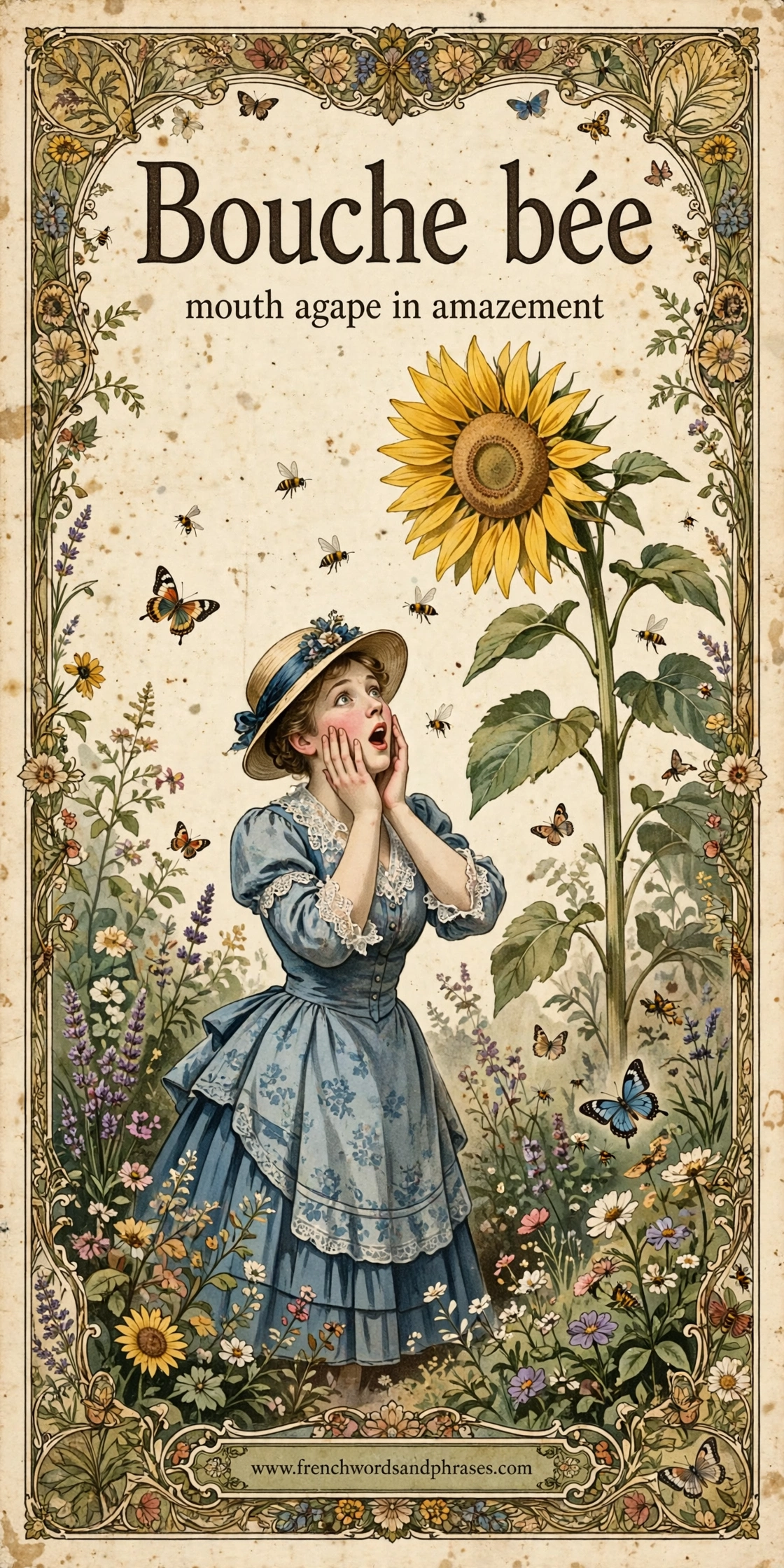
Bouche bée means mouth agape — gaping in astonishment, speechless with wonder.
The magician asks for a volunteer, borrows a five-euro note, and sets it floating in the air above his hand. In the third row, a little girl of seven forgets to close her mouth for a full minute. She is bouche bée — and so, if they are honest, are all the adults around her.
Let’s explore how bouche bée works in French, beginning with the whole phrase on one card.
Understanding the French Phrase Bouche bée
Bouche bée is a French idiomatic phrase built from la bouche (the mouth) and bée (gaping, standing open — from the old verb béer, to gape). The verb has almost vanished from the language, but its participle survives here, describing the face of pure astonishment: mouth open, words gone.
It means gaping in amazement — dumbstruck with wonder, admiration or surprise. Almost always it travels with rester or être: rester bouche bée, to stand there with your mouth hanging open. The wonder is the point: this is the face of fireworks, cathedrals and magic tricks, not of boredom or stupidity. Words have stopped because something better is happening in front of the eyes.
Type: Idiomatic phrase — a reaction, a facial expression
Answers the need: Describing someone dumbstruck with wonder, mouth open
Register: Neutral, slightly literary — loved by stories, reports and grandparents
Strength: Total amazement — speech has left the building
One important usage detail: the phrase behaves like an adjective after rester, être or laisser — le spectacle les a laissés bouche bée, the show left them gaping. Bée is written with its double é and never changes in the fixed phrase: it describes the mouth, and the mouth is la bouche for everyone, men, women and children alike.
Experience the Word
Bouche bée is the most honest review a spectacle can receive — a face that has forgotten every word it knows.
Imagine a grandmother from a landlocked village seeing the sea for the first time at seventy. The train rounds the last hill, the whole horizon turns blue, and the woman who has talked through every journey of her life says nothing at all. Bouche bée. Her grandchildren will tell that silence as the family’s favourite story for fifty years.
French is tender with this expression. An open mouth, in this phrase, is not an empty head — it is a full heart, taking in more than words can carry.
How to Use Bouche bée in French: Complete Guide
Let’s explore how bouche bée works in French, beginning with the whole phrase on one card.
Bouche bée at a Glance
The Whole Phrase on One Card
Real meaning, literal picture, English twin and register — bouche bée in five lines.
| Point | Bouche bée |
|---|---|
| What it really means | gaping in astonishment — mouth open, speechless with wonder |
| Word for word | mouth gaping — bée is the old word for standing wide open |
| English equivalent | mouth agape / open-mouthed with amazement |
| Register | neutral, slightly literary — stories and vivid reports |
| Use it for | fireworks, magic tricks, surprise parties, first sights of wonders |
Example
Les enfants sont restés bouche bée devant le feu d’artifice.
The children stood gaping in front of the fireworks.
Word by Word: The Forgotten Verb
Two small pieces — and the second one is a survivor from old French.
| Word | Literal meaning | Its job in the phrase |
|---|---|---|
| bouche | mouth | the stage of the expression — la bouche, feminine, for everyone |
| bée | gaping, standing open | from béer, an old verb meaning to gape — it survives almost only inside this phrase |
Example
La bouche ouverte, les yeux brillants : elle est bouche bée.
Mouth open, eyes shining: she is gaping in amazement.
Quick Quiz 1
Which old verb hides inside bée?
Reveal the answer
Béer — to gape, to stand open. The verb has nearly vanished; its participle lives on in bouche bée.
Béer a disparu, mais bouche bée est restée.
Béer has disappeared, but bouche bée has remained.
When You Say It: The Wonder Moments
Bouche bée fires at moments like these — wherever something wonderful stops the words.
| Situation | Example |
|---|---|
| The first fireworks | les enfants restent bouche bée devant le ciel — the children stand gaping at the sky |
| The magic trick | le magicien a laissé la salle bouche bée — the magician left the audience gaping |
| The surprise party | elle est entrée et elle est restée bouche bée — she came in and stood there open-mouthed |
| The cathedral | les touristes, bouche bée, regardent la rosace — the tourists, agape, look up at the rose window |
| The good news | à l’annonce des résultats, il est resté bouche bée — at the results announcement, he stood dumbstruck |
Example
Devant la tour Eiffel illuminée, les visiteurs restent bouche bée.
In front of the illuminated Eiffel Tower, the visitors stand gaping.
Make It Yours: The Frame Verbs
Three verbs carry the phrase — rester for the one gaping, laisser for the one causing it.
| Form | French | In English |
|---|---|---|
| Standing gaping | rester bouche bée | to stand gaping, open-mouthed |
| Being gaping | être bouche bée | to be open-mouthed with amazement |
| Leaving someone gaping | laisser quelqu’un bouche bée | to leave someone dumbstruck |
| In a description | les enfants, bouche bée, écoutaient | the children, agape, listened |
| Fuller form | en rester bouche bée | to be left gaping by it |
| With wonder added | bouche bée d’admiration | gaping with admiration |
Example
Le feu d’artifice a laissé tout le village bouche bée.
The fireworks left the whole village gaping.
Quick Quiz 2
Which verb is the phrase’s usual partner — rester or courir?
Reveal the answer
Rester — rester bouche bée, to remain standing there open-mouthed. The wonder stops you; it does not send you running.
Elle est restée bouche bée devant la vitrine.
She stood gaping in front of the shop window.
Everyday Expressions: The Amazement Shelf
Bouche bée slots into these everyday frames — each one ready to use as it stands.
| Frame | In English |
|---|---|
| rester bouche bée | to stand gaping |
| laisser bouche bée | to leave someone dumbstruck |
| sans voix | speechless — the words gone |
| les yeux écarquillés | eyes wide open |
| émerveillé | filled with wonder — the feeling inside |
Example
Sans voix, les yeux écarquillés, ils sont restés bouche bée.
Speechless, eyes wide, they stood gaping.
Close Cousins: The Faces of Amazement
French registers amazement at several settings — bouche bée is the wondering one, mouth first.
| Expression | The difference |
|---|---|
| bouche bée | gaping with wonder — the face of fireworks and magic |
| émerveillé | wonderstruck — the inner feeling, eyes and heart |
| stupéfait | stunned — amazement that can tip into shock, good or bad news |
| ébahi | amazed, flabbergasted — slightly dated, charming |
| bouche ouverte | mouth open — the plain physical description, no idiom |
Example
Émerveillés et bouche bée, les enfants applaudissent le magicien.
Wonderstruck and gaping, the children applaud the magician.
Quick Quiz 3
Which cousin can also describe the shock of bad news?
Reveal the answer
Stupéfait — stunned: it covers shocks of every kind. Bouche bée belongs to wonder.
À la mauvaise nouvelle, il est resté stupéfait.
At the bad news, he stood stunned.
Bouche bée and Its Neighbours
The wonder shelf around the phrase — mouths, eyes and the spectacles that open them.
| French | In English |
|---|---|
| la bouche | the mouth |
| béer | to gape (the old verb) |
| un spectacle | a show, a spectacle |
| une surprise | a surprise |
| le feu d’artifice | the fireworks |
Example
Un spectacle pareil laisse toujours le public bouche bée.
A show like that always leaves the audience gaping.
Watch Out: The Traps Around Bouche bée
The traps: a wonder that is not stupidity, a spelling with two accents, and a mouth that belongs to everyone.
| Trap | The truth |
|---|---|
| the stupidity trap | bouche bée is wonder, not foolishness — the open mouth here is full of admiration, and French would never insult a wondering child with it |
| the spelling trap | bée takes two é’s — the phrase is fixed, and bée does not change for men or groups, because it belongs to la bouche |
| the shock trap | for stunned bad news, reach for stupéfait; bouche bée keeps the magic |
| the frame trap | it needs its frame verb — rester, être, laisser; alone it is a caption, not a sentence |
Example
Bouche bée d’admiration, la petite a oublié sa glace.
Gaping with admiration, the little girl forgot her ice cream.
Quick Quiz 4
True or false: bouche bée insults someone for looking stupid.
Reveal the answer
False — it describes wonder and amazement, kindly. The insult shelf is elsewhere; this face is watching fireworks.
Les enfants bouche bée ne sont pas bêtes, ils sont émerveillés.
Children standing agape aren’t silly, they are wonderstruck.
Bouche bée in Everyday French: Real-Life Examples
Now that you know the word, let’s see how bouche bée appears in everyday French.
Example 1 — The fireworks
Les enfants sont restés bouche bée devant le feu d’artifice.
The children stood gaping in front of the fireworks.
Example 2 — The magician
Le magicien a laissé toute la classe bouche bée.
The magician left the whole class dumbstruck.
Example 3 — The surprise party
Quand elle a ouvert la porte, elle est restée bouche bée : tout le monde était là.
When she opened the door, she stood open-mouthed: everyone was there.
Example 4 — The first sea
Grand-mère, voyant la mer pour la première fois, est restée bouche bée.
Grandma, seeing the sea for the first time, stood gaping.
Example 5 — At the cathedral
Les touristes lèvent la tête, bouche bée, devant la rosace.
The tourists lift their heads, agape, before the rose window.
Example 6 — The puppy’s trick
Le chiot a fait un salto, et les enfants sont restés bouche bée.
The puppy did a somersault, and the children stood gaping.
Beyond Translation: The Meaning of Bouche bée
English gapes too — ‘mouth agape’, ‘open-mouthed’ — and British English adds the gloriously physical ‘gobsmacked’, struck in the mouth by amazement. French’s bouche bée is the gentlest of the family: no blow, no smack, just a mouth that has opened like a door because wonder walked in.
It is the expression of the first row, the front seat, the front of the crowd — of being close enough to marvels for words to fail.
Keep it for the true wonders. A phrase this honest about amazement should never be spent on anything smaller than fireworks.
How to Remember the French Phrase Bouche bée
Remember it this way: Bouche bée is the face of the front row — a mouth opened by wonder, from an old verb that survives nowhere else.
- You rescue the verb — bée comes from béer, to gape, a word that lives on only here.
- You pair it with rester — rester bouche bée, to stand there gaping.
- You keep it kind — this open mouth means wonder, never stupidity; for shock, use stupéfait.
The key idea is bouche bée means mouth agape in amazement — rester bouche bée, to stand gaping with wonder.
Test Your Knowledge of Bouche bée
Let’s see how much you’ve learned. Try answering these questions before revealing the answers.
Question 1
What does bouche bée mean?
Reveal the answer
Mouth agape in astonishment — gaping, speechless with wonder.
Question 2
Which old verb does bée come from?
Reveal the answer
Béer — to gape, to stand open; the verb has vanished except inside this phrase.
Question 3
How do you say ‘The children stood gaping’?
Reveal the answer
Les enfants sont restés bouche bée — rester is the phrase’s usual partner.
Question 4
Is bouche bée an insult for looking stupid?
Reveal the answer
No — it describes wonder kindly; stunned shock, good or bad, is stupéfait.
Question 5
Complete the sentence:
Les enfants sont restés bouche ______ devant le spectacle. (The children stood gaping in front of the show.)
Reveal the answer
bée
Les enfants sont restés bouche bée devant le spectacle.
The children stood gaping in front of the show.
Your Final Challenge
Can You Use It?
How would you say this in French?
“The children stood gaping in front of the fireworks.”
Reveal the answer
Les enfants sont restés bouche bée devant le feu d’artifice.
The children stood gaping in front of the fireworks.
A little French. A little curiosity. A richer everyday life.
LEARN FRENCH ONE WORD AT A TIME