A French Word to Live By
How to Conjugate Bombarder in French
/bɔ̃.baʁ.de/
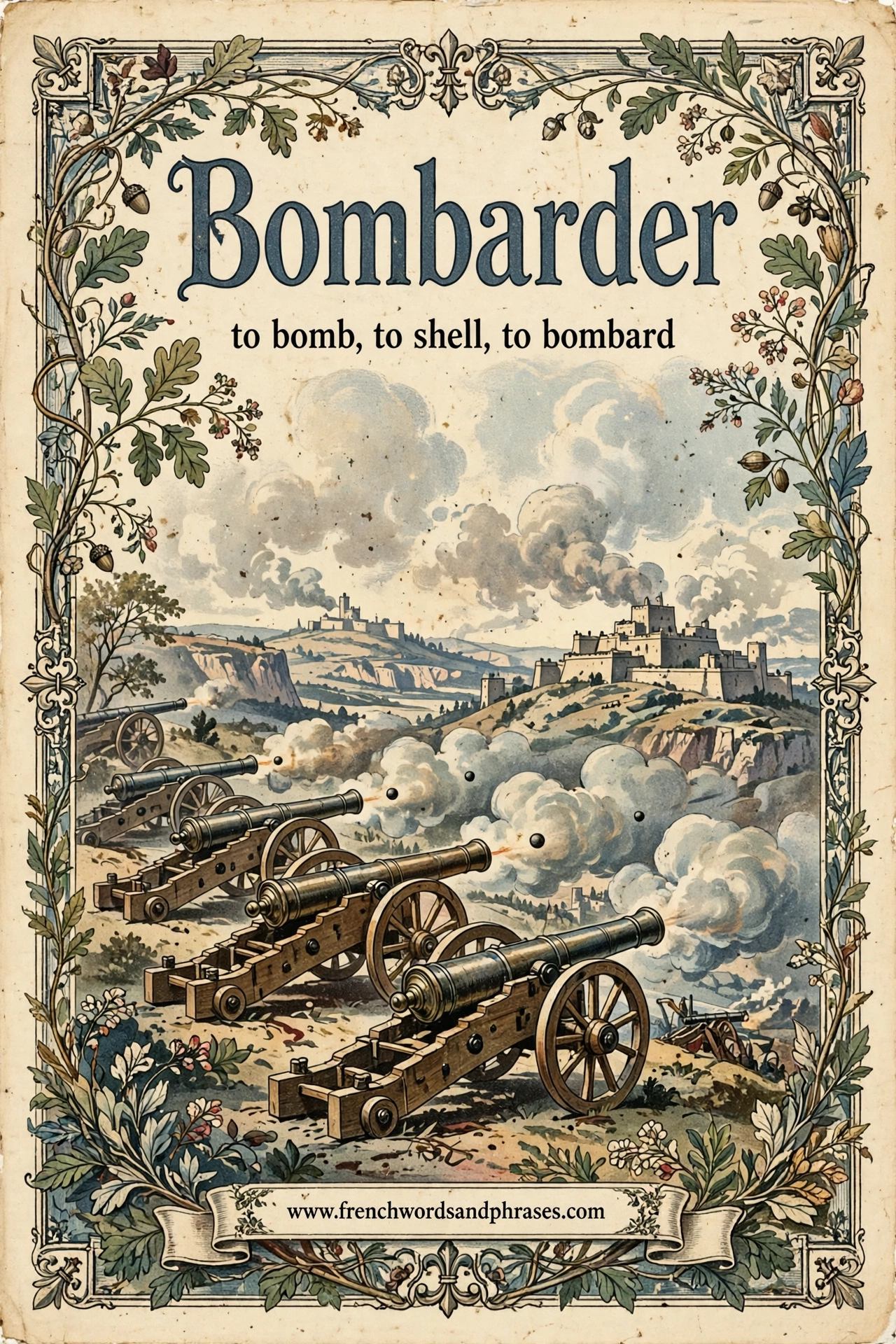
Bombarder means to bombard — to attack with shells and bombs, and, in everyday French, to shower someone with questions, messages or demands.
Artillery working a coastline at dawn, a minister facing fifty journalists at once, a phone lighting up with a hundred messages — bombarder is the verb of the sustained barrage: things falling on a target, one after another, without pause.
In this guide, you’ll learn how to conjugate bombarder in all the major French tenses and moods. Explore complete conjugation tables, French examples, English translations, and practice quizzes.
Understanding the French Verb Bombarder
Bombarder is a regular French verb belonging to the first group of verbs, those ending in-er.
It means to bomb, to shell, to bombard. It is used by historians and journalists for real shelling and bombing, and far more often, with a smile, for the barrages of modern life: questions at a press conference, texts from a worried mother, leaflets over a town, offers in an inbox. The target is always outnumbered by what falls on it.
Verb classification: First group (-er)
Auxiliary verb: Avoir
Past participle: bombardé
Present participle: bombardant
English equivalents: To bombard, to shell, to bomb; bombarder une ville — to shell a town; bombarder quelqu’un de questions — to bombard someone with questions; bombarder de messages — to bombard with messages; un bombardement — a bombardment, a bombing.
One important detail: the figurative use keeps the military grammar — bombarder quelqu’un de quelque chose, with de for the ammunition: bombarder le ministre de questions, bombarder ses amis de photos. The verb itself is regular: je bombarde, nous bombardons, past participle bombardé. Its ancestor is la bombarde, one of the first great cannons — the same word English took for bombard.
Experience the Word
Bombarder is the verb of too much arriving at once — shells over a port, or questions over a breakfast table.
Imagine a young teacher’s first parents’ evening. She has barely sat down when the questions begin — les devoirs, les notes, le voyage scolaire — vingt parents, cent questions; on la bombarde de questions, and her carefully prepared speech dissolves in the first minute.
No shells fell, but the rhythm was military. She was bombarded — bombardée — and she held her position.
How to Conjugate Bombarder: Complete French Conjugation Guide
Let’s explore every major conjugation of bombarder, beginning with the indicative mood.
How to Conjugate Bombarder in the Indicative Mood
The indicative mood is used to express facts, observations, actions, and events.
How to Conjugate Bombarder in the Present Tense (Présent)
Used for actions happening now, habitual actions, and general truths.
| Subject | Conjugation |
|---|---|
| je | bombarde |
| tu | bombardes |
| il / elle | bombarde |
| nous | bombardons |
| vous | bombardez |
| ils / elles | bombardent |
Example
L’artillerie bombarde la ville depuis l’aube.
The artillery has been shelling the town since dawn.
Quick Quiz 1
Complete the sentence:
Nous ______ le ministre de questions.
Reveal the answer
bombardons
Nous bombardons le ministre de questions.
We are bombarding the minister with questions.
How to Conjugate Bombarder in the Passé Composé
Used for completed actions in the past. Bombarder takes the auxiliary verb avoir.
| Subject | Conjugation |
|---|---|
| j’ | ai bombardé |
| tu | as bombardé |
| il / elle | a bombardé |
| nous | avons bombardé |
| vous | avez bombardé |
| ils / elles | ont bombardé |
Example
Les enfants l’ont bombardé de questions.
The children bombarded him with questions.
How to Conjugate Bombarder in the Imparfait (Imperfect Tense)
Used for habitual past actions, descriptions, and ongoing situations in the past.
| Subject | Conjugation |
|---|---|
| je | bombardais |
| tu | bombardais |
| il / elle | bombardait |
| nous | bombardions |
| vous | bombardiez |
| ils / elles | bombardaient |
Example
On bombardait les élèves d’exercices la veille de l’examen.
They used to bombard the pupils with exercises on the eve of the exam.
Quick Quiz 2
Choose the correct form:
The children bombarded him with questions.
Les enfants l’______ de questions. (ont bombardé / sont bombardés)
Reveal the answer
ont bombardé
Les enfants l’ont bombardé de questions.
Bombarder takes avoir.
How to Conjugate Bombarder in the Plus-que-parfait
Used to describe an action that had already been completed before another past event.
| Subject | Conjugation |
|---|---|
| j’ | avais bombardé |
| tu | avais bombardé |
| il / elle | avait bombardé |
| nous | avions bombardé |
| vous | aviez bombardé |
| ils / elles | avaient bombardé |
Example
Elle avait bombardé son frère de textos toute la journée.
She had bombarded her brother with texts all day.
How to Conjugate Bombarder in the Passé Simple
Primarily used in formal writing, literature, and historical narratives. It is rarely used in everyday conversation.
| Subject | Conjugation |
|---|---|
| je | bombardai |
| tu | bombardas |
| il / elle | bombarda |
| nous | bombardâmes |
| vous | bombardâtes |
| ils / elles | bombardèrent |
Example
La flotte bombarda le port pendant trois jours.
The fleet bombarded the port for three days.
How to Conjugate Bombarder in the Passé Antérieur
A literary tense used to express an action completed immediately before another past action, generally in the passé simple.
| Subject | Conjugation |
|---|---|
| j’ | eus bombardé |
| tu | eus bombardé |
| il / elle | eut bombardé |
| nous | eûmes bombardé |
| vous | eûtes bombardé |
| ils / elles | eurent bombardé |
Example
Quand l’aviation eut bombardé le pont, la route fut coupée.
When the air force had bombed the bridge, the road was cut.
How to Conjugate Bombarder in the Future Tense (Futur Simple)
Used to describe actions that will take place in the future.
| Subject | Conjugation |
|---|---|
| je | bombarderai |
| tu | bombarderas |
| il / elle | bombardera |
| nous | bombarderons |
| vous | bombarderez |
| ils / elles | bombarderont |
Example
Demain, les journalistes le bombarderont de questions.
Tomorrow, the journalists will bombard him with questions.
How to Conjugate Bombarder in the Futur Antérieur (Future Perfect)
Used for an action that will have been completed before a particular point in the future.
| Subject | Conjugation |
|---|---|
| j’ | aurai bombardé |
| tu | auras bombardé |
| il / elle | aura bombardé |
| nous | aurons bombardé |
| vous | aurez bombardé |
| ils / elles | auront bombardé |
Example
À la fin de la semaine, on aura bombardé la région de tracts.
By the end of the week, they will have showered the region with leaflets.
How to Conjugate Bombarder in the Near Future (Futur Proche)
Used to describe something that is going to happen soon. Formed with aller + infinitive.
| Subject | Conjugation |
|---|---|
| je | vais bombarder |
| tu | vas bombarder |
| il / elle | va bombarder |
| nous | allons bombarder |
| vous | allez bombarder |
| ils / elles | vont bombarder |
Example
Prépare-toi, les enfants vont te bombarder de questions.
Get ready, the children are going to bombard you with questions.
How to Conjugate Bombarder in the Conditional Mood
The conditional mood expresses what would happen under certain circumstances. It is also frequently used to make polite requests or express wishes.
How to Conjugate Bombarder in the Present Conditional
| Subject | Conjugation |
|---|---|
| je | bombarderais |
| tu | bombarderais |
| il / elle | bombarderait |
| nous | bombarderions |
| vous | bombarderiez |
| ils / elles | bombarderaient |
Example
Sans la trêve, l’armée bombarderait encore la côte.
Without the truce, the army would still be shelling the coast.
How to Conjugate Bombarder in the Past Conditional
| Subject | Conjugation |
|---|---|
| j’ | aurais bombardé |
| tu | aurais bombardé |
| il / elle | aurait bombardé |
| nous | aurions bombardé |
| vous | auriez bombardé |
| ils / elles | auraient bombardé |
Example
Il aurait bombardé ses amis de photos de vacances.
He would have bombarded his friends with holiday photos.
Bombarder in the Literary Past Conditional Form
This less common literary form uses the imperfect subjunctive of avoir.
| Subject | Conjugation |
|---|---|
| j’ | eusse bombardé |
| tu | eusses bombardé |
| il / elle | eût bombardé |
| nous | eussions bombardé |
| vous | eussiez bombardé |
| ils / elles | eussent bombardé |
Example
La garnison eût bombardé le port sans l’ordre de cesser le feu.
The garrison would have bombarded the port without the ceasefire order.
How to Conjugate Bombarder in the Subjunctive Mood
The subjunctive is used to express wishes, emotions, doubts, necessity, and uncertainty. It frequently follows expressions such as il faut que (it is necessary that) or bien que (although).
How to Conjugate Bombarder in the Present Subjunctive
| Subject | Conjugation |
|---|---|
| que je | bombarde |
| que tu | bombardes |
| qu’il / qu’elle | bombarde |
| que nous | bombardions |
| que vous | bombardiez |
| qu’ils / qu’elles | bombardent |
Example
Je ne veux pas que tu me bombardes de messages.
I do not want you to bombard me with messages.
Quick Quiz 3
Complete the sentence using the subjunctive:
Je ne veux pas que vous me ______ de messages.
Reveal the answer
bombardiez
Je ne veux pas que vous me bombardiez de messages.
I do not want you to bombard me with messages.
How to Conjugate Bombarder in the Imperfect Subjunctive
A literary tense, rarely encountered in modern spoken French.
| Subject | Conjugation |
|---|---|
| que je | bombardasse |
| que tu | bombardasses |
| qu’il / qu’elle | bombardât |
| que nous | bombardassions |
| que vous | bombardassiez |
| qu’ils / qu’elles | bombardassent |
Example
Le général ordonna que l’on bombardât le dépôt à l’aube.
The general ordered the depot to be bombarded at dawn.
How to Conjugate Bombarder in the Pluperfect Subjunctive
A literary construction used to express an action completed before another past action.
| Subject | Conjugation |
|---|---|
| que j’ | eusse bombardé |
| que tu | eusses bombardé |
| qu’il / qu’elle | eût bombardé |
| que nous | eussions bombardé |
| que vous | eussiez bombardé |
| qu’ils / qu’elles | eussent bombardé |
Example
On regrettait que l’armée eût bombardé le vieux quartier.
People regretted that the army had bombarded the old quarter.
How to Conjugate Bombarder in the Past Subjunctive
| Subject | Conjugation |
|---|---|
| que j’ | aie bombardé |
| que tu | aies bombardé |
| qu’il / qu’elle | ait bombardé |
| que nous | ayons bombardé |
| que vous | ayez bombardé |
| qu’ils / qu’elles | aient bombardé |
Example
Je suis ravi que les lecteurs aient bombardé la rédaction de lettres.
I am delighted that readers bombarded the editorial office with letters.
How to Conjugate Bombarder in the Imperative
The imperative is used to give commands, instructions, invitations, or suggestions. Subject pronouns are omitted.
How to Conjugate Bombarder in the Present Imperative
| Person | Conjugation |
|---|---|
| (tu) | bombarde |
| (nous) | bombardons |
| (vous) | bombardez |
Example
Ne me bombarde pas de questions, je réfléchis !
Do not bombard me with questions, I am thinking!
Quick Quiz 4
How would you say Do not bombard me with questions (tu form)?
Reveal the answer
Ne me bombarde pas de questions !
French Participles of Bombarder
Participles are verb forms that can be used in compound tenses and other grammatical constructions.
Present Participle of Bombarder
bombardant
En bombardant le public de slogans, la campagne a lassé tout le monde.
By bombarding the public with slogans, the campaign tired everyone out.
Past Participle of Bombarder
bombardé
Bombardée de messages, elle a fini par éteindre son téléphone.
Bombarded with messages, she ended up switching off her phone.
Bombarder in Everyday French: Real-Life Examples
Now that you know the conjugations, let’s see how bombarder appears in everyday French.
Example 1 — Present
L’artillerie bombarde la ville depuis l’aube.
The artillery has been shelling the town since dawn.
Example 2 — Passé composé
Les enfants l’ont bombardé de questions.
The children bombarded him with questions.
Example 3 — Imparfait
On bombardait les élèves d’exercices.
They used to bombard the pupils with exercises.
Example 4 — Future
Les journalistes le bombarderont de questions.
The journalists will bombard him with questions.
Example 5 — Conditional
Il aurait bombardé ses amis de photos.
He would have bombarded his friends with photos.
Example 6 — Imperative
Ne me bombarde pas de questions, je réfléchis !
Do not bombard me with questions, I am thinking!
Beyond Translation: The Meaning of Bombarder
La bombarde was a fourteenth-century cannon so famous that both French bombarder and English bombard descend from it. The metaphorical sense — bombarding with questions — is centuries old too, because the experience it names is timeless.
The grammar preserves the battle plan.
Bombarder quelqu’un DE quelque chose: the person is the fortress, and the de-phrase is the ammunition — questions, shells, texts or tracts, whatever falls thick and fast.
How to Remember the French Verb Bombarder
Remember it this way: Bombarder is about the minister at the press conference, under a rain of questions.
- Military first (shells, bombs), metaphorical second (questions, messages) — same verb, same rhythm.
- The construction is bombarder quelqu’un DE quelque chose: the de-phrase is the ammunition.
- Regular -er: je bombarde, nous bombardons, past participle bombardé.
The key idea is the minister at the press conference, under a rain of questions.
Test Your Knowledge of Bombarder
Let’s see how much you’ve learned. Try answering these questions before revealing the answers.
Question 1
Which preposition introduces the ammunition in bombarder quelqu’un ___ questions?
Reveal the answer
De — bombarder quelqu’un de questions, de messages, de photos.
Question 2
How do you say The children bombarded him with questions in French?
Reveal the answer
Les enfants l’ont bombardé de questions.
Question 3
Translate: The fleet bombarded the port for three days.
Reveal the answer
La flotte bombarda le port pendant trois jours.
Question 4
What is the past participle of bombarder?
Reveal the answer
Bombardé.
Question 5
Complete the sentence:
Je ne veux pas que tu me ______ de messages.
Reveal the answer
bombardes
Je ne veux pas que tu me bombardes de messages.
I do not want you to bombard me with messages.
Your Final Challenge
Can You Use It?
How would you say this in French?
The moment he arrived, the children bombarded him with questions, and he answered every one, one by one.
Reveal the answer
Dès son arrivée, les enfants l’ont bombardé de questions, et il a répondu à toutes, une à une.
The moment he arrived, the children bombarded him with questions, and he answered every one, one by one.
A little French. A little curiosity. A richer everyday life.
LEARN FRENCH ONE WORD AT A TIME