A French Word to Live By
Translate Bois to English
/bwa/
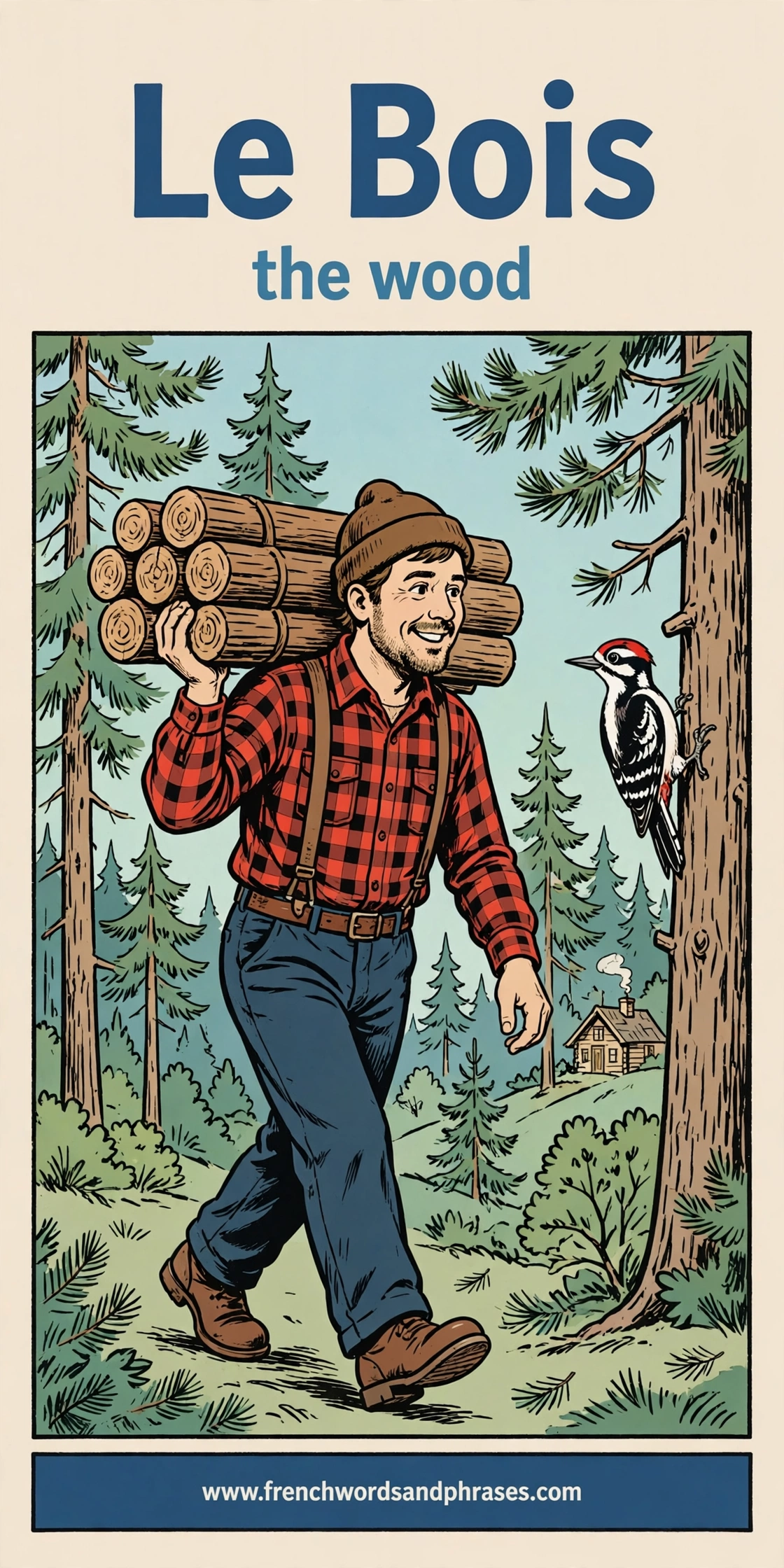
Le Bois means the wood.
At the café table, the conversation turns to luck: the exam tomorrow, the job interview, the driving test. Everyone laughs, leans over, and knocks twice on the table — je touche du bois — I touch wood, just in case.
In this guide, you’ll learn what bois means in English, how to use it with its articles, how to form its plural, and how it appears in everyday French. Explore French examples, English translations, and practice quizzes.
Understanding the French Noun Bois
Bois is a masculine French noun. It is learned together with its article: le bois, du bois. It is a word of three gifts: the material from the tree, the little forest itself, and — in the plural — the antlers of the stag. Its spelling never changes: un bois, des bois, same form.
It means the wood — the hard material of trees, used for fires, furniture and houses: une table en bois, a wooden table. It also means a wood, a small forest: le bois de Boulogne is Paris’s great park-wood. And les bois of a deer are its antlers.
Gender: Masculine
Definite article: le — le bois (the wood)
Indefinite / partitive: du bois (some wood) — the material is measured, not counted
Plural: les bois — same spelling; woods, or a stag’s antlers
Three lives: The material, the small forest, the antlers
English equivalents: The wood; timber; a wood (small forest).
One important usage detail: for luck, French knocks on the material itself — toucher du bois, to touch wood, usually said while actually touching something wooden. Note the partitive: you touch du bois, some wood, not « le bois ».
Experience the Word
Bois is more than a material. It is warmth and shelter in a single word — the beam over the fireplace, the table around which the family fits, the forest at the edge of the town.
Imagine the woodcutter’s yard in autumn: logs stacked for winter, the smell of sap and smoke, every bûche a promise of a warm evening.
You have not just named a substance. You have touched the oldest building material of human life — and knocked on it for luck.
How to Use Bois in French: Complete Guide
Let’s explore how bois works in French, beginning with its articles — a masculine mass noun, measured with du, whose spelling never changes.
Bois with the Definite Article (Le, Les)
Le bois for the material in general, or for one particular wood — the forest kind.
| Form | French |
|---|---|
| Masculine singular | le bois |
| Plural | les bois |
Example
Le bois de ce meuble est du chêne massif.
The wood of this piece of furniture is solid oak.
Bois with the Indefinite and Partitive (Du, Des)
Wood the material is not counted — French measures it with du bois, some wood.
| Form | French |
|---|---|
| Partitive singular | du bois |
| Plural | des bois |
Example
Il achète du bois pour construire une cabane.
He is buying wood to build a cabin.
Bois with the Partitive: Quantities and Amounts
To measure bois, French counts pieces, piles and armfuls rather than the wood itself.
| French | In English |
|---|---|
| du bois | some wood |
| un morceau de bois | a piece of wood |
| un tas de bois | a pile of wood |
| une bûche de bois | a log of wood |
| beaucoup de bois | a lot of wood |
| du bois de chauffage | firewood |
Example
Un tas de bois attend l’hiver près de la grange.
A pile of wood is waiting for winter near the barn.
Quick Quiz 1
Complete the lucky expression:
Je ______ du bois, l’examen est demain !
Reveal the answer
touche
Je touche du bois, l’examen est demain !
Touch wood, the exam is tomorrow — the expression is toucher du bois, with the partitive du.
The Plural of Bois
Bois is spelled the same in the plural — les bois, the woods; and for a stag, its antlers.
| Number | French |
|---|---|
| Singular | le bois / du bois |
| Plural | les bois / des bois |
Example
Les bois entourent le village de tous côtés.
The woods surround the village on all sides.
Bois with Possessive Adjectives (Mon, Ton, Son…)
Possessives agree with the noun — bois is masculine, so it takes mon, ton, son in the singular.
| Owner | French |
|---|---|
| my | mon bois |
| your (tu) | ton bois |
| his / her | son bois |
| our | notre bois |
| your (vous) | votre bois |
| their | leur bois |
Example
Le bûcheron empile son bois derrière la maison.
The woodcutter stacks his wood behind the house.
Quick Quiz 2
Complete the sentence:
______ bois de chauffage est déjà rangé. (Our)
Reveal the answer
Notre
Notre bois de chauffage est déjà rangé.
Our firewood is already stacked away — bois is masculine singular here, so our is notre.
Bois with Demonstrative Adjectives (Ce, Ces)
Used to point: ce bois, this wood here — the material, or the little forest on the hill.
| Form | French |
|---|---|
| Masculine singular | ce bois |
| Plural | ces bois |
Example
Ce bois, derrière l’église, est parfait pour les promenades.
This wood, behind the church, is perfect for walks.
Bois with Adjectives
Adjectives agree with bois — masculine forms; the noun’s own spelling never changes, plural or not.
| Adjective | With Bois |
|---|---|
| sec (dry) | du bois sec |
| dur (hard) | un bois dur / des bois durs |
| massif (solid) | du bois massif |
| ancien (old) | un bois ancien / des bois anciens |
| vert (green, unseasoned) | du bois vert |
Example
Cette table est en bois massif, elle durera cent ans.
This table is solid wood; it will last a hundred years.
Quick Quiz 3
Complete the sentence:
Le feu prend mal: le bois est trop ______. (green, unseasoned)
Reveal the answer
vert
Le feu prend mal: le bois est trop vert.
The fire won’t catch: the wood is too green — vert stays masculine singular with bois.
Everyday Expressions with Bois
Luck, firewood and wooden language — the bois phrases of daily life.
| Expression | In English |
|---|---|
| toucher du bois | to touch wood (for luck) |
| le bois de chauffage | firewood |
| en bois | wooden, made of wood |
| la langue de bois | wooden language — evasive official speak |
| le bois de Boulogne | the Bois de Boulogne, Paris’s great wooded park |
| les bois du cerf | the stag’s antlers |
Example
Pour l’instant tout va bien, je touche du bois.
So far so good — touch wood.
Words from the Same Family as Bois
Forests, logs and woodcutters — the words that travel with bois.
| French | In English |
|---|---|
| boisé | wooded, tree-covered |
| le boisement | afforestation, planting with trees |
| déboiser | to clear of trees, to deforest |
| le bûcheron | the woodcutter, the lumberjack |
| la bûche | the log |
| le bosquet | the grove, the little wood |
Example
Le bûcheron coupe des bûches dans le bosquet.
The woodcutter is cutting logs in the grove.
Quick Quiz 4
What is la langue de bois?
Reveal the answer
Wooden language — the stiff, evasive official speak of politicians who answer without saying anything.
Le ministre a répondu en langue de bois.
The minister answered in wooden, evasive language.
Bois in Everyday French: Real-Life Examples
Now that you know the word, let’s see how bois appears in everyday French.
Example 1 — For luck
Je touche du bois, le train n’a jamais de retard.
Touch wood, the train is never late.
Example 2 — Firewood
Il rentre du bois pour la cheminée avant la neige.
He is bringing in wood for the fireplace before the snow.
Example 3 — Furniture
Cette armoire en bois ancien vient de ma grand-mère.
This old-wood wardrobe comes from my grandmother.
Example 4 — A walk
Nous nous promenons dans le bois derrière le village.
We are walking in the wood behind the village.
Example 5 — A stag
Le cerf porte de grands bois sur la tête.
The stag carries great antlers on its head.
Example 6 — Official speak
Encore un discours en langue de bois, sans une vraie réponse.
Another speech in wooden language, without a single real answer.
Beyond Translation: The Meaning of Bois
Bois is the material of French civilisation before steel: the beam, the barrel, the boat, the fire. Paris itself keeps two great woods at its gates — le bois de Boulogne and le bois de Vincennes — lungs of the city that still carry the forest’s name. And every day, in cafés and offices, hands reach out to knock on it: toucher du bois, the little superstition that turns furniture into a charm.
To say bois is to touch warmth, shelter and luck in one syllable.
It evokes the log fire and the oak table, the stag at the forest edge — and a language so stiff it had to be named after it: la langue de bois.
How to Remember the French Noun Bois
Remember it this way: Bois is the wood — masculine, du bois for the material, and you touch it for luck: toucher du bois.
- You knock for luck — je touche du bois, deux petits coups.
- You measure the material — du bois, un morceau de bois.
- You watch the stag — les bois du cerf, ses cornes.
The key idea is le bois — the wood you knock on for luck.
Test Your Knowledge of Bois
Let’s see how much you’ve learned. Try answering these questions before revealing the answers.
Question 1
Is bois masculine or feminine?
Reveal the answer
Masculine — le bois, du bois.
Question 2
Does the spelling of bois change in the plural?
Reveal the answer
No — un bois, des bois: the form is identical; only the article changes.
Question 3
Translate: Touch wood!
Reveal the answer
Touche du bois ! (Or: Je touche du bois.)
Question 4
What are les bois of a cerf (stag)?
Reveal the answer
Its antlers — the stag’s « woods » grow on its head.
Question 5
Complete the sentence:
La table est en ______ massif. (wood)
Reveal the answer
bois
La table est en bois massif.
The table is made of solid wood.
Your Final Challenge
Can You Use It?
How would you say this in French?
“He touches wood before the exam.”
Reveal the answer
Il touche du bois avant l’examen.
He touches wood before the exam.
A little French. A little curiosity. A richer everyday life.
LEARN FRENCH ONE WORD AT A TIME