A French Word to Live By
How to Conjugate Blottir in French
/blɔ.tiʁ/
Blottir means to cower, to squat — to crouch down small and still, almost always in its reflexive form se blottir.
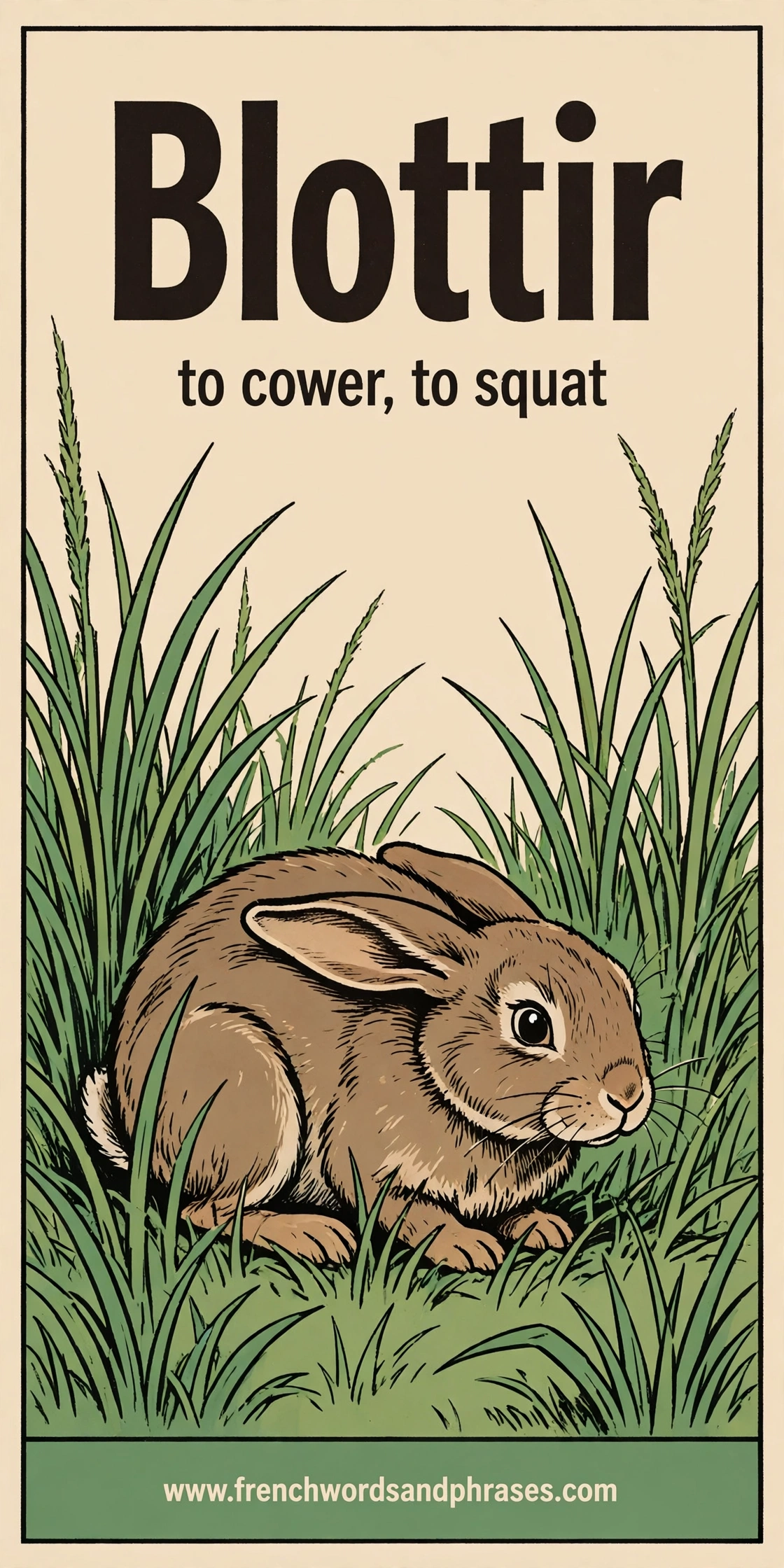
A hare flattened in the long grass, a chick tucked under a wing — blottir is the dictionary’s bare verb for crouching down into the smallest possible shape. It lives an honest but quiet life: open any novel and the animal or child will almost always be se blottir, reflexive, against something warm.
In this guide, you’ll learn how to conjugate blottir in all the major French tenses and moods. Explore complete conjugation tables, French examples, English translations, and practice quizzes.
Understanding the French Verb Blottir
Blottir is a regular French verb belonging to the second group of verbs, those ending in -ir.
It means to cower, to squat. Where it appears without the reflexive, it describes small animals — hares, chicks, dogs — crouching low and motionless in grass, baskets or burrows. For people, children and anything seeking warmth or safety, French speakers reach automatically for se blottir contre quelqu’un.
Verb classification: Second group (-ir)
Auxiliary verb: Avoir
Past participle: blotti
Present participle: blottissant
English equivalents: To cower, to crouch down, to squat low (rare outside dictionaries); se blottir contre — to snuggle up against, the living form; se blottir dans un coin — to curl up in a corner; blotti dans l’herbe — crouched in the grass.
One important detail, and it is a matter of honesty: blottir on its own is a rare, literary verb that modern French has almost entirely handed over to its reflexive twin se blottir. The conjugation itself is a regular second-group pattern — je blottis, nous blottissons, past participle blotti — and you will meet the bare forms chiefly in older writing about animals crouching in cover. Learn this page as the root; live your French life with se blottir.
Experience the Word
Blottir is the verb in its dictionary coat — correct, complete, and waiting for its reflexive to take it out into the world.
Imagine the hunting prints in an old French book: in the tall grass at the field’s edge, a hare lies pressed flat, ears down, blotti — the caption uses the bare verb, the way naturalists once wrote, before every French child learned to say il se blottit.
The hare has not moved a muscle. It is crouched — blotti — smaller than the grass that hides it.
How to Conjugate Blottir: Complete French Conjugation Guide
Let’s explore every major conjugation of blottir, beginning with the indicative mood.
How to Conjugate Blottir in the Indicative Mood
The indicative mood is used to express facts, observations, actions, and events.
How to Conjugate Blottir in the Present Tense (Présent)
Used for actions happening now, habitual actions, and general truths.
| Subject | Conjugation |
|---|---|
| je | blottis |
| tu | blottis |
| il / elle | blottit |
| nous | blottissons |
| vous | blottissez |
| ils / elles | blottissent |
Example
Le lièvre blottit dans les hautes herbes, immobile.
The hare crouches in the tall grass, motionless.
Quick Quiz 1
Complete the sentence:
Nous regardons le faon qui ______ dans les fougères.
Reveal the answer
blottit
Nous regardons le faon qui blottit dans les fougères.
We are watching the fawn crouching in the ferns.
How to Conjugate Blottir in the Passé Composé
Used for completed actions in the past. Blottir takes the auxiliary verb avoir.
| Subject | Conjugation |
|---|---|
| j’ | ai blotti |
| tu | as blotti |
| il / elle | a blotti |
| nous | avons blotti |
| vous | avez blotti |
| ils / elles | ont blotti |
Example
Le petit chien a blotti toute la soirée dans son panier.
The little dog crouched all evening in its basket.
How to Conjugate Blottir in the Imparfait (Imperfect Tense)
Used for habitual past actions, descriptions, and ongoing situations in the past.
| Subject | Conjugation |
|---|---|
| je | blottissais |
| tu | blottissais |
| il / elle | blottissait |
| nous | blottissions |
| vous | blottissiez |
| ils / elles | blottissaient |
Example
Les poussins blottissaient sous l’aile de la poule.
The chicks used to crouch under the hen’s wing.
Quick Quiz 2
Choose the correct form:
The dog crouched in its basket.
Le chien ______ dans son panier. (a blotti / est blotti)
Reveal the answer
a blotti
Le chien a blotti dans son panier.
Blottir takes avoir.
How to Conjugate Blottir in the Plus-que-parfait
Used to describe an action that had already been completed before another past event.
| Subject | Conjugation |
|---|---|
| j’ | avais blotti |
| tu | avais blotti |
| il / elle | avait blotti |
| nous | avions blotti |
| vous | aviez blotti |
| ils / elles | avaient blotti |
Example
L’oiseau avait blotti dans le creux de l’arbre avant l’orage.
The bird had crouched in the hollow of the tree before the storm.
How to Conjugate Blottir in the Passé Simple
Primarily used in formal writing, literature, and historical narratives. It is rarely used in everyday conversation.
| Subject | Conjugation |
|---|---|
| je | blottis |
| tu | blottis |
| il / elle | blottit |
| nous | blottîmes |
| vous | blottîtes |
| ils / elles | blottirent |
Example
Le lièvre blottit sous la haie et ne bougea plus.
The hare crouched under the hedge and did not move again.
How to Conjugate Blottir in the Passé Antérieur
A literary tense used to express an action completed immediately before another past action, generally in the passé simple.
| Subject | Conjugation |
|---|---|
| j’ | eus blotti |
| tu | eus blotti |
| il / elle | eut blotti |
| nous | eûmes blotti |
| vous | eûtes blotti |
| ils / elles | eurent blotti |
Example
Quand le faon eut blotti dans les fougères, le chien passa sans le voir.
When the fawn had crouched down in the ferns, the dog passed without seeing it.
How to Conjugate Blottir in the Future Tense (Futur Simple)
Used to describe actions that will take place in the future.
| Subject | Conjugation |
|---|---|
| je | blottirai |
| tu | blottiras |
| il / elle | blottira |
| nous | blottirons |
| vous | blottirez |
| ils / elles | blottiront |
Example
Au moindre bruit, le faon blottira dans les fougères.
At the slightest noise, the fawn will crouch down in the ferns.
How to Conjugate Blottir in the Futur Antérieur (Future Perfect)
Used for an action that will have been completed before a particular point in the future.
| Subject | Conjugation |
|---|---|
| j’ | aurai blotti |
| tu | auras blotti |
| il / elle | aura blotti |
| nous | aurons blotti |
| vous | aurez blotti |
| ils / elles | auront blotti |
Example
Quand nous passerons, le lièvre aura blotti hors de vue depuis longtemps.
When we pass by, the hare will have been crouching out of sight for a long time.
How to Conjugate Blottir in the Near Future (Futur Proche)
Used to describe something that is going to happen soon. Formed with aller + infinitive.
| Subject | Conjugation |
|---|---|
| je | vais blottir |
| tu | vas blottir |
| il / elle | va blottir |
| nous | allons blottir |
| vous | allez blottir |
| ils / elles | vont blottir |
Example
Regarde, le chat va blottir sous le canapé.
Look, the cat is going to crouch under the sofa.
How to Conjugate Blottir in the Conditional Mood
The conditional mood expresses what would happen under certain circumstances. It is also frequently used to make polite requests or express wishes.
How to Conjugate Blottir in the Present Conditional
| Subject | Conjugation |
|---|---|
| je | blottirais |
| tu | blottirais |
| il / elle | blottirait |
| nous | blottirions |
| vous | blottiriez |
| ils / elles | blottiraient |
Example
Sans ce buisson, l’animal blottirait à découvert.
Without this bush, the animal would crouch in the open.
How to Conjugate Blottir in the Past Conditional
| Subject | Conjugation |
|---|---|
| j’ | aurais blotti |
| tu | aurais blotti |
| il / elle | aurait blotti |
| nous | aurions blotti |
| vous | auriez blotti |
| ils / elles | auraient blotti |
Example
Le faon aurait blotti plus près de sa mère sans le chien.
The fawn would have crouched closer to its mother without the dog.
Blottir in the Literary Past Conditional Form
This less common literary form uses the imperfect subjunctive of avoir.
| Subject | Conjugation |
|---|---|
| j’ | eusse blotti |
| tu | eusses blotti |
| il / elle | eût blotti |
| nous | eussions blotti |
| vous | eussiez blotti |
| ils / elles | eussent blotti |
Example
Le lièvre eût blotti sous la haie sans le bruit des chasseurs.
The hare would have crouched under the hedge without the noise of the hunters.
How to Conjugate Blottir in the Subjunctive Mood
The subjunctive is used to express wishes, emotions, doubts, necessity, and uncertainty. It frequently follows expressions such as il faut que (it is necessary that) or bien que (although).
How to Conjugate Blottir in the Present Subjunctive
| Subject | Conjugation |
|---|---|
| que je | blottisse |
| que tu | blottisses |
| qu’il / qu’elle | blottisse |
| que nous | blottissions |
| que vous | blottissiez |
| qu’ils / qu’elles | blottissent |
Example
Il faut que le poussin blottisse sous l’aile de sa mère.
The chick must crouch under its mother’s wing.
Quick Quiz 3
Complete the sentence using the subjunctive:
Il faut que les poussins ______ sous l’aile de la poule.
Reveal the answer
blottissent
Il faut que les poussins blottissent sous l’aile de la poule.
The chicks must crouch under the hen’s wing.
How to Conjugate Blottir in the Imperfect Subjunctive
A literary tense, rarely encountered in modern spoken French.
| Subject | Conjugation |
|---|---|
| que je | blottisse |
| que tu | blottisses |
| qu’il / qu’elle | blottît |
| que nous | blottissions |
| que vous | blottissiez |
| qu’ils / qu’elles | blottissent |
Example
On veillait à ce que le petit animal blottît à l’abri.
They made sure the little animal crouched in shelter.
How to Conjugate Blottir in the Pluperfect Subjunctive
A literary construction used to express an action completed before another past action.
| Subject | Conjugation |
|---|---|
| que j’ | eusse blotti |
| que tu | eusses blotti |
| qu’il / qu’elle | eût blotti |
| que nous | eussions blotti |
| que vous | eussiez blotti |
| qu’ils / qu’elles | eussent blotti |
Example
On racontait que le lièvre eût blotti dans le même fourré tout l’hiver.
People said the hare had crouched in the same thicket all winter.
How to Conjugate Blottir in the Past Subjunctive
| Subject | Conjugation |
|---|---|
| que j’ | aie blotti |
| que tu | aies blotti |
| qu’il / qu’elle | ait blotti |
| que nous | ayons blotti |
| que vous | ayez blotti |
| qu’ils / qu’elles | aient blotti |
Example
Je suis surpris que le chat ait blotti si longtemps sans bouger.
I am surprised the cat crouched so long without moving.
How to Conjugate Blottir in the Imperative
The imperative is used to give commands, instructions, invitations, or suggestions. Subject pronouns are omitted.
How to Conjugate Blottir in the Present Imperative
| Person | Conjugation |
|---|---|
| (tu) | blottis |
| (nous) | blottissons |
| (vous) | blottissez |
Example
Blottis, petit lièvre, et ne bouge plus !
Crouch down, little hare, and do not move again!
Quick Quiz 4
How would you say Crouch down (tu form, said to the hare in a story)?
Reveal the answer
Blottis, petit lièvre !
French Participles of Blottir
Participles are verb forms that can be used in compound tenses and other grammatical constructions.
Present Participle of Blottir
blottissant
Blottissant dans les herbes, le faon attendait sa mère.
Crouching in the grass, the fawn waited for its mother.
Past Participle of Blottir
blotti
Blotti dans son panier, le chien dormait profondément.
Crouched in its basket, the dog slept deeply.
Blottir in Everyday French: Real-Life Examples
Now that you know the conjugations, let’s see how blottir appears in everyday French.
Example 1 — Present
Le lièvre blottit dans les herbes.
The hare crouches in the grass.
Example 2 — Passé composé
Le chien a blotti dans son panier.
The dog crouched in its basket.
Example 3 — Imparfait
Les poussins blottissaient sous l’aile de la poule.
The chicks used to crouch under the hen’s wing.
Example 4 — Future
Le faon blottira dans les fougères.
The fawn will crouch in the ferns.
Example 5 — Conditional
Sans le buisson, il blottirait à découvert.
Without the bush, it would crouch in the open.
Example 6 — Imperative
Blottis, petit lièvre !
Crouch down, little hare!
Beyond Translation: The Meaning of Blottir
Few verbs show the life cycle of French as clearly as blottir: born a plain verb, it has been almost wholly adopted by its reflexive form, the way a word moves in with a warmer relative.
The dictionaries keep the bare verb; the language keeps the embrace.
You will still meet blotti everywhere as a participle — blotti contre sa mère, blotti dans un fauteuil — the crouch survives even where the plain conjugation rests.
How to Remember the French Verb Blottir
Remember it this way: Blottir is about the hare pressed flat in the tall grass.
- Regular second group underneath: je blottis, nous blottissons, past participle blotti.
- Honest usage note: everyday French says se blottir — the bare verb belongs to books and small animals in the grass.
- The participle blotti is everywhere: blotti contre, blotti dans un coin.
The key idea is the hare pressed flat in the tall grass.
Test Your Knowledge of Blottir
Let’s see how much you’ve learned. Try answering these questions before revealing the answers.
Question 1
Which form of this verb does everyday French actually use?
Reveal the answer
Se blottir — the reflexive; the bare blottir is rare and literary.
Question 2
How do you say The hare crouches in the grass in French?
Reveal the answer
Le lièvre blottit dans les herbes.
Question 3
Translate: The chicks crouched under the hen’s wing.
Reveal the answer
Les poussins ont blotti sous l’aile de la poule.
Question 4
What is the past participle of blottir?
Reveal the answer
Blotti.
Question 5
Complete the sentence:
Il faut que le poussin ______ sous l’aile de sa mère.
Reveal the answer
blottisse
Il faut que le poussin blottisse sous l’aile de sa mère.
The chick must crouch under its mother’s wing.
Your Final Challenge
Can You Use It?
How would you say this in French?
The hare crouches in the tall grass, and the world passes without seeing it.
Reveal the answer
Le lièvre blottit dans l’herbe haute, et le monde passe sans le voir.
The hare crouches in the tall grass, and the world passes without seeing it.
A little French. A little curiosity. A richer everyday life.
LEARN FRENCH ONE WORD AT A TIME