A French Word to Live By
How to Conjugate Blondoyer in French
/blɔ̃.dwa.je/
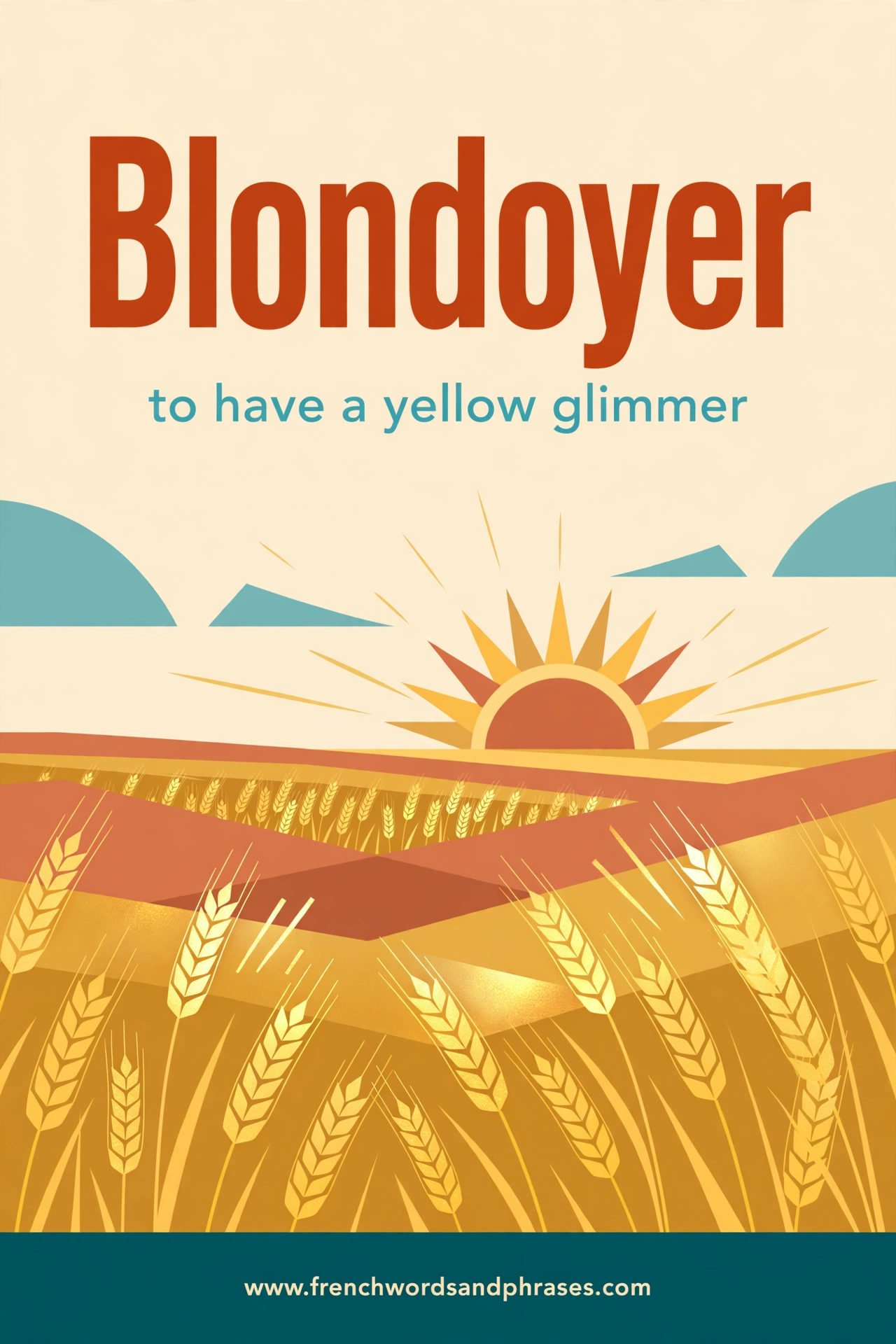
Blondoyer means to have a yellow glimmer — to shimmer golden in the light without changing colour.
Evening light on a ripe cornfield, a fair head of hair catching the sun through a window — blondoyer is the literary verb of the golden shimmer: nothing ripens, nothing changes, the gold is simply there, playing on the surface.
In this guide, you’ll learn how to conjugate blondoyer in all the major French tenses and moods. Explore complete conjugation tables, French examples, English translations, and practice quizzes.
Understanding the French Verb Blondoyer
Blondoyer is a regular French verb belonging to the first group of verbs, those ending in-er.
It means to have a yellow glimmer. It describes a shimmering, shifting golden light on wheat fields, hair, fur or a landscape at evening — the gold of a moment, not of a season. Where blondir is a slow change of colour, blondoyer is pure appearance: the surface glows gold while the light lasts.
Verb classification: First group (-er)
Auxiliary verb: Avoir
Past participle: blondoyé
Present participle: blondoyant
English equivalents: To shimmer gold, to glimmer yellow; les blés blondoyaient au loin — the wheat shimmered gold in the distance; une chevelure qui blondoie — hair with a golden glimmer; blondoyer au soleil — to glimmer gold in the sun.
One important detail: blondoyer is an -oyer verb — the y becomes i before a mute e: je blondoie, tu blondoies, il blondoie, ils blondoient, and through the future and conditional, je blondoierai, je blondoierais. The y survives where the ending is sounded: nous blondoyons, vous blondoyez, je blondoyais, en blondoyant. It is a word of literature and poetry rather than the market square — its everyday cousin is blondir, to turn golden for good.
Experience the Word
Blondoyer is the verb of gold that does not last — the glimmer of a field at seven in the evening.
Imagine the train crossing the plain at sunset. For a few minutes the whole landscape is lit from the side, and the ripe wheat does not just look yellow — it blondoie, it shimmers, wave after wave of gold running to the horizon before the light goes.
An hour later the field is only a field. It glimmered gold — blondoyé — for exactly as long as the light allowed.
How to Conjugate Blondoyer: Complete French Conjugation Guide
Let’s explore every major conjugation of blondoyer, beginning with the indicative mood.
How to Conjugate Blondoyer in the Indicative Mood
The indicative mood is used to express facts, observations, actions, and events.
How to Conjugate Blondoyer in the Present Tense (Présent)
Used for actions happening now, habitual actions, and general truths.
| Subject | Conjugation |
|---|---|
| je | blondoie |
| tu | blondoies |
| il / elle | blondoie |
| nous | blondoyons |
| vous | blondoyez |
| ils / elles | blondoient |
Example
Au loin, les champs de blé blondoient dans la lumière du soir.
In the distance, the wheat fields shimmer gold in the evening light.
Quick Quiz 1
Complete the sentence:
Nous regardons les champs qui ______ au couchant.
Reveal the answer
blondoient
Nous regardons les champs qui blondoient au couchant.
We are watching the fields shimmering gold at sunset.
How to Conjugate Blondoyer in the Passé Composé
Used for completed actions in the past. Blondoyer takes the auxiliary verb avoir.
| Subject | Conjugation |
|---|---|
| j’ | ai blondoyé |
| tu | as blondoyé |
| il / elle | a blondoyé |
| nous | avons blondoyé |
| vous | avez blondoyé |
| ils / elles | ont blondoyé |
Example
Toute la journée, la plaine a blondoyé sous un ciel sans nuages.
All day long, the plain shimmered gold under a cloudless sky.
How to Conjugate Blondoyer in the Imparfait (Imperfect Tense)
Used for habitual past actions, descriptions, and ongoing situations in the past.
| Subject | Conjugation |
|---|---|
| je | blondoyais |
| tu | blondoyais |
| il / elle | blondoyait |
| nous | blondoyions |
| vous | blondoyiez |
| ils / elles | blondoyaient |
Example
Les épis blondoyaient à perte de vue.
The ears of wheat glimmered gold as far as the eye could see.
Quick Quiz 2
Choose the correct form:
The plain shimmered gold all day.
La plaine ______ toute la journée. (a blondoyé / est blondoyée)
Reveal the answer
a blondoyé
La plaine a blondoyé toute la journée.
Blondoyer takes avoir.
How to Conjugate Blondoyer in the Plus-que-parfait
Used to describe an action that had already been completed before another past event.
| Subject | Conjugation |
|---|---|
| j’ | avais blondoyé |
| tu | avais blondoyé |
| il / elle | avait blondoyé |
| nous | avions blondoyé |
| vous | aviez blondoyé |
| ils / elles | avaient blondoyé |
Example
La colline avait blondoyé tout l’après-midi avant l’orage.
The hillside had shimmered gold all afternoon before the storm.
How to Conjugate Blondoyer in the Passé Simple
Primarily used in formal writing, literature, and historical narratives. It is rarely used in everyday conversation.
| Subject | Conjugation |
|---|---|
| je | blondoyai |
| tu | blondoyas |
| il / elle | blondoya |
| nous | blondoyâmes |
| vous | blondoyâtes |
| ils / elles | blondoyèrent |
Example
Un instant, la mer des blés blondoya sous le vent.
For a moment, the sea of wheat glimmered gold in the wind.
How to Conjugate Blondoyer in the Passé Antérieur
A literary tense used to express an action completed immediately before another past action, generally in the passé simple.
| Subject | Conjugation |
|---|---|
| j’ | eus blondoyé |
| tu | eus blondoyé |
| il / elle | eut blondoyé |
| nous | eûmes blondoyé |
| vous | eûtes blondoyé |
| ils / elles | eurent blondoyé |
Example
Dès que les blés eurent blondoyé au soleil couchant, les moissonneurs rentrèrent.
As soon as the wheat had glimmered gold in the setting sun, the harvesters went home.
How to Conjugate Blondoyer in the Future Tense (Futur Simple)
Used to describe actions that will take place in the future.
| Subject | Conjugation |
|---|---|
| je | blondoierai |
| tu | blondoieras |
| il / elle | blondoiera |
| nous | blondoierons |
| vous | blondoierez |
| ils / elles | blondoieront |
Example
Demain, à la même heure, les champs blondoieront encore.
Tomorrow, at the same hour, the fields will shimmer gold again.
How to Conjugate Blondoyer in the Futur Antérieur (Future Perfect)
Used for an action that will have been completed before a particular point in the future.
| Subject | Conjugation |
|---|---|
| j’ | aurai blondoyé |
| tu | auras blondoyé |
| il / elle | aura blondoyé |
| nous | aurons blondoyé |
| vous | aurez blondoyé |
| ils / elles | auront blondoyé |
Example
À la fin du jour, la plaine aura blondoyé pendant des heures.
By the end of the day, the plain will have shimmered gold for hours.
How to Conjugate Blondoyer in the Near Future (Futur Proche)
Used to describe something that is going to happen soon. Formed with aller + infinitive.
| Subject | Conjugation |
|---|---|
| je | vais blondoyer |
| tu | vas blondoyer |
| il / elle | va blondoyer |
| nous | allons blondoyer |
| vous | allez blondoyer |
| ils / elles | vont blondoyer |
Example
Regarde la colline : elle va blondoyer dans un instant.
Look at the hillside: it is going to glimmer gold in a moment.
How to Conjugate Blondoyer in the Conditional Mood
The conditional mood expresses what would happen under certain circumstances. It is also frequently used to make polite requests or express wishes.
How to Conjugate Blondoyer in the Present Conditional
| Subject | Conjugation |
|---|---|
| je | blondoierais |
| tu | blondoierais |
| il / elle | blondoierait |
| nous | blondoierions |
| vous | blondoieriez |
| ils / elles | blondoieraient |
Example
Sans ce voile de brume, la plaine blondoierait jusqu’à l’horizon.
Without this veil of mist, the plain would shimmer gold to the horizon.
How to Conjugate Blondoyer in the Past Conditional
| Subject | Conjugation |
|---|---|
| j’ | aurais blondoyé |
| tu | aurais blondoyé |
| il / elle | aurait blondoyé |
| nous | aurions blondoyé |
| vous | auriez blondoyé |
| ils / elles | auraient blondoyé |
Example
Les blés auraient blondoyé plus longtemps sans la pluie.
The wheat would have glimmered gold longer without the rain.
Blondoyer in the Literary Past Conditional Form
This less common literary form uses the imperfect subjunctive of avoir.
| Subject | Conjugation |
|---|---|
| j’ | eusse blondoyé |
| tu | eusses blondoyé |
| il / elle | eût blondoyé |
| nous | eussions blondoyé |
| vous | eussiez blondoyé |
| ils / elles | eussent blondoyé |
Example
Le froment eût blondoyé jusqu’au soir sans les nuages.
The wheat would have shimmered gold until evening without the clouds.
How to Conjugate Blondoyer in the Subjunctive Mood
The subjunctive is used to express wishes, emotions, doubts, necessity, and uncertainty. It frequently follows expressions such as il faut que (it is necessary that) or bien que (although).
How to Conjugate Blondoyer in the Present Subjunctive
| Subject | Conjugation |
|---|---|
| que je | blondoie |
| que tu | blondoies |
| qu’il / qu’elle | blondoie |
| que nous | blondoyions |
| que vous | blondoyiez |
| qu’ils / qu’elles | blondoient |
Example
Il semble que les champs blondoient déjà au loin.
It seems the fields are already shimmering gold in the distance.
Quick Quiz 3
Complete the sentence using the subjunctive:
Il semble que sa chevelure ______ au soleil.
Reveal the answer
blondoie
Il semble que sa chevelure blondoie au soleil.
It seems her hair glimmers gold in the sun.
How to Conjugate Blondoyer in the Imperfect Subjunctive
A literary tense, rarely encountered in modern spoken French.
| Subject | Conjugation |
|---|---|
| que je | blondoyasse |
| que tu | blondoyasses |
| qu’il / qu’elle | blondoyât |
| que nous | blondoyassions |
| que vous | blondoyassiez |
| qu’ils / qu’elles | blondoyassent |
Example
On eût dit que la plaine blondoyât sous la lune.
You would have said the plain was glimmering gold beneath the moon.
How to Conjugate Blondoyer in the Pluperfect Subjunctive
A literary construction used to express an action completed before another past action.
| Subject | Conjugation |
|---|---|
| que j’ | eusse blondoyé |
| que tu | eusses blondoyé |
| qu’il / qu’elle | eût blondoyé |
| que nous | eussions blondoyé |
| que vous | eussiez blondoyé |
| qu’ils / qu’elles | eussent blondoyé |
Example
Les voyageurs admiraient que les épis eussent blondoyé si tôt dans la saison.
The travellers admired that the wheat had shimmered gold so early in the season.
How to Conjugate Blondoyer in the Past Subjunctive
| Subject | Conjugation |
|---|---|
| que j’ | aie blondoyé |
| que tu | aies blondoyé |
| qu’il / qu’elle | ait blondoyé |
| que nous | ayons blondoyé |
| que vous | ayez blondoyé |
| qu’ils / qu’elles | aient blondoyé |
Example
Je suis heureux que la colline ait blondoyé pour notre arrivée.
I am glad the hillside shimmered gold for our arrival.
How to Conjugate Blondoyer in the Imperative
The imperative is used to give commands, instructions, invitations, or suggestions. Subject pronouns are omitted.
How to Conjugate Blondoyer in the Present Imperative
| Person | Conjugation |
|---|---|
| (tu) | blondoie |
| (nous) | blondoyons |
| (vous) | blondoyez |
Example
Blondoie encore, plaine dorée, avant la nuit !
Shimmer gold a little longer, golden plain, before the night!
Quick Quiz 4
How would you say Shimmer gold (tu form, said to a field in a poem)?
Reveal the answer
Blondoie, beau champ doré !
French Participles of Blondoyer
Participles are verb forms that can be used in compound tenses and other grammatical constructions.
Present Participle of Blondoyer
blondoyant
Blondoyant sous le soleil, les épis ondulaient doucement.
Glimmering gold in the sun, the ears of wheat swayed gently.
Past Participle of Blondoyer
blondoyé
Longtemps blondoyée par les étés, la plaine gardait sa couleur de miel.
Long glimmered gold by the summers, the plain kept its honey colour.
Blondoyer in Everyday French: Real-Life Examples
Now that you know the conjugations, let’s see how blondoyer appears in everyday French.
Example 1 — Present
Les blés blondoient au loin.
The wheat shimmers gold in the distance.
Example 2 — Passé composé
La plaine a blondoyé tout l’après-midi.
The plain shimmered gold all afternoon.
Example 3 — Imparfait
Sa chevelure blondoyait au soleil.
Her hair used to glimmer gold in the sun.
Example 4 — Future
Les champs blondoieront au couchant.
The fields will shimmer gold at sunset.
Example 5 — Conditional
Sans la brume, la colline blondoierait.
Without the mist, the hillside would glimmer gold.
Example 6 — Imperative
Blondoie encore, plaine de juin !
Shimmer on, June plain!
Beyond Translation: The Meaning of Blondoyer
French loves its verbs of coloured light, and blondoyer belongs to a whole shimmering family: verdoyer — to show green, rougoyer — to glow red, flamboyer — to blaze.
Each one is a colour caught in the act of glowing.
Blondoyer is the gentlest of them: no fire, no ripening, just ripe gold trembling in the evening air — a verb made for poets describing wheat and hair.
How to Remember the French Verb Blondoyer
Remember it this way: Blondoyer is about a wheat field glimmering gold at sunset.
- -oyer spelling: je blondoie with i, but nous blondoyons with y.
- A literary verb: it shimmers for an evening, where blondir turns gold for the season.
- Regular -er endings otherwise: je blondoie, nous blondoyons, past participle blondoyé.
The key idea is a wheat field glimmering gold at sunset.
Test Your Knowledge of Blondoyer
Let’s see how much you’ve learned. Try answering these questions before revealing the answers.
Question 1
What happens to the y of blondoyer in je blondoie?
Reveal the answer
It becomes i — je blondoie, ils blondoient — but stays y in nous blondoyons.
Question 2
How do you say The wheat shimmers gold in the distance in French?
Reveal the answer
Les blés blondoient au loin.
Question 3
Translate: The plain shimmered gold all afternoon.
Reveal the answer
La plaine a blondoyé tout l’après-midi.
Question 4
What is the difference between blondir and blondoyer?
Reveal the answer
Blondir is to turn golden for good (ripening); blondoyer is to glimmer gold in the light of the moment.
Question 5
Complete the sentence:
Il semble que les champs ______ déjà au loin.
Reveal the answer
blondoient
Il semble que les champs blondoient déjà au loin.
It seems the fields are already shimmering gold in the distance.
Your Final Challenge
Can You Use It?
How would you say this in French?
When evening came, the wheat shimmered gold to the horizon, and the train rolled through gold.
Reveal the answer
Le soir venu, les blés blondoyaient jusqu’à l’horizon, et le train roulait dans l’or.
When evening came, the wheat shimmered gold to the horizon, and the train rolled through gold.
A little French. A little curiosity. A richer everyday life.
LEARN FRENCH ONE WORD AT A TIME