A French Word to Live By
How to Conjugate Blanchir in French
/blɑ̃.ʃiʁ/
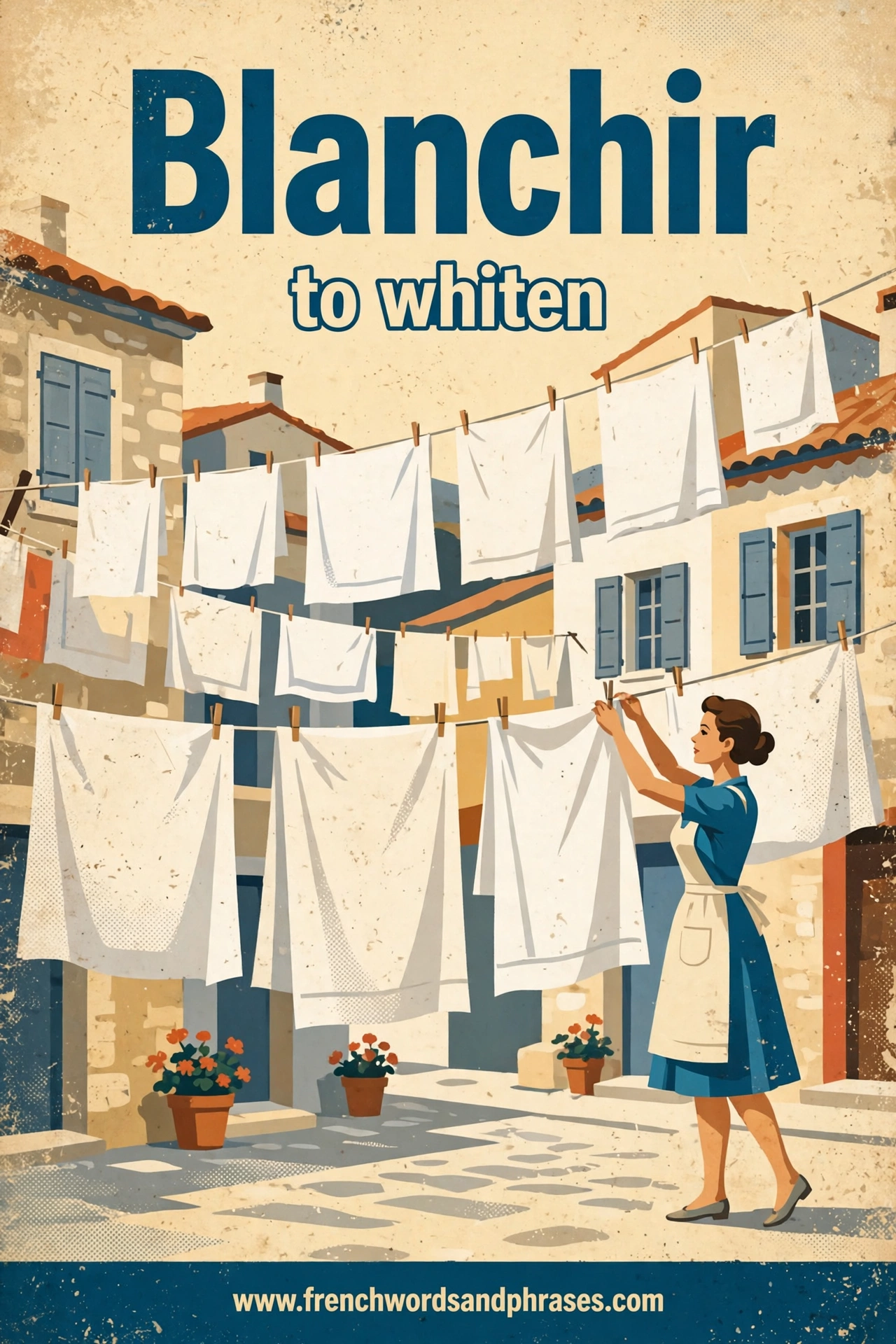
Blanchir means to whiten or to turn white.
Hair turning silver, sheets coming back bright from the wash, a cook dropping green beans into boiling water — blanchir is the verb of everything becoming white, whether we do it or time does.
In this guide, you’ll learn how to conjugate blanchir in all the major French tenses and moods. Explore complete conjugation tables, French examples, English translations, and practice quizzes.
Understanding the French Verb Blanchir
Blanchir is a regular French verb belonging to the second group of verbs, those ending in -ir.
It means to whiten, to turn white. It is commonly used for hair going white with age, linen and walls being whitened, vegetables being blanched before freezing, suspects being cleared of blame, and money being laundered.
Verb classification: Second group (-ir)
Auxiliary verb: Avoir
Past participle: blanchi
Present participle: blanchissant
English equivalents: To whiten, to turn white, to bleach; to blanch (vegetables), to launder; to clear of blame (être blanchi).
One important detail: blanchir runs a whole laundry of meanings. Cooks blanchissent vegetables — a quick dip in boiling water. Hotels blanchissent the sheets — laundering is blanchir too. In the newspapers, blanchir de l’argent is to launder money, the dishonest kind. And hair blanchit all by itself: ses cheveux blanchissent.
Experience the Word
Blanchir is the verb of the slow fade to white — of linen, of hair, of winter fields under frost.
Imagine a grandfather in a village in Provence. At twenty his hair was black as olives; at seventy it is the white of the limestone hills — and he wears it like a medal.
Time has not taken something away. It has whitened — blanchi — and left dignity behind.
How to Conjugate Blanchir: Complete French Conjugation Guide
Let’s explore every major conjugation of blanchir, beginning with the indicative mood.
How to Conjugate Blanchir in the Indicative Mood
The indicative mood is used to express facts, observations, actions, and events.
How to Conjugate Blanchir in the Present Tense (Présent)
Used for actions happening now, habitual actions, and general truths.
| Subject | Conjugation |
|---|---|
| je | blanchis |
| tu | blanchis |
| il / elle | blanchit |
| nous | blanchissons |
| vous | blanchissez |
| ils / elles | blanchissent |
Example
Le soleil blanchit les volets de la maison.
The sun is bleaching the house’s shutters white.
Quick Quiz 1
Complete the sentence:
Nous ______ le linge le samedi.
Reveal the answer
blanchissons
Nous blanchissons le linge le samedi.
We launder the linen on Saturdays.
How to Conjugate Blanchir in the Passé Composé
Used for completed actions in the past. Blanchir takes the auxiliary verb avoir.
| Subject | Conjugation |
|---|---|
| j’ | ai blanchi |
| tu | as blanchi |
| il / elle | a blanchi |
| nous | avons blanchi |
| vous | avez blanchi |
| ils / elles | ont blanchi |
Example
Elle a blanchi les haricots avant de les congeler.
She blanched the beans before freezing them.
How to Conjugate Blanchir in the Imparfait (Imperfect Tense)
Used for habitual past actions, descriptions, and ongoing situations in the past.
| Subject | Conjugation |
|---|---|
| je | blanchissais |
| tu | blanchissais |
| il / elle | blanchissait |
| nous | blanchissions |
| vous | blanchissiez |
| ils / elles | blanchissaient |
Example
Ses cheveux blanchissaient d’année en année.
His hair was turning whiter year by year.
Quick Quiz 2
Choose the correct form:
The investigation cleared him.
L’enquête ______ . (l’a blanchi / l’est blanchi)
Reveal the answer
l’a blanchi
L’enquête l’a blanchi.
Blanchir takes avoir.
How to Conjugate Blanchir in the Plus-que-parfait
Used to describe an action that had already been completed before another past event.
| Subject | Conjugation |
|---|---|
| j’ | avais blanchi |
| tu | avais blanchi |
| il / elle | avait blanchi |
| nous | avions blanchi |
| vous | aviez blanchi |
| ils / elles | avaient blanchi |
Example
La neige avait blanchi les toits pendant la nuit.
The snow had whitened the roofs during the night.
How to Conjugate Blanchir in the Passé Simple
Primarily used in formal writing, literature, and historical narratives. It is rarely used in everyday conversation.
| Subject | Conjugation |
|---|---|
| je | blanchis |
| tu | blanchis |
| il / elle | blanchit |
| nous | blanchîmes |
| vous | blanchîtes |
| ils / elles | blanchirent |
Example
Le givre blanchit les champs au matin.
The frost whitened the fields in the morning.
How to Conjugate Blanchir in the Passé Antérieur
A literary tense used to express an action completed immediately before another past action, generally in the passé simple.
| Subject | Conjugation |
|---|---|
| j’ | eus blanchi |
| tu | eus blanchi |
| il / elle | eut blanchi |
| nous | eûmes blanchi |
| vous | eûtes blanchi |
| ils / elles | eurent blanchi |
Example
Quand elle eut blanchi les draps, elle les étendit.
When she had laundered the sheets, she hung them out.
How to Conjugate Blanchir in the Future Tense (Futur Simple)
Used to describe actions that will take place in the future.
| Subject | Conjugation |
|---|---|
| je | blanchirai |
| tu | blanchiras |
| il / elle | blanchira |
| nous | blanchirons |
| vous | blanchirez |
| ils / elles | blanchiront |
Example
Le temps blanchira nos cheveux à tous.
Time will whiten all our hair.
How to Conjugate Blanchir in the Futur Antérieur (Future Perfect)
Used for an action that will have been completed before a particular point in the future.
| Subject | Conjugation |
|---|---|
| j’ | aurai blanchi |
| tu | auras blanchi |
| il / elle | aura blanchi |
| nous | aurons blanchi |
| vous | aurez blanchi |
| ils / elles | auront blanchi |
Example
À la fin de l’été, le soleil aura blanchi les rideaux.
By the end of the summer, the sun will have bleached the curtains.
How to Conjugate Blanchir in the Near Future (Futur Proche)
Used to describe something that is going to happen soon. Formed with aller + infinitive.
| Subject | Conjugation |
|---|---|
| je | vais blanchir |
| tu | vas blanchir |
| il / elle | va blanchir |
| nous | allons blanchir |
| vous | allez blanchir |
| ils / elles | vont blanchir |
Example
Je vais blanchir les asperges quelques minutes.
I am going to blanch the asparagus for a few minutes.
How to Conjugate Blanchir in the Conditional Mood
The conditional mood expresses what would happen under certain circumstances. It is also frequently used to make polite requests or express wishes.
How to Conjugate Blanchir in the Present Conditional
| Subject | Conjugation |
|---|---|
| je | blanchirais |
| tu | blanchirais |
| il / elle | blanchirait |
| nous | blanchirions |
| vous | blanchiriez |
| ils / elles | blanchiraient |
Example
Sans la neige, rien ne blanchirait le paysage.
Without snow, nothing would whiten the landscape.
How to Conjugate Blanchir in the Past Conditional
| Subject | Conjugation |
|---|---|
| j’ | aurais blanchi |
| tu | aurais blanchi |
| il / elle | aurait blanchi |
| nous | aurions blanchi |
| vous | auriez blanchi |
| ils / elles | auraient blanchi |
Example
Il aurait blanchi les murs avant de vendre.
He would have whitewashed the walls before selling.
Blanchir in the Literary Past Conditional Form
This less common literary form uses the imperfect subjunctive of avoir.
| Subject | Conjugation |
|---|---|
| j’ | eusse blanchi |
| tu | eusses blanchi |
| il / elle | eût blanchi |
| nous | eussions blanchi |
| vous | eussiez blanchi |
| ils / elles | eussent blanchi |
Example
Le givre eût blanchi la plaine entière.
The frost would have whitened the whole plain.
How to Conjugate Blanchir in the Subjunctive Mood
The subjunctive is used to express wishes, emotions, doubts, necessity, and uncertainty. It frequently follows expressions such as il faut que (it is necessary that) or bien que (although).
How to Conjugate Blanchir in the Present Subjunctive
| Subject | Conjugation |
|---|---|
| que je | blanchisse |
| que tu | blanchisses |
| qu’il / qu’elle | blanchisse |
| que nous | blanchissions |
| que vous | blanchissiez |
| qu’ils / qu’elles | blanchissent |
Example
Il faut que tu blanchisses les légumes d’abord.
You must blanch the vegetables first.
Quick Quiz 3
Complete the sentence using the subjunctive:
Il faut que vous ______ les asperges.
Reveal the answer
blanchissiez
Il faut que vous blanchissiez les asperges.
You must blanch the asparagus.
How to Conjugate Blanchir in the Imperfect Subjunctive
A literary tense, rarely encountered in modern spoken French.
| Subject | Conjugation |
|---|---|
| que je | blanchisse |
| que tu | blanchisses |
| qu’il / qu’elle | blanchît |
| que nous | blanchissions |
| que vous | blanchissiez |
| qu’ils / qu’elles | blanchissent |
Example
Elle espérait que le temps blanchît ses cheveux avec douceur.
She hoped time would whiten her hair gently.
How to Conjugate Blanchir in the Pluperfect Subjunctive
A literary construction used to express an action completed before another past action.
| Subject | Conjugation |
|---|---|
| que j’ | eusse blanchi |
| que tu | eusses blanchi |
| qu’il / qu’elle | eût blanchi |
| que nous | eussions blanchi |
| que vous | eussiez blanchi |
| qu’ils / qu’elles | eussent blanchi |
Example
Il semblait que la neige eût blanchi les sommets.
It seemed the snow had whitened the peaks.
How to Conjugate Blanchir in the Past Subjunctive
| Subject | Conjugation |
|---|---|
| que j’ | aie blanchi |
| que tu | aies blanchi |
| qu’il / qu’elle | ait blanchi |
| que nous | ayons blanchi |
| que vous | ayez blanchi |
| qu’ils / qu’elles | aient blanchi |
Example
Je suis content que l’enquête ait blanchi ton frère.
I am glad the investigation cleared your brother.
How to Conjugate Blanchir in the Imperative
The imperative is used to give commands, instructions, invitations, or suggestions. Subject pronouns are omitted.
How to Conjugate Blanchir in the Present Imperative
| Person | Conjugation |
|---|---|
| (tu) | blanchis |
| (nous) | blanchissons |
| (vous) | blanchissez |
Example
Blanchis les haricots deux minutes, pas plus !
Blanch the beans for two minutes, no more!
Quick Quiz 4
How would you say Blanch them (tu form)?
Reveal the answer
Blanchis-les !
French Participles of Blanchir
Participles are verb forms that can be used in compound tenses and other grammatical constructions.
Present Participle of Blanchir
blanchissant
En blanchissant les murs, il a transformé la pièce.
By whitewashing the walls, he transformed the room.
Past Participle of Blanchir
blanchi
Blanchi par les ans, le vieux marin racontait la mer.
Whitened by the years, the old sailor told tales of the sea.
Blanchir in Everyday French: Real-Life Examples
Now that you know the conjugations, let’s see how blanchir appears in everyday French.
Example 1 — Present
Ses cheveux blanchissent lentement.
His hair is slowly turning white.
Example 2 — Passé composé
La neige a blanchi les toits.
The snow has whitened the roofs.
Example 3 — Imparfait
Autrefois, on blanchissait le linge à la rivière.
In the old days, people used to wash the linen white in the river.
Example 4 — Future
Le soleil blanchira les volets.
The sun will bleach the shutters.
Example 5 — Conditional
Je blanchirais les murs du salon.
I would whitewash the living-room walls.
Example 6 — Imperative
Blanchissez les légumes avant de les congeler !
Blanch the vegetables before freezing them!
Beyond Translation: The Meaning of Blanchir
English needs whiten, bleach, blanch, launder and clear; French sends them all through blanchir — if it ends up white, or clean, blanchir was probably involved.
Even reputations pass through it.
To be blanchi by an investigation is to come out white — cleared of every stain. In French, innocence is a colour, and the colour is white.
How to Remember the French Verb Blanchir
Remember it this way: Blanchir is about turning white — hair, linen, vegetables.
- Blanchir les légumes — to blanch vegetables, a short dip in boiling water.
- Blanchir de l’argent — to launder money; être blanchi — to be cleared of blame.
- Regular -ir: je blanchis, nous blanchissons, past participle blanchi.
The key idea is turning white — hair, linen, vegetables.
Test Your Knowledge of Blanchir
Let’s see how much you’ve learned. Try answering these questions before revealing the answers.
Question 1
What does a cook do when she blanchit les légumes?
Reveal the answer
She blanches them — a quick dip in boiling water to keep their colour and bite.
Question 2
How do you say His hair is turning white in French?
Reveal the answer
Ses cheveux blanchissent.
Question 3
Translate: The snow whitened the roofs.
Reveal the answer
La neige a blanchi les toits.
Question 4
What is the past participle of blanchir?
Reveal the answer
Blanchi.
Question 5
Complete the sentence:
Il faut que tu ______ les légumes d’abord.
Reveal the answer
blanchisses
Il faut que tu blanchisses les légumes d’abord.
You must blanch the vegetables first.
Your Final Challenge
Can You Use It?
How would you say this in French?
Winter whitens the roofs, and the village falls silent.
Reveal the answer
L’hiver blanchit les toits, et le village devient silencieux.
Winter whitens the roofs, and the village falls silent.
A little French. A little curiosity. A richer everyday life.
LEARN FRENCH ONE WORD AT A TIME