A French Word to Live By
How to Conjugate Bistrer in French
/bis.tʁe/
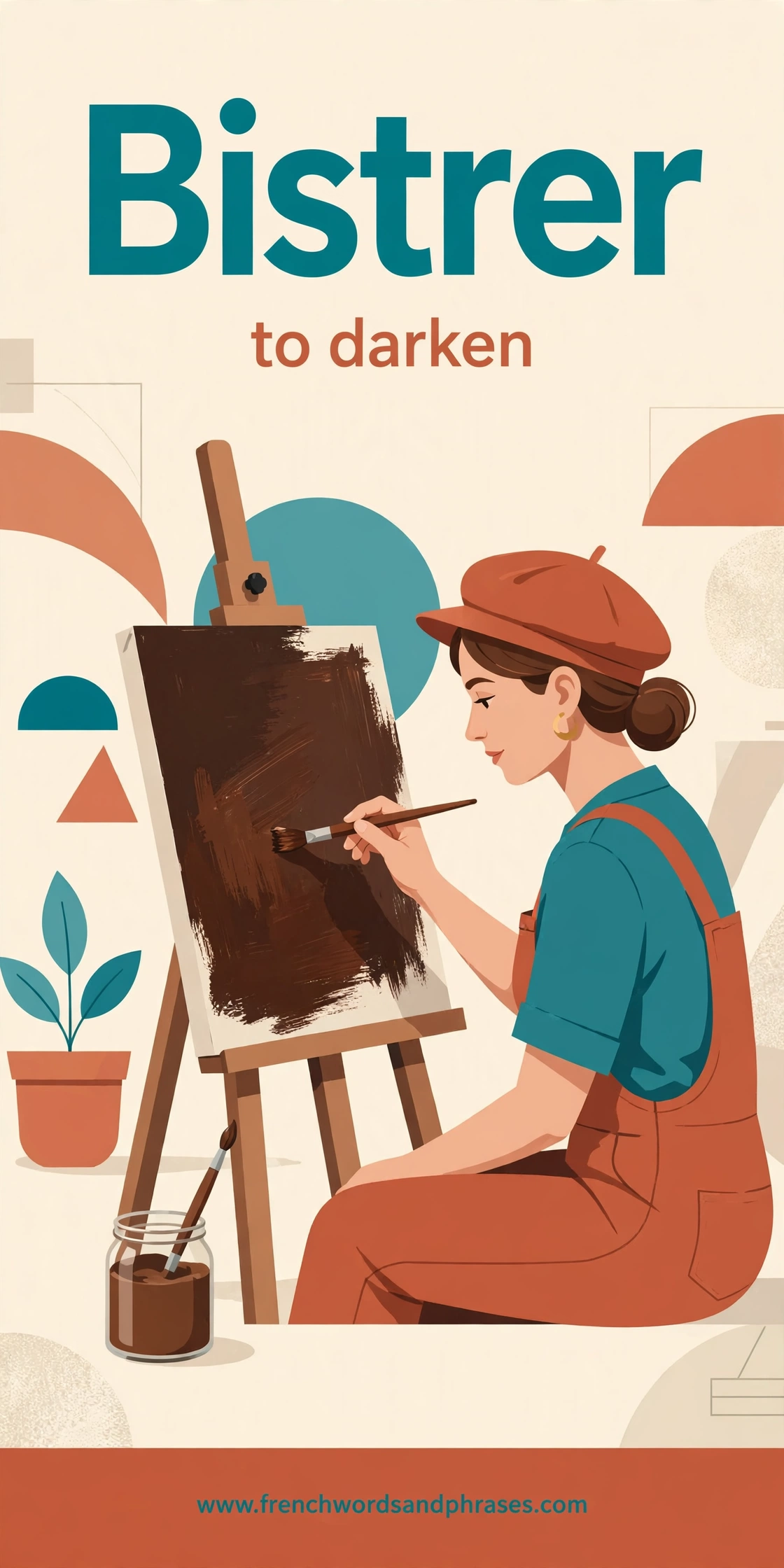
Bistrer means to darken — to give something the deep brown tint of bistre, as sun darkens skin and smoke darkens a ceiling.
A sailor’s face after a summer at sea, a kitchen ceiling after years of wood smoke, the brown wash of an old master’s drawing — bistrer is the verb of that slow, warm darkening, the colour of soot and sunlight settling into things.
In this guide, you’ll learn how to conjugate bistrer in all the major French tenses and moods. Explore complete conjugation tables, French examples, English translations, and practice quizzes.
Understanding the French Verb Bistrer
Bistrer is a regular French verb belonging to the first group of verbs, those ending in -er.
It means to darken. It is a literary and painterly verb rather than a kitchen one: everyday French says bronzer for a suntan and noircir for darkening in general, but bistrer keeps the specific warm-brown tint of soot, sun and age, and writers reach for it when a face, a wall or a page has been browned by life.
Verb classification: First group (-er)
Auxiliary verb: Avoir
Past participle: bistré
Present participle: bistrant
English equivalents: To darken, to colour bistre-brown; le bistre — bistre, a brown pigment made from wood soot; le soleil bistre la peau — the sun darkens (tans) the skin; la fumée bistre les murs — smoke darkens the walls; un teint bistré — a swarthy, sun-darkened complexion.
One important detail: bistrer is the verb of a substance — le bistre, the transparent brown pigment that old artists made from the soot of wood fires and used for washed drawings. To bistrer is therefore always to darken towards that warm brown: sun on skin, smoke on plaster, time on paper. The verb itself is a model regular -er with nothing to hide: je bistre, nous bistrons, ils bistrent, past participle bistré — and the participle lives a second life as an adjective, un teint bistré, a dark, sun-browned complexion.
Experience the Word
Bistrer is the verb of the slow brown — nothing turns black at once; everything is bistré a little at a time.
Imagine the fisherman of a Breton port at the end of August. In May his face was pale from the winter indoors; now, after a hundred mornings on the water, le soleil l’a bistré — his skin has the deep, even brown of an old drawing, and the white mark of his watch strap tells the whole story.
He has not been painted or burned. He has been darkened — bistré, gently, by a whole summer of sun.
How to Conjugate Bistrer: Complete French Conjugation Guide
Let’s explore every major conjugation of bistrer, beginning with the indicative mood.
How to Conjugate Bistrer in the Indicative Mood
The indicative mood is used to express facts, observations, actions, and events.
How to Conjugate Bistrer in the Present Tense (Présent)
Used for actions happening now, habitual actions, and general truths.
| Subject | Conjugation |
|---|---|
| je | bistre |
| tu | bistres |
| il / elle | bistre |
| nous | bistrons |
| vous | bistrez |
| ils / elles | bistrent |
Example
Le soleil bistre la peau des marins.
The sun darkens the sailors’ skin.
Quick Quiz 1
Complete the sentence:
Le soleil ______ la peau des marins.
Reveal the answer
bistre
Le soleil bistre la peau des marins.
The sun darkens the sailors’ skin.
How to Conjugate Bistrer in the Passé Composé
Used for completed actions in the past. Bistrer takes the auxiliary verb avoir.
| Subject | Conjugation |
|---|---|
| j’ | ai bistré |
| tu | as bistré |
| il / elle | a bistré |
| nous | avons bistré |
| vous | avez bistré |
| ils / elles | ont bistré |
Example
Le soleil a bistré son visage pendant la traversée.
The sun tanned his face during the crossing.
How to Conjugate Bistrer in the Imparfait (Imperfect Tense)
Used for habitual past actions, descriptions, and ongoing situations in the past.
| Subject | Conjugation |
|---|---|
| je | bistrais |
| tu | bistrais |
| il / elle | bistrait |
| nous | bistrions |
| vous | bistriez |
| ils / elles | bistraient |
Example
La fumée bistrait peu à peu le plafond de la cuisine.
The smoke gradually darkened the kitchen ceiling.
Quick Quiz 2
Choose the correct form:
The smoke darkened the walls.
La fumée ______ les murs. (a bistré / est bistré)
Reveal the answer
a bistré
La fumée a bistré les murs.
Bistrer takes avoir.
How to Conjugate Bistrer in the Plus-que-parfait
Used to describe an action that had already been completed before another past event.
| Subject | Conjugation |
|---|---|
| j’ | avais bistré |
| tu | avais bistré |
| il / elle | avait bistré |
| nous | avions bistré |
| vous | aviez bistré |
| ils / elles | avaient bistré |
Example
Le temps avait bistré les pages du vieux manuscrit.
Time had darkened the pages of the old manuscript.
How to Conjugate Bistrer in the Passé Simple
Primarily used in formal writing, literature, and historical narratives. It is rarely used in everyday conversation.
| Subject | Conjugation |
|---|---|
| je | bistrai |
| tu | bistras |
| il / elle | bistra |
| nous | bistrâmes |
| vous | bistrâtes |
| ils / elles | bistrèrent |
Example
En quelques semaines, le soleil du désert bistra les voyageurs.
Within a few weeks, the desert sun darkened the travellers.
How to Conjugate Bistrer in the Passé Antérieur
A literary tense used to express an action completed immediately before another past action, generally in the passé simple.
| Subject | Conjugation |
|---|---|
| j’ | eus bistré |
| tu | eus bistré |
| il / elle | eut bistré |
| nous | eûmes bistré |
| vous | eûtes bistré |
| ils / elles | eurent bistré |
Example
Quand la fumée eut bistré les murs, on repeignit la pièce.
When the smoke had darkened the walls, the room was repainted.
How to Conjugate Bistrer in the Future Tense (Futur Simple)
Used to describe actions that will take place in the future.
| Subject | Conjugation |
|---|---|
| je | bistrerai |
| tu | bistreras |
| il / elle | bistrera |
| nous | bistrerons |
| vous | bistrerez |
| ils / elles | bistreront |
Example
Cet été, le soleil bistrera nos visages.
This summer, the sun will tan our faces.
How to Conjugate Bistrer in the Futur Antérieur (Future Perfect)
Used for an action that will have been completed before a particular point in the future.
| Subject | Conjugation |
|---|---|
| j’ | aurai bistré |
| tu | auras bistré |
| il / elle | aura bistré |
| nous | aurons bistré |
| vous | aurez bistré |
| ils / elles | auront bistré |
Example
À la fin de l’été, le soleil aura bistré tous les baigneurs.
By the end of the summer, the sun will have tanned all the bathers.
How to Conjugate Bistrer in the Near Future (Futur Proche)
Used to describe something that is going to happen soon. Formed with aller + infinitive.
| Subject | Conjugation |
|---|---|
| je | vais bistrer |
| tu | vas bistrer |
| il / elle | va bistrer |
| nous | allons bistrer |
| vous | allez bistrer |
| ils / elles | vont bistrer |
Example
Reste à l’ombre, le soleil va te bistrer la peau.
Stay in the shade, the sun is going to darken your skin.
How to Conjugate Bistrer in the Conditional Mood
The conditional mood expresses what would happen under certain circumstances. It is also frequently used to make polite requests or express wishes.
How to Conjugate Bistrer in the Present Conditional
| Subject | Conjugation |
|---|---|
| je | bistrerais |
| tu | bistrerais |
| il / elle | bistrerait |
| nous | bistrerions |
| vous | bistreriez |
| ils / elles | bistreraient |
Example
Sans la fumée, rien ne bistrerait ces murs blancs.
Without the smoke, nothing would darken these white walls.
How to Conjugate Bistrer in the Past Conditional
| Subject | Conjugation |
|---|---|
| j’ | aurais bistré |
| tu | aurais bistré |
| il / elle | aurait bistré |
| nous | aurions bistré |
| vous | auriez bistré |
| ils / elles | auraient bistré |
Example
Le soleil aurait bistré sa peau sans la crème solaire.
The sun would have tanned her skin without the sunscreen.
Bistrer in the Literary Past Conditional Form
This less common literary form uses the imperfect subjunctive of avoir.
| Subject | Conjugation |
|---|---|
| j’ | eusse bistré |
| tu | eusses bistré |
| il / elle | eût bistré |
| nous | eussions bistré |
| vous | eussiez bistré |
| ils / elles | eussent bistré |
Example
Le temps eût bistré ces pages comme il bistre les visages.
Time would have darkened these pages as it darkens faces.
How to Conjugate Bistrer in the Subjunctive Mood
The subjunctive is used to express wishes, emotions, doubts, necessity, and uncertainty. It frequently follows expressions such as il faut que (it is necessary that) or bien que (although).
How to Conjugate Bistrer in the Present Subjunctive
| Subject | Conjugation |
|---|---|
| que je | bistre |
| que tu | bistres |
| qu’il / qu’elle | bistre |
| que nous | bistrions |
| que vous | bistriez |
| qu’ils / qu’elles | bistrent |
Example
Il se peut que la fumée bistre les rideaux.
The smoke may darken the curtains.
Quick Quiz 3
Complete the sentence using the subjunctive:
Il se peut que la fumée ______ les rideaux.
Reveal the answer
bistre
Il se peut que la fumée bistre les rideaux.
The smoke may darken the curtains.
How to Conjugate Bistrer in the Imperfect Subjunctive
A literary tense, rarely encountered in modern spoken French.
| Subject | Conjugation |
|---|---|
| que je | bistrasse |
| que tu | bistrasses |
| qu’il / qu’elle | bistrât |
| que nous | bistrassions |
| que vous | bistrassiez |
| qu’ils / qu’elles | bistrassent |
Example
On craignait que le soleil ne bistrât la peau fragile de l’enfant.
They feared the sun might darken the child’s fragile skin.
How to Conjugate Bistrer in the Pluperfect Subjunctive
A literary construction used to express an action completed before another past action.
| Subject | Conjugation |
|---|---|
| que j’ | eusse bistré |
| que tu | eusses bistré |
| qu’il / qu’elle | eût bistré |
| que nous | eussions bistré |
| que vous | eussiez bistré |
| qu’ils / qu’elles | eussent bistré |
Example
On remarqua que la fumée eût bistré tout le plafond.
They noticed that the smoke had darkened the whole ceiling.
How to Conjugate Bistrer in the Past Subjunctive
| Subject | Conjugation |
|---|---|
| que j’ | aie bistré |
| que tu | aies bistré |
| qu’il / qu’elle | ait bistré |
| que nous | ayons bistré |
| que vous | ayez bistré |
| qu’ils / qu’elles | aient bistré |
Example
Je suis étonné que le soleil ait bistré sa peau si vite.
I am amazed the sun darkened her skin so quickly.
How to Conjugate Bistrer in the Imperative
The imperative is used to give commands, instructions, invitations, or suggestions. Subject pronouns are omitted.
How to Conjugate Bistrer in the Present Imperative
| Person | Conjugation |
|---|---|
| (tu) | bistre |
| (nous) | bistrons |
| (vous) | bistrez |
Example
Bistrez légèrement le papier pour lui donner un air ancien.
Darken the paper slightly to give it an aged look.
Quick Quiz 4
How would you say Darken the edges a little (tu form)?
Reveal the answer
Bistre un peu les bords !
French Participles of Bistrer
Participles are verb forms that can be used in compound tenses and other grammatical constructions.
Present Participle of Bistrer
bistrant
En bistrant le papier, l’artiste imite les vieux dessins.
By darkening the paper, the artist imitates old drawings.
Past Participle of Bistrer
bistré
Bistrée par le soleil, sa peau avait pris une teinte de bronze.
Darkened by the sun, her skin had taken on a bronze tint.
Bistrer in Everyday French: Real-Life Examples
Now that you know the conjugations, let’s see how bistrer appears in everyday French.
Example 1 — Present
Le soleil bistre la peau des marins.
The sun darkens the sailors’ skin.
Example 2 — Passé composé
La fumée a bistré le plafond.
The smoke darkened the ceiling.
Example 3 — Imparfait
Le temps bistrait lentement les vieilles photos.
Time slowly darkened the old photographs.
Example 4 — Future
Le soleil bistrera vos visages cet été.
The sun will tan your faces this summer.
Example 5 — Conditional
La fumée bistrerait les murs sans ventilation.
Smoke would darken the walls without ventilation.
Example 6 — Imperative
Bistre un peu les bords du dessin !
Darken the edges of the drawing a little!
Beyond Translation: The Meaning of Bistrer
English has the same word in the art shop — bistre (or bister), the brown pigment ground from beechwood soot — but only French turned it into a living verb: bistrer.
Every bistré surface tells where it has been.
A face bistré par le soleil has worked outdoors; a ceiling bistré par la fumée has warmed a family for years; a page bistrée par le temps has been read for centuries. The verb browns, and in browning, it remembers.
How to Remember the French Verb Bistrer
Remember it this way: Bistrer is about the sailor’s face browned by a whole summer of sun.
- Le bistre is a brown pigment made from wood soot — bistrer is to give that warm brown tint.
- Three great darkeners: le soleil (skin), la fumée (walls), le temps (paper).
- Regular -er: je bistre, nous bistrons, past participle bistré — also an adjective: un teint bistré.
The key idea is the sailor’s face browned by a whole summer of sun.
Test Your Knowledge of Bistrer
Let’s see how much you’ve learned. Try answering these questions before revealing the answers.
Question 1
What is le bistre, originally?
Reveal the answer
A brown pigment made from wood soot — the tint the verb gives to skin, walls and paper.
Question 2
How do you say The sun tanned his face in French?
Reveal the answer
Le soleil a bistré son visage.
Question 3
Translate: The smoke darkened the ceiling.
Reveal the answer
La fumée a bistré le plafond.
Question 4
What is the past participle of bistrer?
Reveal the answer
Bistré — also an adjective: un teint bistré, a sun-darkened complexion.
Question 5
Complete the sentence:
______ par le soleil, sa peau avait pris une teinte de bronze.
Reveal the answer
Bistrée
Bistrée par le soleil, sa peau avait pris une teinte de bronze.
Darkened by the sun, her skin had taken on a bronze tint.
Your Final Challenge
Can You Use It?
How would you say this in French?
The sun has darkened the sailor’s face, and every wrinkle there tells of a crossing.
Reveal the answer
Le soleil a bistré le visage du marin, et chaque ride y raconte une traversée.
The sun has darkened the sailor’s face, and every wrinkle there tells of a crossing.
A little French. A little curiosity. A richer everyday life.
LEARN FRENCH ONE WORD AT A TIME