A French Word to Live By
How to Conjugate Bisegmenter in French
/bi.sɛɡ.mɑ̃.te/
Bisegmenter means to bisect — in geometry, to cut a segment or an angle into two exactly equal parts.
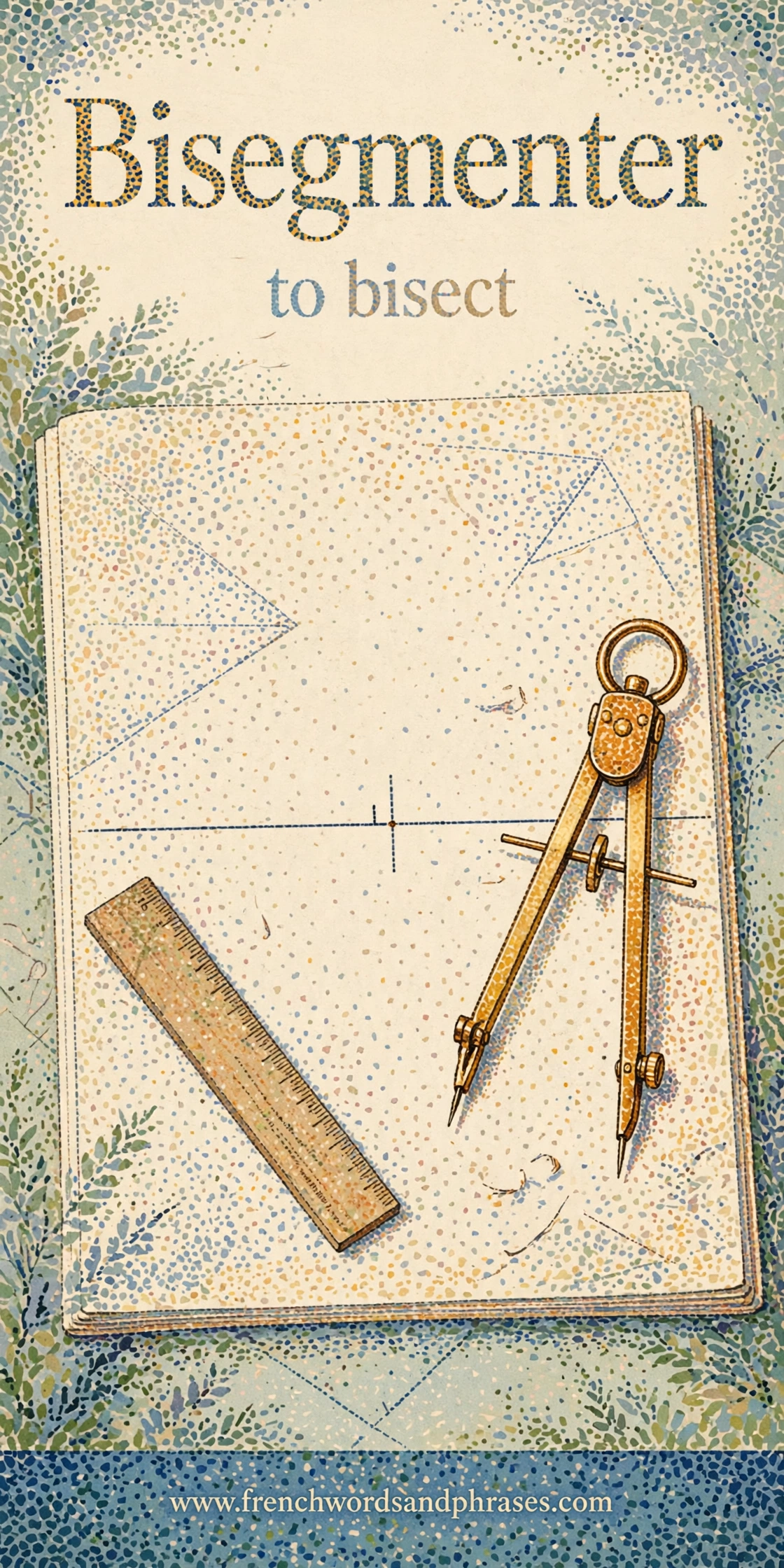
A geometry classroom, compass in hand, a segment drawn on the board and the whole class hunting for its exact middle — bisegmenter is the technical verb of the perfect half: one line, two equal parts, no argument possible.
In this guide, you’ll learn how to conjugate bisegmenter in all the major French tenses and moods. Explore complete conjugation tables, French examples, English translations, and practice quizzes.
Understanding the French Verb Bisegmenter
Bisegmenter is a regular French verb belonging to the first group of verbs, those ending in -er.
It means to bisect. It applies to the objects of geometry — segments, angles, sometimes arcs — and always means an exact, provable halving, not a rough division: to bisegmenter is to cut in two with a compass’s certainty, not a cook’s approximation.
Verb classification: First group (-er)
Auxiliary verb: Avoir
Past participle: bisegmenté
Present participle: bisegmentant
English equivalents: To bisect, to cut into two equal parts (geometry); bisegmenter un segment — to bisect a segment; bisegmenter un angle — to bisect an angle; la bissectrice — the bisector, the line that does the cutting.
One important detail: bisegmenter is a rare, learned word — a transparent construction from bi-, two, and segmenter, to segment. Everyday and classroom French usually prefers couper en deux parties égales or partager en deux, and the famous member of the family is not the verb at all but the noun la bissectrice, the bisector of an angle. When you meet bisegmenter, it will be in a technical text, doing its one precise job. The verb is a regular -er: je bisegmente, nous bisegmentons, past participle bisegmenté.
Experience the Word
Bisegmenter is the verb of the provable half — geometry’s promise that a thing can be divided with absolute fairness.
Imagine a pupil with a compass, faced with a long segment on the page. Two arcs from one end, two arcs from the other, a line through the crossings — elle bisegmente le segment, and the midpoint stands there exact, found without ever measuring a thing.
No ruler, no numbers, no doubt. The segment has been bisected — bisegmenté — by pure geometry.
How to Conjugate Bisegmenter: Complete French Conjugation Guide
Let’s explore every major conjugation of bisegmenter, beginning with the indicative mood.
How to Conjugate Bisegmenter in the Indicative Mood
The indicative mood is used to express facts, observations, actions, and events.
How to Conjugate Bisegmenter in the Present Tense (Présent)
Used for actions happening now, habitual actions, and general truths.
| Subject | Conjugation |
|---|---|
| je | bisegmente |
| tu | bisegmentes |
| il / elle | bisegmente |
| nous | bisegmentons |
| vous | bisegmentez |
| ils / elles | bisegmentent |
Example
La médiatrice bisegmente le segment en son milieu.
The perpendicular bisector bisects the segment at its midpoint.
Quick Quiz 1
Complete the sentence:
Nous ______ le segment en deux parties égales.
Reveal the answer
bisegmentons
Nous bisegmentons le segment en deux parties égales.
We bisect the segment into two equal parts.
How to Conjugate Bisegmenter in the Passé Composé
Used for completed actions in the past. Bisegmenter takes the auxiliary verb avoir.
| Subject | Conjugation |
|---|---|
| j’ | ai bisegmenté |
| tu | as bisegmenté |
| il / elle | a bisegmenté |
| nous | avons bisegmenté |
| vous | avez bisegmenté |
| ils / elles | ont bisegmenté |
Example
L’élève a bisegmenté l’angle avec son compas.
The pupil bisected the angle with his compass.
How to Conjugate Bisegmenter in the Imparfait (Imperfect Tense)
Used for habitual past actions, descriptions, and ongoing situations in the past.
| Subject | Conjugation |
|---|---|
| je | bisegmentais |
| tu | bisegmentais |
| il / elle | bisegmentait |
| nous | bisegmentions |
| vous | bisegmentiez |
| ils / elles | bisegmentaient |
Example
Le professeur bisegmentait chaque segment au tableau.
The teacher used to bisect each segment on the board.
Quick Quiz 2
Choose the correct form:
The pupil bisected the angle.
L’élève ______ l’angle. (a bisegmenté / est bisegmenté)
Reveal the answer
a bisegmenté
L’élève a bisegmenté l’angle.
Bisegmenter takes avoir.
How to Conjugate Bisegmenter in the Plus-que-parfait
Used to describe an action that had already been completed before another past event.
| Subject | Conjugation |
|---|---|
| j’ | avais bisegmenté |
| tu | avais bisegmenté |
| il / elle | avait bisegmenté |
| nous | avions bisegmenté |
| vous | aviez bisegmenté |
| ils / elles | avaient bisegmenté |
Example
Nous avions bisegmenté la droite avant de tracer le cercle.
We had bisected the line before drawing the circle.
How to Conjugate Bisegmenter in the Passé Simple
Primarily used in formal writing, literature, and historical narratives. It is rarely used in everyday conversation.
| Subject | Conjugation |
|---|---|
| je | bisegmentai |
| tu | bisegmentas |
| il / elle | bisegmenta |
| nous | bisegmentâmes |
| vous | bisegmentâtes |
| ils / elles | bisegmentèrent |
Example
Elle bisegmenta l’angle d’un trait sûr.
She bisected the angle with a confident stroke.
How to Conjugate Bisegmenter in the Passé Antérieur
A literary tense used to express an action completed immediately before another past action, generally in the passé simple.
| Subject | Conjugation |
|---|---|
| j’ | eus bisegmenté |
| tu | eus bisegmenté |
| il / elle | eut bisegmenté |
| nous | eûmes bisegmenté |
| vous | eûtes bisegmenté |
| ils / elles | eurent bisegmenté |
Example
Quand il eut bisegmenté le segment, il marqua le milieu.
When he had bisected the segment, he marked the midpoint.
How to Conjugate Bisegmenter in the Future Tense (Futur Simple)
Used to describe actions that will take place in the future.
| Subject | Conjugation |
|---|---|
| je | bisegmenterai |
| tu | bisegmenteras |
| il / elle | bisegmentera |
| nous | bisegmenterons |
| vous | bisegmenterez |
| ils / elles | bisegmenteront |
Example
Vous bisegmenterez cet angle en deux parties égales.
You will bisect this angle into two equal parts.
How to Conjugate Bisegmenter in the Futur Antérieur (Future Perfect)
Used for an action that will have been completed before a particular point in the future.
| Subject | Conjugation |
|---|---|
| j’ | aurai bisegmenté |
| tu | auras bisegmenté |
| il / elle | aura bisegmenté |
| nous | aurons bisegmenté |
| vous | aurez bisegmenté |
| ils / elles | auront bisegmenté |
Example
À la fin de l’exercice, tu auras bisegmenté les trois segments.
By the end of the exercise, you will have bisected the three segments.
How to Conjugate Bisegmenter in the Near Future (Futur Proche)
Used to describe something that is going to happen soon. Formed with aller + infinitive.
| Subject | Conjugation |
|---|---|
| je | vais bisegmenter |
| tu | vas bisegmenter |
| il / elle | va bisegmenter |
| nous | allons bisegmenter |
| vous | allez bisegmenter |
| ils / elles | vont bisegmenter |
Example
Je vais bisegmenter ce segment pour trouver son milieu.
I am going to bisect this segment to find its midpoint.
How to Conjugate Bisegmenter in the Conditional Mood
The conditional mood expresses what would happen under certain circumstances. It is also frequently used to make polite requests or express wishes.
How to Conjugate Bisegmenter in the Present Conditional
| Subject | Conjugation |
|---|---|
| je | bisegmenterais |
| tu | bisegmenterais |
| il / elle | bisegmenterait |
| nous | bisegmenterions |
| vous | bisegmenteriez |
| ils / elles | bisegmenteraient |
Example
Avec un compas, on bisegmenterait cet angle sans mesurer.
With a compass, you could bisect this angle without measuring.
How to Conjugate Bisegmenter in the Past Conditional
| Subject | Conjugation |
|---|---|
| j’ | aurais bisegmenté |
| tu | aurais bisegmenté |
| il / elle | aurait bisegmenté |
| nous | aurions bisegmenté |
| vous | auriez bisegmenté |
| ils / elles | auraient bisegmenté |
Example
Elle aurait bisegmenté l’angle si son compas n’avait pas glissé.
She would have bisected the angle if her compass had not slipped.
Bisegmenter in the Literary Past Conditional Form
This less common literary form uses the imperfect subjunctive of avoir.
| Subject | Conjugation |
|---|---|
| j’ | eusse bisegmenté |
| tu | eusses bisegmenté |
| il / elle | eût bisegmenté |
| nous | eussions bisegmenté |
| vous | eussiez bisegmenté |
| ils / elles | eussent bisegmenté |
Example
Il eût bisegmenté le segment d’un seul trait de compas.
He would have bisected the segment with a single sweep of the compass.
How to Conjugate Bisegmenter in the Subjunctive Mood
The subjunctive is used to express wishes, emotions, doubts, necessity, and uncertainty. It frequently follows expressions such as il faut que (it is necessary that) or bien que (although).
How to Conjugate Bisegmenter in the Present Subjunctive
| Subject | Conjugation |
|---|---|
| que je | bisegmente |
| que tu | bisegmentes |
| qu’il / qu’elle | bisegmente |
| que nous | bisegmentions |
| que vous | bisegmentiez |
| qu’ils / qu’elles | bisegmentent |
Example
Il faut que tu bisegmentes l’angle exactement.
You must bisect the angle exactly.
Quick Quiz 3
Complete the sentence using the subjunctive:
Il faut que vous ______ cet angle exactement.
Reveal the answer
bisegmentiez
Il faut que vous bisegmentiez cet angle exactement.
You must bisect this angle exactly.
How to Conjugate Bisegmenter in the Imperfect Subjunctive
A literary tense, rarely encountered in modern spoken French.
| Subject | Conjugation |
|---|---|
| que je | bisegmentasse |
| que tu | bisegmentasses |
| qu’il / qu’elle | bisegmentât |
| que nous | bisegmentassions |
| que vous | bisegmentassiez |
| qu’ils / qu’elles | bisegmentassent |
Example
Le professeur exigeait que l’élève bisegmentât le segment au compas.
The teacher required the pupil to bisect the segment with the compass.
How to Conjugate Bisegmenter in the Pluperfect Subjunctive
A literary construction used to express an action completed before another past action.
| Subject | Conjugation |
|---|---|
| que j’ | eusse bisegmenté |
| que tu | eusses bisegmenté |
| qu’il / qu’elle | eût bisegmenté |
| que nous | eussions bisegmenté |
| que vous | eussiez bisegmenté |
| qu’ils / qu’elles | eussent bisegmenté |
Example
On doutait qu’il eût bisegmenté la droite correctement.
People doubted he had bisected the line correctly.
How to Conjugate Bisegmenter in the Past Subjunctive
| Subject | Conjugation |
|---|---|
| que j’ | aie bisegmenté |
| que tu | aies bisegmenté |
| qu’il / qu’elle | ait bisegmenté |
| que nous | ayons bisegmenté |
| que vous | ayez bisegmenté |
| qu’ils / qu’elles | aient bisegmenté |
Example
Je suis surpris que tu aies bisegmenté l’angle sans équerre.
I am surprised you bisected the angle without a set square.
How to Conjugate Bisegmenter in the Imperative
The imperative is used to give commands, instructions, invitations, or suggestions. Subject pronouns are omitted.
How to Conjugate Bisegmenter in the Present Imperative
| Person | Conjugation |
|---|---|
| (tu) | bisegmente |
| (nous) | bisegmentons |
| (vous) | bisegmentez |
Example
Bisegmente ce segment en deux parties égales !
Bisect this segment into two equal parts!
Quick Quiz 4
How would you say Bisect this segment (tu form)?
Reveal the answer
Bisegmente ce segment !
French Participles of Bisegmenter
Participles are verb forms that can be used in compound tenses and other grammatical constructions.
Present Participle of Bisegmenter
bisegmentant
En bisegmentant l’angle, on obtient deux angles égaux.
By bisecting the angle, you obtain two equal angles.
Past Participle of Bisegmenter
bisegmenté
Bisegmenté par la médiatrice, le segment présente deux moitiés égales.
Bisected by the perpendicular bisector, the segment shows two equal halves.
Bisegmenter in Everyday French: Real-Life Examples
Now that you know the conjugations, let’s see how bisegmenter appears in everyday French.
Example 1 — Present
La médiatrice bisegmente le segment.
The perpendicular bisector bisects the segment.
Example 2 — Passé composé
L’élève a bisegmenté l’angle.
The pupil bisected the angle.
Example 3 — Imparfait
Le professeur bisegmentait les segments au tableau.
The teacher used to bisect the segments on the board.
Example 4 — Future
Vous bisegmenterez cette droite demain.
You will bisect this line tomorrow.
Example 5 — Conditional
On bisegmenterait plus juste avec un compas neuf.
You could bisect more accurately with a new compass.
Example 6 — Imperative
Bisegmentez l’angle en deux, s’il vous plaît !
Bisect the angle in two, please!
Beyond Translation: The Meaning of Bisegmenter
Some verbs are common coins and some are museum pieces: bisegmenter is a museum piece, built openly from its Latin parts — bi-, twice, and segment.
Its family took the fame instead.
Every French schoolchild meets la bissectrice, the bisector line, and the construction au compas that finds a midpoint without measuring — bisegmenter is simply the verb standing quietly behind both.
How to Remember the French Verb Bisegmenter
Remember it this way: Bisegmenter is about a compass splitting a segment exactly in two.
- Read it in pieces: bi- (two) + segmenter (to segment) — to segment into two equal parts.
- Its famous relative is la bissectrice, the bisector; the verb itself is rare and technical.
- Everyday French says couper en deux parties égales — reach for bisegmenter only in geometry.
The key idea is a compass splitting a segment exactly in two.
Test Your Knowledge of Bisegmenter
Let’s see how much you’ve learned. Try answering these questions before revealing the answers.
Question 1
What does the bi- in bisegmenter tell you?
Reveal the answer
Two — to cut a segment or angle into two equal parts.
Question 2
How do you say The pupil bisected the angle in French?
Reveal the answer
L’élève a bisegmenté l’angle.
Question 3
Translate: You must bisect the angle exactly.
Reveal the answer
Il faut que tu bisegmentes l’angle exactement.
Question 4
What is the past participle of bisegmenter?
Reveal the answer
Bisegmenté.
Question 5
Complete the sentence:
En ______ l’angle, on obtient deux angles égaux.
Reveal the answer
bisegmentant
En bisegmentant l’angle, on obtient deux angles égaux.
By bisecting the angle, you obtain two equal angles.
Your Final Challenge
Can You Use It?
How would you say this in French?
She bisects the segment without measuring, and the midpoint appears as if by magic.
Reveal the answer
Elle bisegmente le segment sans mesurer, et le milieu apparaît comme par magie.
She bisects the segment without measuring, and the midpoint appears as if by magic.
A little French. A little curiosity. A richer everyday life.
LEARN FRENCH ONE WORD AT A TIME