A French Word to Live By
How to Conjugate Billebauder in French
/bij.bo.de/
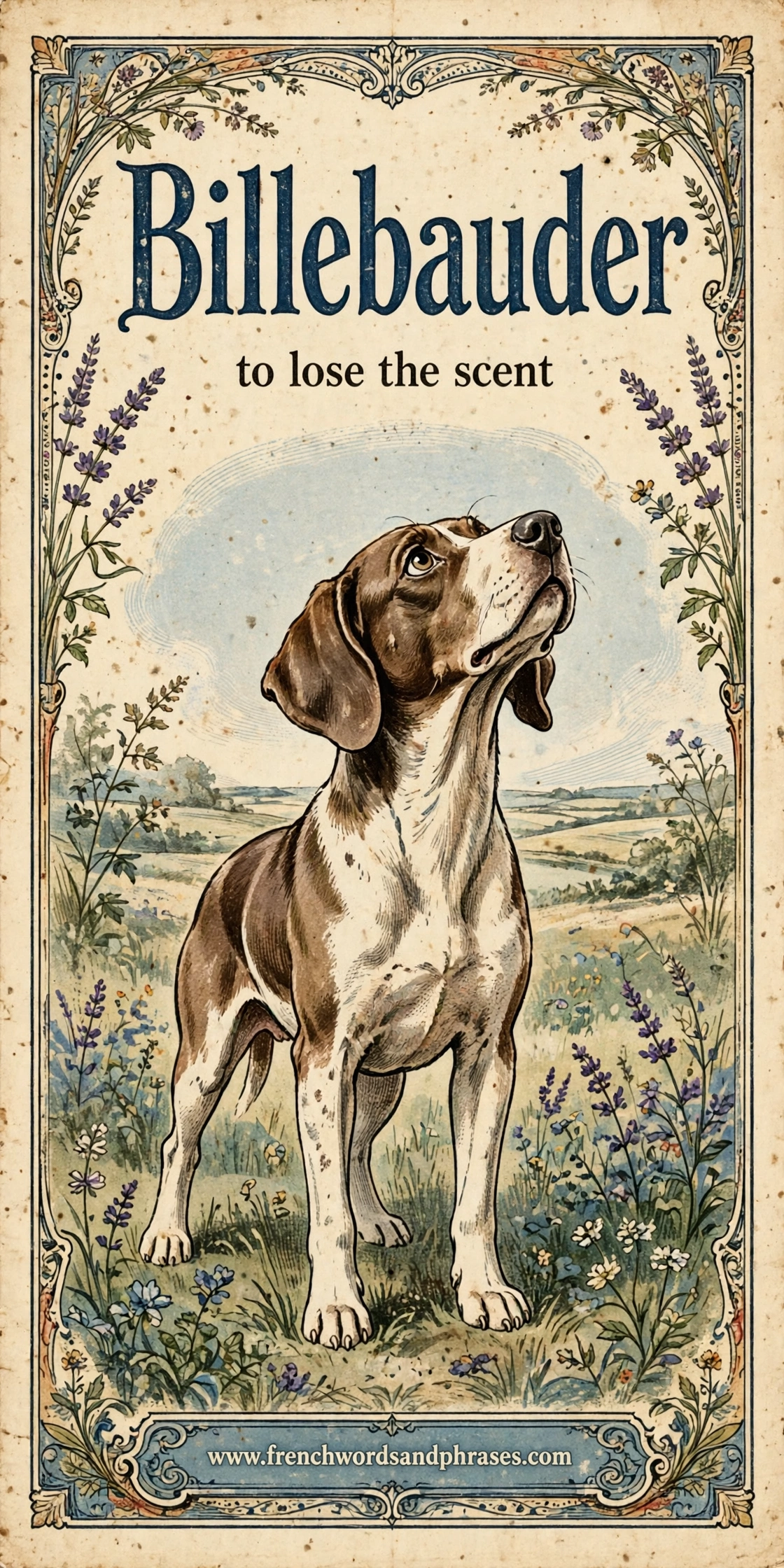
Billebauder means to lose the scent — in the language of the hunt, hounds billebaudent when the trail goes cold and the pack scatters in confusion.
Dawn in a great forest, the horns sounding, a pack of hounds streaming after a deer — until the animal crosses a stream, the line vanishes, and the pack mills about in disorder. That moment of cheerful chaos is billebauder.
In this guide, you’ll learn how to conjugate billebauder in all the major French tenses and moods. Explore complete conjugation tables, French examples, English translations, and practice quizzes.
Understanding the French Verb Billebauder
Billebauder is a regular French verb belonging to the first group of verbs, those ending in -er.
It means to lose the scent. Outside hunting glossaries the verb is rare, and it is never used of people losing a literal smell — it names the precise moment when hounds, having lost the deer’s line, cast about in every direction until a good hound finds it again.
Verb classification: First group (-er)
Auxiliary verb: Avoir
Past participle: billebaudé
Present participle: billebaudant
English equivalents: To lose the scent, to lose the trail (hunting); les chiens billebaudent — the hounds lose the line; la meute billebaude au ruisseau — the pack loses the scent at the stream; billebauder au carrefour — to mill about at the crossroads, scent lost.
One important detail: billebauder is a technical word of la vénerie, hunting with hounds, and its subject is almost always the pack — les chiens, la meute — in the third person. It comes from la billebaude, an old word for disorder and confusion that survives in the phrase à la billebaude, pell-mell, in disarray. A pack that has lost the line runs à la billebaude, and so it billebaude. The verb is a regular -er: les chiens billebaudent, la meute a billebaudé.
Experience the Word
Billebauder is the verb of the cold trail — the hunt’s moment of confusion, when sixty hounds suddenly have no idea where the deer has gone.
Imagine the pack at full cry through the forest, music in every throat. The deer crosses the stream, doubles back on its own tracks — and silence. The hounds billebaudent au bord de l’eau, noses down, tails wagging, turning in circles while the huntsman waits for one wise old hound to find the line again.
The deer is already far away. The pack has lost the scent — billebaudé — in happy, noisy confusion.
How to Conjugate Billebauder: Complete French Conjugation Guide
Let’s explore every major conjugation of billebauder, beginning with the indicative mood.
How to Conjugate Billebauder in the Indicative Mood
The indicative mood is used to express facts, observations, actions, and events.
How to Conjugate Billebauder in the Present Tense (Présent)
Used for actions happening now, habitual actions, and general truths.
| Subject | Conjugation |
|---|---|
| je | billebaude |
| tu | billebaudes |
| il / elle | billebaude |
| nous | billebaudons |
| vous | billebaudez |
| ils / elles | billebaudent |
Example
Après le ruisseau, les chiens billebaudent et perdent la voie.
After the stream, the hounds lose the scent and lose the line.
Quick Quiz 1
Complete the sentence:
Après l’étang, les chiens ______ et perdent la voie.
Reveal the answer
billebaudent
Après l’étang, les chiens billebaudent et perdent la voie.
After the pond, the hounds lose the scent and lose the line.
How to Conjugate Billebauder in the Passé Composé
Used for completed actions in the past. Billebauder takes the auxiliary verb avoir.
| Subject | Conjugation |
|---|---|
| j’ | ai billebaudé |
| tu | as billebaudé |
| il / elle | a billebaudé |
| nous | avons billebaudé |
| vous | avez billebaudé |
| ils / elles | ont billebaudé |
Example
La meute a billebaudé au bord de la rivière.
The pack lost the scent at the edge of the river.
How to Conjugate Billebauder in the Imparfait (Imperfect Tense)
Used for habitual past actions, descriptions, and ongoing situations in the past.
| Subject | Conjugation |
|---|---|
| je | billebaudais |
| tu | billebaudais |
| il / elle | billebaudait |
| nous | billebaudions |
| vous | billebaudiez |
| ils / elles | billebaudaient |
Example
Les chiens billebaudaient dès que le cerf traversait l’étang.
The hounds used to lose the scent whenever the deer crossed the pond.
Quick Quiz 2
Choose the correct form:
The pack lost the scent.
La meute ______ au ruisseau. (a billebaudé / est billebaudé)
Reveal the answer
a billebaudé
La meute a billebaudé au ruisseau.
Billebauder takes avoir.
How to Conjugate Billebauder in the Plus-que-parfait
Used to describe an action that had already been completed before another past event.
| Subject | Conjugation |
|---|---|
| j’ | avais billebaudé |
| tu | avais billebaudé |
| il / elle | avait billebaudé |
| nous | avions billebaudé |
| vous | aviez billebaudé |
| ils / elles | avaient billebaudé |
Example
La meute avait billebaudé avant même le carrefour.
The pack had lost the scent before even reaching the crossroads.
How to Conjugate Billebauder in the Passé Simple
Primarily used in formal writing, literature, and historical narratives. It is rarely used in everyday conversation.
| Subject | Conjugation |
|---|---|
| je | billebaudai |
| tu | billebaudas |
| il / elle | billebauda |
| nous | billebaudâmes |
| vous | billebaudâtes |
| ils / elles | billebaudèrent |
Example
Au sortir du bois, les chiens billebaudèrent et la chasse s’arrêta.
Coming out of the wood, the hounds lost the scent and the hunt stopped.
How to Conjugate Billebauder in the Passé Antérieur
A literary tense used to express an action completed immediately before another past action, generally in the passé simple.
| Subject | Conjugation |
|---|---|
| j’ | eus billebaudé |
| tu | eus billebaudé |
| il / elle | eut billebaudé |
| nous | eûmes billebaudé |
| vous | eûtes billebaudé |
| ils / elles | eurent billebaudé |
Example
Quand la meute eut billebaudé, le veneur sonna le retour.
When the pack had lost the scent, the huntsman sounded the return.
How to Conjugate Billebauder in the Future Tense (Futur Simple)
Used to describe actions that will take place in the future.
| Subject | Conjugation |
|---|---|
| je | billebauderai |
| tu | billebauderas |
| il / elle | billebaudera |
| nous | billebauderons |
| vous | billebauderez |
| ils / elles | billebauderont |
Example
Si le vent tourne, les chiens billebauderont avant midi.
If the wind turns, the hounds will lose the scent before noon.
How to Conjugate Billebauder in the Futur Antérieur (Future Perfect)
Used for an action that will have been completed before a particular point in the future.
| Subject | Conjugation |
|---|---|
| j’ | aurai billebaudé |
| tu | auras billebaudé |
| il / elle | aura billebaudé |
| nous | aurons billebaudé |
| vous | aurez billebaudé |
| ils / elles | auront billebaudé |
Example
À la nuit tombée, la meute aura billebaudé trois fois.
By nightfall, the pack will have lost the scent three times.
How to Conjugate Billebauder in the Near Future (Futur Proche)
Used to describe something that is going to happen soon. Formed with aller + infinitive.
| Subject | Conjugation |
|---|---|
| je | vais billebauder |
| tu | vas billebauder |
| il / elle | va billebauder |
| nous | allons billebauder |
| vous | allez billebauder |
| ils / elles | vont billebauder |
Example
Regarde la meute, elle va billebauder au prochain ruisseau.
Watch the pack, it is going to lose the scent at the next stream.
How to Conjugate Billebauder in the Conditional Mood
The conditional mood expresses what would happen under certain circumstances. It is also frequently used to make polite requests or express wishes.
How to Conjugate Billebauder in the Present Conditional
| Subject | Conjugation |
|---|---|
| je | billebauderais |
| tu | billebauderais |
| il / elle | billebauderait |
| nous | billebauderions |
| vous | billebauderiez |
| ils / elles | billebauderaient |
Example
Sans un bon chien de tête, la meute billebauderait à chaque étang.
Without a good lead hound, the pack would lose the scent at every pond.
How to Conjugate Billebauder in the Past Conditional
| Subject | Conjugation |
|---|---|
| j’ | aurais billebaudé |
| tu | aurais billebaudé |
| il / elle | aurait billebaudé |
| nous | aurions billebaudé |
| vous | auriez billebaudé |
| ils / elles | auraient billebaudé |
Example
Les chiens auraient billebaudé sans le piqueur expérimenté.
The hounds would have lost the scent without the experienced whipper-in.
Billebauder in the Literary Past Conditional Form
This less common literary form uses the imperfect subjunctive of avoir.
| Subject | Conjugation |
|---|---|
| j’ | eusse billebaudé |
| tu | eusses billebaudé |
| il / elle | eût billebaudé |
| nous | eussions billebaudé |
| vous | eussiez billebaudé |
| ils / elles | eussent billebaudé |
Example
La meute eût billebaudé dès le premier ruisseau sans son chien de tête.
The pack would have lost the scent at the first stream without its lead hound.
How to Conjugate Billebauder in the Subjunctive Mood
The subjunctive is used to express wishes, emotions, doubts, necessity, and uncertainty. It frequently follows expressions such as il faut que (it is necessary that) or bien que (although).
How to Conjugate Billebauder in the Present Subjunctive
| Subject | Conjugation |
|---|---|
| que je | billebaude |
| que tu | billebaudes |
| qu’il / qu’elle | billebaude |
| que nous | billebaudions |
| que vous | billebaudiez |
| qu’ils / qu’elles | billebaudent |
Example
Le veneur craint que la meute billebaude dans les fougères.
The huntsman fears the pack will lose the scent in the bracken.
Quick Quiz 3
Complete the sentence using the subjunctive:
Le veneur craint que les chiens ______ au carrefour.
Reveal the answer
billebaudent
Le veneur craint que les chiens billebaudent au carrefour.
The huntsman fears the hounds will lose the scent at the crossroads.
How to Conjugate Billebauder in the Imperfect Subjunctive
A literary tense, rarely encountered in modern spoken French.
| Subject | Conjugation |
|---|---|
| que je | billebaudasse |
| que tu | billebaudasses |
| qu’il / qu’elle | billebaudât |
| que nous | billebaudassions |
| que vous | billebaudassiez |
| qu’ils / qu’elles | billebaudassent |
Example
Tout était disposé pour que les chiens ne billebaudassent point.
Everything was arranged so that the hounds should not lose the scent at all.
How to Conjugate Billebauder in the Pluperfect Subjunctive
A literary construction used to express an action completed before another past action.
| Subject | Conjugation |
|---|---|
| que j’ | eusse billebaudé |
| que tu | eusses billebaudé |
| qu’il / qu’elle | eût billebaudé |
| que nous | eussions billebaudé |
| que vous | eussiez billebaudé |
| qu’ils / qu’elles | eussent billebaudé |
Example
Les anciens racontaient que la meute eût billebaudé ce jour-là dès le matin.
The old hands told how the pack had lost the scent that day from the morning on.
How to Conjugate Billebauder in the Past Subjunctive
| Subject | Conjugation |
|---|---|
| que j’ | aie billebaudé |
| que tu | aies billebaudé |
| qu’il / qu’elle | ait billebaudé |
| que nous | ayons billebaudé |
| que vous | ayez billebaudé |
| qu’ils / qu’elles | aient billebaudé |
Example
Il est rare que la meute ait billebaudé si tôt.
It is rare for the pack to have lost the scent so early.
How to Conjugate Billebauder in the Imperative
The imperative is used to give commands, instructions, invitations, or suggestions. Subject pronouns are omitted.
How to Conjugate Billebauder in the Present Imperative
| Person | Conjugation |
|---|---|
| (tu) | billebaude |
| (nous) | billebaudons |
| (vous) | billebaudez |
Example
Ne billebaudez pas, mes chiens, la voie est là !
Do not lose the scent, my hounds, the line is there!
Quick Quiz 4
How would you say Do not lose the scent (vous form, to the hounds)?
Reveal the answer
Ne billebaudez pas !
French Participles of Billebauder
Participles are verb forms that can be used in compound tenses and other grammatical constructions.
Present Participle of Billebauder
billebaudant
En billebaudant au carrefour, la meute perdit de longues minutes.
By milling about at the crossroads, the pack lost long minutes.
Past Participle of Billebauder
billebaudé
Billebaudé au carrefour, le limier cherchait la voie du museau.
Having lost the scent at the crossroads, the tracker hound searched for the line with its nose.
Billebauder in Everyday French: Real-Life Examples
Now that you know the conjugations, let’s see how billebauder appears in everyday French.
Example 1 — Present
Les chiens billebaudent après l’étang.
The hounds lose the scent after the pond.
Example 2 — Passé composé
La meute a billebaudé au ruisseau.
The pack lost the scent at the stream.
Example 3 — Imparfait
Les chiens billebaudaient dès que le cerf changeait de pied.
The hounds used to lose the scent whenever the deer doubled back.
Example 4 — Future
La meute billebaudera si le vent tourne.
The pack will lose the scent if the wind turns.
Example 5 — Conditional
Sans bon limier, les chiens billebauderaient partout.
Without a good tracker hound, the dogs would lose the scent everywhere.
Example 6 — Imperative
Ne billebaudez pas, suivez le limier !
Do not lose the scent, follow the tracker hound!
Beyond Translation: The Meaning of Billebauder
Behind the hunting term stands an old, lively noun: la billebaude meant confusion and disorder, and à la billebaude still describes anything done pell-mell, in cheerful disarray.
The hunt simply kept the word at work.
When the line is lost, order dissolves: sixty hounds, sixty opinions, and one vanished deer. French hunted for a verb for that moment and found billebauder waiting in the kennel.
How to Remember the French Verb Billebauder
Remember it this way: Billebauder is about the pack milling about where the trail went cold.
- A hunting word only: its subject is the pack — les chiens billebaudent, la meute a billebaudé.
- Think of la billebaude, confusion: à la billebaude means pell-mell, in disorder — exactly how the hounds run.
- Regular -er underneath: ils billebaudent, ils billebaudaient, past participle billebaudé.
The key idea is the pack milling about where the trail went cold.
Test Your Knowledge of Billebauder
Let’s see how much you’ve learned. Try answering these questions before revealing the answers.
Question 1
In what world does billebauder live, and who is its usual subject?
Reveal the answer
The hunt — its subject is the pack of hounds: les chiens, la meute.
Question 2
How do you say The pack lost the scent at the stream in French?
Reveal the answer
La meute a billebaudé au ruisseau.
Question 3
Translate: The hounds lose the scent after the pond.
Reveal the answer
Les chiens billebaudent après l’étang.
Question 4
What is the past participle of billebauder?
Reveal the answer
Billebaudé.
Question 5
Complete the sentence:
Le veneur craint que la meute ______ dans les fougères.
Reveal the answer
billebaude
Le veneur craint que la meute billebaude dans les fougères.
The huntsman fears the pack will lose the scent in the bracken.
Your Final Challenge
Can You Use It?
How would you say this in French?
At the stream’s edge, the pack loses the scent, and the deer, already far away, listens to the silence return.
Reveal the answer
Au bord du ruisseau, la meute billebaude, et le cerf, déjà loin, écoute le silence revenir.
At the stream’s edge, the pack loses the scent, and the deer, already far away, listens to the silence return.
A little French. A little curiosity. A richer everyday life.
LEARN FRENCH ONE WORD AT A TIME